The Ocoee Election Day Massacre of 1920 Subjects
Total Page:16
File Type:pdf, Size:1020Kb
Load more
Recommended publications
-

FIGHTING VOTER SUPPRESSION PRESENTED by ELLEN PRICE -MALOY APRIL 26, 2021 VIDEOS to WATCH Stacey Abrams on 3 Ways Votes Are Suppressed – Youtube
FIGHTING VOTER SUPPRESSION PRESENTED BY ELLEN PRICE -MALOY APRIL 26, 2021 VIDEOS TO WATCH Stacey Abrams on 3 ways votes are suppressed – YouTube Stacey Abrams discussed with Jelani Cobb the three ways that voter suppression occurs in America: registration access restrictions, ballot access restriction... The History of U.S. Voting Rights | Things Explained Who can vote today looked a lot different from those who could vote when the United States was first founded. This video covers the history of voting rights, including women's suffrage, Black disenfranchisement, the Voting Rights Act of 1965, and the various methods American voters can cast their ballots today. For more episodes, specials, and ... 2020 election: What is voter suppression? Tactics used against communities of color throughout history, in Trump-Biden race - ABC7 San Francisco NEW YORK -- As Election Day draws close, some American citizens have experienced barriers to voting, particularly in communities of color. While stories about voter suppression across the nation ... SUPPORT DEMOCRACY H.R.1/S.1 The legislation contains several provisions to fight voter suppression, including national automatic voter registration, prohibitions on voter roll purging and federal partisan gerrymandering, and improved election security measures. It also strengthens ethics providing a strong enforcement of Congress’ Ethics Code – leading to prosecution of those who break the Ethics code and standards and for all three branches of government, e.g. by requiring presidential candidates to disclose 10 years of tax returns and prohibiting members of Congress from using taxpayer dollars to settle sexual harassment cases. The bill aims to curb corporate influence in politics by forcing Super PACs to disclose their donors, requiring government contractors to disclose political spending, and prohibiting coordination between candidates and Super PACs, among other reforms. -
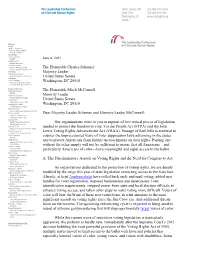
Letter to Senate Leadership on Voting Rights
Officers Chair Judith L. Lichtman National Partnership for Women & Families Vice Chairs Derrick Johnson NAACP June 8, 2021 Farhana Khera Muslim Advocates Thomas A. Saenz Mexican American Legal The Honorable Charles Schumer Defense and Educational Fund Secretary Majority Leader Fatima Goss Graves National Women's Law Center United States Senate Treasurer Lee A. Saunders American Federation of State, Washington, DC 20510 County & Municipal Employees Board of Directors Kimberly Churches The Honorable Mitch McConnell AAUW Alphonso B. David Minority Leader Human Rights Campaign Rory Gamble United States Senate International Union, UAW Jonathan Greenblatt Washington, DC 20510 Anti-Defamation League Mary Kay Henry Service Employees International Union Damon Hewitt Dear Majority Leader Schumer and Minority Leader McConnell: Lawyers' Committee for Civil Rights Under Law Sherrilyn Ifill NAACP Legal Defense and Our organizations write to you in support of two critical pieces of legislation Educational Fund, Inc. David H. Inoue needed to protect the freedom to vote: For the People Act (FTPA) and the John Japanese American Citizens League Benjamin Jealous Lewis Voting Rights Advancement Act (VRAA). Passage of both bills is essential to People for the American Way Derrick Johnson counter the unprecedented wave of voter suppression laws advancing in the states NAACP Virginia Kase and to protect Americans from further encroachments on their rights. Passing one League of Women Voters of the United States Samer E. Khalaf without the other simply will not be sufficient to ensure that all Americans—and American-Arab Anti-Discrimination Committee particularly Americans of color—have meaningful and equal access to the ballot. Marc Morial National Urban League Janet Murguía UnidosUS A. -

Transgender and Gender-Nonconforming Voting Rights After Bostock
UNIVERSITY OF PENNSYLVANIA JOURNAL OF LAW ANDSOCIAL CHANGE Volume 24, Number 3 2021 TRANSGENDER AND GENDER-NONCONFORMING VOTING RIGHTS AFTER BOSTOCK BY MICHAEL MILOV-CORDOBA* & ALI STACK** Abstract. In Bostock v. Clayton County, the Supreme Court issued a landmark holding that allowed workplace protections for the LGBTQ+ community, including transgender people, to be subsumed into the Title VII provision prohibiting “sex” discrimination. Though Bostock was a Title VII case, the textualist logic of the majority opinion has important constitutional implications. In this article, we use Bostock as a point of departure to lay out two novel constitutional theories that further the voting rights of transgender and gender-nonconforming voters. Under our first theory, we argue that because Title VII and the Nineteenth Amendment have almost identical language, the underlying logic of Bostock should govern modern interpretations of the Nineteenth Amendment, meaning that the Amendment’s protections should extend to transgender and gender-nonconforming voters. Because the Nineteenth Amendment should be treated as an analogue to the Fifteenth Amendment, voting regulations that uniquely burden transgender and gender-nonconforming voters should be regarded as per se unconstitutional under the Nineteenth Amendment. Under our second theory, we argue that Bostock provides a stepping stone to elevate the standard of review for gender- based as-applied challenges to voting regulations that implicate gender classifications under the Fourteenth Amendment from Anderson-Burdick review to intermediate scrutiny. This article proposes that both theories offer opportunities to better address the barriers posed by the layering of voter ID laws on top of strict identity document requirements that transgender and gender non-confirming voters face at the ballot box. -

SW 504: Social Justice and Diversity in Social Work (August 29
SW 504: Social Justice and Diversity in Social Work (August 29, 2017) Instructor: Laura Lein (https://ssw.umich.edu/faculty/profiles/tenure-track/leinl) Office: 3852 Phone: (734) 615-7379 Email: leinl@umich.edu Office Hours: Thursdays, 1-3 and by appointment (on campus most of Tuesday, Wednesday, Thursday) Course Sections: 003 (UM # 25820) and 006 (25901) Day and Time: Tuesdays, 9 -12 (003) & Wednesdays, 2-5 (006) 3 Credits, no prerequisites Foundation HBSE Course Approved 4/29/14 Course Description This required foundation course is designed to increase students’ awareness, knowledge, and critical skills related to diversity, human rights, social and economic justice. The topics of this course include developing a framework for 1) engaging diversity and differences in social work practice and 2) advancing human rights and social and economic justice. We will explore the knowledge base that underlies skills needed to work towards justice. These include types and sources of power, multiple social locations, social constructions, social processes, social identities, conflicts, and how all these interact. A major emphasis is on developing skills in critical contextual thinking and analyses, and in praxis, learning to use knowledge and theory to recognize and critique underlying assumptions and paradigms, and inform working for change. Multiple kinds of boundaries are especially important— across groups, between organizations and system levels, and within and between people, related to intersecting social locations. Course Content Students will actively explore how societal power and diversity characterize and shape the human experience, and are critical to the formation of social structures, cultural understandings, group and organizational processes, and identities. -

Christian Nationalism and Restricting Voter Access in the United States1
1 Forthcoming at Sociological Forum “I Don’t Want Everybody to Vote”: Christian Nationalism and Restricting Voter Access in the United States1 Samuel L. Perry Department of Sociology University of Oklahoma Andrew L. Whitehead Department of Sociology Indiana University–Purdue University Indianapolis Joshua B. Grubbs Department of Psychology Bowling Green State University Abstract Though the persistence of voter suppression and disenfranchisement in the US is well- documented, we still know little about their contemporary ideological underpinnings beyond partisanship and racial resentment. Highlighting the Christian Right’s influence in driving anti- democratic sentiment in the post-Civil Rights era, we propose contemporary ideological support for restricting the vote generally, and specifically, to those who prove “worthy,” is undergirded by a pervasive ideology that cloaks authoritarian ethno-traditionalism with the ultimacy and polysemic utility of religious language―Christian nationalism. Nationally representative data collected weeks before the November 2020 elections reveal Christian nationalism is a leading predictor that Americans deny that voter suppression is a problem, believe that the US makes it “too easy to vote,” believe that voter fraud is rampant, and support measures to disenfranchise individuals who could not pass a basic civics test or who committed certain crimes. Interactions show Christian nationalism’s influence is particularly strong among men across most outcomes and, regarding voter suppression, whites compared to Blacks. We argue Christian nationalism seeks to institutionalize founding ideals in which civic participation is rooted in hierarchies, being restricted to a “worthy” few. Appeals to America’s religious heritage thus facilitate stratifying America’s citizenry and justifying restricting participation to preserve dominance. -

From Here to Equality: Reparations for Black Americans in The
From Here to Equality From Here to Equality reparations for b lack a mericans in the twenty-first c entury william a . darity j r. and a. kirsten mullen the university of north carolina press Chapel Hill This book was published with the assistance of the William R. Kenan Jr. Fund of the University of North Carolina Press. © 2020 William A. Darity Jr. and A. Kirsten Mullen All rights reserved Manufactured in the United States of America Designed by Richard Hendel Set in Utopia and TheSans by codeMantra, Inc. The University of North Carolina Press has been a member of the Green Press Initiative since 2003. Cover illustration: Memorial Corridor at the National Memorial for Peace and Justice, Montgomery, Alabama. Photograph by Soniakapadia. Library of Congress Cataloging-in-Publication Data Names: Darity, William A., Jr., 1953– author. | Mullen, A. Kirsten (Andrea Kirsten), author. Title: From here to equality : reparations for black Americans in the twenty-first century / William A. Darity Jr. and A. Kirsten Mullen. Description: Chapel Hill : The University of North Carolina Press, [2020] | Includes bibliographical references and index. Identifiers: LCCN 2019046675 | ISBN 9781469654973 (cloth : alk. paper) | ISBN 9781469654980 (ebook) Subjects: LCSH: African Americans—Reparations. | African Americans— Civil rights—History. | Income distribution—United States—History. | Slavery—United States—History. | Race discrimination—United States—History. | United States—Race relations—History. Classification: LCC E185.89.R45 D37 2020 | DDC 323.1196/073—dc23 LC record available at https://lccn.loc.gov/2019046675 To our sons, Aden and William—members of the fifth generation born since slavery was outlawed—and to our ancestors we have identified who were born enslaved and lived to see emancipation: Rachel King, Jane and Isaac Mullen, and Sallie Mullen (“wife” of Granville Spangler); Jennie Davenport; Nelson Strange, Letty Flippo Hart, Uriah Wise and Hannah Strange Berry Wise, Walker Taliaferro and Patsy Williams Taliaferro, and Rev. -
Overcoming Voting Obstacles
OVERCOMING VOTING OBSTACLES A resource from the National Center for Transgender Equality September 2010 1325 Massachusetts Avenue NW, Suite 700, Washington, DC 20005 (202) 903-0112 ▪ ncte@transequality.org ▪ www.TransEquality.org TRANSGENDER PEOPLE CAN VOTE. DO NOT LET ANYONE REFUSE YOUR RIGHT TO VOTE. September 2010 Everyone should vote! Unfortunately there are issues that sometimes make it difficult for trans people to vote. Don’t let these barriers stop you from voting—you have a right to vote. Trans people may find voting to be an intimidating process for many reasons. Below are trans-specific reasons; on the following pages are other situations that may arise for some transgender people. IF YOUR NAME DOESN’T MATCH YOUR ID You may have obtained ID with a new name that does not match the name listed on the voter rolls. Trans- gender voters should change their names on the voter registration rolls to their new name as soon as pos- sible. Contact your local Registrar of Voters. Even if your name doesn’t match, you should still be allowed to vote. Bring the ID necessary to show that you are the person who is registered to vote. Some possibilities include old ID cards, court orders, or physician letters. IF YOUR PICTURE DOESN’T MATCH YOUR APPEARANCE The picture (or name) displayed on your ID may no longer match your gender expression. If so, it is impor- tant for you to carry whatever identification or documentation is necessary to prove that you are the per- son registered to vote under that name. -
Digital Voter Suppression a Key Influence in the 2020 Elections
A threat to an American Democracy: Digital Voter Suppression A key influence in the 2020 elections Digital Voter Suppression, as we define it, includes several aspects; the use of online services/platforms to distribute inaccurate, misinformation, disinformation, false data, mobile messages, and/or images for the purpose of suppressing the vote during any election season. This is often used in conjunction with or addition to physical voter suppression activities that have a digital, social networking, technical or mobile component. The report outlines both past and present disinformation campaigns used during the election cycles starting from 2016 leading up to today. It includes descriptions of disinformation campaigns as well as examples of digital voter suppression. The report offers multiple examples of images, political ads and data visualizations of current social networks that have the intent to suppress voters and target candidates. Outline Why the Black Voters? (a crucial determinate of the direction of elections) Data on Black Voters Digital Voter Suppression Online Meddling Through Social Media Companies Conclusions Suggested Counter-Measures Resources Why Black Voters? Since before the voting rights act of 1964 the black vote has been targeted for voter suppression. Black women's right to vote was challenged although women got the right to vote in 1920. There are many aspects of the physical voter suppression from literacy tests to lynchings. Many of the forms of voter suppression seen today include gerrymandering, moving polling places, voter id requirements and removing voters from the rolls by exact match systems. What is different today is that social media has become an integral part of the landscape. -

Ocoee Election Day Violence – November 1920
Ocoee Election Day Violence – November 1920 Report No. 19-15 November 2019 November 2019 Report No. 19-15 Ocoee Election Day Violence – November 1920 As directed by the Legislature, OPPAGA conducted a historical review of the 1920 Election Day violence in Ocoee, Florida to provide information on the scope and effects of the incident. To complete the research for this brief, OPPAGA reviewed academic papers and books, maps, oral histories recorded by the Works Progress Administration, congressional testimony, census records, property deeds, interview notes from the National Association for the Advancement of Colored People (NAACP) officials, death certificates from the Florida Department of Health’s Bureau of Vital Statistics, draft cards from World War I, collections at the Orange County Regional History Center, mortuary records, and hundreds of newspaper articles. In cases where there were conflicting accounts of the events, this review favors those accounts provided by eyewitnesses or people with first-hand knowledge of the event. BACKGROUND Ocoee, Florida, is a city in Orange County with a 2019 population of about 47,500 people. The city is approximately 10 miles west of Orlando and is located near the southeastern edge of Lake Apopka, between Apopka and Winter Garden and surrounding Starke Lake. (See Exhibit 1.) Exhibit 1 Map of Ocoee, Orange County, Florida Source: Google Maps. 1 The area was incorporated in the early 1920s and became the City of Ocoee in 1925. Early white settlers began to establish homesteads near Starke Lake in the 1850s, after the Seminole Indians had been resettled west of the Mississippi River or fled to South Florida. -

Maryland Conference on Lynching Finds Links to Voter Suppression, Social Inequality - Baltimore Sun
10/19/2020 Maryland conference on lynching finds links to voter suppression, social inequality - Baltimore Sun Maryland conference on lynching finds links to voter suppression, social inequality By JONATHAN M. PITTS BALTIMORE SUN | OCT 19, 2020 In this Oct. 12, 2020, photo, people fill out a preregistration form while waiting in line to vote at the DeKalb County elections office in Decatur, Georgia. (Ben Gray/AP) Early voting for the U.S. presidential election has begun in many states, and critics of the process say they see signs the minority vote is being suppressed. Lines have been long and slow-moving in several mostly Black districts in Georgia. The Republican governor of Texas has capped the number of drop boxes for ballots at one per county, a move critics say targets minority voters. ADVERTISING https://www.baltimoresun.com/maryland/bs-md-maryland-lynching-conference-20201019-wqdo2w6xorc3vm73jzmtguisda-story.html 1/4 10/19/2020 Maryland conference on lynching finds links to voter suppression, social inequality - Baltimore Sun Several speakers at the third annual Lynching in Maryland conference, which more than a hundred people attended Saturday via videoconference, tied the legacy of lynching to voter suppression of minorities and related social justice issues. “We’re continuing to see such things manifest themselves throughout the country as more and more people of color and their white allies are taking a stance against [the Trump] administration,” said Charles Chavis, an assistant professor of history and conflict resolution at George Mason University in Fairfax. “It’s nothing new in American history.” ADVERTISEMENT The Maryland Lynching Memorial Project, a nonprofit organization that organized the symposium, seeks to tell the truth about lynching, a form of racial terror that killed more than 4,000 people in the U.S. -

Parramore and the Interstate 4: a World Torn Asunder (1880-1980) Yuri K
Rollins College Rollins Scholarship Online Master of Liberal Studies Theses Summer 2015 Parramore and the Interstate 4: A World Torn Asunder (1880-1980) Yuri K. Gama Rollins College, ygama@rollins.edu Follow this and additional works at: http://scholarship.rollins.edu/mls Part of the African American Studies Commons, Social History Commons, and the Urban, Community and Regional Planning Commons Recommended Citation Gama, Yuri K., "Parramore and the Interstate 4: A World Torn Asunder (1880-1980)" (2015). Master of Liberal Studies Theses. 71. http://scholarship.rollins.edu/mls/71 This Open Access is brought to you for free and open access by Rollins Scholarship Online. It has been accepted for inclusion in Master of Liberal Studies Theses by an authorized administrator of Rollins Scholarship Online. For more information, please contact rwalton@rollins.edu. 1 Table of Contents Acknowledgments 04 Abstract 06 Introduction 07 Chapter I: Social Black History and Racial Segregation 14 1865 to 1920 14 1920 to 1945 21 1945 to 1970 30 Chapter II: History of American Urban Sprawl 38 Transportation Development 42 Housing Development 49 Chapter III: Racial Segregation in Florida 60 1860 - 1920 60 1920 – 1950 67 2 1950 – 1980 71 Chapter IV: The Highway System and the I-4 Construction 78 United States’ Roads and Highways 78 Wartime and Postwar Defense Expenditures in a Growing Florida 86 Florida’s Roads and Highways 89 Orlando and Interstate 4 91 Chapter V: Parramore and the I-4 98 Racial Segregation and Parramore’s Foundation 98 Uneven Development and Parramore’s Decline 108 Parramore and the Social Impact of I-4 (1957-1980) 113 Conclusion 122 Bibliography 134 Appendix A 162 Appendix B 163 3 Dedicated to all those who struggle against any form of racial oppression and social inequality. -
Escalation with Iran: Outcomes and Implications for U.S
Testimony Escalation with Iran: Outcomes and Implications for U.S. Interests and Regional Stability Ariane M. Tabatabai CT-522 Testimony presented before the House Foreign Affairs Subcommittee on the Middle East, North Africa, and International Terrorism on January 28, 2020. For more information on this publication, visit www.rand.org/pubs/testimonies/CT522.html Testimonies RAND testimonies record testimony presented or submitted by RAND associates to federal, state, or local legislative committees; government-appointed commissions and panels; and private review and oversight bodies. Published by the RAND Corporation, Santa Monica, Calif. © Copyright 2020 RAND Corporation is a registered trademark. Limited Print and Electronic Distribution Rights This document and trademark(s) contained herein are protected by law. This representation of RAND intellectual property is provided for noncommercial use only. Unauthorized posting of this publication online is prohibited. Permission is given to duplicate this document for personal use only, as long as it is unaltered and complete. Permission is required from RAND to reproduce, or reuse in another form, any of its research documents for commercial use. For information on reprint and linking permissions, please visit www.rand.org/pubs/permissions.html. www.rand.org Escalation with Iran: Outcomes and Implications for U.S. Interests and Regional Stability Testimony of Ariane M. Tabatabai1 The RAND Corporation2 Before the Committee on Foreign Affairs Subcommittee on the Middle East, North Africa, and International Terrorism United States House of Representatives January 28, 2020 hairman Deutch, Ranking Member Wilson, and members of the committee, thank you for the opportunity to share my analysis and testify before the subcommittee today on C“Escalation with Iran: Outcomes and Implications for U.S.