Child Homicide Perpetrators Worldwide: Paediatrics Open a Systematic Review
Total Page:16
File Type:pdf, Size:1020Kb
Load more
Recommended publications
-

Fifth Report Data: January 2009 to December 2015
Fifth Report Data: January 2009 to December 2015 ‘Our daughter Helen is a statistic in these pages. Understanding why, has saved others.’ David White Ngā mate aituā o tātou Ka tangihia e tātou i tēnei wā Haere, haere, haere. The dead, the afflicted, both yours and ours We lament for them at this time Farewell, farewell, farewell. Citation: Family Violence Death Review Committee. 2017. Fifth Report Data: January 2009 to December 2015. Wellington: Family Violence Death Review Committee. Published in June 2017 by the Health Quality & Safety Commission, PO Box 25496, Wellington 6146, New Zealand ISBN 978-0-908345-60-1 (Print) ISBN 978-0-908345-61-8 (Online) This document is available on the Health Quality & Safety Commission’s website: www.hqsc.govt.nz For information on this report, please contact info@hqsc.govt.nz ACKNOWLEDGEMENTS The Family Violence Death Review Committee is grateful to: • the Mortality Review Committee Secretariat based at the Health Quality & Safety Commission, particularly: – Rachel Smith, Specialist, Family Violence Death Review Committee – Joanna Minster, Senior Policy Analyst, Family Violence Death Review Committee – Kiri Rikihana, Acting Group Manager Mortality Review Committee Secretariat and Kaiwhakahaere Te Whai Oranga – Nikolai Minko, Principal Data Scientist, Health Quality Evaluation • Pauline Gulliver, Research Fellow, School of Population Health, University of Auckland • Dr John Little, Consultant Psychiatrist, Capital & Coast District Health Board • the advisors to the Family Violence Death Review Committee. The Family Violence Death Review Committee also thanks the people who have reviewed and provided feedback on drafts of this report. FAMILY VIOLENCE DEATH REVIEW COMMITTEE FIFTH REPORT DATA: JANUARY 2009 TO DECEMBER 2015 1 FOREWORD The Health Quality & Safety Commission (the Commission) welcomes the Fifth Report Data: January 2009 to December 2015 from the Family Violence Death Review Committee (the Committee). -
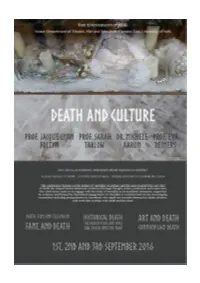
DC1-2016 (PDF , 2934Kb)
Death and Culture Conference, 2016 CONTENTS 1. CONFERENCE ORGANISERS.............................................................................. 1 MR JACK DENHAM........................................................................................................ 1 DR RUTH PENFOLD-MOUNCE ..................................................................................... 1 DR BENJAMIN POORE .................................................................................................. 2 DR JULIE RUGG ............................................................................................................. 2 2. CONFERENCE TIMETABLE................................................................................. 3 3. ABSTRACTS AND BIOGRAPHIES...................................................................... 12 4. INSTALLATIONS ............................................................................................. 67 Afterlife Woodland ...................................................................................................... 67 ‘Small Histories’ Installation, 2016 ............................................................................... 68 That Which The Dying Had To Tell If We Take The Time To Listen.............................. 69 Death Becomes Her..................................................................................................... 70 5. USEFUL INFORMATION .................................................................................. 71 Public transport ............................................................................................................71 -

Architecture of Afterlife: Future Cemetery in Metropolis
ARCHITECTURE OF AFTERLIFE: FUTURE CEMETERY IN METROPOLIS A DARCH PROJECT SUBMITTED TO THE GRADUATE DIVISION OF THE UNIVERSITY OF HAWAI‘I AT MĀNOA IN PARTIAL FULFILLMENT OF THE REQUIREMENTS FOR THE DEGREE OF DOCTOR OF ARCHITECTURE MAY 2017 BY SHIYU SONG DArch Committee: Joyce Noe, Chairperson William Chapman Brian Takahashi Key Words: Conventional Cemetery, Contemporary Cemetery, Future Cemetery, High-technology Innovation Architecture of Afterlife: Future Cemetery in Metropolis Shiyu Song April 2017 We certify that we have read this Doctorate Project and that, in our opinion, it is satisfactory in scope and quality in partial fulfillment for the degree of Doctor of Architecture in the School of Architecture, University of Hawai‘i at Mānoa. Doctorate Project Committee ___________________________________ Joyce Noe ___________________________________ William Chapman ___________________________________ Brian Takahashi Acknowledgments I dedicate this thesis to everyone in my life. I would like to express my deepest appreciation to my committee chair, Professor Joyce Noe, for her support, guidance and insight throughout this doctoral project. Many thanks to my wonderful committee members William Chapman and Brian Takahashi for their precious and valuable guidance and support. Salute to my dear professor Spencer Leineweber who inspires me in spirit and work ethic. Thanks to all the professors for your teaching and encouragement imparted on me throughout my years of study. After all these years of study, finally, I understand why we need to study and how important education is. Overall, this dissertation is an emotional research product. As an idealist, I choose this topic as a lesson for myself to understand life through death. The more I delve into the notion of death, the better I appreciate life itself, and knowing every individual human being is a bless; everyday is a present is my best learning outcome. -
Hierarchy in the Representation of Death in Pre- and Post-Conquest Aztec Codices
1 Multilingual Discourses Vol. 1.2 Spring 2014 Tanya Ball The Power of Death: Hierarchy in the Representation of Death in Pre- and Post-Conquest Aztec Codices hrough an examination of Aztec death iconography in pre- and post-Conquest codices of the central valley of Mexico T (Borgia, Mendoza, Florentine, and Telleriano-Remensis), this paper will explore how attitudes towards the Aztec afterlife were linked to questions of hierarchical structure, ritual performance and the preservation of Aztec cosmovision. Particular attention will be paid to the representation of mummy bundles, sacrificial debt- payment and god-impersonator (ixiptla) sacrificial rituals. The scholarship of Alfredo López-Austin on Aztec world preservation through sacrifice will serve as a framework in this analysis of Aztec iconography on death. The transformation of pre-Hispanic traditions of representing death will be traced from these pre- to post-Conquest Mexican codices, in light of processes of guided syncretism as defined by Hugo G. Nutini and Diana Taylor’s work on the performative role that codices play in re-activating the past. These practices will help to reflect on the creation of the modern-day Mexican holiday of Día de los Muertos. Introduction An exploration of the representation of death in Mexica (popularly known as Aztec) pre- and post-Conquest Central Mexican codices is fascinating because it may reveal to us the persistence and transformation of Aztec attitudes towards death and the after-life, which in some cases still persist today in the Mexican holiday Día de Tanya Ball 2 los Muertos, or Day of the Dead. This tradition, which hails back to pre-Columbian times, occurs every November 1st and 2nd to coincide with All Saints’ Day and All Souls’ day in the Christian calendar, and honours the spirits of the deceased. -
Semento Udel 0060M 1
THE MATERIAL REMAINS: AN INTRODUCTION TO THE OBJECTIFICATION, PERSONHOOD, & POLITICS OF HUMAN REMAINS IN AMERICA by Kristen N. Semento A thesis submitted to the Faculty of the University of Delaware in partial fulfillment of the requirements for the degree of Master of Arts in American Material Culture Summer 2017 © 2017 Kristen Semento All Rights Reserved THE MATERIAL REMAINS: AN INTRODUCTION TO THE OBJECTIFICATION, PERSONHOOD, & POLITICS OF HUMAN REMAINS IN AMERICA by Kristen N. Semento Approved: __________________________________________________________ J. Ritchie Garrison, Ph.D. Professor in charge of thesis on behalf of the Advisory Committee Approved: __________________________________________________________ J. Ritchie Garrison, Ph.D. Director of the Winterthur Program in American Material Culture Approved: __________________________________________________________ George H. Watson, Ph.D. Dean of the College of Arts and Sciences Approved: __________________________________________________________ Ann L. Ardis, Ph.D. Senior Vice Provost for Graduate and Professional Education ACKNOWLEDGMENTS I owe a debt of gratitude to the following industry professionals. Their work inspired this research and greatly informed my thinking. They are: Jaime Barker, Medicolegal Investigator and The Ada County Coroner’s Office; Joni DeTrant, Health Information Manager and the Oregon State Hospital; Jodie Jones, Ret. Deputy Administrator and the Oregon State Hospital Replacement Project; Caleb Wilde, Funeral Director and Parkesburg Funeral Home; and Dave Deihm, Crematory Operations Manager and Evans Burial Vaults and Crematorium. This effort stands on the shoulders of giants. Intended for all audiences, it would not be possible without the work of the brilliant scholarly community that precedes it. I would also like to thank the museum staff and academic programs community at the Winterthur Museum, Garden and Library. -

Homicide Studies: Ten Years After Its Inception
Homicide Studies: Ten Years After Its Inception Proceedings of the 2007 Homicide Research Working Group Annual Symposium Minneapolis, Minnesota June 7-10 Edited by Katharina Gruenberg Lancaster University And C. Gabrielle Salfati John Jay College of Criminal Justice 1 Acknowledgements 2 The Homicide Research Working Group (HRWG) is an international and interdisciplinary organization of volunteers dedicated to cooperation among researchers and practitioners who are trying to understand and limit lethal violence. The HRWG has the following goals: to forge links between research, epidemiology and practical programs to reduce levels of mortality from violence; to promote improved data quality and the linking of diverse homicide data sources; to foster collaborative, interdisciplinary research on lethal and non-lethal violence; to encourage more efficient sharing of techniques for measuring and analyzing homicide; to create and maintain a communication network among those collecting, maintaining and analyzing homicide data sets; and to generate a stronger working relationship among homicide researchers. Homicide Research Working Group publications, which include the Proceedings of each annual Intensive Workshop (beginning in 1992), the HRWG Newsletter, and the contents of issues of the journal Homicide Studies (beginning in 1997), may be downloaded from the HRWG web site, which is maintained by the Inter-University Consortium of Political and Social Research, at the following address: http://www.icpsr.umich.edu/HRWG/ Suggested citation: Lin Huff-Corzine Katharina Gruenberg, Gabrielle Salfati (Eds.) (2007). Homicide Studies: Ten Years After Its Inception. Proceedings of the 2007 Meeting of the Homicide Research Working Group. Minneapolis, MN : Homicide Research Working Group. The views expressed in these Proceedings are those of the authors and speakers, and not necessarily those of the Homicide Research Working Group or the editor of this volume. -

University of Groningen Homicide
View metadata, citation and similar papers at core.ac.uk brought to you by CORE provided by University of Groningen University of Groningen Homicide – Suicide in the Netherlands. An epidemiology. Liem, M; Postulart, M.; Nieuwbeerta, P. Published in: Homicide Studies DOI: 10.1177/1088767908330833 IMPORTANT NOTE: You are advised to consult the publisher's version (publisher's PDF) if you wish to cite from it. Please check the document version below. Document Version Publisher's PDF, also known as Version of record Publication date: 2009 Link to publication in University of Groningen/UMCG research database Citation for published version (APA): Liem, M., Postulart, M., & Nieuwbeerta, P. (2009). Homicide – Suicide in the Netherlands. An epidemiology. Homicide Studies, 13, 99-123. https://doi.org/10.1177/1088767908330833 Copyright Other than for strictly personal use, it is not permitted to download or to forward/distribute the text or part of it without the consent of the author(s) and/or copyright holder(s), unless the work is under an open content license (like Creative Commons). Take-down policy If you believe that this document breaches copyright please contact us providing details, and we will remove access to the work immediately and investigate your claim. Downloaded from the University of Groningen/UMCG research database (Pure): http://www.rug.nl/research/portal. For technical reasons the number of authors shown on this cover page is limited to 10 maximum. Download date: 12-11-2019 Homicide Studies http://hsx.sagepub.com/ Homicide-Suicide -

A Current Absence of Neonaticide in Norway
VOLUME 18 - No 2 - 2012 - Page 155-163 - doi: 10.2478/v10278-012-0005-2 Scandinavian journal of FORENSIC SCIENCE Nordisk rettsmedisin A current absence of neonaticide in Norway Vibeke Ottesen Centre for Evolutionary and Ecological Synthesis (CEES), Department of Biology, University of Oslo, Blindern, Oslo, Norway v.k.ottesen@bio.uio.no ABSTRACT The present study is the first attempt to explore the rate, characteristics and legal reactions to neonaticide in Norway during the years 1990 – 2009. Potential incidents of neonaticide were identified through the national homicide index held by the National Criminal Investigation Service and the national police registers for all recorded crime in Norway held by the National Police Computing and Material Services. The study uncovers that no clear incident of neonaticide has been recorded in the respective registers during the study’s time period. There was however recorded one case of a discarded stillborn and one case of an abandoned neonate that died through exposure. The paper discusses whether the study’s findings are congruent with an evolutionary psychological understanding of filicide and current knowledge of risk factors and rates for neonaticide. Keywords: Evolutionary psychology, Filicide, Neonaticide INtrODUctiON hypothesis concerning alternative probabilities for risk factors for every recognised category of homicide, including filicide, successfully identifying Neonaticide, defined as the killing of a newborn within the first 24 hours after significant risk factors [15-27]. its birth, was first recognised as a distinct type of caretaker perpetrated child The present study is the first attempt to explore the rate and homicide (filicide) in a seminal paper by the psychiatrist Phillip J. -
A Thesis Submitted in Partial Fulfillment of the Requirements for the Degree of Master of Arts
THE USE OF WOMEN’S GRIEF FOR POLITICAL PURPOSES IN AMERICA DURING WORLD WAR I A Thesis submitted in partial fulfillment of the requirements for the degree of Master of Arts by LINDA L. MORGAN B.A., Wright State University, 2010 2020 Wright State University i WRIGHT STATE UNIVERSITY GRADUATE SCHOOL April 24, 2020 I HEREBY RECOMMEND THAT THE THESIS PREPARED UNDER MY SUPERVISION BY Linda L. Morgan ENTITLED The Use of Women’s Grief for Political Purposes in America during World War I BE ACCEPTED IN PARTIAL FULFILLMENT OF THE REQUIREMENTS FOR THE DEGREE OF Master of Arts. __________________________ Nancy G. Garner, Ph.D. Thesis Director __________________________ Jonathan R. Winkler, Ph.D. Chair, History Committee on Final Examination: ________________________________ Nancy G. Garner, Ph.D. ________________________________ Paul D. Lockhart, Ph.D. ________________________________ Opolot Okia, Ph.D. ________________________________ Jonathan R. Winkler, Ph.D. ________________________________ Barry Milligan, Ph.D. Interim Dean of the Graduate School ii ABSTRACT Morgan, Linda L. M.A., Department of History, Wright State University, 2020. The Use of Women’s Grief for Political Purposes in America during World War I. This study discusses a politically driven change in American women’s public mourning customs over the fallen of World War I. During the war, government officials and politicians sought to transform women’s grief over a fallen loved one into a celebration of an honorable military death. They actively discouraged the wearing of traditional black mourning and instead urged the wearing of a simple black armband with a gold star. This substituted glory for grief and thus made their loved one’s death a mark of distinction by giving their life in the service of their country. -
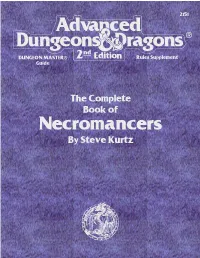
Complete Book of Necromancers by Steve Kurtz
2151 ® ¥DUNGEON MASTER® Rules Supplement Guide The Complete Book of Necromancers By Steve Kurtz ª Table of Contents Introduction Bodily Afflictions How to Use This Book Insanity and Madness Necromancy and the PC Unholy Compulsions What You Will Need Paid In Full Chapter 1: Necromancers Chapter 4: The Dark Art The Standard Necromancer Spell Selection for the Wizard Ability Scores Criminal or Black Necromancy Race Gray or Neutral Necromancy Experience Level Advancement Benign or White Necromancy Spells New Wizard Spells Spell Restrictions 1st-Level Spells Magic Item Restrictions 2nd-Level Spells Proficiencies 3rd-Level Spells New Necromancer Wizard Kits 4th-Level Spells Archetypal Necromancer 5th-Level Spells Anatomist 6th-Level Spells Deathslayer 7th-Level Spells Philosopher 8th-Level Spells Undead Master 9th-Level Spells Other Necromancer Kits Chapter 5: Death Priests Witch Necromantic Priesthoods Ghul Lord The God of the Dead New Nonweapon Proficiencies The Goddess of Murder Anatomy The God of Pestilence Necrology The God of Suffering Netherworld Knowledge The Lord of Undead Spirit Lore Other Priestly Resources Venom Handling Chapter 6: The Priest Sphere Chapter 2: Dark Gifts New Priest Spells Dual-Classed Characters 1st-Level Spells Fighter/Necromancer 2nd-Level Spells Thief / Necromancer 3rd-Level Spells Cleric/Necromancer 4th-Level Spells Psionicist/Necromancer 5th-Level Spells Wild Talents 6th-Level Spells Vile Pacts and Dark Gifts 7th-Level Spells Nonhuman Necromancers Chapter 7: Allies Humanoid Necromancers Apprentices Drow Necromancers -

Moya Lloyd* Professor of Political Theory, Loughborough University
Review of International Studies, page 1 of 20. doi:10.1017/S0260210516000358 © British International Studies Association 2016 Naming the dead and the politics of the ‘human’ Moya Lloyd* Professor of Political Theory, Loughborough University Abstract The summer of 2014 saw several campaigns to name the dead of Gaza. This article aims to explore these initiatives through the idea of the ‘human’; understood both in terms of grievability, as a life that matters, and as a ‘litigious name’ employed by subaltern groups to make political demands. My argument in this article is that politically not all attempts at nomination are equivalent and that a distinction needs to be drawn between those carried out on behalf of the ‘ungrievable’ and those engaged in by them. Only the latter enables a critical politics of the human potentially capable of transforming the prevailing order of grievability in order to make their lives count. After exploring the interventions that occurred in Gaza in 2014, I turn to how the Western (and Israeli) media represent international deaths to consider what that reveals about the differential valuation of human life. To help make my case I elaborate the idea of an order of grievability. I then explore various attempts by others to name Gaza’s dead, and the limitations of their ensuing politics, before finally examining the activities of Humanize Palestine as an example of a more radical, critical politics of the human. Keywords Politics of the Human; Naming; Dehumanisation; Grievability; Hierarchies of Death Introduction Throughout July and August of 2014, as numerous media outlets in the UK, US, and elsewhere publicised mortality statistics on a daily basis, it was difficult not to be bombarded with the numbers of those killed and injured in the conflict in Gaza. -

HOMICIDE STUDIES an Interdisciplinary & International Journal
HOMICIDE STUDIES An Interdisciplinary & International Journal Editor M. Dwayne Smith, Criminology, University of South Florida Associate Editors Carolyn Rebecca Block, Illinois Criminal Justice Information Authority, Cofounder of Homicide Research Working Group Richard Block, Sociology, Loyola University, Cofounder of Homicide Research Working Group Jay Corzine, Sociology, University of Central Florida Editorial Board Allan F.Abrahamse, RAND Corporation Leigh Buchanan Bienen, Law, Northwestern University Paul H. Blackman, National Rifle Association Alfred Blumstein, Public Policy and Management, Carnegie Mellon University Jacquelyn Campbell, Nursing, Johns Hopkins University David Canter, Psychology, University of Liverpool, United Kingdom Derral Cheatwood, Social and Policy Sciences, University of Texas–San Antonio Martin Daly, Psychology, McMaster University, Canada Chris Dunn, ICPSR, University of Michigan Michael Finnegan, Anthropology, Kansas State University James Alan Fox, Criminal Justice, Northeastern University Kenneth C. Haas, Criminal Justice, University of Delaware Darnell F.Hawkins, African American Studies, University of Illinois–Chicago Kathleen M. Heide, Criminology, University of South Florida Ronald M. Holmes, Justice Administration, University of Louisville Lin Huff-Corzine, Sociology, University of Central Florida John P.Jarvis, Federal Bureau of Investigation Academy Simha F.Landau, Criminology & Law, Hebrew University, Israel Pamela K. Lattimore, Research Triangle Institute Cheryl Maxson, Law & Society, University