Women in Administration in India Jayasheela George
Total Page:16
File Type:pdf, Size:1020Kb
Load more
Recommended publications
-

6. the Indian Forest Service
6.1THE INDIAN FOREST SERVICE (APPOINTMENT BY PROMOTION) REGULATIONS, 1966 In pursuance of sub-rule (1) of rule 8 of the Indian Forest Service (Recruitment) Rules, 1966, the Central Government, in consultation with the State Governments and the Union Public Service Commission, hereby makes the following regulations namely: 1. Short title & commencement.- 1(1) These regulations may be called the Indian Forest Service (Appointment by promotion) Regulations 1966. 1(2) They shall be deemed to have come into force with effect from the 1st July 1966. 2. Definitions.- 2(1) In these regulations, unless the context otherwise requires : a) `Cadre Officer’ means a member of the Service; b) `Cadre Post’ means any of the posts specified as such in the regulations made under sub-rule (1) of rule 4 of the Cadre Rules; c) `Cadre Rules’ means the Indian Forest Service (Cadre) Rules, 1966; d) `Committee’ means the Committee set up in accordance with regulation 3; e) `Commission’ means the Union Public Service Commission; f) `Recruitment Rules’ means the Indian Forest Service (Recruitment) Rules, 1966; g) `State Government’ means: (i) in relation to a State in respect of which a separate cadre of the service exists, the Government of such State ; and 2(ii) in relation to a group of States in respect of which a Joint Cadre of the Service is constituted, the Joint Cadre Authority; (iii) in relation to a group of Union Territories , and in respect of which a joint cadre of the service is constituted, the Central Government. 3h) `Year’ means the period commencing of the first day of January and ending on 31st day of December of the same year. -

Unit 11 All India and Central Services
UNIT 11 ALL INDIA AND CENTRAL SERVICES Structure 1 1.0 Objectives 1 1.1 Introduction 1 1.2 Historical Development 1 1.3 Constitution of All India Services 1 1.3.1 Indian Administrative Service 1 1.3.2 Indian Police Service 1 1.3.3 Indian Forest Service 1 1.4 Importance of Indian Administrative Service 1 1.5 Recruitment of All India Services 1 1.5.1 Training of All India Services Personnel 1 1 5.2 Cadre Management 1 1.6 Need for All India Services 1 1.7 Central Services 1 1.7.1 Recwihent 1 1.7.2 Tra~ningand Cadre Management 1 1.7.3 Indian Foreign Service 1 1.8 Let Us Sum Up 1 1.9 Key Words 1 1.10 References and Further Readings 1 1.1 1 Answers to Check Your Progregs Exercises r 1.0 OBJECTIVES 'lfter studying this Unit you should be able to: Explain the historical development, importance and need of the All India Services; Discuss the recruitment and training methods of the All India Seryice; and Through light on the classification, recruitment and training of the Central Civil Services. 11.1 INTRODUCTION A unique feature of the Indian Administration system, is the creation of certain services common to both - the Centre and the States, namely, the All India Services. These are composed of officers who are in the exclusive employment of neither Centre nor the States, and may at any time be at the disposal of either. The officers of these Services are recruited on an all-India basis with common qualifications and uniform scales of pay, and notwithstanding their division among the States, each of them forms a single service with a common status and a common standard of rights and remuneration. -

The Chinese Civil Service Examination's Impact on Confucian Gender Roles
University of Louisville ThinkIR: The University of Louisville's Institutional Repository College of Arts & Sciences Senior Honors Theses College of Arts & Sciences 5-2015 The Chinese civil service examination's impact on Confucian gender roles. Albert Oliver Bragg University of Louisville Follow this and additional works at: https://ir.library.louisville.edu/honors Part of the Asian History Commons, and the History of Gender Commons Recommended Citation Bragg, Albert Oliver, "The Chinese civil service examination's impact on Confucian gender roles." (2015). College of Arts & Sciences Senior Honors Theses. Paper 71. http://doi.org/10.18297/honors/71 This Senior Honors Thesis is brought to you for free and open access by the College of Arts & Sciences at ThinkIR: The University of Louisville's Institutional Repository. It has been accepted for inclusion in College of Arts & Sciences Senior Honors Theses by an authorized administrator of ThinkIR: The University of Louisville's Institutional Repository. This title appears here courtesy of the author, who has retained all other copyrights. For more information, please contact thinkir@louisville.edu. The Chinese Civil Service Examination’s Impact on Confucian Gender Roles By Albert Oliver Bragg Submitted in partial fulfilment of the requirements for Graduation summa cum laude University of Louisville May 2015 Bragg 2 Introduction The Chinese Civil Service Examination was an institution that lasted virtually uninterrupted for roughly thirteen-hundred years, beginning during the late Sui Dynasty in 587 C.E. and ending in 1904 shortly before the collapse of the Qing Dynasty1. While the structure and number of examinations varied widely from dynasty to dynasty, the fundamental content of the examinations was to test one’s knowledge of the Confucian classics: The Analects, The Book of Mencius, The Book of Changes, The Book of Documents, The Book of Poetry, The Book of Rites, and the Tso Chuan. -
Determinants and Consequences of Bureaucrat Effectiveness: Evidence
Determinants and Consequences of Bureaucrat Effectiveness: Evidence from the Indian Administrative Service∗ Marianne Bertrand, Robin Burgess, Arunish Chawla and Guo Xu† October 21, 2015 Abstract Do bureaucrats matter? This paper studies high ranking bureaucrats in India to examine what determines their effectiveness and whether effective- ness affects state-level outcomes. Combining rich administrative data from the Indian Administrative Service (IAS) with a unique stakeholder survey on the effectiveness of IAS officers, we (i) document correlates of individual bureaucrat effectiveness, (ii) identify the extent to which rigid seniority-based promotion and exit rules affect effectiveness, and (iii) quantify the impact of this rigidity on state-level performance. Our empirical strategy exploits variation in cohort sizes and age at entry induced by the rule-based assignment of IAS officers across states as a source of differential promotion incentives. JEL classifica- tion: H11, D73, J38, M1, O20 ∗This project represents a colloboration between the Lal Bahadur Shastri National Academy of Administration (LBSNAA), the University of Chicago and London School of Economics. We are grateful to Padamvir Singh, the former Director of LBSNAA for his help with getting this project started. The paper has benefited from seminar/conference presentations at Berkeley, Bocconi, CEPR Public Economics Conference, IGC Political Economy Conference, LBSNAA, LSE, NBER India Conference, Stanford and Stockholm University. †Marianne Bertrand [University of Chicago Booth School of Business: Mari- anne.Bertrand@chicagobooth.edu]; Robin Burgess [London School of Economics (LSE) and the International Growth Centre (IGC): r.burgess@lse.ac.uk]; Arunish Chawla [Indian Administrative Service (IAS)]; Guo Xu [London School of Economics (LSE): g.xu2@lse.ac.uk] 1 1 Introduction Bureaucrats are a core element of state capacity. -

Updated Civil List of Indian Forest Service of West Bengal Cadre
INDIAN FOREST SERVICE (CIVIL LIST) AS ON 01.01.2021 (FOR OFFICIAL USE ONLY) (THE CONTENTS OF THIS LIST SHOULD NOT BE DEEMED TO CONVEY ANY SANCTION OR AUTHORITY IN THE MATTER OF SENIORITY) Any error or suggestion for further improvement may kindly be informed at ccfgaz-wb@nic.in DIRECTORATE OF FORESTS GOVERNMENT OF WEST BENGAL GAZETTED CELL IFS Cadre of West Bengal as on 01.01.2021 Sl. Authorised Structure of the Cadre No of Present Srength No of No. vide G.O No. 16016/2(i)/2011-AIS- Post of Cadre as on Post (II)(A) dt.13.03.2012 01.01.2021 1 Senior Duty Post under the State Govt 78 Senior Duty Post 78* 2 Central Deputation Reserve @ 20% of 15 Central Deputation 7 (1) above 3 State Deputation Reserve @ 25% of (1) 19 State Deputation 20 above 4 Training Reserve @ 3.5% of (1) above 2 Training Reserve 8 5 Post to be filled by promotion in 38 Posts Filled by 33 accordance with Rule 8 of India Forest promotion from Service (Recruitment) Rules,1966 not WBFS exceeding 33.33% of items (1),(2),(3) & (4) above 6 Leave Reserve & Junior Posts Reserve 12 Leave Reserve & 1 @ 16.5% if item (1) above Junior Posts 7 Post to be filled by Direct Recruitment 88 Posts filled by 72 (1+2+3+4+6-5) Direct Recruitment 8 Total Authorised Strength 126 Total Present 105 Strength *Includes 12 IFS officers of Junior Time Scale holding Senior Duty Posts CIVIL LIST OF INDIAN FOREST SERVICE OF WEST BENGAL CADRE AS ON 01-01-2021 Sl No. -

Mandate and Organisational Structure of the Ministry of Home Affairs
MANDATE AND ORGANISATIONAL CHAPTER STRUCTURE OF THE MINISTRY OF HOME AFFAIRS I 1.1 The Ministry of Home Affairs (MHA) has Fighters’ pension, Human rights, Prison multifarious responsibilities, important among them Reforms, Police Reforms, etc. ; being internal security, management of para-military forces, border management, Centre-State relations, Department of Home, dealing with the administration of Union territories, disaster notification of assumption of office by the management, etc. Though in terms of Entries 1 and President and Vice-President, notification of 2 of List II – ‘State List’ – in the Seventh Schedule to appointment/resignation of the Prime Minister, the Constitution of India, ‘public order’ and ‘police’ Ministers, Governors, nomination to Rajya are the responsibilities of States, Article 355 of the Sabha/Lok Sabha, Census of population, Constitution enjoins the Union to protect every State registration of births and deaths, etc.; against external aggression and internal disturbance and to ensure that the government of every State is Department of Jammu and Kashmir (J&K) carried on in accordance with the provisions of the Affairs, dealing with the constitutional Constitution. In pursuance of these obligations, the provisions in respect of the State of Jammu Ministry of Home Affairs extends manpower and and Kashmir and all other matters relating to financial support, guidance and expertise to the State the State, excluding those with which the Governments for maintenance of security, peace and Ministry of External Affairs -

64Th ANNUAL REPORT
64th (2013-14) Annual Report UNION PUBLIC SERVICE COMMISSION Dholpur House, Shahjahan Road New Delhi – 110069 http: //www.upsc.gov.in The Union Public Service Commission have the privilege to present before the President their Sixty Fourth Report as required under Article 323(1) of the Constitution. This Report covers the period from April 1, 2013 (Chaitra 11, 1935 Saka) to March 31, 2014 (Chaitra 10, 1936 Saka). Annual Report 2013-14 Contents List of abbreviations ----------------------------------------------------------------------------- (ix) Composition of the Commission during the year 2013-14 ----------------------------- (xi) List of Chapters Chapter Heading Page No. 1 Highlights 1-3 2 Brief History and Workload over the years 5-10 3 Recruitment by Examinations 11-19 4 Direct Recruitment by Selection 21-27 5 Recruitment Rules, Service Rules and Mode of Recruitment 29-31 6 Promotions and Deputations 33-40 7 Representation of candidates belonging to Scheduled Castes, Scheduled 41-44 Tribes, Other Backward Classes and Persons with Disabilities 8 Disciplinary Cases 45-46 9 Delays in implementing advice of the Commission 47-48 10 Non-acceptance of the Advice of the Commission by the Government 49-70 11 Administration and Finance 71-72 12 Miscellaneous 73-77 Acknowledgement 79 List of Appendices Appendix Subject Page No. 1 Profiles of Hon’ble Chairman and Hon’ble Members of the Commission. 81-88 2 Recommendations made by the Commission – Relating to suitability of 89 candidates/officials. 3 Recommendations made by the Commission – Relating to Exemption 89 cases, Service matters, Seniority etc. 4 Recruitment by Examinations – Details of recommendations made during 90 the year 2013-14 for Civil Services/Posts. -

All That You Need to Know About the UPSC Civil Services Examination
All that you need to know about the UPSC Civil services examination: What is UPSC Civil Service Examination? The Civil Services Examination (CSE) is an all India level open competitive examination. It is conducted by the Union Public Service Commission for recruitment to various Civil Services of the Government of India. It includes the Indian Administrative Service (IAS), Indian Foreign Service (IFS), Indian Police Service (IPS) and Indian Revenue Service (IRS) among more than 20 highly cherished civil services. What are the examination dates? For this year Exam, Notification for Preliminary Test – 24th Apr 2016, Date of Preliminary Test – 7th Aug 2016 Expected preliminary results- End of Sep 2016 UPSC Main Examination starts on 3rd Dec 2016 Expected Mains results- end of Feb/March 2017 Tentative Personality Test dates- Mar/Apr/May 2017 Tentative Final Results- End of May 2017. Who can appear for the civil services? The eligibility norms for the examination are as follows For the Indian Administrative Service, the Indian Foreign Service and the Indian Police Service, a candidate must be a citizen of India. For the Indian Revenue Service, a candidate must be one of the following: o A citizen of India o A person of Indian origin who has migrated from Pakistan, Myanmar, Sri Lanka, Kenya, Uganda, Tanzania, Zambia, Malawi, Zaire, Ethiopia or Vietnam with the intention of permanently settling in India For other services, a candidate must be one of the following: o A citizen of India o A citizen of Nepal or a subject of Bhutan o A person of Indian origin who has migrated from Pakistan, Myanmar, Sri Lanka, Kenya, Uganda, Tanzania, Zambia, Malawi, Zaire, Ethiopia or Vietnam with the intention of permanently settling in India How do I apply for the examination? One can apply online for the UPSC Civil Services Preliminary exam once the notification is released by the UPSC. -
Cadre Allocation Policy for the All India Services-IAS/IPS/Ifos — Reg
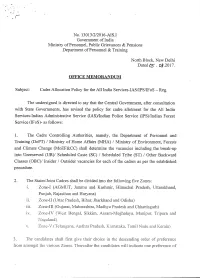
No. 13013/2/2016-AISJ Government of India Ministry of Personnel, Public Grievances & Pensions Department of Personnel & Training North Block, New Delhi Dated OS' . 0.9.2017. OFFICE MEMORANDUM Subject: Cadre Allocation Policy for the All India Services-IAS/IPS/IFoS — Reg. The undersigned is directed to say that the Central Government, after consultation with State Governments, has revised the policy for cadre allotment for the All India Services-Indian Administrative Service (IAS)/Indian Police Service (IPS)/Indian Forest Service (IFoS)- as follows: 1. The Cadre Controlling Authorities, namely, the Department of Personnel and Training (DoPT) / Ministry of Home Affairs (MHA) / Ministry of Environment, Forests and Climate Change (MoEF&CC) shall determine the vacancies including the break-up into Unreserved (UR)/ Scheduled Caste (SC) / Scheduled Tribe (ST) / Other Backward Classes (OBC)/ Insider / Outsider vacancies for each of the cadres as per the established procedure. 2. The States/Joint Cadres shall be divided into the following five Zones: i. Zone-I (AGMUT, Jammu and Kashmir, Himachal Pradesh, Uttarakhand, Punjab, Rajasthan and Haryana) ii. Zone-II (Uttar Pradesh, Bihar, Jharkhand and Odisha) iii. Zone-III (Gujarat, Maharashtra, Madhya Pradesh and Chhattisgarh) iv. Zone-IV (West Bengal, Sikkim, Assam-Meghalaya. Manipur, Tripura and v. Zone-V (Telangana. Andhra Pradesh, Karnataka, Tamil Nadu and Kerala) 3. The candidates shall first give their choice in the descending order of preference from amongst the various Zones. Thereafter the candidates will indicate one preference of -2- cadre from each preferred zone. The candidates will indicate their second cadre preference for every preferred zone thereafter. Similar process will continue till a preference for all the cadres is indicated by the candidate. -

India: Surveillance by State Authorities
Responses to Information Requests - Immigration and Refugee Board of Canada Page 1 of 17 Home Country of Origin Information Responses to Information Requests Responses to Information Requests Responses to Information Requests (RIR) are research reports on country conditions. They are requested by IRB decision makers. The database contains a seven-year archive of English and French RIR. Earlier RIR may be found on the UNHCR's Refworld website. Please note that some RIR have attachments which are not electronically accessible here. To obtain a copy of an attachment, please e-mail us. Related Links • Advanced search help 25 June 2018 IND106120.E India: Surveillance by state authorities; communication between police offices across the country, including use of the Crime and Criminal Tracking Network and Systems (CCTNS); categories of persons that may be included in police databases; tenant verification; whether police authorities across India are able to locate an individual (2016-May 2018) Research Directorate, Immigration and Refugee Board of Canada, Ottawa 1. Surveillance According to sources, surveillance schemes have been implemented in India in order to tackle crime and terrorism (openDemocracy 10 Feb. 2014; Privacy International Jan. 2018). Sources indicate that the Central Monitoring System (CMS) is a surveillance programme in India (The Wire 2 Jan. 2018; CIS 14 June 2018). https://irb-cisr.gc.ca/en/country-information/rir/Pages/index.aspx?doc=457520&pls=1 8/1/2018 Responses to Information Requests - Immigration and Refugee Board of Canada Page 2 of 17 1.1 CMS In correspondence with the Research Directorate, a representative of the Centre for Internet and Society (CIS) [1] stated that the CMS is a Central Government project to intercept communications, both voice and data, that is transmitted via telephones and the Internet to, from and within India. -

Nepotism and Meritocracy
CORE Metadata, citation and similar papers at core.ac.uk Provided by Göteborgs universitets publikationer - e-publicering och e-arkiv NEPOTISM AND MERITOCRACY ANDERS SUNDELL WORKING PAPER SERIES 2014:16 QOG THE QUALITY OF GOVERNMENT INSTITUTE Department of Political Science University of Gothenburg Box 711, SE 405 30 GÖTEBORG December 2014 ISSN 1653-8919 © 2014 by Anders Sundell. All rights reserved. Nepotism and meritocracy Anders Sundell QoG Working Paper Series 2014:16 December 2014 ISSN 1653-8919 ABSTRACT Despite the crucial importance of a well-functioning and impartial public administration for growth and well-being, we know little of how such bureaucracies can be created, and why elites allow them to be. One reason for this dearth of studies is that there are few to none quantitative measures of historical bureaucratic development. This paper analyzes the surnames of civil servants in the Swe- dish central public administration over 200 years to track nepotism in recruitment. A decline in nepotism is registered during the 19th century. The nobility however continued to thrive in the ad- ministration even after reform, due to disproportionate access to education. Paradoxically, birth was thus an important predictor of success in a system that generally was considered meritocratic. This continuity could explain why the old elite accepted reform.1 Anders Sundell The Quality of Government Institute Department of Political Science University of Gothenburg Anders.sundell@pol.gu.se 1 The author wishes to thank Andreas Bågenholm, Heather Congdon Fors, Carl Dahlström, Mikael Gilljam, Jenny de Fine Licht, Victor Lapuente, Martin Sjöstedt and seminar participants at University of Gothenburg and Lund University for valuable input during the preparation of this manuscript. -
Implementation of Meritocracy in the Public Sector of Kazakhstan
IMPLEMENTATION OF MERITOCRACY IN THE PUBLIC SECTOR OF KAZAKHSTAN by Nargis Saginova A Thesis Submitted in Partial Fulfilment of the Requirements for the Degree of Master of Public Administration at NAZARBAYEV UNIVERSITY GRADUATE SCHOOL OF PUBIC POLICY ʼ ASTANA 2017 ABSTRACT Kazakhstan's ultimate goal for the next 20 years is to become one of the most economically successful top 30 countries in the world. In order to get onto that list, the President of the country, on a regular basis, sets goals that should be achieved by politicians, businessmen, scholars, students and others. One of the latest goals was the introduction of 5 reforms in 2015 that included a huge transformation of the civil service. The reform was aimed at creating a professional and effective civil service free from corruption, nepotism, and tribalism, with bright leaders who will guide the country towards success and prosperity. Thus, political stability will gradually result in economic success. The focus of the civil service reform was the implementation of principles of meritocracy. Meritocracy guarantees that access to the civil service will be equally given to everyone interested in working for the government and who has the proper qualifications. Promotion should be based on their merits ignoring things like subjectivism, nepotism, corruption etc. On the basis of the reforms, the government has introduced new law ‘On civil service’. Thus the main objective of this thesis paper is to investigate whether the principle of meritocracy has been introduced and implemented in the civil service of Kazakhstan. Using the example of the Ministry of Foreign Affairs of Kazakhstan I have researched whether the results of this process have been successful or not.