Pacific Golden-Plover (Pluvialis Fulva) in Florida: a First State Record
Total Page:16
File Type:pdf, Size:1020Kb
Load more
Recommended publications
-

Meinmahla Kyun Wildlife Sanctuary Myanmar
Meinmahla Kyun Wildlife Sanctuary Myanmar EAAF NETWORK SITE CODE FOR OFFICE USE ONLY: E A A F 1 4 0 Site Information Sheet on East Asian-Australasian Flyway Network Sites (SIS) – 2017 version Available for download from http://www.eaaflyway.net/about/the-flyway/flyway-site-network/ 1 of 22 Information Sheet on EAA Flyway Network Sites | Meinmahla Kyun Wildlife Sanctuary [EAAF140] Categories approved by Second Meeting of the Partners of the East Asian-Australasian Flyway Partnership in Beijing, China 13-14 November 2007 - Report (Minutes) Agenda Item 3.13 Notes for compilers: 1. The management body intending to nominate a site for inclusion in the East Asian - Australasian Flyway Site Network is requested to complete a Site Information Sheet. The Site Information Sheet will provide the basic information of the site and detail how the site meets the criteria for inclusion in the Flyway Site Network. When there is a new nomination or an SIS update, the following sections with an asterisk (*), from Questions 1-14 and Question 30, must be filled or updated at least so that it can justify the international importance of the habitat for migratory waterbirds. 2. The Site Information Sheet is based on the Ramsar Information Sheet. If the site proposed for the Flyway Site Network is an existing Ramsar site then the documentation process can be simplified. 3. Once completed, the Site Information Sheet (and accompanying map(s)) should be submitted to the Secretariat. Compilers should provide an electronic (MS Word) copy of the Information Sheet and, where possible, digital versions (e.g. -
The Wrybill <I>Anarhynchus Frontalis</I>: a Brief Review of Status, Threats and Work in Progress
The Wrybill Anarhynchus frontalis: a brief review of status, threats and work in progress ADRIAN C. RIEGEN '1 & JOHN E. DOWDING 2 •231 ForestHill Road, Waiatarua, Auckland 8, NewZealand, e-maih riegen @xtra.co. nz; 2p.o. BOX36-274, Merivale, Christchurch 8030, New Zealand, e-maih jdowding@xtra.co. nz Riegen,A.C. & Dowding, J.E. 2003. The Wrybill Anarhynchusfrontalis:a brief review of status,threats and work in progress.Wader Study Group Bull. 100: 20-24. The Wrybill is a threatenedplover endemic to New Zealandand unique in havinga bill curvedto the right.It is specializedfor breedingon bareshingle in thebraided riverbeds of Canterburyand Otago in the SouthIsland. After breeding,almost the entirepopulation migrates north and wintersin the harboursaround Auckland. The speciesis classifiedas Vulnerable. Based on countsof winteringflocks, the population currently appears to number4,500-5,000 individuals.However, countingproblems mean that trendsare difficult to determine. The mainthreats to theWrybill arebelieved to be predationon thebreeding grounds, degradation of breeding habitat,and floodingof nests.In a recentstudy in the MackenzieBasin, predation by introducedmammals (mainly stoats,cats and possibly ferrets) had a substantialimpact on Wrybill survivaland productivity. Prey- switchingby predatorsfollowing the introductionof rabbithaemorrhagic disease in 1997 probablyincreased predationrates on breedingwaders. A recentstudy of stoatsin the TasmanRiver showedthat 11% of stoat densexamined contained Wrybill remains.Breeding habitat is beinglost in somerivers and degraded in oth- ers,mainly by waterabstraction and flow manipulation,invasion of weeds,and human recreational use. Flood- ing causessome loss of nestsbut is alsobeneficial, keeping nesting areas weed-free. The breedingrange of the speciesappears to be contractingand fragmenting, with the bulk of the popula- tion now breedingin three large catchments. -

The All-Bird Bulletin
Advancing Integrated Bird Conservation in North America Spring 2014 Inside this issue: The All-Bird Bulletin Protecting Habitat for 4 the Buff-breasted Sandpiper in Bolivia The Neotropical Migratory Bird Conservation Conserving the “Jewels 6 Act (NMBCA): Thirteen Years of Hemispheric in the Crown” for Neotropical Migrants Bird Conservation Guy Foulks, Program Coordinator, Division of Bird Habitat Conservation, U.S. Fish and Bird Conservation in 8 Wildlife Service (USFWS) Costa Rica’s Agricultural Matrix In 2000, responding to alarming declines in many Neotropical migratory bird popu- Uruguayan Rice Fields 10 lations due to habitat loss and degradation, Congress passed the Neotropical Migra- as Wintering Habitat for tory Bird Conservation Act (NMBCA). The legislation created a unique funding Neotropical Shorebirds source to foster the cooperative conservation needed to sustain these species through all stages of their life cycles, which occur throughout the Western Hemi- Conserving Antigua’s 12 sphere. Since its first year of appropriations in 2002, the NMBCA has become in- Most Critical Bird strumental to migratory bird conservation Habitat in the Americas. Neotropical Migratory 14 Bird Conservation in the The mission of the North American Bird Heart of South America Conservation Initiative is to ensure that populations and habitats of North Ameri- Aros/Yaqui River Habi- 16 ca's birds are protected, restored, and en- tat Conservation hanced through coordinated efforts at in- ternational, national, regional, and local Strategic Conservation 18 levels, guided by sound science and effec- in the Appalachians of tive management. The NMBCA’s mission Southern Quebec is to achieve just this for over 380 Neo- tropical migratory bird species by provid- ...and more! Cerulean Warbler, a Neotropical migrant, is a ing conservation support within and be- USFWS Bird of Conservation Concern and listed as yond North America—to Latin America Vulnerable on the International Union for Conser- Coordination and editorial vation of Nature (IUCN) Red List. -

Spur-Winged Lapwing Vanellus Spinosus
Spur-winged Lapwing Vanellus spinosus Class: Aves Order: Charadriiformes Family: Charadriidae Characteristics: Also known as the spur-winged plover (not to be confused with the recently renamed masked lapwing of Australasia), this lapwing is a wading bird identified by their striking white cheek feathers, black head cap, brown wings against a black body and long black legs. Behavior: In Africa, lapwings don’t travel far outside their home area but merely make short movements to find wetter areas of their habitats. They spend Range & Habitat: their time searching the marshy ground for small invertebrates. Marshes and wetland habitats of central Africa Reproduction: Because of their large range, these birds have variable breeding seasons. Spur-winged lapwings nest in solitary monogamous pairs, often with other mixed species bird nesting colonies. The large nesting groups help protect the birds in the colonies against predation. The lapwing pair will build a nest in a scrape on the ground sometimes lined with vegetation. The female lays 2 eggs that are yellow with brownish black mottling. They hatch after a 28-day incubation period and both sexes help feed the young. If they double-clutch, the male tends the older chicks while the female incubates the second brood (Sacramento Zoo). Lifespan: over 15 years in Diet: captivity, up to 15 years in the Wild: Invertebrates wild. Zoo: softbill, feline diet, capelin, mealworms and insectivore diet Special Adaptations: Spur- Conservation: winged lapwings have a unique Spur-winged lapwings are abundant in their range in Africa and as such call that acts as an alert when are listed as Least Concern by IUCN. -
List of Shorebird Profiles
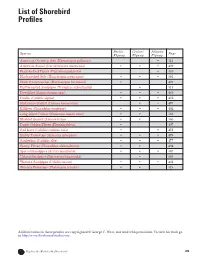
List of Shorebird Profiles Pacific Central Atlantic Species Page Flyway Flyway Flyway American Oystercatcher (Haematopus palliatus) •513 American Avocet (Recurvirostra americana) •••499 Black-bellied Plover (Pluvialis squatarola) •488 Black-necked Stilt (Himantopus mexicanus) •••501 Black Oystercatcher (Haematopus bachmani)•490 Buff-breasted Sandpiper (Tryngites subruficollis) •511 Dowitcher (Limnodromus spp.)•••485 Dunlin (Calidris alpina)•••483 Hudsonian Godwit (Limosa haemestica)••475 Killdeer (Charadrius vociferus)•••492 Long-billed Curlew (Numenius americanus) ••503 Marbled Godwit (Limosa fedoa)••505 Pacific Golden-Plover (Pluvialis fulva) •497 Red Knot (Calidris canutus rufa)••473 Ruddy Turnstone (Arenaria interpres)•••479 Sanderling (Calidris alba)•••477 Snowy Plover (Charadrius alexandrinus)••494 Spotted Sandpiper (Actitis macularia)•••507 Upland Sandpiper (Bartramia longicauda)•509 Western Sandpiper (Calidris mauri) •••481 Wilson’s Phalarope (Phalaropus tricolor) ••515 All illustrations in these profiles are copyrighted © George C. West, and used with permission. To view his work go to http://www.birchwoodstudio.com. S H O R E B I R D S M 472 I Explore the World with Shorebirds! S A T R ER G S RO CHOOLS P Red Knot (Calidris canutus) Description The Red Knot is a chunky, medium sized shorebird that measures about 10 inches from bill to tail. When in its breeding plumage, the edges of its head and the underside of its neck and belly are orangish. The bird’s upper body is streaked a dark brown. It has a brownish gray tail and yellow green legs and feet. In the winter, the Red Knot carries a plain, grayish plumage that has very few distinctive features. Call Its call is a low, two-note whistle that sometimes includes a churring “knot” sound that is what inspired its name. -

Foot-Trembling in the Spur-Winged Plover (Vanellus Miles Novaehollandiae)
Notornis, 2001, Vol. 48: 59-60 0029-4470 0The Ornithological Society of New Zealand, Inc. 2001 SHORT NOTE Foot-trembling in the spur-winged plover (Vanellus miles novaehollandiae) BRUCE R. KEELEY 13 The Glebe, Howick, Auckland 1705 millkee@ nznetgen. nz A range of distinct foot and leg movements, associated alternately It was not clear whether or not the foot made with feeding behaviour, has been described in several contact with the mud, though at times it appeared to be Palearctic-breeding charadriids, and the possible adaptive 'leg-shaking' rather than 'foot-tapping' that was involved. significance of such movements in the search and There was no obvious correlation between the foot capture of prey has been debated (Simmonds 1961a, b; movement and any subsequent capture of prey Sparks 1961). The range of movements has been broadly While, amongst the lapwings (Subfamily Mnellinae), divided into 'foot-trembling' (involving 1 leg at a time), similar behaviour is well documented in the Eurasian and 'foot-paddling' (where both feet are involved), lapwing (Cramp 1983), perusal of literature on the spur- (Simmonds 1961b). Species in which this behaviour had winged plover/masked lapwing yielded only 2 references: been observed included Eurasian lapwing (Knellus Barlow (1983), in describing elements of feeding vanellus), little ringed plover (Charadrius dubius), ringed behaviour which must be learned bv/J iuvenile ~lovers. plover (C. hiaticula), Kentish plover (C. alexandrinus), refers to 'the foot tremor, the lunge, the stab'; and Frith and dotterel (C, morinellus). (1969) states that 'on wet ground they shuffle 1 foot In New Zealand. foot-tremblingu in the black-fronted and stand on the other, and they thus flush prey animals.' dotterel (C. -

Masked Lapwings)
ATSB Bird Information Sheet No.3 MMaasskkeedd LLaappwwiinnggss Managing bird strike risk at Australian airports MASKED LAPWING Vanellus miles Strike Risk ATSB rank 14* Between 1991 and 2001 there were 143 bird strikes reported to ATSB which involved “plovers” (Masked Lapwings). Of these: 7% resulted in damage to aircraft 2.8% had an effect on planned flight 35% involved more than 1 bird *Ranking and figures were obtained from The Hazard Posed to Aircraft by Birds (ATSB 2002). http://www.atsb.gov.au/aviation/research/birdstrike.cfm Prior to breeding season, Masked Lapwings form flocks. During breeding season Masked Lapwings pair off, become highly territorial and are reluctant to move from their territory even for large aircraft. This makes them particularly prone to being struck. Ian Montgomery About Masked Lapwings \ Masked Lapwing Masked Lapwings at Airports Vanellus miles Masked Lapwings are attracted to the airport environment to either Other Names feed or nest. Plover, Masked Plover or Spur-winged They prefer barren, rocky ground or short grass to build nests. These Plover surfaces are also ideal for feeding on insects and other invertebrates in Size the soil. Length 30-37cm; wingspan 75-85cm; They tend to be a seasonal problem for airports, particularly weight 230-400g. immediately before, during and just after the breeding season. Identification When undertaking bird counts or reporting strikes, it is important to Adults have a black crown head, light differentiate between Masked Lapwings and the migrating plovers brown upperparts, white underneath, (such as Pacific Golden, Grey, Red-capped, Sand, or Oriental Plover) reddish legs and a yellow fleshy ‘mask’ at and dotterels (such as Red-kneed and Black-fronted Dotterel). -
SHOREBIRDS (Charadriiformes*) CARE MANUAL *Does Not Include Alcidae
SHOREBIRDS (Charadriiformes*) CARE MANUAL *Does not include Alcidae CREATED BY AZA CHARADRIIFORMES TAXON ADVISORY GROUP IN ASSOCIATION WITH AZA ANIMAL WELFARE COMMITTEE Shorebirds (Charadriiformes) Care Manual Shorebirds (Charadriiformes) Care Manual Published by the Association of Zoos and Aquariums in association with the AZA Animal Welfare Committee Formal Citation: AZA Charadriiformes Taxon Advisory Group. (2014). Shorebirds (Charadriiformes) Care Manual. Silver Spring, MD: Association of Zoos and Aquariums. Original Completion Date: October 2013 Authors and Significant Contributors: Aimee Greenebaum: AZA Charadriiformes TAG Vice Chair, Monterey Bay Aquarium, USA Alex Waier: Milwaukee County Zoo, USA Carol Hendrickson: Birmingham Zoo, USA Cindy Pinger: AZA Charadriiformes TAG Chair, Birmingham Zoo, USA CJ McCarty: Oregon Coast Aquarium, USA Heidi Cline: Alaska SeaLife Center, USA Jamie Ries: Central Park Zoo, USA Joe Barkowski: Sedgwick County Zoo, USA Kim Wanders: Monterey Bay Aquarium, USA Mary Carlson: Charadriiformes Program Advisor, Seattle Aquarium, USA Sara Perry: Seattle Aquarium, USA Sara Crook-Martin: Buttonwood Park Zoo, USA Shana R. Lavin, Ph.D.,Wildlife Nutrition Fellow University of Florida, Dept. of Animal Sciences , Walt Disney World Animal Programs Dr. Stephanie McCain: AZA Charadriiformes TAG Veterinarian Advisor, DVM, Birmingham Zoo, USA Phil King: Assiniboine Park Zoo, Canada Reviewers: Dr. Mike Murray (Monterey Bay Aquarium, USA) John C. Anderson (Seattle Aquarium volunteer) Kristina Neuman (Point Blue Conservation Science) Sarah Saunders (Conservation Biology Graduate Program,University of Minnesota) AZA Staff Editors: Maya Seaman, MS, Animal Care Manual Editing Consultant Candice Dorsey, PhD, Director of Animal Programs Debborah Luke, PhD, Vice President, Conservation & Science Cover Photo Credits: Jeff Pribble Disclaimer: This manual presents a compilation of knowledge provided by recognized animal experts based on the current science, practice, and technology of animal management. -
Migratory Shorebird Guild
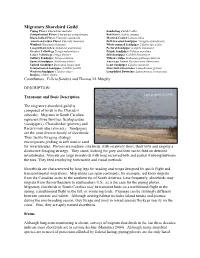
Migratory Shorebird Guild Piping Plover Charadrius melodus Sanderling Calidris alba Semipalmated Plover Charadrius semipalmatus Red Knot Calidris canutus Black-bellied Plover Pluvialis squatarola Marbled Godwit Limosa fedoa American Golden Plover Pluvialis dominica Buff-breasted Sandpiper Tryngites subruficollis Wimbrel Numenius phaeopus White-rumped Sandpiper Calidris fuscicollis Long-billed Curlew Numenius americanus Pectoral Sandpiper Calidris melanotos Greater Yellowlegs Tringa melanoleuca Purple Sandpiper Calidris maritima Lesser Yellowlegs Tringa flavipes Stilt Sandpiper Calidris himantopus Solitary Sandpiper Tringa solitaria Wilson’s Snipe Gallinago gallinago delicata Spotted Sandpiper Actitis macularia American Avocet Recurvirostra Americana Upland Sandpiper Bartramia longicauda Least Sandpiper Calidris minutilla Semipalmated Sandpiper Calidris pusilla Short-billed Dowitcher Limnodromus griseus Western Sandpiper Calidris mauri Long-billed Dowitcher Limnodromus scolopaceus Dunlin Calidris alpina Contributors: Felicia Sanders and Thomas M. Murphy DESCRIPTION Photograph by SC DNR Taxonomy and Basic Description The migratory shorebird guild is composed of birds in the Charadrii suborder. Migrants in South Carolina represent three families: Scolopacidae (sandpipers), Charadriidae (plovers) and Recurvirostridae (avocets). Sandpipers are the most diverse family of shorebirds. Their tactile foraging strategy encompasses probing in soft mud or sand for invertebrates. Plovers are medium size birds, with relatively short, thick bills and employ a distinctive foraging strategy. They stand, looking for prey and then run to feed on detected invertebrates. Avocets are large shorebirds with long recurved bills and partial webbing between the toes. They feed employing both tactile and visual methods. Shorebirds are characterized by long legs for wading and wings designed for quick flight and transcontinental migrations. Migrations can span continents; for example, red knots migrate from the Canadian arctic to the southern tip of South America. -

Biometrics and Breeding Phenology of Terek Sandpipers in the Pripyat’ Valley, S Belarus
54 Wader Study Group Bulletin Biometrics and breeding phenology of Terek Sandpipers in the Pripyat’ Valley, S Belarus NATALIA KARLIONOVA1, MAGDALENA REMISIEWICZ2, PAVEL PINCHUK1 1Institute of Zoology, Belarussian National Academy of Sciences, Academichnaya Str. 27, 220072 Minsk, Belarus. karlionova@tut.by 2Avian Ecophysiology Unit, Dept of Vertebrate Ecology and Zoology, Univ. of Gdansk, al. Legionów 9, 80-441 Gdansk, Poland. biomr@univ.gda.pl Karlionova, N., Remisiewicz, M. & Pinchuk, P. 2006. Biometrics and breeding phenology of Terek Sandpipers in the Pripyat’ Valley, S Belarus. Wader Study Group Bull. 110: 54–58. Keywords: Terek Sandpiper, Xenus cinereus, biometrics, breeding phenology, Pripyat’ Valley, Belarus We present data on the breeding phenology and biometrics of Terek Sandpipers from the isolated westernmost population in the Pripyat’ river valley, S Belarus, close to the border with Ukraine. Studies were conducted on floodplain islands between the beginning of April and mid-July during 1996–1999 and 2002–2006. Over the years, the first arrivals appeared during 10–26 April (median 14 April), first eggs were laid during 24 April to 5 May (median 30 April) and the latest egg was laid on 25 May, first chicks hatched during 19 May to 1 June (median 25 May) and the first fledged juveniles were caught on 23 June. We present biometric data for juve- niles (at the post-fledging stage) and adults. The mean wing length of juveniles, just before departure from the breeding grounds in mid June, reached 96% of that of adults. Juvenile total head lengths were 91% of adult, and bill and nalospi lengths 85% of adult, but tarsus and tarsus plus toe lengths were the same as adults. -
Compendium of Avian Ecology
Compendium of Avian Ecology ZOL 360 Brian M. Napoletano All images taken from the USGS Patuxent Wildlife Research Center. http://www.mbr-pwrc.usgs.gov/id/framlst/infocenter.html Taxonomic information based on the A.O.U. Check List of North American Birds, 7th Edition, 1998. Ecological Information obtained from multiple sources, including The Sibley Guide to Birds, Stokes Field Guide to Birds. Nest and other images scanned from the ZOL 360 Coursepack. Neither the images nor the information herein be copied or reproduced for commercial purposes without the prior consent of the original copyright holders. Full Species Names Common Loon Wood Duck Gaviiformes Anseriformes Gaviidae Anatidae Gavia immer Anatinae Anatini Horned Grebe Aix sponsa Podicipediformes Mallard Podicipedidae Anseriformes Podiceps auritus Anatidae Double-crested Cormorant Anatinae Pelecaniformes Anatini Phalacrocoracidae Anas platyrhynchos Phalacrocorax auritus Blue-Winged Teal Anseriformes Tundra Swan Anatidae Anseriformes Anatinae Anserinae Anatini Cygnini Anas discors Cygnus columbianus Canvasback Anseriformes Snow Goose Anatidae Anseriformes Anatinae Anserinae Aythyini Anserini Aythya valisineria Chen caerulescens Common Goldeneye Canada Goose Anseriformes Anseriformes Anatidae Anserinae Anatinae Anserini Aythyini Branta canadensis Bucephala clangula Red-Breasted Merganser Caspian Tern Anseriformes Charadriiformes Anatidae Scolopaci Anatinae Laridae Aythyini Sterninae Mergus serrator Sterna caspia Hooded Merganser Anseriformes Black Tern Anatidae Charadriiformes Anatinae -

177 European Golden Plover Put Your Logo Here
Javier Blasco-Zumeta & Gerd-Michael Heinze Sponsor is needed. Write your name here 177 European Golden Plover Put your logo here Golden Plover. Winter. Adult (14-I) EUROPEAN GOLDEN PLOVER (Pluvialis apricaria) Grey Plover IDENTIFICATION 26-28 cm. In winter with dark upperparts with dense golden notches; pale underparts with brown streaks; white underwing; white axilla- ries; grey-greenish legs. SEXING In winter, plumage of both sexes alike. AGEING It is not possible to find juveniles in Ara- gon, so only 2 types of age can be recognized: 1st year autumn/2nd year spring similar to adult but with worn juvenile feathers on back, rump, tail, outer tertials and wing; wing always with only one generation of flight feat- hers; tail feathers with broken short off-white bars or spots; unmoulted inner median coverts and tertials with a broad dark shaft-streak to tips. Adult with fresh feathers; if some seconda- ries remain unmoulted, then with a mixed of new and old feathers; tail feathers with narrow and shallow greyish-yellow chevrons; inner me- dian coverts with a fine dark shaft-streak to tips; tertials without a dark shaft-streak on tips. Golden Plover. Winter. Pattern of underwing, rump, wing and upperparts. SIMILAR SPECIES Recalls a Grey Plover, with black axillaries, wide wingbar and white rump. http://blascozumeta.com Write your website here Page 1 Javier Blasco-Zumeta & Gerd-Michael Heinze Sponsor is needed. Write your name here 177 European Golden Plover Put your logo here MOULT Complete postbreeding moult, but many birds can retain secondaries and wing coverts: usually starts in July and suspended before migration.