Ethiopia Relations Historical Linkages Between India and Ethiopia Go Back
Total Page:16
File Type:pdf, Size:1020Kb
Load more
Recommended publications
-
Managing Ethiopia's Transition
Managing Ethiopia’s Unsettled Transition $IULFD5HSRUW1 _ )HEUXDU\ +HDGTXDUWHUV ,QWHUQDWLRQDO&ULVLV*URXS $YHQXH/RXLVH %UXVVHOV%HOJLXP 7HO )D[ EUXVVHOV#FULVLVJURXSRUJ Preventing War. Shaping Peace. Table of Contents Executive Summary ................................................................................................................... i I. Introduction ..................................................................................................................... 1 II. Anatomy of a Crisis ........................................................................................................... 2 A. Popular Protests and Communal Clashes ................................................................. 3 B. The EPRDF’s Internal Fissures ................................................................................. 6 C. Economic Change and Social Malaise ....................................................................... 8 III. Abiy Ahmed Takes the Reins ............................................................................................ 12 A. A Wider Political Crisis .............................................................................................. 12 B. Abiy’s High-octane Ten Months ................................................................................ 15 IV. Internal Challenges and Opportunities ............................................................................ 21 A. Calming Ethnic and Communal Conflict .................................................................. -

The Africa Union Handbook
African Union Handbook African THE YEAR OF REFUGEES, RETURNEES AND INTERNALLY DISPLACED PERSONS: Towards Durable Solutions to Forced Displacement in Africa The logo for the 2019 Theme of the Year has been built around the crisis facing refugees in Africa. New Zealand is proud to once again partner with the African Union “Whereas migration is a common Commission to produce the latest version of the African Union Handbook. phenomenon as people have always relocated for various reasons, in the With new and updated information about the Union, its organs and related case of Africa, the continent is painted as a miserable place bodies, the Handbook serves as a factual and concise reference guide to all because migration is as a result of aspects of the African Union and its Commission, and remains an invaluable civil strife, poverty and a myriad of tool for anyone working with, and within, the AU system. other factors, thereby promoting the narrative that Africa cannot care for Through its ambitious integration agenda, African Union members have its people. Africa knows how to take care of its own in each regard no committed themselves to aspire to a world where international connections matter what, and many African between peoples and nations are the most powerful tools for creating countries continue to welcome and prosperous societies based on inclusive growth and sustainable development. host refugees while working to resolve the issues that caused them At a time when the need for collective global action and multilateralism has to flee their homes. never been clearer, New Zealand expresses its profound respect to the African For the 2019 Theme, an identity has Union for its commitments made under Agenda 2063 towards achieving an been developed of a mother with integrated, inclusive and united Africa. -

Press Release
AFRICAN UNION UNION AFRICAINE UNIÃO AFRICANA Addis Ababa, Ethiopia P.O.Box:3243 Tel. (251-1) 51 38 22 Fax: (251-1) 51 93 21 Email: situationroom@africa-union.org PRESS RELEASE AU CHAIRPERSON HOLDS HIGH LEVEL CONSULTATIONS ON THE MARGINS OF THE LONDON CONFERENCE ON SOMALIA Addis Ababa, 11 May 2017: The Chairperson of the African Union Commission (AUC) Moussa Faki Mahamat held high level consultations on the margins of the London Conference on Somalia. The Chairperson of the AUC met with H.E , Yoweri Kaguta Museveni, President of the Republic of Uganda, H. E Hailemariam Desalegn, Prime Minister of the Federal Democratic Republic of Ethiopia, H.E Uhuru Kenyatta, President of the Republic of Kenya and H.E Mohamed Abdullahi Mohamed, President of the Federal Republic of Somalia. The Chairperson of the AU Commission further met with the Secretary General of the United Nations, Antonio Guterres, United Kingdom Secretary of State for Foreign Affairs, Boris Johnson, the Minister of Foreign Affairs of the Netherlands, Bert Koenders, Denmark's State Secretary for international cooperation, Martin Bille. He also held bilateral discussions with the Vice President of the European Union Commission and High Representative for Foreign Affairs and Security Policy, Federica Mogherini and the Secretary General of the Arab League, Ahmed Aboul-Gheit. The Chairperson of the AU Commission, Moussa Faki Mahamat underlined the need to redouble efforts in support of Somalia to allow the administration of H.E Mohamed Abdullahi Farmajo to overcome the many challenges facing the country. He stressed the importance to support the full implementation of the newly adopted national security architecture in order to stand up Somalia security forces as part of the African Union Mission in Somalia (AMISOM)'s exit strategy. -

Ethnolinguistic Favoritism in African Politics ONLINE APPENDIX
Ethnolinguistic Favoritism in African Politics ONLINE APPENDIX Andrew Dickensy For publication in the American Economic Journal: Applied Economics yBrock University, Department of Economics, 1812 Sir Issac Brock Way, L2S 3A2, St. Catharines, ON, Canada (email: adickens@brocku.ca). 1 A Data Descriptions, Sources and Summary Statistics A.1 Regional-Level Data Description and Sources Country-language groups: Geo-referenced country-language group data comes from the World Language Mapping System (WLMS). These data map information from each language in the Ethnologue to the corresponding polygon. When calculating averages within these language group polygons, I use the Africa Albers Equal Area Conic projection. Source: http://www.worldgeodatasets.com/language/ Linguistic similarity: I construct two measures of linguistic similarity: lexicostatistical similarity from the Automatic Similarity Judgement Program (ASJP), and cladistic similar- ity using Ethnologue data from the WLMS. I use these to measure the similarity between each language group and the ethnolinguistic identity of that country's national leader. I discuss how I assign a leader's ethnolinguistic identity in Section 1 of the paper. Source: http://asjp.clld.org and http://www.worldgeodatasets.com/language/ Night lights: Night light intensity comes from the Defense Meteorological Satellite Program (DMSP). My measure of night lights is calculated by averaging across pixels that fall within each WLMS country-language group polygon for each year the night light data is available (1992-2013). To minimize area distortions I use the Africa Albers Equal Area Conic pro- jection. In some years data is available for two separate satellites, and in all such cases the correlation between the two is greater than 99% in my sample. -
Jean Devlin Compiled with Data from CORE
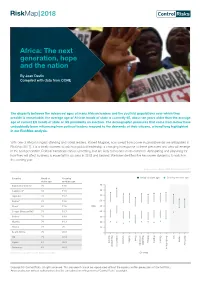
خارطة ا�خاطر Africa: The next generation, hope and the nation By Jean Devlin Compiled with data from CORE The disparity between the advanced ages of many African leaders and the youthful populations over which they preside is remarkable: the average age of African heads of state is currently 65, about ten years older than the average age of current EU heads of state or US presidents on election. The demographic pressures that come from below have undoubtedly been influencing how political leaders respond to the demands of their citizens, a trend long highlighted in our RiskMap analysis. With one of Africa’s longest-standing and oldest leaders, Robert Mugabe, now swept from power in Zimbabwe (as we anticipated in RiskMap 2017), it is a timely moment to ask how political leadership is changing in response to these pressures and who will emerge in the next generation. Political transitions can be unsettling, but are likely to become more common. Anticipating and preparing for how they will affect business is essential for success in 2018 and beyond. We have identified five key power dynamics to watch in the coming year. Source: Control Risks CORE © Control Risks 2017 Country Head of Country Head of state age Country median age state age median age Equatorial Guinea* 75 19.6 90 Cameroon* 84 18.5 80 Uganda* 73 15.7 70 Sudan* 73 19.6 60 Chad* 65 17.6 Age 50 Congo (Brazzaville)* 73 19.7 40 Eritrea* 71 19.4 30 Nigeria 74 18.3 20 Ghana 73 21 10 South Africa 75 26.8 Cameroon Uganda Sudan Chad Eritrea Nigeria Ghana US Japan Germany Guinea Equatorial South Africa of Congo Republic US 71 37.9 Japan 63 46.9 Germany 63 46.8 *Have been in power for more than two decades Country Copyright © Control Risks. -
University of Florida Thesis Or Dissertation Formatting Template
REPRESENTATION, HERITAGE, AND ARCHAEOLOGY AMONG THE WOLAITA OF ETHIOPIA By JUSTIN DUNNAVANT A DISSERTATION PRESENTED TO THE GRADUATE SCHOOL OF THE UNIVERSITY OF FLORIDA IN PARTIAL FULFILLMENT OF THE REQUIREMENTS FOR THE DEGREE OF DOCTOR OF PHILOSOPHY UNIVERSITY OF FLORIDA 2017 © 2017 Justin Dunnavant To the life and memory of Warren Dunnavant, Sr. (1953-2011), Professor Mark E. Mack (1961-2012), and Dolores “Bunny” McCullough (1931-2014). ACKNOWLEDGMENTS First, I must acknowledge the support and sacrifice of my friends and family. I give thanks for all that they have done and continue to do to help me to grow as an individual and scholar. Thanks Tiffany Walker for the continued support and encouragement during the extended fieldwork trips and long writing sessions. I would like to thank my committee for the support and guidance throughout the dissertation process. Thanks to Dr. James Davidson for allowing me to participate in the Kingsley Plantation Field School and hone my archaeological field method skills. Dr. Terje Ostebo provided positive critique on the socio-historical context of Ethiopia. Dr. Paul Ortiz served as an academic and personal mentor and demonstrated how academic work is paired with social activism. Finally, I owe a debt of gratitude to Dr. Steven Brandt for extending the initial invitation to come to Ethiopia and giving me the freedom to explore new and interesting questions related to historical archaeology in the country. I am also indebted to him for reading previous drafts of this dissertation in a relatively short time frame and providing critical feedback. I am indebted to all of those in Ethiopia who helped to facilitate my research in Addis Ababa and Wolaita. -
High-Level Steering Group for Every Woman Every Child
HIGH-LEVEL STEERING GROUP FOR EVERY WOMAN EVERY CHILD MEMBERSHIP LIST CO-CHAIRS António Guterres, the ninth Secretary-General of the United Nations, took office on 1st January 2017. Having witnessed the suffering of the most vulnerable people on earth, in refugee camps and in war zones, the Secretary-General is determined to make human dignity the core of his work, and to serve as a peace broker, a bridge-builder and a promoter of reform and innovation. Prior to his appointment as Secretary-General, Mr. Guterres served as United Nations High Commissioner for Refugees from June 2005 to December António Guterres 2015, heading one of the world’s foremost humanitarian Secretary-General of the United organizations during some of the most serious displacement crises in Nations decades. Before joining UNHCR, Mr. Guterres spent more than 20 years in government and public service. He served as prime minister of Portugal from 1995 to 2002, during which time he was heavily involved in the international effort to resolve the crisis in East Timor. As president of the European Council in early 2000, he led the adoption of the Lisbon Agenda for growth and jobs, and co-chaired the first European Union-Africa summit. He was a member of the Portuguese Council of State from 1991 to 2002. Mr. Guterres was elected to the Portuguese Parliament in 1976 where he served as a member for 17 years. During that time, he chaired the Parliamentary Committee for Economy, Finance and Planning, and later the Parliamentary Committee for Territorial Administration, Municipalities and Environment. He was also leader of his party’s parliamentary group. -

BAB IV KESIMPULAN Indonesia Memulai Hubungan Diplomatik Dengan Ethiopia Pada Saat KAA Tahun 1955, Tetapi Stabilitas Politik
55 BAB IV KESIMPULAN Indonesia memulai hubungan diplomatik dengan Ethiopia pada saat KAA tahun 1955, tetapi stabilitas politik dan perubahan kepemimpinan dari sisi Ethiopia menghambat terjalinya kerjsama ekonomi yang baik. Ethiopia baru memutuskan untuk memakai sistem pemerinahan demokratik pada tahun 1995 dan mulai mencapai stabilitas politik. Kualitas hubungan diplomatik Indonesia dengan Ethiopia mulai membaik ketika Ethiopia memutuskan untuk membuka kantor diplomatik di Jakarta pada tahun 2016 dan dengan adanya kedutaan, akan mempermudah kerjasama antara negara. Indonesia sudah memiliki sebanyak 5 perusahaan yang sudah aktif dari tahun 2015. Presiden Ethiopia Mulatu Teshome, meminta kepada Menlu Retno Marsudi untuk Indonesia lebih memperbanyak investasi ke Ethiopia. Sebagai upaya untuk memenuhi permintaan dari Presiden Ethiopia, Indonesia melakukan beberapa upaya untuk menumbuhkan keinginan pengusaha Indonesia untuk 56 berinvestasi. Indonesia melalui Kementrian Perdagangan dan KBRI melakukan kegiatan promosi untuk produk-produk dalam negeri kepada masyarakat Ethiopia dan membantu meningkatkan nilai transaksi. KBRI Addis Ababa sebagai kantor perwakilan diplomatik Indonesia di Ethiopia memiliki beberapa program dalam meningkatkan nilai transaksi ke Ethiopia. Salah satu kegiatan yang dilakukan adalah menjalin relasi dengan masyarkat Ethiopia sebagai bentuk diplomasi publik. Tujuan dari kegiatan ini adalah untuk membangun opini publik yang baik terhadap Indonesia dan membantu menumbuhkan keinginan masyarkat Ethiopia untuk bertransaksi dengan Indonesia. Selain program diplomasi publik, KBRI Addis Ababa juga ikut serta dalam pameran dagang di Ethiopia dan membantu memamerkan produk- produk Indoesia yang memiliki potensi ekspor yang sesuai dengan kebutuhan Ethiopia. Selain itu, Kedutaan Ethiopia di Jakarta juga melakukan seminar dagang dengan tujuan untuk memberikan informasi seputar potensi investasi di Ethiopia. Upaya yang sudah dilakukan oleh Indonesia untuk meningkatkan nilai ekspor ke Ethiopia tidak memberikan hasil yang masksimal. -
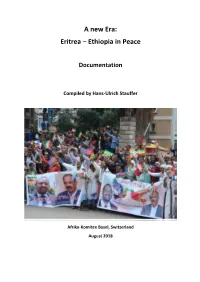
Eritrea – Ethiopia in Peace
A new Era: Eritrea – Ethiopia in Peace Documentation Compiled by Hans-Ulrich Stauffer Afrika-Komitee Basel, Switzerland August 2018 Contents Introduction 3 Timetable of the developments 4 Ethiopia's PM says ending war, expanding economic links with Eritrea key for 5 regional stability Eritrea – Ethiopia: Once Bitten, Twice Shy 7 President Isaias' Speech on Martyrs Day, June 20, 2018 10 ‘Selam’ at Last! - Eritrea and Ethiopia join in peace after two decades of hostilities 13 Joint Declaration of Peace and Friendship between Eritrea and Ethiopia 17 “Yes Peace, No War.” 19 Eritrea and Ethiopia: Recap and Brief Commentary on 21 Recent Developments President Isaias arrives in Addis Ababa 25 Eritrean, Ethiopian leaders call new peace example to Africa 27 President Isaias Afwerki’s Official Visit to Ethiopia 29 A Historic visit reciprocated with Peace and Friendship 30 Eritrean Embassy in Addis Ababa Reopens 33 Peace in the Horn: An Idea Whose Time Has Come 33 Ethiopian Airlines Makes Historic Flight to Eritrea 36 Interview with Former Ethiopian PM Hailemariam Desalgne 38 Eritrea in New Bid to Woo US Investors 41 Statement by Mr. Nebil Said, Counsellor, Permanent Mission of Eritrea 43 to the United Nations, During UN Security Council Meeting 8322 New York, 30 July 2018 2 Introduction By Hans-Ulrich Stauffer, Afrika-Komitee, Basel 20 years after the outbreake of war between Eritrea and Ethiopia, 18 years after the armistice and 16 years after the arbitrable judgment, an unforseen development put an end to a period of “no war – no peace”. Both countries and their peoples had suffered for years. -

Ethiopian Embassy in Brussels Weekly Issue N° 17
Newsletter 2 January 2014 Ethiopian Embassy in Brussels Weekly Issue N° 17 Ambassador Teshome Toga in Estonia, last month. Dear Reader, We are very pleased to send you the frst 2015 edition of our newsletter, where you can read fresh news and insights about recent developments concerning Ethiopia. You will also fnd the season’s greetings from Ambassador Teshome Toga attached to this newsletter. We wish you all a happy and successful new year for you, your family and the people close to you. Sincerely, The Ethiopian Embassy in Brussels Content Ugandan President Museveni in Ethiopia for a three day ofcial visit Ethiopia set to double its hydropower in July Mekelle University undertaking expansion with close to 3 billion birr Addis Light railway to go operational next month Ethiopian Connecting Africa to the world Agenda 1 Ethiopian Embassy in Brussels, 2 January 2015 Newsletter of the Ethiopian Embassy in Brussels − Weekly Issue No 17 Ugandan President Museveni in Ethiopia for a three day ofcial visit A high level delegation of Ethiopia and Uganda, led by unprecedented opportunities to use our comparative Prime Minister Hailemariam Desalegn and President advantage for the betterment of the peoples of our Yoweri Kaguta Museveni held consultation on Friday sub-region.” He also noted that meager expansion of December 26 at National Palace on bilateral, regional infrastructure heavily reduced trade and investment and global matters of mutual interest. Prime Minister ties in the sub-region, stressing that both countries need to undertake projects aimed infrastructure linkages as bridges of closer cooperation and partnership through bilateral cooperation and through the implementation of the IGAD Minimum Integration Plan. -

Coup D'etat Events, 1946-2012
COUP D’ÉTAT EVENTS, 1946-2018 CODEBOOK Monty G. Marshall and Donna Ramsey Marshall Center for Systemic Peace July 25, 2019 Overview: This data list compiles basic descriptive information on all coups d’état occurring in countries reaching a population greater than 500,000 during the period 1946-2018. For purposes of this compilation, a coup d’état is defined as a forceful seizure of executive authority and office by a dissident/opposition faction within the country’s ruling or political elites that results in a substantial change in the executive leadership and the policies of the prior regime (although not necessarily in the nature of regime authority or mode of governance). Social revolutions, victories by oppositional forces in civil wars, and popular uprisings, while they may lead to substantial changes in central authority, are not considered coups d’état. Voluntary transfers of executive authority or transfers of office due to the death or incapacitance of a ruling executive are, likewise, not considered coups d’état. The forcible ouster of a regime accomplished by, or with the crucial support of, invading foreign forces is not here considered a coup d’état. The dataset includes four types of coup events: successful coups, attempted (failed) coups, coup plots, and alleged coup plots. In order for a coup to be considered “successful” effective authority must be exercised by new executive for at least one month. We are confident that the list of successful coups is comprehensive. Our confidence in the comprehensiveness of the coup lists diminishes across the remaining three categories: good coverage (reporting) of attempted coups and more questionable quality of coverage/reporting of coup plots (“discovered” and alleged). -

Ethiopia: Prospects for Peace in Ogaden
Ethiopia: Prospects for Peace in Ogaden Africa Report N°207 | 6 August 2013 International Crisis Group Headquarters Avenue Louise 149 1050 Brussels, Belgium Tel: +32 2 502 90 38 Fax: +32 2 502 50 38 brussels@crisisgroup.org Table of Contents Executive Summary ................................................................................................................... i I. Introduction ..................................................................................................................... 1 II. Ogaden: Ethiopia’s Most Contested Territory ................................................................. 2 III. The ONLF and Federal Ethiopia ...................................................................................... 5 A. The ONLF and the EPRDF ........................................................................................ 5 B. Article 39 .................................................................................................................... 7 C. Amateur Insurgents ................................................................................................... 7 D. Local Governance Issues ............................................................................................ 9 IV. Externalisation of the Conflict ......................................................................................... 10 A. The Eritrean Factor .................................................................................................... 10 B. The Somali Factor .....................................................................................................