Chapter Outline Thinking Ahead 2 OBSERVING the SKY: the BIRTH of ASTRONOMY
Total Page:16
File Type:pdf, Size:1020Kb
Load more
Recommended publications
-
The Planisphere of the Heavens
The Planisphere of the Heavens by Steven E. Behrmann Book V Copyright© by Steven E. Behrmann All rights reserved 2010 First Draft (Sunnyside Edition) Dedication: This book is dedicated to my blessed little son, Jonathan William Edward, to whom I hope to teach the names of the stars. Table of Contents A Planisphere of the Heavens .......................................................... 12 The Signs of the Seasons ................................................................. 15 The Virgin (Virgo) ........................................................................... 24 Virgo ............................................................................................ 25 Coma ............................................................................................ 27 The Centaur .................................................................................. 29 Boötes ........................................................................................... 31 The Scales (Libra) ............................................................................ 34 Libra ............................................................................................. 35 The Cross (Crux) .......................................................................... 37 The Victim ................................................................................... 39 The Crown .................................................................................... 41 The Scorpion ................................................................................... -

Aquarius Aries Pisces Taurus
Zodiac Constellation Cards Aquarius Pisces January 21 – February 20 – February 19 March 20 Aries Taurus March 21 – April 21 – April 20 May 21 Zodiac Constellation Cards Gemini Cancer May 22 – June 22 – June 21 July 22 Leo Virgo July 23 – August 23 – August 22 September 23 Zodiac Constellation Cards Libra Scorpio September 24 – October 23 – October 22 November 22 Sagittarius Capricorn November 23 – December 23 – December 22 January 20 Zodiac Constellations There are 12 zodiac constellations that form a belt around the earth. This belt is considered special because it is where the sun, the moon, and the planets all move. The word zodiac means “circle of figures” or “circle of life”. As the earth revolves around the sun, different parts of the sky become visible. Each month, one of the 12 constellations show up above the horizon in the east and disappears below the horizon in the west. If you are born under a particular sign, the constellation it is named for can’t be seen at night. Instead, the sun is passing through it around that time of year making it a daytime constellation that you can’t see! Aquarius Aries Cancer Capricorn Gemini Leo January 21 – March 21 – June 22 – December 23 – May 22 – July 23 – February 19 April 20 July 22 January 20 June 21 August 22 Libra Pisces Sagittarius Scorpio Taurus Virgo September 24 – February 20 – November 23 – October 23 – April 21 – August 23 – October 22 March 20 December 22 November 22 May 21 September 23 1. Why is the belt that the constellations form around the earth special? 2. -
Constructing a Galactic Coordinate System Based on Near-Infrared and Radio Catalogs
A&A 536, A102 (2011) Astronomy DOI: 10.1051/0004-6361/201116947 & c ESO 2011 Astrophysics Constructing a Galactic coordinate system based on near-infrared and radio catalogs J.-C. Liu1,2,Z.Zhu1,2, and B. Hu3,4 1 Department of astronomy, Nanjing University, Nanjing 210093, PR China e-mail: [jcliu;zhuzi]@nju.edu.cn 2 key Laboratory of Modern Astronomy and Astrophysics (Nanjing University), Ministry of Education, Nanjing 210093, PR China 3 Purple Mountain Observatory, Chinese Academy of Sciences, Nanjing 210008, PR China 4 Graduate School of Chinese Academy of Sciences, Beijing 100049, PR China e-mail: hubo@pmo.ac.cn Received 24 March 2011 / Accepted 13 October 2011 ABSTRACT Context. The definition of the Galactic coordinate system was announced by the IAU Sub-Commission 33b on behalf of the IAU in 1958. An unrigorous transformation was adopted by the Hipparcos group to transform the Galactic coordinate system from the FK4-based B1950.0 system to the FK5-based J2000.0 system or to the International Celestial Reference System (ICRS). For more than 50 years, the definition of the Galactic coordinate system has remained unchanged from this IAU1958 version. On the basis of deep and all-sky catalogs, the position of the Galactic plane can be revised and updated definitions of the Galactic coordinate systems can be proposed. Aims. We re-determine the position of the Galactic plane based on modern large catalogs, such as the Two-Micron All-Sky Survey (2MASS) and the SPECFIND v2.0. This paper also aims to propose a possible definition of the optimal Galactic coordinate system by adopting the ICRS position of the Sgr A* at the Galactic center. -
Basic Principles of Celestial Navigation James A
Basic principles of celestial navigation James A. Van Allena) Department of Physics and Astronomy, The University of Iowa, Iowa City, Iowa 52242 ͑Received 16 January 2004; accepted 10 June 2004͒ Celestial navigation is a technique for determining one’s geographic position by the observation of identified stars, identified planets, the Sun, and the Moon. This subject has a multitude of refinements which, although valuable to a professional navigator, tend to obscure the basic principles. I describe these principles, give an analytical solution of the classical two-star-sight problem without any dependence on prior knowledge of position, and include several examples. Some approximations and simplifications are made in the interest of clarity. © 2004 American Association of Physics Teachers. ͓DOI: 10.1119/1.1778391͔ I. INTRODUCTION longitude ⌳ is between 0° and 360°, although often it is convenient to take the longitude westward of the prime me- Celestial navigation is a technique for determining one’s ridian to be between 0° and Ϫ180°. The longitude of P also geographic position by the observation of identified stars, can be specified by the plane angle in the equatorial plane identified planets, the Sun, and the Moon. Its basic principles whose vertex is at O with one radial line through the point at are a combination of rudimentary astronomical knowledge 1–3 which the meridian through P intersects the equatorial plane and spherical trigonometry. and the other radial line through the point G at which the Anyone who has been on a ship that is remote from any prime meridian intersects the equatorial plane ͑see Fig. -
Naming the Extrasolar Planets
Naming the extrasolar planets W. Lyra Max Planck Institute for Astronomy, K¨onigstuhl 17, 69177, Heidelberg, Germany wlyra@mpia.de Abstract and OGLE-TR-182 b, which does not help educators convey the message that these planets are quite similar to Jupiter. Extrasolar planets are not named and are referred to only In stark contrast, the sentence“planet Apollo is a gas giant by their assigned scientific designation. The reason given like Jupiter” is heavily - yet invisibly - coated with Coper- by the IAU to not name the planets is that it is consid- nicanism. ered impractical as planets are expected to be common. I One reason given by the IAU for not considering naming advance some reasons as to why this logic is flawed, and sug- the extrasolar planets is that it is a task deemed impractical. gest names for the 403 extrasolar planet candidates known One source is quoted as having said “if planets are found to as of Oct 2009. The names follow a scheme of association occur very frequently in the Universe, a system of individual with the constellation that the host star pertains to, and names for planets might well rapidly be found equally im- therefore are mostly drawn from Roman-Greek mythology. practicable as it is for stars, as planet discoveries progress.” Other mythologies may also be used given that a suitable 1. This leads to a second argument. It is indeed impractical association is established. to name all stars. But some stars are named nonetheless. In fact, all other classes of astronomical bodies are named. -

Scutum Apus Aquarius Aquila Ara Bootes Canes Venatici Capricornus Centaurus Cepheus Circinus Coma Berenices Corona Austrina Coro
Polaris Ursa Minor Cepheus Camelopardus Thuban Draco Cassiopeia Mizar Ursa Major Lacerta Lynx Deneb Capella Perseus Auriga Canes Venatici Algol Cygnus Vega Cor Caroli Andromeda Lyra Bootes Leo Minor Castor Triangulum Corona Borealis Albireo Hercules Pollux Alphecca Gemini Vulpecula Coma Berenices Pleiades Aries Pegasus Sagitta Arcturus Taurus Cancer Aldebaran Denebola Leo Delphinus Serpens [Caput] Regulus Equuleus Altair Canis Minor Pisces Betelgeuse Aquila Procyon Orion Serpens [Cauda] Ophiuchus Virgo Sextans Monoceros Mira Scutum Rigel Aquarius Spica Cetus Libra Crater Capricornus Hydra Sirius Corvus Lepus Deneb Kaitos Canis Major Eridanus Antares Fomalhaut Piscis Austrinus Sagittarius Scorpius Antlia Pyxis Fornax Sculptor Microscopium Columba Caelum Corona Austrina Lupus Puppis Grus Centaurus Vela Norma Horologium Phoenix Telescopium Ara Canopus Indus Crux Pictor Achernar Hadar Carina Dorado Tucana Circinus Rigel Kentaurus Reticulum Pavo Triangulum Australe Musca Volans Hydrus Mensa Apus SampleOctans file Chamaeleon AND THE LONELY WAR Sample file STAR POWER VOLUME FOUR: STAR POWER and the LONELY WAR Copyright © 2018 Michael Terracciano and Garth Graham. All rights reserved. Star Power, the Star Power logo, and all characters, likenesses, and situations herein are trademarks of Michael Terracciano and Garth Graham. Except for review purposes, no portion of this publication may be reproduced or transmitted, in any form or by any means, without the express written consent of the copyright holders. All characters and events in this publication are fictional and any resemblance to real people or events is purely coincidental. Star chartsSample adapted from charts found at hoshifuru.jp file Portions of this book are published online at www.starpowercomic.com. This volume collects STAR POWER and the LONELY WAR Issues #16-20 published online between Oct 2016 and Oct 2017. -

Capricorn (Astrology) - Wikipedia, the Free Encyclopedia
מַ זַל גְּדִ י http://www.morfix.co.il/en/Capricorn بُ ْر ُج ال َج ْدي http://www.arabdict.com/en/english-arabic/Capricorn برج جدی https://translate.google.com/#auto/fa/Capricorn Αιγόκερως Capricornus - Wikipedia, the free encyclopedia http://en.wikipedia.org/wiki/Capricornus h m s Capricornus Coordinates: 21 00 00 , −20° 00 ′ 00 ″ From Wikipedia, the free encyclopedia Capricornus /ˌkæprɨˈkɔrnəs/ is one of the constellations of the zodiac. Its name is Latin for "horned goat" or Capricornus "goat horn", and it is commonly represented in the form Constellation of a sea-goat: a mythical creature that is half goat, half fish. Its symbol is (Unicode ♑). Capricornus is one of the 88 modern constellations, and was also one of the 48 constellations listed by the 2nd century astronomer Ptolemy. Under its modern boundaries it is bordered by Aquila, Sagittarius, Microscopium, Piscis Austrinus, and Aquarius. The constellation is located in an area of sky called the Sea or the Water, consisting of many water-related constellations such as Aquarius, Pisces and Eridanus. It is the smallest constellation in the zodiac. List of stars in Capricornus Contents Abbreviation Cap Genitive Capricorni 1 Notable features Pronunciation /ˌkæprɨˈkɔrnəs/, genitive 1.1 Deep-sky objects /ˌkæprɨˈkɔrnaɪ/ 1.2 Stars 2 History and mythology Symbolism the Sea Goat 3 Visualizations Right ascension 20 h 06 m 46.4871 s–21 h 59 m 04.8693 s[1] 4 Equivalents Declination −8.4043999°–−27.6914144° [1] 5 Astrology 6 Namesakes Family Zodiac 7 Citations Area 414 sq. deg. (40th) 8 See also Main stars 9, 13,23 9 External links Bayer/Flamsteed 49 stars Notable features Stars with 5 planets Deep-sky objects Stars brighter 1 than 3.00 m Several galaxies and star clusters are contained within Stars within 3 Capricornus. -

The Sky Tonight
MARCH POUTŪ-TE-RANGI HIGHLIGHTS Conjunction of Saturn and the Moon A conjunction is when two astronomical objects appear close in the sky as seen THE- SKY TONIGHT- - from Earth. The planets, along with the TE AHUA O TE RAKI I TENEI PO Sun and the Moon, appear to travel across Brightest Stars our sky roughly following a path called the At this time of the year, we can see the ecliptic. Each body travels at its own speed, three brightest stars in the night sky. sometimes entering ‘retrograde’ where they The brightness of a star, as seen from seem to move backwards for a period of time Earth, is measured as its apparent (though the backwards motion is only from magnitude. Pictured on the cover is our vantage point, and in fact the planets Sirius, the brightest star in our night sky, are still orbiting the Sun normally). which is 8.6 light-years away. Sometimes these celestial bodies will cross With an apparent magnitude of −1.46, paths along the ecliptic line and occupy the this star can be found in the constellation same space in our sky, though they are still Canis Major, high in the northern sky. millions of kilometres away from each other. Sirius is actually a binary star system, consisting of Sirius A which is twice the On March 19, the Moon and Saturn will be size of the Sun, and a faint white dwarf in conjunction. While the unaided eye will companion named Sirius B. only see Saturn as a bright star-like object (Saturn is the eighth brightest object in our Sirius is almost twice as bright as the night sky), a telescope can offer a spectacular second brightest star in the night sky, view of the ringed planet close to our Moon. -
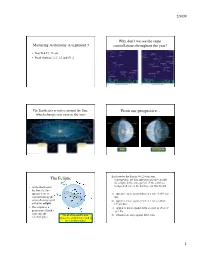
From Our Perspective... the Ecliptic
2/9/09 Why don’t we see the same Mastering Astronomy Assignment 3 constellations throughout the year? • Due Feb 17, 11 am • Read Sections 2.1, 2.2 and S1.2 The Earth also revolves around the Sun, From our perspective... which changes our view of the stars March September Earth circles the Sun in 365.25 days and, The Ecliptic consequently, the Sun appears to go once around the ecliptic in the same period. If we could see • As the Earth orbits background stars in the daytime, our Sun would the Sun, the Sun appears to move a) appear to move against them at a rate of 360° per eastward among the day. stars following a path b) appear to move against them at a rate of about called the ecliptic 15° per day. • The ecliptic is a c) appear to move against them at a rate of about 1° projection of Earth’s per day. orbit onto the The tilt of the Earth's axis d) remain stationary against these stars. celestial sphere causes the ecliptic to be tilted to the celestial equator 1 2/9/09 The sky varies as Earth orbits the Sun • As the Earth orbits the Sun, the Sun appears to move along the Zodiac ecliptic. • At midnight, the stars on our meridian are opposite the Sun in The 13 Zodiacal constellations that our Sun the sky. covers-up (blocks) in the course of one year (used to be only 12) • Aquarius • Leo • Pisces • Libra • Aries • Virgo • Scorpius • Taurus • Ophiuchus • Gemini • Sagittarius • Cancer • Capricornus The Zodiacal Constellations that our Sun blocks in the course of one year (only 12 are shown here) North Star Aquarius Pisces Capricornus Aries 1 day Sagittarius Taurus Scorpius 365 days Libra Gemini Virgo Cancer Leo North Star Aquarius Pisces Capricornus In-class Activities: Seasonal Stars Aries 1 day Sagittarius • Work with a partner! Taurus Scorpius • Read the instructions and questions carefully. -
2. Descriptive Astronomy (“Astronomy Without a Telescope”)
2. Descriptive Astronomy (“Astronomy Without a Telescope”) http://apod.nasa.gov/apod/astropix.html • How do we locate stars in the heavens? • What stars are visible from a given location? • Where is the sun in the sky at any given time? • Where are you on the Earth? An “asterism” is two stars that appear To be close in the sky but actually aren’t In 1930 the International Astronomical Union (IAU) ruled the heavens off into 88 legal, precise constellations. (52 N, 36 S) Every star, galaxy, etc., is a member of one of these constellations. Many stars are named according to their constellation and relative brightness (Bayer 1603). Sirius α − Centauri, α-Canis declination less http://calgary.rasc.ca/constellation.htm - list than -53o not Majoris, α-Orionis visible from SC http://www.google.com/sky/ Betelgeuse https://en.wikipedia.org/wiki/List_of_Messier_objects (1758 – 1782) Biggest constellation – Hydra – the female water snake 1303 square degrees, but Ursa Major and Virgo almost as big. Hydrus – the male water snake is much smaller – 2243 square degrees Smallest is Crux – the Southern Cross – 68 square degrees Brief History Some of the current constellations can be traced back to the inhabitants of the Euphrates valley, from whom they were handed down through the Greeks and Arabs. Few pictorial records of the ancient constellation figures have survived, but in the Almagest AD 150, Ptolemy catalogued the positions of 1,022 of the brightest stars both in terms of celestial latitude and longitude, and of their places in 48 constellations. The Ptolemaic constellations left a blank area centered not on the present south pole but on a point which, because of precession, would have been the south pole c. -

Sydney Observatory Night Sky Map September 2012 a Map for Each Month of the Year, to Help You Learn About the Night Sky
Sydney Observatory night sky map September 2012 A map for each month of the year, to help you learn about the night sky www.sydneyobservatory.com This star chart shows the stars and constellations visible in the night sky for Sydney, Melbourne, Brisbane, Canberra, Hobart, Adelaide and Perth for September 2012 at about 7:30 pm (local standard time). For Darwin and similar locations the chart will still apply, but some stars will be lost off the southern edge while extra stars will be visible to the north. Stars down to a brightness or magnitude limit of 4.5 are shown. To use this chart, rotate it so that the direction you are facing (north, south, east or west) is shown at the bottom. The centre of the chart represents the point directly above your head, called the zenith, and the outer circular edge represents the horizon. h t r No Star brightness Moon phase Last quarter: 08th Zero or brighter New Moon: 16th 1st magnitude LACERTA nd Deneb First quarter: 23rd 2 CYGNUS Full Moon: 30th rd N 3 E LYRA th Vega W 4 LYRA N CORONA BOREALIS HERCULES BOOTES VULPECULA SAGITTA PEGASUS DELPHINUS Arcturus Altair EQUULEUS SERPENS AQUILA OPHIUCHUS SCUTUM PISCES Moon on 23rd SERPENS Zubeneschamali AQUARIUS CAPRICORNUS E SAGITTARIUS LIBRA a Saturn Centre of the Galaxy Antares Zubenelgenubi t s Antares VIRGO s t SAGITTARIUS P SCORPIUS P e PISCESMICROSCOPIUM AUSTRINUS SCORPIUS Mars Spica W PISCIS AUSTRINUS CORONA AUSTRALIS Fomalhaut Centre of the Galaxy TELESCOPIUM LUPUS ARA GRUSGRUS INDUS NORMA CORVUS INDUS CETUS SCULPTOR PAVO CIRCINUS CENTAURUS TRIANGULUM -
Celestial Sphere, Solar Motion, Coordinates
Celestial Sphere, Solar Motion, Coordinates Lecture Outline -- 1 Reading: Astronomy Notes sections 3.1 through 3.5 Vocabulary terms used: celestial poles⎯points on celestial sphere directly above geographic poles. celestial equator⎯circle around the sky directly above the Earth’s equator. zenith⎯point on the celestial sphere that is always straight overhead. meridian⎯circle around the sky that goes through celestial poles and the zenith point. Separates the daytime motions of the Sun into “a.m.” and “p.m.”. solar day⎯time between successive meridian crossings of the Sun. Our clocks are based on this. ecliptic⎯the apparent yearly path of the Sun through the stars on the celestial sphere. It is the projection of the Earth’s orbit around the Sun onto the celestial sphere. vernal equinox⎯specific moment in the year (on March 21) when the Sun is directly on the celestial equator, moving north of the celestial equator. autumnal equinox⎯specific moment in the year (on September 22) when the Sun is directly on the celestial equator, moving south of the celestial equator. season⎯approximately three-month period bounded by an equinox and a solstice. solstice⎯specific moment in the year when the Sun is farthest away from the celestial equator. The summer solstice is when the Sun gets closest to zenith at noon (on June 21 for U.S.). The winter solstice is when the Sun gets closest to the horizon at noon (on December 21 for U.S.). latitude⎯used to specify position on the Earth, it is the number of degrees north or south of the Earth’s equator.