Three New Palaeoniscoid Fishes from the Bear Gulch Limestone
Total Page:16
File Type:pdf, Size:1020Kb
Load more
Recommended publications
-
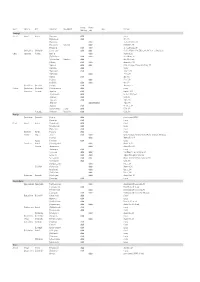
Table S1.Xlsx
Bone type Bone type Taxonomy Order/series Family Valid binomial Outdated binomial Notes Reference(s) (skeletal bone) (scales) Actinopterygii Incertae sedis Incertae sedis Incertae sedis †Birgeria stensioei cellular this study †Birgeria groenlandica cellular Ørvig, 1978 †Eurynotus crenatus cellular Goodrich, 1907; Schultze, 2016 †Mimipiscis toombsi †Mimia toombsi cellular Richter & Smith, 1995 †Moythomasia sp. cellular cellular Sire et al., 2009; Schultze, 2016 †Cheirolepidiformes †Cheirolepididae †Cheirolepis canadensis cellular cellular Goodrich, 1907; Sire et al., 2009; Zylberberg et al., 2016; Meunier et al. 2018a; this study Cladistia Polypteriformes Polypteridae †Bawitius sp. cellular Meunier et al., 2016 †Dajetella sudamericana cellular cellular Gayet & Meunier, 1992 Erpetoichthys calabaricus Calamoichthys sp. cellular Moss, 1961a; this study †Pollia suarezi cellular cellular Meunier & Gayet, 1996 Polypterus bichir cellular cellular Kölliker, 1859; Stéphan, 1900; Goodrich, 1907; Ørvig, 1978 Polypterus delhezi cellular this study Polypterus ornatipinnis cellular Totland et al., 2011 Polypterus senegalus cellular Sire et al., 2009 Polypterus sp. cellular Moss, 1961a †Scanilepis sp. cellular Sire et al., 2009 †Scanilepis dubia cellular cellular Ørvig, 1978 †Saurichthyiformes †Saurichthyidae †Saurichthys sp. cellular Scheyer et al., 2014 Chondrostei †Chondrosteiformes †Chondrosteidae †Chondrosteus acipenseroides cellular this study Acipenseriformes Acipenseridae Acipenser baerii cellular Leprévost et al., 2017 Acipenser gueldenstaedtii -
A Late Permian Ichthyofauna from the Zechstein Basin, Lithuania-Latvia Region
bioRxiv preprint doi: https://doi.org/10.1101/554998; this version posted February 20, 2019. The copyright holder for this preprint (which was not certified by peer review) is the author/funder, who has granted bioRxiv a license to display the preprint in perpetuity. It is made available under aCC-BY 4.0 International license. 1 A late Permian ichthyofauna from the Zechstein Basin, Lithuania-Latvia Region 2 3 Darja Dankina-Beyer1*, Andrej Spiridonov1,4, Ģirts Stinkulis2, Esther Manzanares3, 4 Sigitas Radzevičius1 5 6 1 Department of Geology and Mineralogy, Vilnius University, Vilnius, Lithuania 7 2 Chairman of Bedrock Geology, Faculty of Geography and Earth Sciences, University 8 of Latvia, Riga, Latvia 9 3 Department of Botany and Geology, University of Valencia, Valencia, Spain 10 4 Laboratory of Bedrock Geology, Nature Research Centre, Vilnius, Lithuania 11 12 *darja.dankina@gmail.com (DD-B) 13 14 Abstract 15 The late Permian is a transformative time, which ended in one of the most 16 significant extinction events in Earth’s history. Fish assemblages are a major 17 component of marine foods webs. The macroevolution and biogeographic patterns of 18 late Permian fish are currently insufficiently known. In this contribution, the late Permian 19 fish fauna from Kūmas quarry (southern Latvia) is described for the first time. As a 20 result, the studied late Permian Latvian assemblage consisted of isolated 21 chondrichthyan teeth of Helodus sp., ?Acrodus sp., ?Omanoselache sp. and 22 euselachian type dermal denticles as well as many osteichthyan scales of the 23 Haplolepidae and Elonichthydae; numerous teeth of Palaeoniscus, rare teeth findings of 1 bioRxiv preprint doi: https://doi.org/10.1101/554998; this version posted February 20, 2019. -

Geological Survey of Ohio
GEOLOGICAL SURVEY OF OHIO. VOL. I.—PART II. PALÆONTOLOGY. SECTION II. DESCRIPTIONS OF FOSSIL FISHES. BY J. S. NEWBERRY. Digital version copyrighted ©2012 by Don Chesnut. THE CLASSIFICATION AND GEOLOGICAL DISTRIBUTION OF OUR FOSSIL FISHES. So little is generally known in regard to American fossil fishes, that I have thought the notes which I now give upon some of them would be more interesting and intelligible if those into whose hands they will fall could have a more comprehensive view of this branch of palæontology than they afford. I shall therefore preface the descriptions which follow with a few words on the geological distribution of our Palæozoic fishes, and on the relations which they sustain to fossil forms found in other countries, and to living fishes. This seems the more necessary, as no summary of what is known of our fossil fishes has ever been given, and the literature of the subject is so scattered through scientific journals and the proceedings of learned societies, as to be practically inaccessible to most of those who will be readers of this report. I. THE ZOOLOGICAL RELATIONS OF OUR FOSSIL FISHES. To the common observer, the class of Fishes seems to be well defined and quite distin ct from all the other groups o f vertebrate animals; but the comparative anatomist finds in certain unusual and aberrant forms peculiarities of structure which link the Fishes to the Invertebrates below and Amphibians above, in such a way as to render it difficult, if not impossible, to draw the lines sharply between these great groups. -

Osteichthyes, Actinopterygii) from the Early Triassic of Northwestern Madagascar
Rivista Italiana di Paleontologia e Stratigrafia (Research in Paleontology and Stratigraphy) vol. 123(2): 219-242. July 2017 REDESCRIPTION OF ‘PERLEIDUS’ (OSTEICHTHYES, ACTINOPTERYGII) FROM THE EARLY TRIASSIC OF NORTHWESTERN MADAGASCAR GIUSEPPE MARRAMÀ1*, CRISTINA LOMBARDO2, ANDREA TINTORI2 & GIORGIO CARNEVALE3 1*Corresponding author. Department of Paleontology, University of Vienna, Geozentrum, Althanstrasse 14, 1090 Vienna, Austria. E-mail: marramag81@univie.ac.at 2Dipartimento di Scienze della Terra, Università degli Studi di Milano, Via Mangiagalli 34, I-20133 Milano, Italy. E-mail: cristina.lombardo@ unimi.it; andrea.tintori@unimi.it 3Dipartimento di Scienze della Terra, Università degli Studi di Torino, Via Valperga Caluso 35, I-10125 Torino, Italy. E-mail: giorgio.carnevale@ unito.it To cite this article: Marramà G., Lombardo C., Tintori A. & Carnevale G. (2017) - Redescription of ‘Perleidus’ (Osteichthyes, Actinopterygii) from the Early Triassic of northwestern Madagascar . Riv. It. Paleontol. Strat., 123(2): 219-242. Keywords: Teffichthys gen. n.; TEFF; Ankitokazo basin; geometric morphometrics; intraspecific variation; basal actinopterygians. Abstract. The revision of the material from the Lower Triassic fossil-bearing-nodule levels from northwe- stern Madagascar supports the assumption that the genus Perleidus De Alessandri, 1910 is not present in the Early Triassic. In the past, the presence of this genus has been reported in the Early Triassic of Angola, Canada, China, Greenland, Madagascar and Spitsbergen. More recently, it has been pointed out that these taxa may not be ascri- bed to Perleidus owing to several anatomical differences. The morphometric, meristic and morphological analyses revealed a remarkable ontogenetic and individual intraspecific variation among dozens of specimens from the lower Triassic of Ankitokazo basin, northwestern Madagascar and allowed to consider the two Malagasyan species P. -

Copyrighted Material
06_250317 part1-3.qxd 12/13/05 7:32 PM Page 15 Phylum Chordata Chordates are placed in the superphylum Deuterostomia. The possible rela- tionships of the chordates and deuterostomes to other metazoans are dis- cussed in Halanych (2004). He restricts the taxon of deuterostomes to the chordates and their proposed immediate sister group, a taxon comprising the hemichordates, echinoderms, and the wormlike Xenoturbella. The phylum Chordata has been used by most recent workers to encompass members of the subphyla Urochordata (tunicates or sea-squirts), Cephalochordata (lancelets), and Craniata (fishes, amphibians, reptiles, birds, and mammals). The Cephalochordata and Craniata form a mono- phyletic group (e.g., Cameron et al., 2000; Halanych, 2004). Much disagree- ment exists concerning the interrelationships and classification of the Chordata, and the inclusion of the urochordates as sister to the cephalochor- dates and craniates is not as broadly held as the sister-group relationship of cephalochordates and craniates (Halanych, 2004). Many excitingCOPYRIGHTED fossil finds in recent years MATERIAL reveal what the first fishes may have looked like, and these finds push the fossil record of fishes back into the early Cambrian, far further back than previously known. There is still much difference of opinion on the phylogenetic position of these new Cambrian species, and many new discoveries and changes in early fish systematics may be expected over the next decade. As noted by Halanych (2004), D.-G. (D.) Shu and collaborators have discovered fossil ascidians (e.g., Cheungkongella), cephalochordate-like yunnanozoans (Haikouella and Yunnanozoon), and jaw- less craniates (Myllokunmingia, and its junior synonym Haikouichthys) over the 15 06_250317 part1-3.qxd 12/13/05 7:32 PM Page 16 16 Fishes of the World last few years that push the origins of these three major taxa at least into the Lower Cambrian (approximately 530–540 million years ago). -
APS Bulletin June 1987
VOLUME 2, NUMBER 2 JUNE 1987 - 1 - ALBERTA PALAEONTOLOGICAL SOCIETY OFFICERS: President Wayne Braunberger 278-5154 Vice President Don Sabo 238-1190 Secretary Susan Lancaster 228-0773 Treasurer Les Adler 289-9972 DIRECTORS: Editor Geoffrey Barrett 246-8738 Education & Programs Don Sabo 238-1190 Membership & Fund RaisingIrene Markhasin 253-2860 Librarian Karen Weinhold 274-3576 Curator & Field Trip Co-ordinator Harvey Negrich 249-4497 Director at Large Dr. Michael C. Wilson 239-8289 The Society was incorporated in 1986, a non-profit organization formed to: A. Promote the science of palaeontology through study and education. B. Make contributions to the science by: 1) Discovery 2) Collection 3) Description, curation, and display 4) Education of the general public 5) Preserve material for study and the future C. Provide information and expertise to other collectors. D. Work with professionals at museums and universities to add to the palaeontological collections of the Province (preserve Alberta's heritage). MEMBERSHIP: Any person with a sincere interest in palaeontology is eligible to present their application for membership in the Society. Single Membership $10.00 annually Family or Institution $15.00 annually OUR BULLETIN WILL BE PUBLISHED QUARTERLY: March 1, June 1, September 1, and December 1 annually DEADLINE FOR SUBMITTING MATERIAL FOR PUBLICATION IS THE 15TH OF THE MONTH PRIOR TO PUBLICATION. Mailing Address: Alberta Palaeontological Society P. O. Box 7371, Station E Calgary, Alberta, Canada T3C 3M2 Meeting Room: Room 1032 (Rock Lab) Mount Royal College 4825 Richard Road S. W. Calgary, Alberta, Canada - 2 - PRESIDENT'S VIEWPOINT Wayne F. Braunberger Over the past several months, controversy has raged over several articles published in various newspapers and magazines on the subject of ammonites and mining. -
Copyrighted Material
06_250317 part1-3.qxd 12/13/05 7:32 PM Page 15 Phylum Chordata Chordates are placed in the superphylum Deuterostomia. The possible rela- tionships of the chordates and deuterostomes to other metazoans are dis- cussed in Halanych (2004). He restricts the taxon of deuterostomes to the chordates and their proposed immediate sister group, a taxon comprising the hemichordates, echinoderms, and the wormlike Xenoturbella. The phylum Chordata has been used by most recent workers to encompass members of the subphyla Urochordata (tunicates or sea-squirts), Cephalochordata (lancelets), and Craniata (fishes, amphibians, reptiles, birds, and mammals). The Cephalochordata and Craniata form a mono- phyletic group (e.g., Cameron et al., 2000; Halanych, 2004). Much disagree- ment exists concerning the interrelationships and classification of the Chordata, and the inclusion of the urochordates as sister to the cephalochor- dates and craniates is not as broadly held as the sister-group relationship of cephalochordates and craniates (Halanych, 2004). Many excitingCOPYRIGHTED fossil finds in recent years MATERIAL reveal what the first fishes may have looked like, and these finds push the fossil record of fishes back into the early Cambrian, far further back than previously known. There is still much difference of opinion on the phylogenetic position of these new Cambrian species, and many new discoveries and changes in early fish systematics may be expected over the next decade. As noted by Halanych (2004), D.-G. (D.) Shu and collaborators have discovered fossil ascidians (e.g., Cheungkongella), cephalochordate-like yunnanozoans (Haikouella and Yunnanozoon), and jaw- less craniates (Myllokunmingia, and its junior synonym Haikouichthys) over the 15 06_250317 part1-3.qxd 12/13/05 7:32 PM Page 16 16 Fishes of the World last few years that push the origins of these three major taxa at least into the Lower Cambrian (approximately 530–540 million years ago). -

A Hiatus Obscures the Early Evolution of Modern Lineages of Bony Fishes
Zurich Open Repository and Archive University of Zurich Main Library Strickhofstrasse 39 CH-8057 Zurich www.zora.uzh.ch Year: 2021 A Hiatus Obscures the Early Evolution of Modern Lineages of Bony Fishes Romano, Carlo Abstract: About half of all vertebrate species today are ray-finned fishes (Actinopterygii), and nearly all of them belong to the Neopterygii (modern ray-fins). The oldest unequivocal neopterygian fossils are known from the Early Triassic. They appear during a time when global fish faunas consisted of mostly cosmopolitan taxa, and contemporary bony fishes belonged mainly to non-neopterygian (“pale- opterygian”) lineages. In the Middle Triassic (Pelsonian substage and later), less than 10 myrs (million years) after the Permian-Triassic boundary mass extinction event (PTBME), neopterygians were already species-rich and trophically diverse, and bony fish faunas were more regionally differentiated compared to the Early Triassic. Still little is known about the early evolution of neopterygians leading up to this first diversity peak. A major factor limiting our understanding of this “Triassic revolution” isaninter- val marked by a very poor fossil record, overlapping with the Spathian (late Olenekian, Early Triassic), Aegean (Early Anisian, Middle Triassic), and Bithynian (early Middle Anisian) substages. Here, I review the fossil record of Early and Middle Triassic marine bony fishes (Actinistia and Actinopterygii) at the substage-level in order to evaluate the impact of this hiatus–named herein the Spathian–Bithynian gap (SBG)–on our understanding of their diversification after the largest mass extinction event of the past. I propose three hypotheses: 1) the SSBE hypothesis, suggesting that most of the Middle Triassic diver- sity appeared in the aftermath of the Smithian-Spathian boundary extinction (SSBE; 2 myrs after the PTBME), 2) the Pelsonian explosion hypothesis, which states that most of the Middle Triassic ichthyo- diversity is the result of a radiation event in the Pelsonian, and 3) the gradual replacement hypothesis, i.e. -
Fossils Provide Better Estimates of Ancestral Body Size Than Do Extant
Acta Zoologica (Stockholm) 90 (Suppl. 1): 357–384 (January 2009) doi: 10.1111/j.1463-6395.2008.00364.x FossilsBlackwell Publishing Ltd provide better estimates of ancestral body size than do extant taxa in fishes James S. Albert,1 Derek M. Johnson1 and Jason H. Knouft2 Abstract 1Department of Biology, University of Albert, J.S., Johnson, D.M. and Knouft, J.H. 2009. Fossils provide better Louisiana at Lafayette, Lafayette, LA estimates of ancestral body size than do extant taxa in fishes. — Acta Zoologica 2 70504-2451, USA; Department of (Stockholm) 90 (Suppl. 1): 357–384 Biology, Saint Louis University, St. Louis, MO, USA The use of fossils in studies of character evolution is an active area of research. Characters from fossils have been viewed as less informative or more subjective Keywords: than comparable information from extant taxa. However, fossils are often the continuous trait evolution, character state only known representatives of many higher taxa, including some of the earliest optimization, morphological diversification, forms, and have been important in determining character polarity and filling vertebrate taphonomy morphological gaps. Here we evaluate the influence of fossils on the interpretation of character evolution by comparing estimates of ancestral body Accepted for publication: 22 July 2008 size in fishes (non-tetrapod craniates) from two large and previously unpublished datasets; a palaeontological dataset representing all principal clades from throughout the Phanerozoic, and a macroecological dataset for all 515 families of living (Recent) fishes. Ancestral size was estimated from phylogenetically based (i.e. parsimony) optimization methods. Ancestral size estimates obtained from analysis of extant fish families are five to eight times larger than estimates using fossil members of the same higher taxa. -

Anewlatepermianray-Finned(Actinopterygian)Fishfrom the Beaufort Group, South Africa
Palaeont. afr., 38, 33-47 (2002) ANEWLATEPERMIANRAY-FINNED(ACTINOPTERYGIAN)FISHFROM THE BEAUFORT GROUP, SOUTH AFRICA by Patrick Bender Council for Geoscience, Private Bag X112, Pretoria, South Africa. e-mail: bender@nfi.co.za ABSTRACT A new genus and species of actinopterygian (ray-finned) fish, Kompasia delaharpei, is described from Late Permian (Tatarian) fluvio-lacustrine, siltstone dominated deposits within the lower Beaufort Group of South Africa. It is currently known from two localities on adjoining farms, Wilgerbosch and Ganora, both in the New Bethesda district of the Eastern Cape Karoo region. The fossils were recovered from an uncertain formation, possibly closely equivalent to the Balfour Formation, within the Dicynodon Assemblage Zone. Kompasia delaharpei differs from previously described early actinopterygians, including the recently described new lower Beaufort Group taxon Bethesdaichthys kitchingi, on the basis of a combination of skull and post cranial characters. The genus is characterised by: a uniquely shaped subrectangular posterior blade of the maxilla, a shortened dorsal limb of the preopercular, and a dermopterotic and dermosphenotic contacting the nasal; furthermore, the subopercular is equal to or longer than the opercular, the dorsal fin is situated in the posterior third of the body, slightly behind the position of the anal fin, and the anterior rnidflank scales exhibit a smooth dermal pattern or surface, with a number of faint ganoine ridges present parallel to the posterior and ventral scale margins. Kompasia appears to exhibit a relatively conservative morphology similar to that in the lower Beaufort Group taxon Bethesdaichthys kitchingi. As such, Kompasia is derived relative to stem-actinopterans such as Howqualepis, Mimia and Moythomasia, and also derived relative to earlier southern African Palaeozoic actinopterygians such as Mentzichthys jubbi and Namaichthys schroederi, but basal to stem-neopterygians such as Australosomus and Saurichthys. -

A New Actinopterygian Fish Species from the Late Permian Beaufort Group, South Africa
Palaeont. a.fr., 37, 25-40 (2001) A NEW ACTINOPTERYGIAN FISH SPECIES FROM THE LATE PERMIAN BEAUFORT GROUP, SOUTH AFRICA by Patrick Bender Council for Geoscience, Private Bag Xl12, Pretoria, South Africa. e-mail·bender@.?li:co.za ABSTRACT A new genus and species of actinopterygian (ray-finned) fish, Bethesdaichthys kitchingi, is described from the Tatarian, Late Permian, Lower Beaufort Group of South Africa. Bethesdaichthys is presently known from three localities, two in the New Bethesda and one in the Victoria West districts of the Karoo region respectively. The fossils were recovered from within the Abrahamskraal Formation Tapinocephalus Assemblage Zone at the Victoria West locality, and from an uncertain Formation possibly closely equivalent to the Balfour Formation, within the Dicynodon Assemblage Zone at the New Bethesda sites. Bethesdaichthys kitchingi is a fusiform fish, up to approximately 300mm in total length, with the skull displaying a moderately oblique suspensorium, and a maxilla with a large sub-rectangular postorbital blade. Furthermore there is a complex offour suborbital bones adjacent to the orbit. The pectoral fin is large relative to body size and the tail is heterocercal with an elongate tapered dorsal body lobe. The anterior midflank scales in particular exhibit a distinctive dermal ornamentation consisting of numerous ganoineridges. The phylogenetics and interrelationships of Bethesdaichthys kitchingiare examined. It appears to exhibit a relatively conservative morphology similar to that found in possibly related Carboniferous taxa such as the South African taxa Australichthysand Willomorichthys. Bethesdaichthys kitchingiis derived relative to stem-actinopterans such as the Howqualepis and Mimia, and also derived relative to southern African Palaeozoic actinoptyerygians such as Mentzichthys jubbl; and Namaichthys schroeden; but basal to stem neopterygians such as Australosomus, Perleldus and Saurichthys. -

Online Supplementary Material Feroxichthys Panzhouensis
Online Supplementary Material Feroxichthys panzhouensis sp. nov., a hump-backed colobodontid (Neopterygii, Actinopterygii) from the early Middle Triassic of Panzhou, Guizhou, China Table of Contents 1. Taxa and principal sources of data 2. Supplementary figure 3. Character list 4. Data matrix 5. References to supplementary information 1 1. Taxa and principal sources of data FMNH, Field Museum of Natural History, Chicago, USA IVPP, Institute of Vertebrate Paleontology and Paleoanthropology, Chinese Academy of Sciences, Beijing, China NHMUK, Natural History Museum, London, UK; PIMUZ, Paläontologisches Institut und Museum, Universität Zürich, Zürich, Switzerland Moythomasia durgaringa: Gardiner, 1984 Australosomus kochi: Nielsen, 1949; NHMUK P17141–17143, 17156, 17157, 17160, 17161, 20940–20945 Acipenser brevirostrum: Hilton et al., 2011 Amia calva: Grande and Bemis, 1998 Boreosomus piveteaui: Nielsen, 1942 Brookvalia gracilis: Hutchinson, 1973b Caturus furcatus: FMNH UC2057; Patterson, 1975; Grande and Bemis, 1998 Chondrosteus acipenseroides: Hilton and Forey, 2009 Cleithrolepidina minor: Hutchinson, 1973b Cleithrolepis granulate: Wade, 1935; Hutchinson, 1973b Colobodus baii: Sun et al., 2008; IVPP V19974 Colobodus bassanii: Mutter, 2002, 2004 Colobodus giganteus: Cartanyà et al., 2015 Crenilepis sandbergeri: Mutter, 2002, 2004 Ctenognathichthys bellottii: Bürgin, 1992 Daedalichthys higginsi: Hutchinson, 1973b Dipteronotus olgiatii: Tintori, 1990 Elops hawaiensis: Forey, 1973 Feroxichthys yunnanensis Xu, 2020 Fuyuanperleidus dengi: Geng