Frisians in Sioux County; from Heitellin to Homeland
Total Page:16
File Type:pdf, Size:1020Kb
Load more
Recommended publications
-
A Geological History of Groningen's Subsurface
A geological history of Groningen’s subsurface Erik Meijles, University of Groningen Date June 2015 Editors Jan van Elk & Dirk Doornhof Translated by E.L. Howard General introduction Ground acceleration caused by an induced earthquake is strongly dependent on the composition of local shallow soils. NAM commissioned Deltares to conduct a detailed survey of the shallow subsurface above the Groningen gas field. The survey focuses on Quaternary geology with an emphasis on the upper 50 metres. This report provides an introduction to Groningen’s Quaternary geology as a background to the comprehensive Deltares report, which has culminated in a detailed model of Groningen’s shallow subsurface. This report was written by Dr ir Erik Meijles, Assistant Professor of Physical Geography at the University of Groningen. Wim Dubelaar, Dr Jan Stafleu and Dr Wim Westerhoff of TNO Geological Survey of the Netherlands (TNO- NITG) in Utrecht assisted with editing this report and provided a number of key diagrams. Title A geological history of Groningen’s subsurface Date June 2015 Client NAM Author Erik Meijles, Assistant Professor Edited by Jan van Elk of Physical Geography and Dirk Doornhof Organization University of Groningen Organization NAM Significance for Research theme: earthquake Predicting ground acceleration research Explanation: Ground acceleration caused by an induced earthquake is strongly dependent on the composition of local shallow soils. NAM commissioned Deltares to conduct a detailed survey of the shallow subsurface above the Groningen gas field. This survey focuses on the Quaternary geology of Groningen with an emphasis on the upper 50 metres. Directly This research serves as background to the report entitled ‘Geological schematisation of related the shallow subsurface of Groningen’ written by various Deltares staff members. -

Veere Is in the South Western Part of the Netherlands: Zeeland
Veere Veere is in the south western part of the Netherlands: Zeeland. It is a province that consists of a number of islands (hence its name “sea land”) wherein a large portion of it is below sea level but ‘reclaimed’ over time from the sea by the locals as they formed man-made hills, dikes, and more. Which is called the Oosterscheldekering: the largest of the 13 Delta Works made by Netherlands. The name Veere means "ferry": Wolfert Van Borssele established a ferry and ferry house there in 1281. This ferry he called the "camper-veer" or "Ferry of Campu" which soon became known as "de Veer". That same year Wolfert built the castle Sandenburg on one of the dikes he had built. On 12 November 1282, Count Floris V. thereupon issued a charter by which Wolfert received the sovereignty to the land and castle with the ferry and ferry house. From that time on Wolfert was given the title of Lord Van der Veer. Veere received city rights in 1355. Veere has different inland marinas. A marina is a dock with moorings for small boats and yachts. Just beside the marina is The Grote Kerk (Big Church). The tower is somehow unfinished (dating back from 1348) as it was intended to be 3 times taller than it is now. Beside the church, there is a cistern (water reservoir) built in 1551 by the order of Maximilian of Bourgondy for the benefit of the Scottish wool merchants and this reservoir has a magnificent capacity of 2000 hectoliters (approx 45000 imp. -
Britain and the Dutch Revolt 1560–1700 Hugh Dunthorne Frontmatter More Information
Cambridge University Press 978-0-521-83747-7 - Britain and the Dutch Revolt 1560–1700 Hugh Dunthorne Frontmatter More information Britain and the Dutch Revolt 1560–1700 England’s response to the Revolt of the Netherlands (1568–1648) has been studied hitherto mainly in terms of government policy, yet the Dutch struggle with Habsburg Spain affected a much wider commu- nity than just the English political elite. It attracted attention across Britain and drew not just statesmen and diplomats but also soldiers, merchants, religious refugees, journalists, travellers and students into the confl ict. Hugh Dunthorne draws on pamphlet literature to reveal how British contemporaries viewed the progress of their near neigh- bours’ rebellion, and assesses the lasting impact which the Revolt and the rise of the Dutch Republic had on Britain’s domestic history. The book explores affi nities between the Dutch Revolt and the British civil wars of the seventeenth century – the fi rst major challenges to royal authority in modern times – showing how much Britain’s chang- ing commercial, religious and political culture owed to the country’s involvement with events across the North Sea. HUGH DUNTHORNE specializes in the history of the early modern period, the Dutch revolt and the Dutch republic and empire, the his- tory of war, and the Enlightenment. He was formerly Senior Lecturer in History at Swansea University, and his previous publications include The Enlightenment (1991) and The Historical Imagination in Nineteenth-Century Britain and the Low Countries -

A Concise History of Relationships Between Two Related but Separated Denominations: the Reformed Church in America and the Christian Reformed Church in North America
A CONCISE HISTORY OF RELATIONSHIPS BETWEEN TWO RELATED BUT SEPARATED DENOMINATIONS: THE REFORMED CHURCH IN AMERICA AND THE CHRISTIAN REFORMED CHURCH IN NORTH AMERICA The focus of this essay is on the interactions between two denominations whose roots in this country have different depths, but whose roots in the Netherlands extend all the way back to the Synod of Dort in 1618–1619; indeed, they extend back through John Calvin to the very beginning of Christianity. Some members of the Reformed Church in America (RCA) and most members of the Christian Reformed Church in North America (CRCNA) are also rooted in the Afscheiding (Secession) of 1834, so they share a heritage of secession from established churches. The Reformed Church in America, known as the Reformed Protestant Dutch Church (RPDC) prior to 1867, identifies 1628 as its date of origin, whereas the CRCNA views 1857 as its founding date. The latter date is the point at which our historical narrative begins, since the founding congregations of the CRCNA withdrew from the RPDC at that time. This account will reveal both tensions and collegiality between the denominations across the years. Secession of 1857 Ten years after the Reformed immigrants from the Netherlands and Germany settled in West Michigan and Iowa, four congregations with approximately three hundred families and two ministers seceded from their kin to form a new denomination. The specific issues cited in 1857 were the use of hymns in formal worship services, the lack of consistent catechetical instruction for young people, and the practice of open communion. Ten years later the question of church members belonging to secret, oath-bound societies further divided the two, because the RCA left the question of membership to local consistories, whereas the CRCNA forbade it. -
Putting Frisian Names on the Map
GEGN.2/2021/68/CRP.68 15 March 2021 English United Nations Group of Experts on Geographical Names Second session New York, 3 – 7 May 2021 Item 12 of the provisional agenda * Geographical names as culture, heritage and identity, including indigenous, minority and regional languages and multilingual issues Putting Frisian names on the map Submitted by the Netherlands** * GEGN.2/2021/1 ** Prepared by Jasper Hogerwerf, Kadaster GEGN.2/2021/68/CRP.68 Introduction Dutch is the national language of the Netherlands. It has official status throughout the Kingdom of the Netherlands. In addition, there are several other recognized languages. Papiamentu (or Papiamento) and English are formally used in the Caribbean parts of the Kingdom, while Low-Saxon and Limburgish are recognized as non-standardized regional languages, and Yiddish and Sinte Romani as non-territorial minority languages in the European part of the Kingdom. The Dutch Sign Language is formally recognized as well. The largest minority language is (West) Frisian or Frysk, an official language in the province of Friesland (Fryslân). Frisian is a West Germanic language closely related to the Saterland Frisian and North Frisian languages spoken in Germany. The Frisian languages as a group are closer related to English than to Dutch or German. Frisian is spoken as a mother tongue by about 55% of the population in the province of Friesland, which translates to some 350,000 native speakers. In many rural areas a large majority speaks Frisian, while most cities have a Dutch-speaking majority. A standardized Frisian orthography was established in 1879 and reformed in 1945, 1980 and 2015. -

Information Communicated by Member States Regarding State Aid
Information communicated by Member States regarding State aid granted under Commission Regulation (EC) No 800/2008 of 6 August 2008 declaring certain categories of aid compatible with the common market in application of Articles 87 and 88 of the Treaty (General block exemption Regulation)(Text with EEA relevance) Aid number SA.39243 (2014/X) Member State Netherlands Member State reference number Name of the Region (NUTS) ACHTERHOEK, AGGLOM. LEIDEN EN BOLLENST., AGGLOM. HAARLEM, AGGLOM.'S-GRAVENHAGE, ALKMAAR E.O., ARNHEM/NIJMEGEN, DELFT EN WESTLAND, DELFZIJL E.O., DRENTHE, FLEVOLAND, FRIESLAND, GELDERLAND, GRONINGEN, GROOT-AMSTERDAM, GROOT-RIJNMOND, HET GOOI EN VECHTSTREEK, IJMOND, KOP VAN NOORD-HOLLAND, LIMBURG (NL), MIDDEN-LIMBURG, MIDDEN-NOORD-BRABANT, NOORD-BRABANT, NOORD-DRENTHE, NOORD-FRIESLAND, NOORD-HOLLAND, NOORD-LIMBURG, NOORD-NEDERLAND, NOORD-OVERIJSSEL, NOORDOOST-NOORD-BRABANT, OOST ZUID-HOLLAND, OOST-GRONINGEN, OOST-NEDERLAND, OVERIG GRONINGEN, OVERIG ZEELAND, OVERIJSSEL, TWENTE, UTRECHT, VELUWE, WEST-NEDERLAND, WEST-NOORD-BRABANT, ZAANSTREEK, ZEELAND, ZEEUWSCH-VLAANDEREN, ZUID-HOLLAND, ZUID-LIMBURG, ZUID-NEDERLAND, ZUIDOOST ZUID-HOLLAND, ZUIDOOST-DRENTHE, ZUIDOOST-FRIESLAND, ZUIDOOST-NOORD-BRABANT, ZUIDWEST-DRENTHE, ZUIDWEST-FRIESLAND, ZUIDWEST-GELDERLAND, ZUIDWEST-OVERIJSSEL Non-assisted areas Granting authority Ministerie van Economische Zaken Postbus 20401, 2500EK, Den Haag, Nederland Title of the aid measure SEED Capital regeling National legal basis (Reference to the relevant Artikel 2 Kaderwet EZ-subsidies Regeling -

A FRISIAN MODEL Henryk Sjaardema
THE INDIVIDUATED SOCIETY: A FRISIAN MODEL Henryk Sjaardema Preface It has long seemed to me that the dynamic of human activity is directly related to ecological variables within the society. It is the intimate rela- tionship of-the individual to the requirements of his society that not only channels human energies, but provides a framework for value orientations as well. It is as if society were a vast complex of machinery and man the kinetic force driving it. As machinery falls into social disuse, malfunction and inoperation, man must turn to new or alternative avenues or see his kinetic energy fall into disuse. When the crucial social machinery becomes patterned and routinized a surplus of human energy is made available. The stable society has a way of rechanneling these energies into other roles. Where these addi- tional roles are not present-where energy becomes constricted--social revolu- tions transpire. This study has been directed toward one socio-economic segment of Western man in which the role of the individual has been measured against the ecological requirements of the society. This pilot study is an attempt to probe variables which seem crucial to the rise of the individuated society. Introduction Purpose. To investigate the individuated basis for Frisian society. If the total society can be considered in its broadest sense, as a social configuration which transcends the normal limits of thinking built into political conceptions of the totalitarian state, my meaning will be made clear- er. This social configuration is one which places the requirements of the commun'ity on all levels above that of the commnity's individual constituents. -
The Netherlands 6
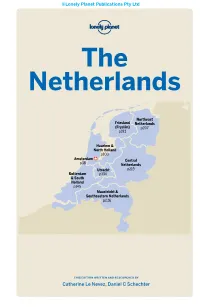
©Lonely Planet Publications Pty Ltd The Netherlands Northeast Friesland Netherlands (Fryslân) p207 p193 Haarlem & North Holland p100 #_ Amsterdam Central p38 Netherlands Utrecht p219 Rotterdam p134 & South Holland p145 Maastricht & Southeastern Netherlands p236 THIS EDITION WRITTEN AND RESEARCHED BY Catherine Le Nevez, Daniel C Schechter PLAN YOUR TRIP ON THE ROAD Welcome to the AMSTERDAM . 38 Texel . 121 Netherlands . 4 Muiden . 129 The Netherlands’ Map . 6 HAARLEM & NORTH Het Gooi . 130 The Netherlands’ HOLLAND . 100 Flevoland . 132 Top 10 . .. 8 North Holland . 102 Lelystad . 132 Need to Know . 14 Haarlem . 102 Urk . 133 Around Haarlem . 107 What’s New . 16 Zaanse Schans . 107 UTRECHT . 134 If You Like… . 17 Waterland Region . 108 Utrecht City . 135 Month by Month . 20 Alkmaar . 112 Around Utrecht City . 142 Itineraries . 23 Broek op Langedijk . 115 Kasteel de Haar . 142 Hoorn . 116 Utrechtse Heuvelrug Cycling in National Park . 142 the Netherlands . 26 Enkhuizen . 118 Medemblik . 120 Amersfoort . 143 Travel with Children . 31 Den Helder . 121 Oudewater . 144 Regions at a Glance . 34 STEVEN SWINNEN / GETTY IMAGES © IMAGES GETTY / SWINNEN STEVEN JEAN-PIERRE LESCOURRET / GETTY IMAGES © IMAGES GETTY / LESCOURRET JEAN-PIERRE CUBE HOUSES, ROTTERDAM P148 AMOSS / LONELY PLANET © PLANET LONELY / AMOSS DUTCH TULIPS P255 BRIDGE OVER SINGEL CANAL, AMSTERDAM P73 Contents UNDERSTAND ROTTERDAM Northwest Groningen . 215 The Netherlands & SOUTH Hoogeland . 215 Today . 252 HOLLAND . 145 Bourtange . 216 History . 254 South Holland . 147 Drenthe . 217 The Dutch Rotterdam . 147 Assen . 217 Way of Life . 264 Around Rotterdam . 161 Kamp Westerbork . 218 Dutch Art . 269 Dordrecht . 162 Dwingelderveld Architecture . 276 Biesbosch National Park . 218 National Park . 165 The Dutch Slot Loevestein . -

A Short History of Holland, Belgium and Luxembourg
A Short History of Holland, Belgium and Luxembourg Foreword ............................................................................2 Chapter 1. The Low Countries until A.D.200 : Celts, Batavians, Frisians, Romans, Franks. ........................................3 Chapter 2. The Empire of the Franks. ........................................5 Chapter 3. The Feudal Period (10th to 14th Centuries): The Flanders Cloth Industry. .......................................................7 Chapter 4. The Burgundian Period (1384-1477): Belgium’s “Golden Age”......................................................................9 Chapter 5. The Habsburgs: The Empire of Charles V: The Reformation: Calvinism..........................................10 Chapter 6. The Rise of the Dutch Republic................................12 Chapter 7. Holland’s “Golden Age” ..........................................15 Chapter 8. A Period of Wars: 1650 to 1713. .............................17 Chapter 9. The 18th Century. ..................................................20 Chapter 10. The Napoleonic Interlude: The Union of Holland and Belgium. ..............................................................22 Chapter 11. Belgium Becomes Independent ...............................24 Chapter 13. Foreign Affairs 1839-19 .........................................29 Chapter 14. Between the Two World Wars. ................................31 Chapter 15. The Second World War...........................................33 Chapter 16. Since the Second World War: European Co-operation: -

Descendants of Willem Van Regenmorter Five Generations
Lem H. Rainwater, Dec 2001, LemHRainwater@aol.com Descendants of Willem Van Regenmorter Five Generations Generation No. 1 1 1. WILLEM VAN REGENMORTER was born Abt. 1680 in Ouddorp, Zuid-Holland, Nederland ?. He married KRIJNTJE JANSDR JOOS 10 November 1710 in Ouddorp, Zuid-Holland, Nederland. She was born Abt. 1684 in Ouddorp, Zuid-Holland, Nederland ?. Child of WILLEM VAN REGENMORTER and KRIJNTJE JOOS is: 2. i. PIETER2 VAN REGENMORTER, b. 23 July 1713, Ouddorp, Zuid-Holland, Nederland. Generation No. 2 2 1 2. PIETER VAN REGENMORTER (WILLEM ) was born 23 July 1713 in Ouddorp, Zuid-Holland, Nederland. He 1 married NEELTJE DERKSDR WITTE 05 July 1744 in Goedereede, Zuid-Holland, Nederland , daughter of DERK WITTE and LIJNTJE VAN WAAGE. She was born 27 January 1719/20 in Goedereede, Zuid-Holland, Nederland. Child of PIETER VAN REGENMORTER and NEELTJE WITTE is: 3. i. WILLEM3 VAN REGENMORTER, b. 17 December 1752, Goedereede, Zuid-Holland, Nederland; d. 23 September 1815, Ouddorp, Zuid-Holland, Nederland. Generation No. 3 3 2 1 3. WILLEM VAN REGENMORTER (PIETER , WILLEM ) was born 17 December 1752 in Goedereede, Zuid-Holland, Nederland, and died 23 September 1815 in Ouddorp, Zuid-Holland, Nederland. He married ARENTJE VAN OOSTVOOREN 28 March 1784 in Sommilsdijk, Zuid-Holland, Nederland, daughter of MELGER VAN OOSTVOOREN and AGENIETJE MUIJEN. She was born 14 February 1762 in Sommilsdijk, Zuid-Holland, Nederland, and died 02 February 1841 in Ouddorp, Zuid-Holland, Nederland. Children of WILLEM VAN REGENMORTER and ARENTJE VAN OOSTVOOREN are: i. NEELTJE4 VAN REGENMORTER, b. 15 October 1786, Goedereede, Zuid-Holland, Nederland; m. ARIE VAN DER HOVEN, 05 May 1815, Goedereede, Zuid-Holland, Nederland2. -

Airborne Geophysical Investigations of CLIWAT Pilot Areas – Survey Area
B. Siemon,A. Ullmann, M. Ibs-von Seht, W. Voß, J. Pielawa Airborne Geophysical Investigations of CLIWAT Pilot Areas Survey Area Friesland, The Netherlands, 2009 Interreg IVB Project: CLIWAT – Adaptive and sustainable water management and protection of society and nature in an extreme climate Bundesanstalt für Geowissenschaften und Rohstoffe Federal Institute for Geosciences and Natural Resources CLIWAT – Adaptive and sustainable water management and protection of society and nature in an extreme climate Survey Area Friesland, The Netherlands 2009 Technical Report on the Interreg IVB Project The project is part-financed by the European Union In Cooperation with TNO Deltares Wetterskip Fryslân Provincje Fryslân Authors: B. Siemon A. Ullmann M. Ibs-von Seht W. Voß J. Pielawa Date: December 15, 2010 Airborne Geophysical Investigations of CLIWAT Pilot Areas – I – Survey Area Friesland, The Netherlands, 2009 Table of contents Personnel ....................................................................................................................... III List of figures .................................................................................................................. IV List of tables .....................................................................................................................V List of maps .................................................................................................................... VI List of vertical resistivity sections ................................................................................. -

Public Transportation “Made by OV- Bureau” How Do We Do It ?
Public Transportation “Made by OV- bureau” How do we do it ? London 2017, June 8th ir. Erwin Stoker Manager PT development Outline Introduction • Public transportation in the Netherlands • Public transportation in Groningen Drenthe • Franchising history Cases 1. Joint development and business cases 2. Buses 3. Bus depots 4. Personnel 5. Concession Management 6. OV-chipcard and national datawarehouse public transportation I won’t bite ! Concession = Franchise Public transportation in the Netherlands PT in the Netherlands National railways (Main network) Operator: - NS Nederlandse Spoorwegen - 100% public company - Negotiated contract 2015-2025 - Ministry of Infrastructure and Environment Tracks: - Prorail - 100% public company - Negotiated contract 2015-2025 - Maintenance and extensions - Ministry of Infrastructure and Environment PT in the Netherlands: Regional PT 14 responsible public bodies - 12 provinces - Rotterdam/The Hague - Amsterdam Modes: - Regional rail - Metro - Tram - Bus Responsible for tracks/road: - Local or regional road administration Wet Personenvervoer 2000 (PT bill 2000) - Privatisation of (former) provincial and city public transport (bus) companies - Obligation for PTA to franchise all public transportation from 2000 - Exclusive right for 1 operator in a certain area or on a certain line PT in the Netherlands: PT franchises (2017) All bus contracts franchised (Except Rotterdam/The Hague and Amsterdam: negotiated contract) Public transportation in Groningen and Drenthe Population Groningen 570.000 (City of Groningen