Acrididae: Orthoptera)
Total Page:16
File Type:pdf, Size:1020Kb
Load more
Recommended publications
-

Mottled Grasshopper Translocation to Sand Dunes in Essex, England
The designation of geographical entities in this book, and the presentation of the material, do not imply the expression of any opinion whatsoever on the part of IUCN or any of the funding organizations concerning the legal status of any country, territory, or area, or of its authorities, or concerning the delimitation of its frontiers or boundaries. The views expressed in this publication do not necessarily reflect those of IUCN. Published by: IUCN/SSC Re-introduction Specialist Group & Environment Agency-ABU DHABI Copyright: © 2011 International Union for the Conservation of Nature and Natural Resources Citation: Soorae, P. S. (ed.) (2011). Global Re-introduction Perspectives: 2011. More case studies from around the globe. Gland, Switzerland: IUCN/SSC Re-introduction Specialist Group and Abu Dhabi, UAE: Environment Agency-Abu Dhabi. xiv + 250 pp. ISBN: 978-2-8317-1432-5 Cover photo: Clockwise starting from top-left: i. Mountain yellow-legged frog © Adam Backlin ii. American alligator © Ruth Elsey iii. Dwarf eelgrass © Laura Govers, RU Nijmegen iv. Mangrove finch © Michael Dvorak BirdLife Austria v. Berg-Breede whitefish © N. Dean Impson vi. Zanzibar red colobus monkey © Tom Butynski & Yvonne de Jong Cover design & layout by: Pritpal S. Soorae, IUCN/SSC Re-introduction Specialist Group Produced by: IUCN/SSC Re-introduction Specialist Group & Environment Agency-ABU DHABI Download at: www.iucnsscrsg.org iii Invertebrates Mottled grasshopper translocation to sand dunes in Essex, England Tim Gardiner Environment Agency, Fisheries, Recreation & Biodiversity (FRB), Iceni House, Cobham Road, Ipswich, Suffolk, IP3 9JD, UK tim.gardiner@environment-agency.gov.uk Introduction The mottled grasshopper (Myrmeleotettix maculatus (Orthoptera: Acrididae)) is widely distributed, but not necessarily common, throughout mainland Britain. -

Transmission Rates of the B Chromosome of Myrmeleote7tix Maculatus (Orthoptera: Acrididae) M
Heredity (1984), 53 (2), 259—268 1984. The Genetical Society of Great Britain THEEFFECT OF TEMPERATURE ON MEIOTIC TRANSMISSION RATES OF THE B CHROMOSOME OF MYRMELEOTE7TIX MACULATUS (ORTHOPTERA: ACRIDIDAE) M. W. SHAW* AND G. M. HEWIU School of Biological Sciences, University of East Anglia, Norwich NR3 7 TJ, U. K. Received19.xii.83 SUMMARY Meiotic drive of B-chromosomes in Myrmeleotettix maculatus females decreased slightly during the course of egg-laying but was not detectably different under different temperature regimes. A proportion of males, however, showed substan- tially reduced transmission of the B chromosome when maintained at lower temperatures. This could explain some of the geographic variation in B chromo- some frequency that has been observed. 1. INTRODUCTION The B chromosome polymorphism of the heathiand grasshopper Myr- meleotettix maculatus is restricted to the southern and central parts of the U.K., although the animal itself is much more widespread (e.g., Hewitt and John, 1967). This restricted range may be due in part to historical and geographical accidents—there is evidence that in at least one part of the boundary of the B chromosome distribution the B may still be spreading (Shaw, 1983). However, it is also likely that the equilibrium B frequency varies from place to place. For example, Hewitt and Ruscoe (1971) examined both microclimatic variables and B frequency in a series of populations along a 1 km transect in the Welsh hills near Aberystwyth. It was clear that where the microclimate was cooler, the B frequency was lower. This suggests that the B might be restricted to the southern U.K. -
About the Book the Format Acknowledgments
About the Book For more than ten years I have been working on a book on bryophyte ecology and was joined by Heinjo During, who has been very helpful in critiquing multiple versions of the chapters. But as the book progressed, the field of bryophyte ecology progressed faster. No chapter ever seemed to stay finished, hence the decision to publish online. Furthermore, rather than being a textbook, it is evolving into an encyclopedia that would be at least three volumes. Having reached the age when I could retire whenever I wanted to, I no longer needed be so concerned with the publish or perish paradigm. In keeping with the sharing nature of bryologists, and the need to educate the non-bryologists about the nature and role of bryophytes in the ecosystem, it seemed my personal goals could best be accomplished by publishing online. This has several advantages for me. I can choose the format I want, I can include lots of color images, and I can post chapters or parts of chapters as I complete them and update later if I find it important. Throughout the book I have posed questions. I have even attempt to offer hypotheses for many of these. It is my hope that these questions and hypotheses will inspire students of all ages to attempt to answer these. Some are simple and could even be done by elementary school children. Others are suitable for undergraduate projects. And some will take lifelong work or a large team of researchers around the world. Have fun with them! The Format The decision to publish Bryophyte Ecology as an ebook occurred after I had a publisher, and I am sure I have not thought of all the complexities of publishing as I complete things, rather than in the order of the planned organization. -
The Transcriptomic and Genomic Architecture of Acrididae Grasshoppers
The Transcriptomic and Genomic Architecture of Acrididae Grasshoppers Dissertation To Fulfil the Requirements for the Degree of “Doctor of Philosophy” (PhD) Submitted to the Council of the Faculty of Biological Sciences of the Friedrich Schiller University Jena by Bachelor of Science, Master of Science, Abhijeet Shah born on 7th November 1984, Hyderabad, India 1 Academic reviewers: 1. Prof. Holger Schielzeth, Friedrich Schiller University Jena 2. Prof. Manja Marz, Friedrich Schiller University Jena 3. Prof. Rolf Beutel, Friedrich Schiller University Jena 4. Prof. Frieder Mayer, Museum für Naturkunde Leibniz-Institut für Evolutions- und Biodiversitätsforschung, Berlin 5. Prof. Steve Hoffmann, Leibniz Institute on Aging – Fritz Lipmann Institute, Jena 6. Prof. Aletta Bonn, Friedrich Schiller University Jena Date of oral defense: 24.02.2020 2 Table of Contents Abstract ........................................................................................................................... 5 Zusammenfassung............................................................................................................ 7 Introduction ..................................................................................................................... 9 Genetic polymorphism ............................................................................................................. 9 Lewontin’s paradox ....................................................................................................................................... 9 The evolution -

The Cytology of Tasmanian Short-Horned Grasshoppers ( Orthoptera: Acridoidea)
PAP. & PROC. ROY. Soc. TASMANIA. VOL. 86. (15TH SEPTEMBER. 1952.) The Cytology of Tasmanian Short-Horned Grasshoppers ( Orthoptera: Acridoidea) By G. B. SHARMAN Department of Botany, University of Tasmania* WITH 1 PLATE AND 57 TEXT FIGURES SUMMARY The cytology of twenty-six of the twenty-nine species of short-horned grass hoppers (superfamily Acridoidea) recorded from Tasmania is described. Intra specific cytological polymorphism is described in some species. Cytological evidence of phylogenetic relationships has been indicated where possible. INTRODUCTION Mainly because of their large size, and general suitability for cyto logical study the chromosomes of the short-horned grasshoppers (super family Acridoidea) have been the subject of wide research. In the largest and most widely studied family, the Acrididae, early workers (McClung, 1905; Davis, 1908) reported the male number as being uniformly twenty three rod-shaped chromosomes, but Granata (1910) showed that Pam phagus possessed nineteen rod-shaped chromosomes. With few exceptions an XO sex chromosome sy~tem is found. Later work has shown that one group of subfamilies of the Acrididae is characterised by the male diploid number of· nineteen rod-shaped chromosomes, whilst another and larger group is characterised by the male diploid number of twenty-three. These are usually called the ten and twelve chromosome groups, and correspond to the Chasmosacci and Cryptosacci groups of subfamilies (Roberts, 1941). Cytologically the Chasmosacci is a very uniform group as has been shown by Rao (1937) and Powers (1942). The twelve chromosome group, how ever, has some cytological variability. In more than forty genera the characteristic male diploid chromosome number of twenty-three is found (White, 1945) ; but" centric fusions" (White, 1945) have been responsible for lowering the chromosome number of some species, although the characteristic twenty-three arms are still found. -

An Illustrated Key of Pyrgomorphidae (Orthoptera: Caelifera) of the Indian Subcontinent Region
Zootaxa 4895 (3): 381–397 ISSN 1175-5326 (print edition) https://www.mapress.com/j/zt/ Article ZOOTAXA Copyright © 2020 Magnolia Press ISSN 1175-5334 (online edition) https://doi.org/10.11646/zootaxa.4895.3.4 http://zoobank.org/urn:lsid:zoobank.org:pub:EDD13FF7-E045-4D13-A865-55682DC13C61 An Illustrated Key of Pyrgomorphidae (Orthoptera: Caelifera) of the Indian Subcontinent Region SUNDUS ZAHID1,2,5, RICARDO MARIÑO-PÉREZ2,4, SARDAR AZHAR AMEHMOOD1,6, KUSHI MUHAMMAD3 & HOJUN SONG2* 1Department of Zoology, Hazara University, Mansehra, Pakistan 2Department of Entomology, Texas A&M University, College Station, TX, USA 3Department of Genetics, Hazara University, Mansehra, Pakistan �khushisbs@yahoo.com; https://orcid.org/0000-0003-4425-4742 4Department of Ecology & Evolutionary Biology, University of Michigan, Ann Arbor, MI, USA �pselliopus@yahoo.com.mx; https://orcid.org/0000-0002-0566-1372 5 �sundus_zahid@hotmail.com; https://orcid.org/0000-0001-8986-3459 6 �banianhu@gmail.com; https://orcid.org/0000-0003-4121-9271 *Corresponding author. �hsong@tamu.edu; https://orcid.org/0000-0001-6115-0473 Abstract The Indian subcontinent is known to harbor a high level of insect biodiversity and endemism, but the grasshopper fauna in this region is poorly understood, in part due to the lack of appropriate taxonomic resources. Based on detailed examinations of museum specimens and high-resolution digital images, we have produced an illustrated key to 21 Pyrgomorphidae genera known from the Indian subcontinent. This new identification key will become a useful tool for increasing our knowledge on the taxonomy of grasshoppers in this important biogeographic region. Key words: dichotomous key, gaudy grasshoppers, taxonomy Introduction The Indian subcontinent is known to harbor a high level of insect biodiversity and endemism (Ghosh 1996), but is also one of the most poorly studied regions in terms of biodiversity discovery (Song 2010). -

Myrmeleotettix Bolivar (Orthoptera, Gomphocerinae)
Zootaxa 2917: 29–47 (2011) ISSN 1175-5326 (print edition) www.mapress.com/zootaxa/ Article ZOOTAXA Copyright © 2011 · Magnolia Press ISSN 1175-5334 (online edition) Myrmeleotettix Bolivar (Orthoptera, Gomphocerinae) in Anatolia on the basis of morphological and behavioural characters: data suggest a new species from southern end of the Anatolian refugium DENIZ SIRIN1, ABBAS MOL2 & BATTAL CIPLAK3,4 1Department of Biology, Faculty of Art & Science, Namik Kemal University 59030 Tekirdağ, Turkey. E-mail: dsirin19@gmail.com 2Guzelyurt Vocational School, Aksaray University, Guzelyurt, Aksaray, Turkey. E-mail: abbasmol19@gmail.com 3Department of Biology, Faculty of Science, Akdeniz University 07058 Antalya, Turkey. E-mail:ciplak@akdeniz.edu.tr 4Corresponding author Abstract Myrmeleotettix Bolivar, 1914 (Orthoptera, Acrididae, Gomphocerinae) is a genus represented by nine species in the whole Palaearctic. It is poorly known in Anatolia except some records of M. maculatus. As for the other glacial refugia, cold preferring members of this genus are discontinuously distributed on high altitudes in Anatolia. Additionally, morphology is not sufficiently useful in taxonomy of gomphocerinae members for those producing a complicate courtship song. Thus an accurate taxonomy requires extensive materials and different character sources. In this study, the taxonomy of Anato- lian Myrmeleotettix is reexamined on the basis of qualitative and morphometric morphology, and male calling and court- ship songs. Song and morphology both suggest the existence of two species in Anatolia. The first is M. maculatus (Thunberg) which is distributed along the northern one-third of Anatolia in addition to other parts of West Palaearctic. The second is a new species, Myrmeleotettix ethicus sp. n. possibly endemic to the southwest corner of Anatolia. -
Grasshoppers
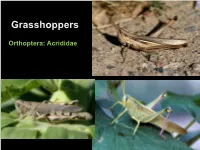
Grasshoppers Orthoptera: Acrididae Plains Lubber Pictured grasshoppers Great crested grasshopper Snakeweed grasshoppers Primary Pest Grasshoppers • Migratory grasshopper • Twostriped grasshopper • Differential grasshopper • Redlegged grasshopper • Clearwinged grasshopper Twostriped Grasshopper, Melanoplus bivittatus Redlegged Grasshopper, Melanoplus femurrubrum Differential Grasshopper, Melanoplus differentialis Migratory Grasshopper, Melanoplus sanguinipes Clearwinged Grasshopper Camnula pellucida Diagram courtesy of Alexandre Latchininsky, University of Wyoming Photograph courtesy of Jean-Francoise Duranton, CIRAD Grasshoppers lay pods of eggs below ground Grasshopper Egg Pods Molting is not for wimps! Grasshopper Nymphs Some grasshoppers found in winter and early spring Velvet-striped grasshopper – a common spring species Grasshopper Controls • Weather (rainfall mediated primarily) • Natural enemies – Predators, diseases • Treatment of breeding areas • Biological controls • Row covers Temperature and rainfall are important mortality factors Grasshoppers and Rainfall Moisture prior to egg hatch generally aids survival – Newly hatched young need succulent foliage Moisture after egg hatch generally reduces problems – Assists spread of diseases – Allows for plenty of food, reducing competition for rangeland and crops Grasshopper predators Robber Flies Larvae of many blister beetles develop on grasshopper egg pods Blister beetle larva Fungus-killed Grasshoppers Pathogen: Entomophthora grylli Mermis nigrescens, a nematode parasite of grasshoppers -
Tetrigidae (Orthoptera) with Partly Exposed Wings
University of Nebraska - Lincoln DigitalCommons@University of Nebraska - Lincoln Center for Systematic Entomology, Gainesville, Insecta Mundi Florida March 1990 Tetrigidae (Orthoptera) With Partly Exposed Wings R. E. Blackith Trinity College, Dublin, Ireland Follow this and additional works at: https://digitalcommons.unl.edu/insectamundi Part of the Entomology Commons Blackith, R. E., "Tetrigidae (Orthoptera) With Partly Exposed Wings" (1990). Insecta Mundi. 391. https://digitalcommons.unl.edu/insectamundi/391 This Article is brought to you for free and open access by the Center for Systematic Entomology, Gainesville, Florida at DigitalCommons@University of Nebraska - Lincoln. It has been accepted for inclusion in Insecta Mundi by an authorized administrator of DigitalCommons@University of Nebraska - Lincoln. Vol. 4, No. 1-4, March-December 1990 87 Tetrigidae (Orthoptera) With Partly Exposed Wings R. E Blackith Zoology Department Trinity College Dublin-2 Ireland Abstract in this respect, and it is no longer reasonable to be satisfied with putative alary polymorphism Long series of some species of Tetrigidae as an explanation of the phenomenon of exposed from south Asia show that the wings regularly wings. Where alary polymorphism exits, as in project beyond the pronotal shield by some 15- Hedotettix gracilis Bolivar, we still need to 35 percent of their leilgth, depending on the address the question of why such exposed wings species. There is little intraspecific variation are built in as one pole of the polymorphism. and alary polymorphism is not normally detect- For instance, 119 Taiwanese specimens of able. The role of such exposed wings is dis- Paratettix cingalensis (Walker) from the Lyman cussed and one new species is described. -

Examining the Role of Cave Crickets (Rhaphidophoridae) in Central Texas Cave Ecosystems: Isotope Ratios (Δ13c, Δ15n) and Radio Tracking
Final Report Examining the Role of Cave Crickets (Rhaphidophoridae) in Central Texas Cave Ecosystems: Isotope Ratios (δ13C, δ15N) and Radio Tracking Steven J. Taylor1, Keith Hackley2, Jean K. Krejca3, Michael J. Dreslik 1, Sallie E. Greenberg2, and Erin L. Raboin1 1Center for Biodiversity Illinois Natural History Survey 607 East Peabody Drive Champaign, Illinois 61820 (217) 333-5702 sjtaylor@inhs.uiuc.edu 2 Isotope Geochemistry Laboratory Illinois State Geological Survey 615 East Peabody Drive Champaign, Illinois 61820 3Zara Environmental LLC 118 West Goforth Road Buda, Texas 78610 Illinois Natural History Survey Center for Biodiversity Technical Report 2004 (9) Prepared for: U.S. Army Engineer Research and Development Center ERDC-CTC, ATTN: Michael L. Denight 2902 Newmark Drive Champaign, IL 61822-1076 27 September 2004 Cover: A cave cricket (Ceuthophilus The Red Imported Fire Ant (Solenopsis secretus) shedding its exuvium on a shrub (False Indigo, Amorpha fruticosa L.) outside invicta Buren, RIFA) has been shown to enter and of Big Red Cave. Photo by Jean K. Krejca. forage in caves in central Texas (Elliott 1992, 1994; Reddell 2001; Reddell and Cokendolpher 2001b). Many of these caves are home to federally endangered invertebrates (USFWS 1988, 1993, 2000) or closely related, often rare taxa (Reddell 2001, Reddell and Cokendolpher 2001a). The majority of these caves are small – at Fort Hood (Bell and Coryell counties), the mean length1 of the caves is 51.7 m (range 2.1 - 2571.6 m, n=105 caves). Few of the caves harbor large numbers of bats, perhaps because low ceiling heights increase their vulnerability to depredation by other vertebrate predators (e.g., raccoons, Procyon lotor). -
The Effects of Grazing and Mowing on Large Marsh Grasshopper, Stethophyma Grossum (Orthoptera: Acrididae), Populations in Western Europe: a Review
Review Article J. MILLER AND T. GARDINERJournal of Orthoptera Research 2018, 27(1): 91-9691 The effects of grazing and mowing on large marsh grasshopper, Stethophyma grossum (Orthoptera: Acrididae), populations in Western Europe: a review JACQUI MILLER1, TIM GARDINER2 1 RSPB, Stalham House, 65 Thorpe Road, Norwich, UK. 2 Environment Agency, Iceni House, Cobham Road, Ipswich, Suffolk, UK. Corresponding author: Jacqui Miller (jacqui.miller@rspb.org.uk) Academic editor: Corinna S. Bazelet | Received 25 January 2018 | Accepted 25 April 2018 | Published 12 June 2018 http://zoobank.org/787ED432-BEBC-4A66-8651-DB6A2BD35196 Citation: Miller J, Gardiner T (2018) The effects of grazing and mowing on large marsh grasshopper, Stethophyma grossum (Orthoptera: Acrididae), populations in Western Europe: a review. Journal of Orthoptera Research 27(1): 91–96. https://doi.org/10.3897/jor.27.23835 Abstract 1980s and 2000s (Beckmann et al. 2015), and is currently con- fined to the Dorset Heaths and New Forest. In Europe, it is locally The large marsh grasshopper, Stethophyma grossum L. (Orthoptera: distributed with an IUCN status of Least Concern (Hochkirch et Acrididae), has undergone a significant range contraction in the UK and is al. 2016), however, in Switzerland and Austria it is listed as Vulner- now restricted to the bogs and mires of the New Forest and Dorset Heaths. able (Berg et al. 2005, Monnerat et al. 2007) and in Denmark it is In other parts of Western Europe, the species makes use of a wider range of considered Near Threatened (Wind and Pihl 2010). It is the aim of wetland habitat types. Traditionally, many of these habitats would be man- this paper to describe what is known about the links between the aged through low intensity grazing, mowing, or both, and these measures are now often employed in the conservation management of wet grassland life cycle and habitat requirements of S. -

Non Banded and C-Banded Karyotypes of Ten Species of Short Horned Grasshoppers (Acrididae) from South India
© 2004 The Japan Mendel Society Cytologia 69(2): 167–174, 2004 Non Banded and C-banded Karyotypes of Ten Species of Short Horned Grasshoppers (Acrididae) from South India Seetharama Mayya1,*, Kanale S. Sreepada2 and Mundkur J. Hegde3 1 Sri Venkataramana Swamy College, Bantwal-574 211, Karnataka, India 2 Post Graduate Department of Applied Zoology, Mangalore University, Mangalagangothri-574 199, Karnataka, India 3 Post Graduate Department of Studies and Research in Biosciences, Mangalore University, Mangalagangothri-574 199, Karnataka, India Received January 23, 2004; accepted February 21, 2004 Summary The non-banded and C-banded karyotypes of 10 species of South Indian short horned grasshoppers of the family Acrididae with diploid number 23 in males and 24 in females were stud- ied. All the species except Dociostaurus species A. and Leva indica have shown telocentric chromo- somes. Interspecific non-banded and banded karyotypic comparison and its evolutionary implica- tions are discussed. Key words Acrididae, Grasshoppers, Chromosomes, Karyotype, C-banding. Karyotype forms the cytological basis of species identity. Acrididae is known for its karyotyp- ic uniformity or conservatism. But the instances of karyotypic variation with respect to number and morphology of chromosomes are observed in natural populations, which will add to the evolution- ary pattern of a species. One of the mechanisms of species differentiation is the C-banding of chromosomes. C-band- ing technique has proven very effective for chromosomal identification and characterization and the pattern of C-banding has been found to be characteristic for a species or at least to a group of species (Kalkman 1984). King and John (1980) have found a remarkable degree of C-band varia- tion between many species of grasshoppers.