Stonewall LGBT Worksheet
Total Page:16
File Type:pdf, Size:1020Kb
Load more
Recommended publications
-

Thematic Review: American Gay Rights Movement Directions and Obje
Name:_____________________________________ Class Period:______ Thematic Review: American Gay Rights Movement Although the topic of homosexuality continues to ignite passionate debate and is often omitted from history discussions due to the sensitivity of the topic, it is important to consider gays and lesbians when defining and analyzing modern American identity. The purpose of this activity is to review the struggle for respect, dignity, and equal protection under the law that so many have fought for throughout American history. Racial minorities… from slaves fighting for freedom to immigrants battling for opportunity… to modern-day racial and ethnic minorities working to overcome previous and current inequities in the American system. Women… fighting for property rights, education, suffrage, divorce, and birth control. Non- Protestants… from Catholics, Mormons, and Jews battling discrimination to modern day Muslims and others seeking peaceful co-existence in this “land of the free.” Where do gays and lesbians fit in? Once marginalized as criminals and/or mentally ill, they are increasingly being included in the “fabric” we call America. From the Period 8 Content Outline: Stirred by a growing awareness of inequalities in American society and by the African American civil rights movement, activists also addressed issues of identity and social justice, such as gender/sexuality and ethnicity. Activists began to question society’s assumptions about gender and to call for social and economic equality for women and for gays and lesbians. Directions and Objectives: Review the events in the Gay Rights Thematic Review Timeline, analyze changes in American identity, and make connections to other historically significant events occurring along the way. -

An Amazing 1969 Account of the Stonewall Uprising
An Amazing 1969 Account of the Stonewall Uprising GARANCE FRANKE- RUTA THE ATLANTIC JAN 24, 2013 Despite progress, the circumstances that gave rise to the rebellion that began the contemporary gay rights movement haven't changed as much as we might think. When President Obama briefly mentioned Stonewall during his Inaugural address, it prompted a lot of chatter about of the Stonewall riot and his historic adoption of the gay rights cause as his own. But what happened at the Stonewall Inn, really? New York papers tend to call it the Stonewall uprising, not the Stonewall riot, because it played out as six days of skirmishes between young gay, lesbian, and transgender individuals and the New York Police Department in the wake of a police raid of the Christopher Street bar in Manhattan's West Village. The raid came amid a broader police crackdown on gay bars for operating without N. Y. State Liquor Authority licenses, which was something they did only because the SLA refused to grant bars that served gays licenses, forcing them to operate as illegal saloons. Into that void stepped opportunists and Mafia affiliates, who ran the unlicensed establishments and reputedly had deals with the police to stay in business. But on the night of June 27, 1969, a police raid on the Stonewall involving the arrests of 13 people inside the bar met unexpected resistance when a crowd gathered and one of those arrested, a woman, cried out to the assembled bystanders as she was shoved into a paddy wagon, "Why don't you guys do something!" The conflict over the next six days played out as a very gay variant of a classic New York street rebellion. -
Sip-In" That Drew from the Civil Rights Movement by History.Com, Adapted by Newsela Staff on 11.07.19 Word Count 887 Level 1020L
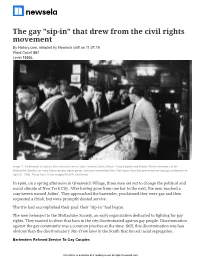
The gay "sip-in" that drew from the civil rights movement By History.com, adapted by Newsela staff on 11.07.19 Word Count 887 Level 1020L Image 1. A bartender in Julius's Bar refuses to serve John Timmins, Dick Leitsch, Craig Rodwell and Randy Wicker, members of the Mattachine Society, an early American gay rights group, who were protesting New York liquor laws that prevented serving gay customers on April 21, 1966. Photo from: Getty Images/Fred W. McDarrah. In 1966, on a spring afternoon in Greenwich Village, three men set out to change the political and social climate of New York City. After having gone from one bar to the next, the men reached a cozy tavern named Julius'. They approached the bartender, proclaimed they were gay and then requested a drink, but were promptly denied service. The trio had accomplished their goal: their "sip-in" had begun. The men belonged to the Mattachine Society, an early organization dedicated to fighting for gay rights. They wanted to show that bars in the city discriminated against gay people. Discrimination against the gay community was a common practice at the time. Still, this discrimination was less obvious than the discriminatory Jim Crow laws in the South that forced racial segregation. Bartenders Refused Service To Gay Couples This article is available at 5 reading levels at https://newsela.com. A person's sexual orientation couldn't be detected as easily as a person's sex or race. With that in mind, the New York State Liquor Authority, a state agency that controls liquor sales, took action. -

Queer Expertise: Urban Policing and the Construction of Public Knowledge About Homosexuality, 1920–1970
Queer Expertise: Urban Policing and the Construction of Public Knowledge About Homosexuality, 1920–1970 The Harvard community has made this article openly available. Please share how this access benefits you. Your story matters Citation Lvovsky, Anna. 2015. Queer Expertise: Urban Policing and the Construction of Public Knowledge About Homosexuality, 1920–1970. Doctoral dissertation, Harvard University, Graduate School of Arts & Sciences. Citable link http://nrs.harvard.edu/urn-3:HUL.InstRepos:17463142 Terms of Use This article was downloaded from Harvard University’s DASH repository, and is made available under the terms and conditions applicable to Other Posted Material, as set forth at http:// nrs.harvard.edu/urn-3:HUL.InstRepos:dash.current.terms-of- use#LAA Queer Expertise: Urban Policing and the Construction of Public Knowledge about Homosexuality, 1920–1970 A dissertation presented by Anna Lvovsky to The Committee on Higher Degrees in the History of American Civilization in partial fulfillment of the requirements for the degree of Doctor of Philosophy in the subject of History of American Civilization Harvard University Cambridge, Massachusetts May 2015 © 2015 – Anna Lvovsky All rights reserved. Advisor: Nancy Cott Anna Lvovsky Queer Expertise: Urban Policing and the Construction of Public Knowledge about Homosexuality, 1920–1970 Abstract This dissertation tracks how urban police tactics against homosexuality participated in the construction, ratification, and dissemination of authoritative public knowledge about gay men in the -

When Did You Become Gay?
1 | AN INTRODUCTION TO WHAT I HEAR WHEN YOU SAY Deeply ingrained in human nature is a tendency to organize, classify, and categorize our complex world. Often, this is a good thing. This ability helps us make sense of our environment and navigate unfamiliar landscapes while keeping us from being overwhelmed by the constant stream of new information and experiences. When we apply this same impulse to social interactions, however, it can be, at best, reductive and, at worst, dangerous. Seeing each other through the lens of labels and stereotypes prevents us from making authentic connections and understanding each other’s experiences. Through the initiative, What I Hear When You Say ( WIHWYS ), we explore how words can both divide and unite us and learn more about the complex and everchanging ways that language shapes our expectations, opportunities, and social privilege. WIHWYS ’s interactive multimedia resources challenge what we think we know about race, class, gender, and identity, and provide a dynamic digital space where we can raise difficult questions, discuss new ideas, and share fresh perspectives. 1 | Introduction WHEN DID YOU BECOME GAY? if you don’t have an answer it doesn’t make you any less gay, it doesn’t make you any less queer or less trans be- “ cause we’re all evolving and we all change, and we don’t have this one day on our calendar where we suddenly understood everything. Kristin Russo, Activist / YouTube def•i•ni•tion of, relating to, or exhibiting sexual desire or behavior direct- GAY [gey] adjective ed toward a person or persons of one’s own sex. -

Legacy, Vol. 17, 2017
2017 A Journal of Student Scholarship A Publication of the Sigma Kappa Chapter of Phi Alpha Theta A Publication of the Sigma Kappa & the Southern Illinois University Carbondale History Department & the Southern Illinois University Volume 17 Volume LEGACY • A Journal of Student Scholarship • Volume 17 • 2017 LEGACY Volume 17 2017 A Journal of Student Scholarship Editorial Staff Denise Diliberto Geoff Lybeck Gray Whaley Faculty Editor Hale Yılmaz The editorial staff would like to thank all those who supported this issue of Legacy, especially the SIU Undergradute Student Government, Phi Alpha Theta, SIU Department of History faculty and staff, our history alumni, our department chair Dr. Jonathan Wiesen, the students who submitted papers, and their faculty mentors Professors Jo Ann Argersinger, Jonathan Bean, José Najar, Joseph Sramek and Hale Yılmaz. A publication of the Sigma Kappa Chapter of Phi Alpha Theta & the History Department Southern Illinois University Carbondale history.siu.edu © 2017 Department of History, Southern Illinois University All rights reserved LEGACY Volume 17 2017 A Journal of Student Scholarship Table of Contents The Effects of Collegiate Gay Straight Alliances in the 1980s and 1990s Alicia Mayen ....................................................................................... 1 Students in the Carbondale, Illinois Civil Rights Movement Bryan Jenks ...................................................................................... 15 The Crisis of Legitimacy: Resistance, Unity, and the Stamp Act of 1765, -

The Stonewall Riots 2/5/16 10:34 PM Page Iii DM - the Stonewall Riots 2/5/16 10:34 PM Page V
DM - The Stonewall Riots 2/5/16 10:34 PM Page iii DM - The Stonewall Riots 2/5/16 10:34 PM Page v Table of Contents Preface . vii How to Use This Book . xi Research Topics for Defining Moments: The Stonewall Riots . xiii NARRATIVE OVERVIEW Prologue . 3 Chapter 1: Homophobia and Discrimination . 9 Chapter 2: The LGBT Experience in New York City . 23 Chapter 3: Raid on the Stonewall Inn . 37 Chapter 4: Growth of the LGBT Rights Movement . 53 Chapter 5: The AIDS Crisis and the Struggle for Acceptance . 65 Chapter 6: Progress in the Courts . 79 Chapter 7: Legacy of the Stonewall Riots . 95 BIOGRAPHIES Marsha P. Johnson (1945–1992) . 107 Stonewall Riot Participant and Transgender Rights Activist Frank Kameny (1925–2011) . 111 Father of the LGBT Rights Movement Dick Leitsch (1935–) . 116 LGBT Rights Activist and New York Mattachine Society Leader v DM - The Stonewall Riots 2/9/16 2:06 PM Page vi Defining Moments: The Stonewall Riots Seymour Pine (1919–2010) . 120 New York Police Inspector Who Led the Stonewall Inn Raid Sylvia Rivera (1951–2002) . 123 Stonewall Riot Participant and Transgender Rights Activist Craig Rodwell (1940–1993) . 127 Bookstore Owner, Activist, and Stonewall Riot Participant Martha Shelley (1943–) . 131 LGBT Rights Activist and Witness to the Stonewall Riots Howard Smith (1936–2014) . 135 Journalist Who Reported from Inside the Stonewall Inn PRIMARY SOURCES A Medical Journal Exhibits Homophobia . 141 The Kinsey Report Explodes Myths about Homosexuality . 143 Lucian Truscott Covers the Stonewall Riots . 149 Howard Smith Reports from Inside the Bar . 154 Media Coverage Angers LGBT Activists . -

Chapter Six: Activist Agendas and Visions After Stonewall (1969-1973)
Chapter Six: Activist Agendas and Visions after Stonewall (1969-1973) Documents 103-108: Gay Liberation Manifestos, 1969-1970 The documents reprinted in The Stonewall Riots are “Gay Revolution Comes Out,” Rat, 12 Aug. 1969, 7; North American Conference of Homophile Organizations Committee on Youth, “A Radical Manifesto—The Homophile Movement Must Be Radicalized!” 28 Aug. 1969, reprinted in Stephen Donaldson, “Student Homophile League News,” Gay Power (1.2), c. Sep. 1969, 16, 19-20; Preamble, Gay Activists Alliance Constitution, 21 Dec. 1969, Gay Activists Alliance Records, Box 18, Folder 2, New York Public Library; Carl Wittman, “Refugees from Amerika: A Gay Manifesto,” San Francisco Free Press, 22 Dec. 1969, 3-5; Martha Shelley, “Gay is Good,” Rat, 24 Feb. 1970, 11; Steve Kuromiya, “Come Out, Wherever You Are! Come Out,” Philadelphia Free Press, 27 July 1970, 6-7. For related early sources on gay liberation agendas and philosophies in New York, see “Come Out for Freedom,” Come Out!, 14 Nov. 1969, 1; Bob Fontanella, “Sexuality and the American Male,” Come Out!, 14 Nov. 1969, 15; Lois Hart, “Community Center,” Come Out!, 14 Nov. 1969, 15; Leo Louis Martello, “A Positive Image for the Homosexual,” Come Out!, 14 Nov. 1969, 16; “An Interview with New York City Liberationists,” San Francisco Free Press, 7 Dec. 1969, 5; Bob Martin, “Radicalism and Homosexuality,” Come Out!, 10 Jan. 1970, 4; Allan Warshawsky and Ellen Bedoz, “G.L.F. and the Movement,” Come Out!,” 10 Jan. 1970, 4-5; Red Butterfly, “Red Butterfly,” Come Out!, 10 Jan. 1970, 4-5; Bob Kohler, “Where Have All the Flowers Gone,” Come Out!, 10 Jan. -

Lesbian, Gay, Bisexual and Transgender Support Toolkit
Lesbian, Gay, Bisexual and Transgender Support Toolkit Social Care, Health and Wellbeing Lesbian, Gay, Bisexual and Transgender Support Toolkit Issue Date: 31/05/2011 Review Date: 30/07/2015 Revised date: 1/09/2015 Amendments Introduced Care Act 2014 and duty made to to promote wellbeing version 1.1 Updated the history of LGBT rights Updated list of famous LGBT people examples Updated national and local statistics Version 2 Next review September 2015 date due: Owner: Policy and Standards Team Invicta House, 3rd Floor County Hall Maidstone ME15 1XX 1 Lesbian, Gay, Bisexual and Transgender Support Toolkit 1. Foreword This document is a toolkit to help promote and embed good practice when working with lesbian, gay, bisexual and transgender [LGB&T] people. It contains a number of case studies and good practice examples, as well as links to other resources that staff may find useful in working with LGB&T individuals. This document is intended to raise awareness of: issues specific to LGB&T individuals what this means for anyone working with or supporting LGB&T people how this may affect their carers and support networks how to address homophobia, biphobia and transphobia our legal responsibilities Anne Tidmarsh, Director Older People and Physical Disability and Chair of the Directorate Equalities Group: “The LGB&T Support Toolkit provides important information and guidance for staff in an area that they may not be familiar with. The toolkit helps to remind us to not make assumptions about who we are talking to and recognise the importance of sexual orientation in someone’s life. -
The Spark of Stonewall
View metadata, citation and similar papers at core.ac.uk brought to you by CORE provided by James Madison University James Madison University JMU Scholarly Commons Proceedings of the Sixth Annual MadRush MAD-RUSH Undergraduate Research Conference Conference: Best Papers, Spring 2015 A Movement on the Verge: The pS ark of Stonewall Tiffany Renee Nelson James Madison University Follow this and additional works at: http://commons.lib.jmu.edu/madrush Part of the Social History Commons Tiffany Renee Nelson, "A Movement on the Verge: The pS ark of Stonewall" (April 10, 2015). MAD-RUSH Undergraduate Research Conference. Paper 1. http://commons.lib.jmu.edu/madrush/2015/SocialMovements/1 This Event is brought to you for free and open access by the Conference Proceedings at JMU Scholarly Commons. It has been accepted for inclusion in MAD-RUSH Undergraduate Research Conference by an authorized administrator of JMU Scholarly Commons. For more information, please contact dc_admin@jmu.edu. A Movement on the Verge: The Spark of Stonewall The night of Saturday, June 28, 1969, the streets of Central Greenwich Village were crowded with angered gay men, lesbians, “flame queens”, and Trans*genders. 1 That was the second day of disorder of what would later be called the Stonewall Riots. Centering around Christopher Street’s bar for homosexuals, the Stonewall Inn, the riots began the night before on June 27 and lasted until July 2. These five days of rioting were the result of decades of disdain against the police force and the general population that had oppressed the gay inhabitants of New York City. -
View PDF File
LESBIAN, GAY, BISEXUAL, AND TRANSGENDER 2017 HERITAGE MONTH CITY OF LOS ANGELES LOS ANGELES CITY COUNCIL CULTURAL AFFAIRS Eric Garcetti Herb J. Wesson, Jr. COMMISSION Mayor District 10 Eric Paquette President Mike Feuer President Los Angeles City Attorney Gilbert Cedillo Charmaine Jefferson District 1 Ron Galperin Vice President Los Angeles City Controller Paul Krekorian Jill Cohen District 2 Thien Ho Bob Blumenfield Josefina Lopez District 3 Elissa Scrafano David Ryu John Wirfs District 4 Paul Koretz CITY OF LOS ANGELES District 5 DEPARTMENT OF Nury Martinez CULTURAL AFFAIRS District 6 Danielle Brazell Vacant General Manager District 7 Daniel Tarica Marqueece Harris-Dawson Assistant General Manager District 8 Will Caperton y Montoya Curren D. Price, Jr. Director of Marketing and Development District 9 Mike Bonin CALENDAR PRODUCTION District 11 Will Caperton y Montoya Mitchell Englander Editor and Art Director District 12 Marcia Harris Mitch O’Farrell PMAC District 13 Jose Huizar CALENDAR DESIGN District 14 Rubén Esparza, Red Studios Joe Buscaino PMAC District 15 Front Cover: Hector Silva, Los Novios, Pencil, colored pencil on 2 ply museum board, 22” x 28”, 2017 LESBIAN, GAY, BISEXUAL, AND TRANSGENDER 2017 HERITAGE MONTH ERIC GARCETTI MAYOR CITY OF LOS ANGELES Dear Friends, It is my pleasure to lead Los Angeles in celebrating Lesbian, Gay, Bisexual, and Transgender (LGBT) Heritage Month and the immense contributions that our city’s LGBT residents make in the arts, academia, and private, public, and nonprofit sectors. I encourage Angelenos to take full advantage of this Calendar and Cultural Guide created by our Department of Cultural Affairs highlighting the many activities happening all over L.A. -
Summer Library Events & Classes
Palm Springs We present another IMPORTANT MILESTONES IN HISTORY: IMPORTANT MILESTONES IN HISTORY: PUBLIC season of classes, films 50th Anniversary of the and lectures for you 50th Anniversary of the Stonewall Riots Apollo 11 Moon Landing Library to enjoy. We take your suggestions and areas The Stonewall riots (also referred of interest and try to to as the Stonewall uprising or create a lineup that the Stonewall rebellion) served J u n e – A u g u s t is diverse and as a catalyst for the gay rights entertaining, yet fulfills movement. In the early hours 2 0 1 9 the yearning to learn On July 20, 1969, America and the world new things. A more detailed description of of June 28, 1969, New York watched as Astronauts Neil Armstrong and our programs is available on our web site City police raided the Stonewall Buzz Aldrin took mankind’s first steps on the calendar but our brochure provides an Inn, a gay club located in Greenwich Village in lunar surface. This unprecedented engineering, overview of the quarter’s planned events so New York City. Armed with a warrant, police that you can mark your calendar and plan scientific, and political achievement, secured our officers entered the club, roughed up patrons, ahead. Stay up-to-date by subscribing to Nation’s leadership in space for generations to and arrested 13 people; including employees our monthly electronic newsletter. Tell your come. The national goal set in 1961 by President and people violating the state’s gender- friends and plan to attend; we look forward John F.