The World According to Bhairava-Kali-Dharma
Total Page:16
File Type:pdf, Size:1020Kb
Load more
Recommended publications
-

A Translation of the Vijñāna-Bhairava-Tantra (Complete but Lacking Commentary) ©2017 by Christopher Wallis Aka Hareesh
A translation of the Vijñāna-bhairava-tantra (complete but lacking commentary) ©2017 by Christopher Wallis aka Hareesh Introductory verse (maṅgala-śloka): “Shiva is also known as ‘Bhairava’ because He brings about the [initial awakening that makes us] cry out in fear of remaining in the dreamstate (bhava-bhaya)—and due to that cry of longing he becomes manifest in the radiant domain of the heart, bestowing absence of fear (abhaya) for those who are terrified. He is also known as Bhairava because he is the Lord of those who delight in his awesome roar (bhīrava), which signals the death of Death! Being the Master of that flock of excellent Yogins who tire of fear and seek release, he is Bhairava—the Supreme, whose form is Consciousness (vijñāna). As the giver of nourishment, he extends his Power throughout the universe!” ~ the great master Rājānaka Kṣemarāja, c. 1020 CE Like most Tantrik scriptures, the Vijñāna-bhairava-tantra (c. 850 CE) takes the form of a dialogue between Śiva and Śakti, here called Bhairava and Bhairavī. It begins with the Goddess asking Bhairava: śrutaṃ deva mayā sarvaṃ rudra-yāmala-saṃbhavam | trika-bhedam aśeṣeṇa sārāt sāra-vibhāgaśaḥ || 1 || . 1. O Lord, I have heard the entire teaching of the Trika1 that has arisen from our union, in scriptures of ever greater essentiality, 2. but my doubts have not yet dissolved. What is the true nature of Reality, O Lord? Does it consist of the powers of the mystic alphabet (śabda-rāśi)?2 3. Or, amongst the terrifying forms of Bhairava, is it Navātman?3 Or is it the trinity of śaktis (Parā, Parāparā, and Aparā) that [also] constitute the three ‘heads’ of Triśirobhairava? 4. -
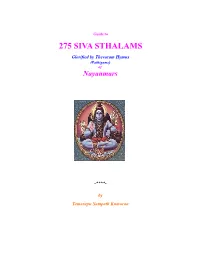
Guide to 275 SIVA STHALAMS Glorified by Thevaram Hymns (Pathigams) of Nayanmars
Guide to 275 SIVA STHALAMS Glorified by Thevaram Hymns (Pathigams) of Nayanmars -****- by Tamarapu Sampath Kumaran About the Author: Mr T Sampath Kumaran is a freelance writer. He regularly contributes articles on Management, Business, Ancient Temples and Temple Architecture to many leading Dailies and Magazines. His articles for the young is very popular in “The Young World section” of THE HINDU. He was associated in the production of two Documentary films on Nava Tirupathi Temples, and Tirukkurungudi Temple in Tamilnadu. His book on “The Path of Ramanuja”, and “The Guide to 108 Divya Desams” in book form on the CD, has been well received in the religious circle. Preface: Tirth Yatras or pilgrimages have been an integral part of Hinduism. Pilgrimages are considered quite important by the ritualistic followers of Sanathana dharma. There are a few centers of sacredness, which are held at high esteem by the ardent devotees who dream to travel and worship God in these holy places. All these holy sites have some mythological significance attached to them. When people go to a temple, they say they go for Darsan – of the image of the presiding deity. The pinnacle act of Hindu worship is to stand in the presence of the deity and to look upon the image so as to see and be seen by the deity and to gain the blessings. There are thousands of Siva sthalams- pilgrimage sites - renowned for their divine images. And it is for the Darsan of these divine images as well the pilgrimage places themselves - which are believed to be the natural places where Gods have dwelled - the pilgrimage is made. -

108 Upanishads
108 Upanishads From the Rigveda 36 Dakshinamurti Upanishad From the Atharvaveda 1 Aitareya Upanishad 37 Dhyana-Bindu Upanishad 78 Annapurna Upanishad 2 Aksha-Malika Upanishad - 38 Ekakshara Upanishad 79 Atharvasikha Upanishad about rosary beads 39 Garbha Upanishad 80 Atharvasiras Upanishad 3 Atma-Bodha Upanishad 40 Kaivalya Upanishad 81 Atma Upanishad 4 Bahvricha Upanishad 41 Kalagni-Rudra Upanishad 82 Bhasma-Jabala Upanishad 5 Kaushitaki-Brahmana 42 Kali-Santarana Upanishad 83 Bhavana Upanishad Upanishad 43 Katha Upanishad 84 Brihad-Jabala Upanishad 6 Mudgala Upanishad 44 Katharudra Upanishad 85 Dattatreya Upanishad 7 Nada-Bindu Upanishad 45 Kshurika Upanishad 86 Devi Upanishad 8 Nirvana Upanishad 46 Maha-Narayana (or) Yajniki 87 Ganapati Upanishad 9 Saubhagya-Lakshmi Upanishad Upanishad 88 Garuda Upanishad 10 Tripura Upanishad 47 Pancha-Brahma Upanishad 48 Pranagnihotra Upanishad 89 Gopala-Tapaniya Upanishad From the Shuklapaksha 49 Rudra-Hridaya Upanishad 90 Hayagriva Upanishad Yajurveda 50 Sarasvati-Rahasya Upanishad 91 Krishna Upanishad 51 Sariraka Upanishad 92 Maha-Vakya Upanishad 11 Adhyatma Upanishad 52 Sarva-Sara Upanishad 93 Mandukya Upanishad 12 Advaya-Taraka Upanishad 53 Skanda Upanishad 94 Mundaka Upanishad 13 Bhikshuka Upanishad 54 Suka-Rahasya Upanishad 95 Narada-Parivrajaka 14 Brihadaranyaka Upanishad 55 Svetasvatara Upanishad Upanishad 15 Hamsa Upanishad 56 Taittiriya Upanishad 96 Nrisimha-Tapaniya 16 Isavasya Upanishad 57 Tejo-Bindu Upanishad Upanishad 17 Jabala Upanishad 58 Varaha Upanishad 97 Para-Brahma Upanishad -

South-Indian Images of Gods and Goddesses
ASIA II MB- • ! 00/ CORNELL UNIVERSITY* LIBRARY Date Due >Sf{JviVre > -&h—2 RftPP )9 -Af v^r- tjy J A j£ **'lr *7 i !! in ^_ fc-£r Pg&diJBii'* Cornell University Library NB 1001.K92 South-indian images of gods and goddesse 3 1924 022 943 447 AGENTS FOR THE SALE OF MADRAS GOVERNMENT PUBLICATIONS. IN INDIA. A. G. Barraud & Co. (Late A. J. Combridge & Co.)> Madras. R. Cambrav & Co., Calcutta. E. M. Gopalakrishna Kone, Pudumantapam, Madura. Higginbothams (Ltd.), Mount Road, Madras. V. Kalyanarama Iyer & Co., Esplanade, Madras. G. C. Loganatham Brothers, Madras. S. Murthv & Co., Madras. G. A. Natesan & Co., Madras. The Superintendent, Nazair Kanun Hind Press, Allahabad. P. R. Rama Iyer & Co., Madras. D. B. Taraporevala Sons & Co., Bombay. Thacker & Co. (Ltd.), Bombay. Thacker, Spink & Co., Calcutta. S. Vas & Co., Madras. S.P.C.K. Press, Madras. IN THE UNITED KINGDOM. B. H. Blackwell, 50 and 51, Broad Street, Oxford. Constable & Co., 10, Orange Street, Leicester Square, London, W.C. Deighton, Bell & Co. (Ltd.), Cambridge. \ T. Fisher Unwin (Ltd.), j, Adelphi Terrace, London, W.C. Grindlay & Co., 54, Parliament Street, London, S.W. Kegan Paul, Trench, Trubner & Co. (Ltd.), 68—74, iCarter Lane, London, E.C. and 25, Museum Street, London, W.C. Henry S. King & Co., 65, Cornhill, London, E.C. X P. S. King & Son, 2 and 4, Great Smith Street, Westminster, London, S.W.- Luzac & Co., 46, Great Russell Street, London, W.C. B. Quaritch, 11, Grafton Street, New Bond Street, London, W. W. Thacker & Co.^f*Cre<d Lane, London, E.O? *' Oliver and Boyd, Tweeddale Court, Edinburgh. -
Is the Gaudiya Vaishnava Sampradaya Connected to the Madhva Line?
Is the Gaudiya Vaishnava sampradaya connected to the Madhva line? Is the Gaudiya Vaishnava sampradaya connected to the Madhva line? – Jagadananda Das – The relationship of the Madhva-sampradaya to the Gaudiya Vaishnavas is one that has been sensitive for more than 200 years. Not only did it rear its head in the time of Baladeva Vidyabhushan, when the legitimacy of the Gaudiyas was challenged in Jaipur, but repeatedly since then. Bhaktivinoda Thakur wrote in his 1892 work Mahaprabhura siksha that those who reject this connection are “the greatest enemies of Sri Krishna Chaitanya’s family of followers.” In subsequent years, nearly every scholar of Bengal Vaishnavism has cast his doubts on this connection including S. K. De, Surendranath Dasgupta, Sundarananda Vidyavinoda, Friedhelm Hardy and others. The degree to which these various authors reject this connection is different. According to Gaudiya tradition, Madhavendra Puri appeared in the 14th century. He was a guru of the Brahma or Madhva-sampradaya, one of the four (Brahma, Sri, Rudra and Sanaka) legitimate Vaishnava lineages of the Kali Yuga. Madhavendra’s disciple Isvara Puri took Sri Krishna Chaitanya as his disciple. The followers of Sri Chaitanya are thus members of the Madhva line. The authoritative sources for this identification with the Madhva lineage are principally four: Kavi Karnapura’s Gaura-ganoddesa-dipika (1576), the writings of Gopala Guru Goswami from around the same time, Baladeva’s Prameya-ratnavali from the late 18th century, and anothe late 18th century work, Narahari’s -
One and Three Bhairavas: the Hypocrisy of Iconographic Mediation Gregory Price Grieve
Revista de Estudos da Religião Nº 4 / 2005 / pp. 63-79 ISSN 1677-1222 One and Three Bhairavas: The Hypocrisy of Iconographic Mediation Gregory Price Grieve The artist-as-anthropologist, as a student of culture, has as his job to articulate a model of art, the purpose of which is to understand culture by making its implicit nature explicit. [T]his is not simply circular because the agents are continually interacting and socio-historically located. It is a non-static, in-the-world model. Joseph Kosuth1, “The Artist as Anthropologist” (1991[1975]) Iconography is a hypocritical term. On the face of it, “iconography” simply denotes the critical study of images (Panofsky 1939; 1955). Yet, one must readily admit that iconography stems from the fear of images (Mitchell 1987). In fact, iconography can be defined as a strategy for writing over images. But why fear images? Iconography’s zealotry—from idols made in the likeness of God to fetishes made in the image of capital—stems from the terror of the material. Accordingly, to proceed in an analysis of iconography, one must make explicit what most religious discursive systems must by necessity leave implict religion is never just “spirit.” Whether iconophobia or iconophilia, whether iconoclastic or idolatry, what all religions have in common is that they rely on matter for their dissemination. Even speech, the most reified communication, relies on air and the physicality of the human body. Accordingly, to write about, rather than write over, religious images, we need to return to the material. Stop and take a look at the god-image of Bhairava, a fierce form of Shiva from the Nepalese city of Bhaktapur2. -

Sebuah Kajian Pustaka
International Journal of Linguistics, Literature and Culture Available online at https://sloap.org/journals/index.php/ijllc/ Vol. 2, No. 3, September 2016, pages: 28~34 ISSN: 2455-8028 https://sloap.org/journals/index.php/ijllc/article/view/114 The Paradigm of Religious Evolution: The Transformation of Rudra to Pashupata Satendra Kumar Mishra a Article history: Abstract The Pashupata cult is the oldest known cult of the Saivism. Pashupata cult Received: 10 June 2016 was established around 200 BC by Lakulisha. Born to a Brahmin family Revised: 10 July 2016 according to Karavana Mahatmya, he died in the seventh month and during Approved: 20 August 2016 his short span he displayed remarkable spiritual powers. His mother floated Published: 1 September 2016 his body in a river as per the tradition and as said a group of tortoise carried the body to a Shiva shrine. The child became alive and became an ascetic. By Keywords: yet another account Lakulisha died but was revived by Lord Siva himself. Lord entered his body and preached the Pashupata moral and ethics to the Shaivism; world. The place of his rebirth is today a town called Kayavarohana "to Lakulisha; incarnate in another's body". This miracle is still celebrated among the Kaurusha; Pashupata believers. The archeological department takes care of two stone Pashupata; inscriptions there with the names of Lakulisha’s four disciples- Kushika, Kayavarohana; Maitreya, Gargya, and Kaurusha. Lakulisha was a basically a dynamic Pashupata reformist. 2455-8028 ©Copyright 2016. The Author. This is an open-access article under the CC BY-SA license (https://creativecommons.org/licenses/by-sa/4.0/) All rights reserved. -

Yogaofsound-Allreadings.Pdf
1 Class One: The Generative Power of Language and the Song of Silence I. The Two Truths About Reality From the Guide to the Bodhisattva’s Way of Life: saṁvṛtiḥ paramārthaśca satyadvayamidaṁ matam| buddheragocarastattvaṁ buddhiḥ saṁvṛtirucyate|| Truth about reality is considered to be of two kinds – deceptive and ultimate. How things really are is inaccessible to the intellect, for the intellect is said to be deceptive. (9.2) II. The Power of the Word A. From Atisha’s Lamp for the Path of Awakening: bhavo vikalpobhūto'yaṁ tadvikalpātmakastataḥ| sarvakalpaparityāgaḥ nivārṇaḥ paramo'sti hi|| This world has come into being through concepts and thus exists purely conceptually. The abandonment of all such conceptual thinking is the highest nirvana. (56) B. From Nagarjuna’s Root Verses on the Middle Way: vyavahāramanāśritya paramārtho na deśyate | paramārthamanāgamya nirvāṇaṁ nādhigamyate || Without relying on conventional reality, The ultimate meaning cannot be taught. Without arriving at the ultimate meaning of things, Nirvana cannot be attained. (24.10) 2 yaḥ pratītyasamutpādaḥ śūnyatāṁ tāṁ pracakṣmahe | sā prajïaptirupādāya pratipatsaiva madhyamā || Whatever arises dependently Is what is called emptiness. That which is conventionally designated Is the middle way. (24.18) apratītya samutpanno dharmaḥ kaścinna vidyate | yasmāttasmādaśūnyo hi dharmaḥ kaścinna vidyate || There is nothing whatsoever That does not arise dependently. And thus there is nothing whatsoever That is not empty. (24.19) yadyaśūnyaṁ bhavetkiṁ citsyāccūnyamiti kiṁ cana | na kiṁ cidastyaśūnyaṁ ca kutaḥ śūnyaṁ bhaviṣyati || If there was anything at all that was not empty, Then there would be something that we could call “empty.” There is nothing at all that is not empty, So how could there be something that is empty? (13.7) III. -

CONCEIVING the GODDESS an Old Woman Drawing a Picture of Durga-Mahishasuramardini on a Village Wall, Gujrat State, India
CONCEIVING THE GODDESS An old woman drawing a picture of Durga-Mahishasuramardini on a village wall, Gujrat State, India. Photo courtesy Jyoti Bhatt, Vadodara, India. CONCEIVING THE GODDESS TRANSFORMATION AND APPROPRIATION IN INDIC RELIGIONS Edited by Jayant Bhalchandra Bapat and Ian Mabbett Conceiving the Goddess: Transformation and Appropriation in Indic Religions © Copyright 2017 Copyright of this collection in its entirety belongs to the editors, Jayant Bhalchandra Bapat and Ian Mabbett. Copyright of the individual chapters belongs to the respective authors. All rights reserved. Apart from any uses permitted by Australia’s Copyright Act 1968, no part of this book may be reproduced by any process without prior written permission from the copyright owners. Inquiries should be directed to the publisher. Monash University Publishing Matheson Library and Information Services Building, 40 Exhibition Walk Monash University Clayton, Victoria 3800, Australia www.publishing.monash.edu Monash University Publishing brings to the world publications which advance the best traditions of humane and enlightened thought. Monash University Publishing titles pass through a rigorous process of independent peer review. www.publishing.monash.edu/books/cg-9781925377309.html Design: Les Thomas. Cover image: The Goddess Sonjai at Wai, Maharashtra State, India. Photograph: Jayant Bhalchandra Bapat. ISBN: 9781925377309 (paperback) ISBN: 9781925377316 (PDF) ISBN: 9781925377606 (ePub) The Monash Asia Series Conceiving the Goddess: Transformation and Appropriation in Indic Religions is published as part of the Monash Asia Series. The Monash Asia Series comprises works that make a significant contribution to our understanding of one or more Asian nations or regions. The individual works that make up this multi-disciplinary series are selected on the basis of their contemporary relevance. -

Significance of Astavaranas in Lingayatism Dr
Significance of Astavaranas in Lingayatism Dr. Jagannath K Guest Lecturer, Department of History, Gulbarga University, Kalaburagi: 585106, Karnataka Abstract: Though Lingayatism has believed to be prevailed since pre-historic times, it was reformed by Vishwajyoti Basaveshwar in 12th century. He has formed certain principles and emphasized different practices to keep away from evil instincts and live happily to attain Moksha or Salvation in life. The Lingayatism is based on Astavaranas or Eight Shields. The paper discussed the significance of Astavaranas enunciated by Basaveshwar in 12th century. Introduction: It is noted that Lingayatism or Veerashaivism was prevailed since remote past. Lord Shiva is the only god worshipped by followers of Lingayatism. Many of the philosophers have stated that Basaveshwar has found Lingayatism or Veerashaivism, but it is noted that Basaveshwar has reformed Lingayatism. Basaveshwar has improved and given systematic methods and principles to Lingayatism at the early 12th century. He was taught about the importance of Enlightenment, Work Culture, Democracy, Human Rights, Gender and Racial equality to form an egalitarian Society. Basavanna or Basaveshwarwas a Hindu philosopher, statesman, Kannada poet in the Shiva-focussed Bhakti movement and a social reformer during the reign of the Kalachuri-dynasty king Bijjala I in Karnataka, India. Basavanna spread social awareness through his poetry, popularly known as Vachanaas. Basavanna rejected gender or social discrimination, superstitions and rituals such as the wearing of sacred thread, but introduced Ishtalinganecklace, with an image of the Shiva Liṅga, to every person regardless of his or her birth, to be a constant reminder of one's bhakti to Shiva. As the chief minister of his kingdom, he introduced new public institutions such as the AnubhavaMantapa, which welcomed men and women from all socio- economic backgrounds to discuss spiritual and mundane questions of life, in open. -

I Introduction to Bhairava-Kali- Abhichara
I Introduction to Bhairava-Kali- Abhichara ABHICHARA India is like a treasury full of precious stones shining with all the colours of the rain - bow. Hundreds of peoples, each of them rich in their unique ethnic culture, art, tra - ditions and customs, have been living in that country for ages. Such a number and diversity of religions as can be found in India is impossible to meet in any other country. India is the birthplace of Buddhism, Jainism and Sikhism. Islam, Christian - ity and Shamanism can also be found there; Judaism and Zoroastrianism are related to India as well. However, most of India’s population practices Hinduism, which is a colourful multitude of various spiritual movements united by certain principles. India gave us sophisticated medicine, the first grammar treatises in history, the dec - imal numeration system, a number of algebraic, geometric and trigonometric con - cepts, chess, highly developed religious and philosophical systems, masterpieces of world art, and much more. Within the colourful diversity of cultural, geographic, religious, caste and social formations of India, there evolved and flowered unique mystical-magical traditions: namely, the tantric ones. The main definAinbgh fiechataurrae’ of all tantric schools is their practical mysticism based on a detailed and multileveled study of doctrinal concepts of sacred texts and on religious-magical practices in - cluding theurgy and mantic arts. The applied mystical-magical aspect of Tantrism is called ‘ in Sanskrit. The root ‘abhi’ can be translated into English as ‘action’, and ‘char’ - as ‘movement’, ‘following’ or ‘way’. Thus, it can be said that Abhichara is ‘the way of performing actions’. -

Varanasi, Uttar Pradesh
VARANASI, UTTAR PRADESH Varanasi or Banaras, unlike other cities is overwhelming. It is a city that requires you to be sensitive, spiritual, careful and open minded. The Tree of Life Resort & Spa, Varanasi encompasses all that Varanasi is, with a twist – it is your oasis of peace and calm after an over- whelming experience of the city. Varanasi as a city, competes for every inch of space. You will experience the crowds, the noise, the struggle of traffic while in the city. Coming back to the solace of your Resort, we offer you 18 Junior Suites, each with a private area of around 650 sq.ft. - Accommodation – Done in local style architecture, each Junior Suite allows you the luxury of space and privacy. High ceiling, teak wood carved furniture, hand painted Shiva on the wall, a separate living area with comfortable sofa and a large flat screen television; very spacious and well lit en suite 150 sq.ft bathroom with a style so unique you would not have seen else where. And added to all of this, is your large private sit-out overlooking the gardens, the ‘kund’ (religious pond) and the open spaces around. - Culinary Delight – AnnTripti – Our multi-cuisine restaurant derives its name from two Sanskrit words – ‘Ann’ which means food and ‘Tripti’ which means satisfaction – AnnTripti. We believe that food must be cooked and served fresh and to your delight. It is for this reason that we do not do buffets. We offer Indian and Continental options, along with some special local Banarasi signature dishes. Our menus change every day.