Oxford Book of Australasian Verse
Total Page:16
File Type:pdf, Size:1020Kb
Load more
Recommended publications
-

For Creative Minds
For Creative Minds The For Creative Minds educational section may be photocopied or printed from our website by the owner of this book for educational, non-commercial uses. Cross-curricular teaching activities, interactive quizzes, and more are available online. Go to www.ArbordalePublishing.com and click on the book’s cover to explore all the links. Moon Observations The months as we know them (January, February, etc.) are solar, based on how many days it takes the earth to revolve around the sun, roughly divided by twelve. A moon-th, or lunar (moon) month, is based on how long it takes the moon to orbit around the earth. The phases (shapes) of the moon change according to its cycle as it rotates around the earth, and the position of the moon with respect to the rising or setting sun. This cycle lasts about 29 ½ days. A (moon) month starts on “day one” with a new moon. The sun and the moon are in the same position and rise and set together. We can’t see the new moon. New Moon The moon rises and sets roughly 50 minutes later each day. The moon appears to “grow” or it waxes each day from a new moon to a full moon. The waxing moon’s bright side points at the setting Waxing sun and can be seen in the late afternoon on a clear day. Crescent A crescent moon is between new and half (less than half full), and may be waxing or waning. First Quarter The half-moon waxing or first quarter moon occurs about a week after the new moon. -

THIRTEEN MOONS Curriculum
THIRTEEN MOONS Curriculum OJIBWAY CREE MOHAWK PRACTITIONER GUIDE LBS LEVELS 2 AND 3 13 MOONS – Teacher’s Guide 0 13 MOONS – Teacher’s Guide 1 © Ontario Native Literacy Coalition [2010] Table of Contents Introduction………………………………………………………………………………………………..4 Aboriginal Calendars………………………………………………………………………………..…5 OJIBWE Unit………………………………………………………………………………………………………………….6 Introduction & Pronunciation Guide…………………………………………………….8 Moons …………………………………………………………………………………………………..9 Numbers …………………………………………………………………………………………….12 Days of the Week …………………………………………………………………………….….14 Seasons ……………………………………………………………………………………………...15 CREE Unit…………………………………………………………………………………………………..16 Introduction ……………………………………………………………………………………….18 Moons ………………………………………………………………………………………………...19 Numbers ………………………………………………………………………………………….…20 Seasons and Days of the Week ………………………………………………………..…..22 MOHAWK Unit…………………………………………………………………………………………..24 Vowels………………………………………….………………………………………………..……26 Consonants……………………………………………………………………………………..…..27 Months…………………………………………………………………………………………..……29 Numbers………………………………………………………………………………………..……30 Days………………………………………………………………………………………………..…..32 Seasons…………………………………………………………………………………………..…..33 Cycle of Ceremonies……………………………………………………………………………34 Resources……………………………………………………………………………………………….…36 2011-2012 Calendars ……………………………………………………………………..…37 2011 Moon Phases ………………………………………………………………………..…..38 Sample Calendar Page …………………………………………………………………...….40 Task-Based Activities……………………………………………………………………………………44 Writing Activity -
Intrusives and Lava Tubes: Potential Lunar Swirl Source Bodies? S
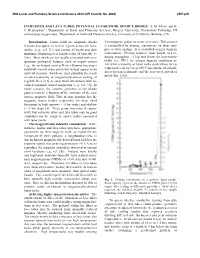
49th Lunar and Planetary Science Conference 2018 (LPI Contrib. No. 2083) 2587.pdf INTRUSIVES AND LAVA TUBES: POTENTIAL LUNAR SWIRL SOURCE BODIES? S. M. Tikoo1 and D. J. Hemingway2, 1Department of Earth and Planetary Sciences, Rutgers University, Piscataway Township, NJ (stikoo@eps.rutgers.edu), 2Department of Earth and Planetary Science, University of California, Berkeley, CA. Introduction: Lunar swirls are enigmatic albedo ferromagnetic grains or create new ones. This process features that appear in several regions across the lunar is exemplified by heating experiments on lunar sam- surface (e.g., ref. [1]) and consist of bright and dark ples or their analogs in a controlled oxygen fugacity markings alternating over length scales of typically 1– environment. Heating synthetic mare basalts in a re- 5 km. Most swirls are not readily associated with con- ducing atmosphere ~1 log unit below the iron-wustite spicuous geological features, such as impact craters buffer (i.e., IW-1; the oxygen fugacity conditions in- (e.g., the archetypal swirl at Reiner Gamma lies atop a ferred for a majority of lunar rocks studied thus far) to relatively smooth mare plain) but instead appear to be temperatures in excess of 600°C has produced subsoli- surficial in nature. Swirls are most plausibly the result dus reduction of ilmenite and the associated growth of metal (Fig. 1) [6]. of electrostatically or magnetically-driven sorting of regolith fines [2,3] or solar wind interactions with lo- calized remanent crustal magnetism (e.g., ref. [4]). In either scenario, the complex geometry of the albedo pattern must be a function of the structure of the near surface magnetic field. -
"Blue Moon" to Shine on New Year's Eve 1 2 for the First Time in Almost
1 "Blue Moon" to Shine on New Year's Eve 2 3 For the first time in almost 20 years, a bright "blue moon" will grace New Year's Eve celebrations worldwide. If the skies 4 are clear, revelers looking up at midnight will get an eyeful of the second full moon of the month—commonly called a 5 blue moon. The last time a blue moon appeared on New Year's Eve was in 1990, and it won't happen again until 2028. A 6 blue moon isn't actually blue—as commonly defined, the name reflects the relative rarity of two full moons in a month 7 and is linked to the saying "once in a blue moon." With this New Year's Eve blue moon, "there is nothing scientific about 8 it, and it has no astronomical significance," said Mark Hammergren, a staff astronomer at the Adler Planetarium in 9 Chicago, Illinois. "But I believe it does give us some insight into history and makes us think of how our calendar system 10 has derived from motions of objects in the sky." 11 12 Blue Moon Error 13 The popular definition of a blue moon isn't the only one—and it's one that's based on an editorial error, astronomers 14 contend. 15 The widespread definition of the second full moon in a month stems from errors made in an astronomy magazine, when a 16 writer misinterpreted how the term was used in the Maine Farmer's Almanac. Later studies of almanacs published from 17 1819 to 1962 revealed that the term "blue moon" actually refers to the "extra" full moon that can occur in a year due to 18 differences between the calendar year and the astronomical year. -

Sky This Month May 2019
Mother’s Day The Sky This Month Edition RASC Recreational Astronomy for Apr 24th to May 21st Location: M.A.M.A. Prepared by: Bryon Czarnik !1 Mother’s Luna and Sol Dates . Day Edition • Luna [Gr. Selene] rides her chariot across the night sky, while her brother, Sol [Gr. Helios], rests � Last Qtr � Earth Day 6:18 pm Moon Apogee � 404,576 km New Moon 2:21 pm 6:45 pm � First Qtr 9:12 pm Int’l Astronomy Day Mothers Day Moon Perigee � 369,015 km Full Moon � 5:54 pm � 5:11 pm Flower Moon, Corn Planting Moon, and Milk Moon Tigmiyikvik (Inuit), “time when ducks & geese return from south” Blue Moon (3rd full moon in astro. season with 4 full moons) Hunter’s Moon (S Hemisphere) Native Full Moon Names: http://americanindian.net/moons.html !2 Mother’s Luna and Sol Dates . Day Edition • Luna [Gr. Selene] rides her chariot across the night sky, while her brother, Sol [Gr. Helios], rests � Last Qtr � Earth Day 6:18 pm Moon Apogee � 404,576 km New Moon 2:21 pm 6:45 pm Sunrise / Sunset (Daylight) Astronomical Twilight (Night) Apr 24 6:20 am / 8:11 pm (13:51) 4:32 am / 10:00 pm (6:32) � May 21 5:46 am / 8:41 pm (14:55) 3:39 am / 10:49 pm (4:50) First Qtr 9:12 pm Int’l Astronomy Day Mothers Day Moon Perigee � 369,015 km Full Moon � 5:54 pm � 5:11 pm Flower Moon, Corn Planting Moon, and Milk Moon Tigmiyikvik (Inuit), “time when ducks & geese return from south” Blue Moon (3rd full moon in astro. -
Guide to the Night Sky 2021
The Manx Night Sky 2021 Highlights 2021 Jan 4 - Quadrantids maximum. Mar 5 - Jupiter and Mercury conjunction 0.19’ apart. Apr 22. - Lyrid meteor shower maximum. May 29 - Venus and Mercury close in PM sky. Jun 10 - Annular eclipse, Partial (25%) from IOM. Jul 13 - Venus and Mars conjunction 0.24’apart. Aug 2 - Saturn at opposition. Aug 12 - Perseid meteor shower maximum. Aug 20 - Jupiter at opposition. Oct 3 - Grazing occultation of η Leonis (mag 3.5). Nov 19 - Partial lunar eclipse, Visible at Moonset IOM. Dec 7 - Venus at brightest in evening sky (Mag -4.7). Dec 14 - Geminids meteor shower. Dec 29 - Venus and Mercury close in PM sky. The January 2021 Manx Night Sky January 2 - Earth at perigee. 147,093,163 km from Sun. January 3, 4 - Quadrantids Meteor Shower (80 ZHR). The shower runs to 12 January, peaking on the 3rd/4th. The Moon is full on Dec 30th so will interfere but minimally as the shower is in the north. Meteors tend to leave fine trains. January 9 to 14 – Moon, Mercury, Jupiter and Saturn close. January 11 - Venus and waning crescent Moon conjunction. January 13 - New Moon. This is the best time of the month to observe faint objects as there is no moonlight to interfere. January 24 – Mercury at Greatest Eastern Elongation (PM) The planet Mercury reaches greatest eastern elongation of 18.6 degrees from the Sun. Look in western sky after sunset. January 25 – Moon occults M35 cluster in Gemini. January 28 – Full Moon at 19:18 UT. The February 2021 Manx Night Sky February 1 to 3 – Mercury just visible in dusk sky. -

FARSIDE Probe Study Final Report
Study Participants List, Disclaimers, and Acknowledgements Study Participants List Principal Authors Jack O. Burns, University of Colorado Boulder Gregg Hallinan, California Institute of Technology Co-Authors Jim Lux, NASA Jet Propulsion Laboratory, California Institute of Andres Romero-Wolf, NASA Jet Propulsion Laboratory, California Technology Institute of Technology Lawrence Teitelbaum, NASA Jet Propulsion Laboratory, California Tzu-Ching Chang, NASA Jet Propulsion Laboratory, California Institute of Technology Institute of Technology Jonathon Kocz, California Institute of Technology Judd Bowman, Arizona State University Robert MacDowall, NASA Goddard Space Flight Center Justin Kasper, University of Michigan Richard Bradley, National Radio Astronomy Observatory Marin Anderson, California Institute of Technology David Rapetti, University of Colorado Boulder Zhongwen Zhen, California Institute of Technology Wenbo Wu, California Institute of Technology Jonathan Pober, Brown University Steven Furlanetto, UCLA Jordan Mirocha, McGill University Alex Austin, NASA Jet Propulsion Laboratory, California Institute of Technology Disclaimers/Acknowledgements Part of this research was carried out at the Jet Propulsion Laboratory, California Institute of Technology, under a contract with the National Aeronautics and Space Administration. The cost information contained in this document is of a budgetary and planning nature and is intended for informational purposes only. It does not constitute a commitment on the part of JPL and/or Caltech © 2019. -
Science Concept 7: the Moon Is a Natural Laboratory for Regolith Processes and Weathering on Anhydrous Airless Bodies
Science Concept 7: The Moon is a Natural Laboratory for Regolith Processes and Weathering on Anhydrous Airless Bodies Science Concept 7: The Moon is a natural laboratory for regolith processes and weathering on anhydrous airless bodies Science Goals: a. Search for and characterize ancient regolith. b. Determine the physical properties of the regolith at diverse locations of expected human activity. c. Understand regolith modification processes (including space weathering), particularly deposition of volatile materials. d. Separate and study rare materials in the lunar regolith. INTRODUCTION The Moon is unmodified by processes that have changed other terrestrial planets, including Mars, and thus offers a pristine history of evolution of the terrestrial planets. Though Mars demonstrates the evolution of a warm, wet planet, water is an erosive substance that can erase a planet‘s geological history. The Moon, on the other hand, is anhydrous. It has never had liquid water on its surface. The Moon is also airless, as opposed to the Venus, the Earth, and Mars. An atmosphere, too, is a weathering component that can distort a planet‘s geologic history. Thus, the Moon offers a pristine history of the evolution of terrestrial planets that can increase our understanding of the formation of all rocky bodies, including the Earth. Additionally, the Moon offers many resources that can be exploited, from metals like iron and titanium to implanted volatiles like hydrogen and helium. There is evidence for water at the poles in permanently shadowed regions (PSRs) (Nozette et al., 1996). Such volatiles could not only support human exploration and habitation on the Moon, but they could also be the constituents for fuel or fuel cells to propel explorers to farther reaches of the Solar System (NRC, 2007). -
2018 Spring VAS Newsletter
Morning Star Spring 2018 Contents Every 2 years and 50 days, Mars and New Members ____________Pg 1 New Members Earth have "close encounters" with Meetings ________________ Pg 1-3 each other. Approximately every 15.7 Apr 2 Mars - Summer Viewing 2018 VAS welcomes the following new years, Mars has a closer than typical ap- May 7 Annual Banquet & Business Meeting member who joined us since the last proach to Earth. In the summer of June 4 A Tale of Two Observatories newsletter: 2018 Mars will have one of these closer Events ___________________Pg 2-3 Robert Diehl approaches called a Perihelic Opposi- -VAS Events Maura Kelley tion (described in more detail in the - Public Star Gazing Larry Dallamura talk). At that time, amateur size tele- - GMAAA Events Ron Russotti scopes will have some reasonable views Articles __________________ Pg 3-5 Dana DeWitt of Martian surface features. Mars is the - NASA’s Space Place Article Sandra Romero Diez only planet in our Solar System (besides - M33 Earth of course) that we have a reason- - NGC 7822/Ced 214 Meetings/Presentations able chance of seeing the actual surface Board Talk ____________ Pg 5-8 features (the Moon doesn't count- it's a moon). Several major Martian surface - Board Minutes Meetings are held the first (non-holi- - Committee Updates features are readily visible in a good day) Monday of the month, at 7:30 P.M. telescope. Mars is a dynamic planet Observer’s Page _________Pg 8-14 in the Kolvoord Community Room of - The Super-Moon, Blue-Moon, Total with surface features that show subtle the Brownell Library, 6 Lincoln St., changes over time due to the effects of Eclipse of the Moon Essex Jct (2nd building north of Essex - Asteroid News the Martian atmosphere. -

Private Sector Lunar Exploration Hearing
PRIVATE SECTOR LUNAR EXPLORATION HEARING BEFORE THE SUBCOMMITTEE ON SPACE COMMITTEE ON SCIENCE, SPACE, AND TECHNOLOGY HOUSE OF REPRESENTATIVES ONE HUNDRED FIFTEENTH CONGRESS FIRST SESSION SEPTEMBER 7, 2017 Serial No. 115–27 Printed for the use of the Committee on Science, Space, and Technology ( Available via the World Wide Web: http://science.house.gov U.S. GOVERNMENT PUBLISHING OFFICE 27–174PDF WASHINGTON : 2017 For sale by the Superintendent of Documents, U.S. Government Publishing Office Internet: bookstore.gpo.gov Phone: toll free (866) 512–1800; DC area (202) 512–1800 Fax: (202) 512–2104 Mail: Stop IDCC, Washington, DC 20402–0001 COMMITTEE ON SCIENCE, SPACE, AND TECHNOLOGY HON. LAMAR S. SMITH, Texas, Chair FRANK D. LUCAS, Oklahoma EDDIE BERNICE JOHNSON, Texas DANA ROHRABACHER, California ZOE LOFGREN, California MO BROOKS, Alabama DANIEL LIPINSKI, Illinois RANDY HULTGREN, Illinois SUZANNE BONAMICI, Oregon BILL POSEY, Florida ALAN GRAYSON, Florida THOMAS MASSIE, Kentucky AMI BERA, California JIM BRIDENSTINE, Oklahoma ELIZABETH H. ESTY, Connecticut RANDY K. WEBER, Texas MARC A. VEASEY, Texas STEPHEN KNIGHT, California DONALD S. BEYER, JR., Virginia BRIAN BABIN, Texas JACKY ROSEN, Nevada BARBARA COMSTOCK, Virginia JERRY MCNERNEY, California BARRY LOUDERMILK, Georgia ED PERLMUTTER, Colorado RALPH LEE ABRAHAM, Louisiana PAUL TONKO, New York DRAIN LAHOOD, Illinois BILL FOSTER, Illinois DANIEL WEBSTER, Florida MARK TAKANO, California JIM BANKS, Indiana COLLEEN HANABUSA, Hawaii ANDY BIGGS, Arizona CHARLIE CRIST, Florida ROGER W. MARSHALL, Kansas NEAL P. DUNN, Florida CLAY HIGGINS, Louisiana RALPH NORMAN, South Carolina SUBCOMMITTEE ON SPACE HON. BRIAN BABIN, Texas, Chair DANA ROHRABACHER, California AMI BERA, California, Ranking Member FRANK D. LUCAS, Oklahoma ZOE LOFGREN, California MO BROOKS, Alabama DONALD S. -

Once in a Blue Moon: Airmen in Theater Command Lauris Norstad, Albrecht Kesselring, and Their Relevance to the Twenty-First Century Air Force
COLLEGE OF AEROSPACE DOCTRINE, RESEARCH AND EDUCATION AIR UNIVERSITY AIR Y U SIT NI V ER Once in a Blue Moon: Airmen in Theater Command Lauris Norstad, Albrecht Kesselring, and Their Relevance to the Twenty-First Century Air Force HOWARD D. BELOTE Lieutenant Colonel, USAF CADRE Paper No. 7 Air University Press Maxwell Air Force Base, Alabama 36112-6615 July 2000 Library of Congress Cataloging-in-Publication Data Belote, Howard D., 1963– Once in a blue moon : airmen in theater command : Lauris Norstad, Albrecht Kesselring, and their relevance to the twenty-first century Air Force/Howard D. Belote. p. cm. -- (CADRE paper ; no. 7) Includes bibliographical references. ISBN 1-58566-082-5 1. United States. Air Force--Officers. 2. Generals--United States. 3. Unified operations (Military science) 4. Combined operations (Military science) 5. Command of troops. I. Title. II. CADRE paper ; 7. UG793 .B45 2000 358.4'133'0973--dc21 00-055881 Disclaimer Opinions, conclusions, and recommendations expressed or implied within are solely those of the author and do not necessarily represent the views of Air University, the United States Air Force, the Department of Defense, or any other US government agency. Cleared for public release: distribution unlimited. This CADRE Paper, and others in the series, is available electronically at the Air University Research web site http://research.maxwell.af.mil under “Research Papers” then “Special Collections.” ii CADRE Papers CADRE Papers are occasional publications sponsored by the Airpower Research Institute of Air University’s (AU) College of Aerospace Doctrine, Research and Education (CADRE). Dedicated to promoting understanding of air and space power theory and application, these studies are published by the Air University Press and broadly distributed to the US Air Force, the Department of Defense and other governmental organiza- tions, leading scholars, selected institutions of higher learn- ing, public policy institutes, and the media. -
BLUE MOON COUNTDOWN the Purpose of This Chart Is to Highlight Some Very Peculiar Day Counts from the Blue Moon of July 31, 2015
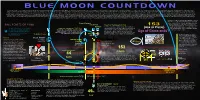
BLUE MOON COUNTDOWN The purpose of this chart is to highlight some very peculiar day counts from the Blue Moon of July 31, 2015. Blue Moons are somewhat rare and occur when there are 2 full Moons in a given month. The color of the Moon is not ‘blue’ but it has been named as such when this phenomenon occurs. The next Blue Moon won’t occur until 2018. What is very peculiar is that a Jewish feast falls on this date. In 2015 the Blue Moon occurs on Tu B’Av. This is the minor Jewish feast equivalent to Valentine’s Day in the West. It really commemorates the taking or ‘rapturing’ of the maidens for brides by the tribe of Benjamin. This took place after a disastrous civil war in Israel that jeopardized the bloodline. It is a Biblical case of the mess that YHVH’s People makes due to sin and how YHVH turns what was meant for evil into something good. The Blue Moon countdown involves the intelligent design of the clockwork of the celestial bodies. Indeed as Genesis declares the schedule of the Creator is encoded in the Sun, Moon and Stars. They serve as signals for Humanity and particularly for YHVH’s People. Such bodies provide ‘signals’ that keeps prophetic time. YHVH has encoded certain clues to His Beloved of the prophetic time it is to get her ready because her work in the ‘vineyard’ is about to end. Perhaps this Tu B’Av that ‘coincides’ with the Blue Moon is but such a signal.