Weekly News Digest on Georgia May 11-18, 2021
Total Page:16
File Type:pdf, Size:1020Kb
Load more
Recommended publications
-
N E W S L E T T E R
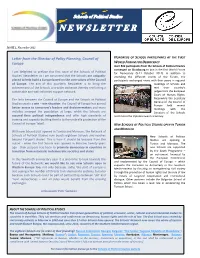
Schools of Political Studies ISSUE 1, November 2012 ISSUE 0, October 2012 N E W S L E T T E R ISSUE 1 , November 2012 ISSUE 0, October 2012 Letter from the Director of Policy Planning, Council of HUNDREDS OF SCHOOL PARTICIPANTS AT THE FIRST Europe WORLD FORUM FOR DEMOCRACY Over 500 participants from the Schools of Political Studies converged on Strasbourg to join in the first World Forum I am delighted to preface this first issue of the Schools of Political for Democracy (5-11 October 2012). In addition to Studies’ Newsletter as I am convinced that the Schools are uniquely- attending the different events of the Forum, the placed to help build a Europe based on the core values of the Council participants exchanged views with their peers in regional of Europe. The aim of this quarterly Newsletter is to bring the meetings of Schools and achievements of the Schools to a wider audience thereby reinforcing a met their country’s sustainable and well-informed support network. judges from the European Court of Human Rights. The links between the Council of Europe and the Schools of Political Meanwhile the Secretary General of the Council of Studies create a win – win situation: the Council of Europe has gained Europe held several better access to tomorrow’s leaders and decision-makers and more meetings with the visibility amongst the population at large; whilst the Schools are Directors of the Schools assured their political independence and offer high standards of and hosted the diploma award ceremony. training and capacity-building thanks to the umbrella protection of the Council of Europe ‘label’. -

Azerbaijani Settlements of the Gardabani Municipality
Unknown Suburbs: Azerbaijani Settlements of the Gardabani Municipality 2020 POLICY STUDY Unknown Suburbs: Azerbaijani Settlements of the Gardabani Municipality Aleksandre Kvakhadze POLICY STUDY 2020 Introduction Since declaring its independence, the Georgian state has been struggling with the integration of its ethnic minorities. The regions densely populated by ethnic Azerbaijanis and Armenians have been passively involved in the social and political processes in Georgia. The combination of the legacy of Soviet ‘national policy,’ an ineffective educational system and socio-economic problems hinder the integration of these regions. This paper will be devoted to the Gardabani municipality, an administrative entity with a significant Azerbaijani population. Several factors have determined the choice of this region for this study. Firstly, geographically speaking, the region represents a suburban area of the cities of Tbilisi and Rustavi. It can be considered as a part of ‘greater Tbilisi/Rustavi’ or a ‘Tbilisi-Rustavi agglomeration.’ Secondly, despite its proximity to Georgia’s political and economic center, the Azerbaijani community in this region has been leading a parallel life and is disconnected from the country’s social and political dynamics. Simultaneously, very little is known about this region and very little research has been carried out on its multi-ethnic population. Unlike the neighboring Marneuli municipality, which has been receiving increasing attention from academia, the media and the non-governmental sector, the Azerbaijani population in Garbadani remains neglected by academic and non-governmental bodies. For instance, there is no comprehensive academic research on the linguistic, historical, ethnologic, social and religious parameters of Azerbaijanis in Gardabani. The absence of reliable works leads to myths and uncertainties regarding Georgia’s Azerbaijanis. -
Annual Report 2009
1 2 In summer 2008, Division of National/Ethnic Minority Issues and Division of Civil Integration were established under the Office of the State Minister of Georgia for Reintegration. It is noteworthy that the staff members of these two divisions are the representatives of national minorities in Georgia (Azeris, Armenians, and Chechens). Prior to this, the Civil Integration and Tolerance Council functioning under President of Georgia has been working on the elaboration of the “National Concept for Tolerance and Civic Integration” and its five-year Action Plan. Several on-site visits in the regions compactly settled with national minorities (Kvemo Kartli, Kaspi district of Shida Kartli region settled compactly with ethnic Azeris, Samtskhe-Javakheti and Kakheti regions settled with ethnic Ossetians, Azeris, Armenians, Assyrians, Udins, Lezghins, Roma, Kists) have been organized with a purpose to make more effective the functioning of the Office and to enhance competence. During on-site visits in the regions, several meetings have been conducted with the representatives of the local self-governments as well as with the local population. On-site visits enabled us to get information on the existing condition and considerably promoted our effective involvement in the elaboration of the National Concept. With the cooperation of the Civil Integration and Tolerance Council functioning under President of Georgia the “National Concept for Tolerance and Civic Integration” and Action Plan has been approved by the governmental decree №348 of 8 May 2009. According to the National Concept, the Office of the State Minister has been entitled for the elaboration and coordination of the policy as well as for the presentation of the annual reports (on December of each year) on the implementation of the Action Plan for Tolerance and Civic Integration to the Government of Georgia and Civil Integration and Tolerance Council functioning under President of Georgia. -

Political Prisoners in Post- Revolutionary Georgia
After the rose, the thorns: political prisoners in post- revolutionary Georgia Article 1: All human beings are born free and equal Article 1: All human beings are born free and equal in dignity and rights. They are endowed with reason and conscience and should act towards one another in a in dignity and rights. They are endowed with reason and conscience and should act towards one another in a spirit of brotherhood. Article 2: Everyone is entitled to all the rights and freedoms set forth in this Declaration, spirit of brotherhood. Article 2: Everyone is entitled to all the rights and freedoms set forth in this Declaration, without distinction of any kind, such as race, colour, sex, language, religion, political or other opinion, national without distinction of any kind, such as race, colour, sex, language, religion, political or other opinion, national or social origin, property, birth or other status. Furthermore, no distinction shall be made on the basis of the or social origin, property, birth or other status. Furthermore, no distinction shall be made on the basis of the political, jurisdictional or international status of the country or territory to which a person belongs, whether it political, jurisdictional or international status of the country or territory to which a person belongs, whether it be independent, trust, non-self-governing or under any other limitation of sovereignty. Article 3: Everyone has be independent, trust, non-self-governing or under any other limitation of sovereignty. Article 3: Everyone has the right to life, liberty and security of person. Article 4: No one shall be held in slavery or servitude; slavery and the the right to life, liberty and security of person. -
Update to the Market Analysis Kvemo Kartli
UPDATE TO THE MARKET ANALYSIS KVEMO KARTLI ALLIANCES LESSER CAUCASUS PROGRAMME INTRODUCTION ............................................................................................................................................... 2 SUMMARY MARKET ANALYSIS ........................................................................................................................ 2 THE KEY CHARACTERISTICS OF THE EXPANDED PROGRAMME AREA ............................................................... 7 The Programme Area ..................................................................................................................................... 7 Summary of the poulation ............................................................................................................................. 9 CORE MARKET SYSTEMS ................................................................................................................................ 10 DAIRY: COWS, BUFFALO, SHEEP ............................................................................................................................... 10 Summary ...................................................................................................................................................... 10 Womens roles in the dairy sector ................................................................................................................. 11 MEAT ................................................................................................................................................................. -

European Parliament
EUROPEAN PARLIAMENT 2004 2009 Session document 26.11.2007 B6-0492/2007 MOTION FOR A RESOLUTION to wind up the debate on statements by the Council and Commission pursuant to Rule 103(2) of the Rules of Procedure by Jan Marinus Wiersma, Hannes Swoboda and Alexandra Dobolyi on behalf of the PSE Group on the situation in Georgia RE\696717EN.doc PE398.148v01-00 EN EN B6-0492/2007 European Parliament resolution on the situation in Georgia The European Parliament, – having regard to the Partnership and Cooperation Agreement between the European Union and Georgia, which entered into force on 1 July 1999, – having regard to the inclusion of Georgia in the EU’s European Neighbourhood Policy and the endorsement of the Action Plan by the EU-Georgia Cooperation Council on 14 November 2006, – having regard to its previous resolutions on relations with the region, in particular its resolutions of February 2004 on EU policy towards the countries of the South Caucasus and of October 2006 on relations with Georgia, – having regard to its report on the European Neighbourhood Policy adopted in November 2007, – having regard to the recommendations adopted by the EU-Georgia Parliamentary Cooperation Committee on 25-26 June 2007, – having regard to the declaration of 8 November 2007 by the Presidency on behalf of the European Union on the current situation in Georgia, – having regard to the conclusions of the eighth meeting of the EU-Georgia Cooperation Council held in Luxembourg on 16 October 2007, – having regard to Rule 103(2) of its Rules of Procedure, A. whereas the European Union is strongly committed to further strengthening its relations with Georgia; whereas the European Union therefore gives its full support to the economic and social development of Georgia as well as to the further development of its democratic institutions, full observance of democratic standards and procedures and full respect for the rule of law in the country, B. -

Realizing the Urban Potential in Georgia: National Urban Assessment
REALIZING THE URBAN POTENTIAL IN GEORGIA National Urban Assessment ASIAN DEVELOPMENT BANK REALIZING THE URBAN POTENTIAL IN GEORGIA NATIONAL URBAN ASSESSMENT ASIAN DEVELOPMENT BANK Creative Commons Attribution 3.0 IGO license (CC BY 3.0 IGO) © 2016 Asian Development Bank 6 ADB Avenue, Mandaluyong City, 1550 Metro Manila, Philippines Tel +63 2 632 4444; Fax +63 2 636 2444 www.adb.org Some rights reserved. Published in 2016. Printed in the Philippines. ISBN 978-92-9257-352-2 (Print), 978-92-9257-353-9 (e-ISBN) Publication Stock No. RPT168254 Cataloging-In-Publication Data Asian Development Bank. Realizing the urban potential in Georgia—National urban assessment. Mandaluyong City, Philippines: Asian Development Bank, 2016. 1. Urban development.2. Georgia.3. National urban assessment, strategy, and road maps. I. Asian Development Bank. The views expressed in this publication are those of the authors and do not necessarily reflect the views and policies of the Asian Development Bank (ADB) or its Board of Governors or the governments they represent. ADB does not guarantee the accuracy of the data included in this publication and accepts no responsibility for any consequence of their use. This publication was finalized in November 2015 and statistical data used was from the National Statistics Office of Georgia as available at the time on http://www.geostat.ge The mention of specific companies or products of manufacturers does not imply that they are endorsed or recommended by ADB in preference to others of a similar nature that are not mentioned. By making any designation of or reference to a particular territory or geographic area, or by using the term “country” in this document, ADB does not intend to make any judgments as to the legal or other status of any territory or area. -

Five Ministers Fired, Two Re-Assigned
11/12/2014 The Messenger - Five ministers fired, two re-assigned Home About Us Subscription E-mail Us ► Environment ► Green Issues ► Green Friendly ► Energy and Green Five ministers fired, two re-assigned By Gvantsa Gabekhadze Tuesday, July 22 For the first time since taking office, a government reshuffle took place on July 21. Prime Minister Irakli Gharibashvili fired five ministers and moved two others into other duties. Gharibashvili stressed that the changes were created after Georgia’s signing of the Association Agreement (AA) with EU. Gharibashvili claims that the cabinet turnover is not yet complete. The PM informed that he would name the candidates that will replace these ministers, either on Tuesday or Wednesday. Minister of Agriculture Shalva Pipia, Minister of Natural Resources and Environmental Protection Khatuna Gogaladze, Minister of Refugees and Accommodation Davit Darakhvelidze, Minister of Culture and Monument Protection Guram Odisharia, State Minister of Georgia for Diaspora Issues Konstantine Surguladze-are the ministers who have been dismissed. Those reshuffled into another position are Minister of Correction of Georgia Sozar Subari and Minister of Regional Development and Infrastructure Elguja Khokrishvili. Subari will take the post of the Minister for Internally Displaced Persons and Accommodation; Khokrishvili will replace Gogaladze on the position of the Minister of Environment. Gharibashvili stressed that Georgia has already undergone several vital “exams”, from conducting fair elections to signing the AA. The PM stressed that the government required new energy and motivation to meet all the promises given to the population and the demands of the international community. “I think we should move to another mode, more pace is required as we are facing new challenges,” Gharibashvili said. -

Georgia [Republic]: Recent Developments and U.S
Georgia [Republic]: Recent Developments and U.S. Interests Jim Nichol Specialist in Russian and Eurasian Affairs May 18, 2011 Congressional Research Service 7-5700 www.crs.gov 97-727 CRS Report for Congress Prepared for Members and Committees of Congress Georgia [Republic]: Recent Developments and U.S. Interests Summary The small Black Sea-bordering country of Georgia gained its independence at the end of 1991 with the dissolution of the former Soviet Union. The United States had an early interest in its fate, since the well-known former Soviet foreign minister, Eduard Shevardnadze, soon became its leader. Democratic and economic reforms faltered during his rule, however. New prospects for the country emerged after Shevardnadze was ousted in 2003 and the U.S.-educated Mikheil Saakashvili was elected president. Then-U.S. President George W. Bush visited Georgia in 2005, and praised the democratic and economic aims of the Saakashvili government while calling on it to deepen reforms. The August 2008 Russia-Georgia conflict caused much damage to Georgia’s economy and military, as well as contributing to hundreds of casualties and tens of thousands of displaced persons in Georgia. The United States quickly pledged $1 billion in humanitarian and recovery assistance for Georgia. In early 2009, the United States and Georgia signed a Strategic Partnership Charter, which pledged U.S. support for democratization, economic development, and security reforms in Georgia. The Obama Administration has pledged continued U.S. support to uphold Georgia’s sovereignty and territorial integrity. The United States has been Georgia’s largest bilateral aid donor, budgeting cumulative aid of $2.7 billion in FY1992-FY2008 (all agencies and programs). -

14 April 2020 Oil and Gas Sector of GEORGIA in the Transition Period
Teimuraz Gochitashvili Oil and Gas Sector of GEORGIA in the Transition Period TBILISI 2020 უაკ (UDC) 622.691 622.24 Teimuraz Gochitashvili OIL AND GAS SECTOR OF GEORGIA IN THE TRANSITION PERIOD Tbilisi, 2020 The publication deals with the current state of oil and gas sector, prospects for its development and energy security of Georgia; it also focuses on regional oil and gas potential, production and delivery prospects to the European market. Special attention is paid to the transit and inland transmission pipelines, their reliability and safety, preconditioning security of supply to local and European markets. It also highligths the issues of harmonization of Georgian energy legislation with the European one and institutional structures as well as the integration of the market into the single energy space, discussing the corresponding legal grounds. The information presented in this publication, including assessments of the current state of the sector and scenarios for the development of the natural gas market, reflects only the personal opinion of the author, is not related to his job responsibilities and not reproduce the views or positions of his employer or government bodies Editor - Dr. Teimuraz Javakhishvili Language Editor – Tekla Gabunia All rights reserved by the legislation of Georgia „Meridian“ Publishing House, 2020 ISBN 978-9941-25-866-4 2 Acknowledgements I would like to acknowledge the help and support of my colleagues from Georgian Oil and Gas Corporation, including Dr. Soso Gudushauri, Dr. David Tsitsishvili. Ms. Liana Lomidze, Ms. Ia Goisashvili, Mr. Archil Dekanosidze, Mr. Suliko Tsintsadze, Mr. Irakli Chachibaia and others. I am also deeply indebted to many people, including those engaged in the energy sector of Georgia, who have discussed the issues in the publication. -
Environmental and Socio-Economic Implications of the Mining Sector
ENVIRONMENTAL AND SOCIO-ECONOMIC IMPLICATIONS OF THE MINING SECTOR AND PROSPECTS OF RESPONSIBLE MINING IN GEORGIA The study was prepared within the framework of the project 'Promoting Environmental and Social Accountability in the Mining Sector in the Caucasus', which is being implemented with the financial support of the Bread for the World Protestant Development Service (BftW). The content of the publication is the responsibility of the implementing organisation alone. 2 CONTENT INTRODUCTION 5 1. Mineral reSourceS of GeorGia anD The hiSTory of Their MininG anD ProceSSing 7 1.1 Brief DeScriPTion of Mineral reSources 7 1.2 Brief hiSTory of MininG in GeorGia 7 1.3 DynaMicS of The DeveloPMenT of MininG inDuSTry in GeorGia 9 1.3.1 SoliD MineralS 9 1.3.2 oil anD Gas 10 2. GeorGian laWS anD inSTiTuTional SeT-uP relaTeD To MininG 13 2.1 naTional leGiSlaTion 13 2.1.1 conSTiTuTion of GeorGia 13 2.1.2 laW of GeorGia on enTrailS of The earTh 13 2.1.3 laW of GeorGia on licenceS anD PerMits 13 2.1.4 laW of GeorGia on environMenTal ProTecTion 14 2.1.5 laW of GeorGia on culTural heriTaGe 14 2.1.6 oTher reGulaTionS relaTeD To culTural heriTaGe 14 2.1.7 inTernaTional convenTionS relaTeD To culTural heriTaGe raTifieD By GeorGia 14 2.2 inSTiTuTional fraMeWork of The GeorGian MininG inDuSTry 15 2.2.1 STaTe inSTiTuTionS anD Their ManDaTes 15 2.2.2 inTeraGency cooPeraTion 17 3. inTernaTional DeveloPMenT orGanizaTionS acTive in GeorGia anD caTeGorieS of DeveloPMenT Projects 19 4. STa.TiSTicS of inveSTMenTS MaDe in The MininG SecTor of GeorGia (2009-2015) 23 4.1 aMounT of inveSTMents 23 4.2 inveSTMenT SourceS 24 5. -

Situation of Human Rights in Georgia October 2006 Since the Coming Into Power of Mr
Note Situation of Human Rights in Georgia October 2006 Since the coming into power of Mr. Mikhaïl Saakaschvili at the favor of the so-called “roses’ revolution”, local and international organisations observe regular deterioration of fundamental freedoms. The violations of rights and freedoms are encouraged by a very personalised and authoritarian sense of power from the President. The first consequences of it are the exessive use of violence et and the impunity by law-enforcement bodies, repression and harassment against journalists, human right defenders, etc... This also contributed to conflictual situations at both internal (minorities and separatist regions of Abkhazia and South Ossetia) and external (recent break of diplomatic relations with Russia) levels. This new escalation of internal and external tension can provoke a serious deterioration of the situation of civilian population of Georgia and lies within the on-going agravation of a general human rights situation. A. Torture, ill treatments and excessive use of force Use of torture and ill treatments by law enforcement officials FIDH and Human Rights Information and Documentation Center (HRIDC), member of FIDH, strongly condemn the increase of torture, inhuman and humiliating treatments especially by law enforcement bodies. Despite the fact that, NGOs and UN human rights mechanisms reported numerous cases of torture committed by police officers, the impunity of their perpetrators is still a reality. In his annual report to the 62nd Commission on human rights (march 2006) and following a mission to Georgia, the Special Rapporteur on torture and other cruel, inhuman or degrading treatment or punishment, declared that “torture and ill-treatment by law enforcement officials still exist in Georgia” and that “ the methods of torture included beatings with fists, butts of guns and truncheons and the use of electric shocks, and cigarette burns; injuries sustained by the victims included, among other things, broken bones, cigarette burns, scars, as well as neuropsychological changes”.