Plant Guide for Shortspine Horsebrush (Tetradymia Spinosa)
Total Page:16
File Type:pdf, Size:1020Kb
Load more
Recommended publications
-

Unmarked Plants Were Observed on Hike Within Boundary of De-Na-Zin Badlands Wilderness
Plants of De-Na-Zin Badlands [San Juan Co(s), New Mexico] Observed on CONPS fieldtrip, 4/23/2007 to 4/23/2007 Leader(s): Arnold Clifford, AL Schneider; Recorder(s); Loraine Yeatts, Jan Turner, John Bregar, Travis Ward Scientific Name Synonym Common Name Agavaceae (formerly in Liliaceae) Agave 1. Yucca harrimaniae Harriman yucca Alliaceae (formerly in Liliaceae) Onion 2. Allium macropetalum San Juan onion 3. Androstephium breviflorum Wild hyacinth, funnel lily Apiaceae (Umbelliferae) Parsley 4. Cymopterus acaulis var. (C. fendleri, C. decipiens) Springparsley fendleri 5. Cymopterus bulbosus Onion spring-parsley Asteraceae (Compositae) Sunflower 6. Artemisia bigelovii Bigelow sagebrush / wormwood 7. Artemisia ludoviciana Praire sagewort 8. Chrysothamnus nauseosus ssp. Rubber rabbitbrush graveolens 9. Gutierrezia sarothrae (Xanthocephalum sarothrae) Broom snakeweed 10. Gutierrezia sarothrae (Xanthocephalum sarothrae) Broom snakeweed 11. Hymenopappus filifolius Fineleaf hymenopappus 12. Machaeranthera grindelioides Gumweed aster 13. Malacothrix sonchoides Sowthistle malacothrix 14. Packera multilobata (Senecio multilobatus) Uinta groundsel 15. Petradoria pumila (Solidago petradoria) Rock goldenrod 16. Picrothamnus desertorum (Artemisia spinescens) Budsage 17. Platyschkuhria integrifolia var. Desert bahia oblongifolia 18. Seriphidium tridentatum (Artemisia tridentata) Big sagebrush 19. Tetraneuris ivesiana (Hymenoxys acaulis var. ivesiana) Stemless woollybase 20. Townsendia annua Annual townsendia 21. Townsendia incana Silvery townsendia Boraginaceae -

December 2012 Number 1
Calochortiana December 2012 Number 1 December 2012 Number 1 CONTENTS Proceedings of the Fifth South- western Rare and Endangered Plant Conference Calochortiana, a new publication of the Utah Native Plant Society . 3 The Fifth Southwestern Rare and En- dangered Plant Conference, Salt Lake City, Utah, March 2009 . 3 Abstracts of presentations and posters not submitted for the proceedings . 4 Southwestern cienegas: Rare habitats for endangered wetland plants. Robert Sivinski . 17 A new look at ranking plant rarity for conservation purposes, with an em- phasis on the flora of the American Southwest. John R. Spence . 25 The contribution of Cedar Breaks Na- tional Monument to the conservation of vascular plant diversity in Utah. Walter Fertig and Douglas N. Rey- nolds . 35 Studying the seed bank dynamics of rare plants. Susan Meyer . 46 East meets west: Rare desert Alliums in Arizona. John L. Anderson . 56 Calochortus nuttallii (Sego lily), Spatial patterns of endemic plant spe- state flower of Utah. By Kaye cies of the Colorado Plateau. Crystal Thorne. Krause . 63 Continued on page 2 Copyright 2012 Utah Native Plant Society. All Rights Reserved. Utah Native Plant Society Utah Native Plant Society, PO Box 520041, Salt Lake Copyright 2012 Utah Native Plant Society. All Rights City, Utah, 84152-0041. www.unps.org Reserved. Calochortiana is a publication of the Utah Native Plant Society, a 501(c)(3) not-for-profit organi- Editor: Walter Fertig (walt@kanab.net), zation dedicated to conserving and promoting steward- Editorial Committee: Walter Fertig, Mindy Wheeler, ship of our native plants. Leila Shultz, and Susan Meyer CONTENTS, continued Biogeography of rare plants of the Ash Meadows National Wildlife Refuge, Nevada. -

Dieteria [Machaeranthera] Cansecens
HOARY TANSYASTER Dieteria (Machaeranthera) canescens (Pursh) Nutt. Asteraceae – Aster family Corey L. Gucker & Nancy L. Shaw | 2018 ORGANIZATION NOMENCLATURE Dieteria canescens (Pursh) Nutt. until recently Names, subtaxa, chromosome number(s), hybridization. (2010) was known as Machaeranthera canescens (Pursh) A. Gray (ITIS 2017; USDA NRCS 2017). This species belongs to the Astereae tribe of the Asteraceae family (Morgan Range, habitat, plant associations, elevation, soils. 2006) and will hereafter be referred to by its common name, hoary tansyaster. NRCS Plant Code. MACA2 (USDA NRCS 2017). Life form, morphology, distinguishing characteristics, reproduction. Subtaxa. The Flora of North America (Morgan 2006) recognizes ten varieties of hoary tansyaster: Dieteria canescens var. Growth rate, successional status, disturbance ecology, importance to canescens, ambigua, aristata, glabra, incana, animals/people. leucanthemifolia, nebraskana, sessiliflora, shastensis, and ziegleri. Current or potential uses in restoration. Synonyms (Morgan 2006). Dieteria canescens: Machaeranthera canescens (Pursh) A. Gray; Aster canescens Seed sourcing, wildland seed collection, seed cleaning, storage, Pursh testing and marketing standards. D. c. var. ambigua: M. canescens (Pursh) A. Gray var. ambigua B.L. Turner D. c. var. aristatus: A. canescens Pursh var. Recommendations/guidelines for producing seed. aristatus Eastwood; M. canescens (Pursh) A. Gray var. aristata (Eastwood) B.L. Turner; M. rigida Greene D. c. var. canescens: M. divaricata (Nuttall) Recommendations/guidelines for producing planting stock. Greene; M. laetevirens Greene; M. latifolia A. Nelson; M. pulverulenta (Nuttall) Greene; M. viscosa (Nuttall) Greene D. c. var. glabra: M. canescens (Pursh) A. Gray Recommendations/guidelines, wildland restoration successes/ var. glabra A. Gray; A. canescens Pursh var. failures. viridis A. Gray; M. linearis Greene D. -

Food Habits of Rodents Inhabiting Arid and Semi-Arid Ecosystems of Central New Mexico." (2007)
University of New Mexico UNM Digital Repository Special Publications Museum of Southwestern Biology 5-10-2007 Food Habits of Rodents Inhabiting Arid and Semi- arid Ecosystems of Central New Mexico Andrew G. Hope Robert R. Parmenter Follow this and additional works at: https://digitalrepository.unm.edu/msb_special_publications Recommended Citation Hope, Andrew G. and Robert R. Parmenter. "Food Habits of Rodents Inhabiting Arid and Semi-arid Ecosystems of Central New Mexico." (2007). https://digitalrepository.unm.edu/msb_special_publications/2 This Article is brought to you for free and open access by the Museum of Southwestern Biology at UNM Digital Repository. It has been accepted for inclusion in Special Publications by an authorized administrator of UNM Digital Repository. For more information, please contact disc@unm.edu. SPECIAL PUBLICATION OF THE MUSEUM OF SOUTHWESTERN BIOLOGY NUMBER 9, pp. 1–75 10 May 2007 Food Habits of Rodents Inhabiting Arid and Semi-arid Ecosystems of Central New Mexico ANDREW G. HOPE AND ROBERT R. PARMENTER1 Special Publication of the Museum of Southwestern Biology 1 CONTENTS Abstract................................................................................................................................................ 5 Introduction ......................................................................................................................................... 5 Study Sites .......................................................................................................................................... -
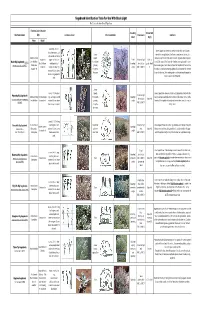
Sagebrush Identification Guide
Sagebrush Identification Table For Use With Black Light For Use in the Inter-Great Basin Area Fluoresces Under Ultraviolet Branching Mature Plant Plant Nomenclature Light Leaf shape and size Plant Growth Form Environment Comments Pattern Height Water Alcohol Leaves 3/4 ‐1 1/4 in. Uneven topped; Main stem is undivided and trunk‐like at base;. Located long; long narrow; Leaf Uneven normally in drainage bottoms; Small concave areas and valley floors, but will normally be 4 times Colorless to Very topped; always on deep Non‐saline Non‐calcareous soils. Vegetative leader is greater Brownish to longer than it is at its "V"ed Mesic to Frigid 3.5 ft. to Very Pale blue Floral stems than 1/2 the length of the flower stalk from the same single branch. In Basin Basin Big Sagebrush Artemisia Reddish‐Brown widest point; Leaf branching/ Xeric to Ustic greater than 8 tridentata subsp. tridentata (ARTRT) Rarely pale growing there are two growth forms: One the Typical tall form (Diploid); Two a shorter to colorless margins not extending upright 4000 to 8000 ft. ft. Brownish‐red throughout form that looks similar to Wyoming sagebrush if you do not look for the trunk outward; Crushed leaves the crown (around 1 inch or so); the branching pattern; and the seedhead to vegetative have a strong turpentine leader characteristics (Tetraploid). smell Uneven Leaves 1/2 ‐ 3/4 inches topped; Uneven topped; Main stem is usually divided at ground level. Plants will often Mesic to Frigid Wyoming Big Sagebrush Colorless to Very Colorless to pale long; Leaf margins curved Floral stems Spreading/ keep the last years seed stalks into the following fall. -

Attachment a - Biological Review, Report of Site Visit & Species Inventory
Attachment A - Biological Review, Report of Site Visit & Species Inventory From August 31 – September 2, 2014, Charles Britt conducted a pedestrian survey for all diurnal faunal and floral species along the proposed fiber optic line route for WNMT. Approximately 18 miles of cable to be placed. The project begins at milepost 28.28 on NM Highway 1, crosses NM Highway 1 at milepost 25.37, and crosses I-25 at milepost 116.572. It continues on State Route 107 at milepost 0 and ends at milepost 15.37. All three days had clear skies. Surveyor recorded all faunal and floral species observed within the Project Area/Action Area, taking photographs, and noting any features that may present potential impediments for the project The route traversed across six ecological sites. The Nolam gravelly sandy loam, 1 to 7 percent slopes (655) soil map unit is found in the R042XB035NM Gravelly Loam ecological site. This site usually occurs on nearly level to rolling piedmont slopes, hill slopes, fan remnants, or alluvial fans. Slopes range from 0 to 15 percent and occasionally reach 30 percent but average 4 to 9 percent. Elevations range from 4,300 to 5,000 feet. This site is not influenced by water from wetlands or streams. This ecological site is frequently associated with gravelly ecological sites. The historic plant community type is assumed to have exhibited dominance by black grama (Bouteloua eriopoda) and secondarily by bush muhly (Muhlenbergia porteri), Arizona cottontop (Digitaria californica) and/or cane bluestem (Bothriochloa barbinodis). Creosotebush (Larrea tridentata) and mesquite (Prosopis glandulosa) occur but are not co-dominants with grasses. -

Rare Plant Survey of San Juan Public Lands, Colorado
Rare Plant Survey of San Juan Public Lands, Colorado 2005 Prepared by Colorado Natural Heritage Program 254 General Services Building Colorado State University Fort Collins CO 80523 Rare Plant Survey of San Juan Public Lands, Colorado 2005 Prepared by Peggy Lyon and Julia Hanson Colorado Natural Heritage Program 254 General Services Building Colorado State University Fort Collins CO 80523 December 2005 Cover: Imperiled (G1 and G2) plants of the San Juan Public Lands, top left to bottom right: Lesquerella pruinosa, Draba graminea, Cryptantha gypsophila, Machaeranthera coloradoensis, Astragalus naturitensis, Physaria pulvinata, Ipomopsis polyantha, Townsendia glabella, Townsendia rothrockii. Executive Summary This survey was a continuation of several years of rare plant survey on San Juan Public Lands. Funding for the project was provided by San Juan National Forest and the San Juan Resource Area of the Bureau of Land Management. Previous rare plant surveys on San Juan Public Lands by CNHP were conducted in conjunction with county wide surveys of La Plata, Archuleta, San Juan and San Miguel counties, with partial funding from Great Outdoors Colorado (GOCO); and in 2004, public lands only in Dolores and Montezuma counties, funded entirely by the San Juan Public Lands. Funding for 2005 was again provided by San Juan Public Lands. The primary emphases for field work in 2005 were: 1. revisit and update information on rare plant occurrences of agency sensitive species in the Colorado Natural Heritage Program (CNHP) database that were last observed prior to 2000, in order to have the most current information available for informing the revision of the Resource Management Plan for the San Juan Public Lands (BLM and San Juan National Forest); 2. -

Flórula Vascular De La Sierra De Catorce Y Territorios Adyacentes, San Luis Potosi, México
Acta Botanica Mexicana 78: 1-38 (2007) FLÓRULA VASCULAR DE LA SIERRA DE CATORCE Y TERRITORIOS ADYACENTES, SAN LUIS POTOSI, MÉXICO ONÉSIMO GONZÁLEZ COSTILLA1,2, JOAQUÍN GIMÉNEZ DE AZCÁRATE3, JOSÉ GARCÍA PÉREZ1 Y JUAN RogELIO AGUIRRE RIVERA1 1Universidad Autónoma de San Luis Potosí, Instituto de Investigación de Zonas Desérticas, Altair 200, Fraccionamiento El Llano, Apdo. postal 504, 78377 San Luis Potosí, México. 2Universidad Complutense de Madrid, Departamento de Biología Vegetal II, Facultad de Farmacia, Madrid, España. onygc@yahoo.com.mx 3Universidad de Santiago de Compostela, Departamento de Botánica, Escuela Politécnica Superior, 27002 Lugo, España. RESUMEN La Sierra de Catorce, localizada en el norte del estado de San Luis Potosí, reúne algunas de las principales cimas del Desierto Chihuahuense cuyas cotas superan los 3000 metros. Ello ha favorecido que la Sierra sea una importante área de diversificación de la flora y las fitocenosis de dicha ecorregión. A partir del estudio fitosociológico de la vegetación del territorio, que se está realizando desde 1999, se ha obtenido un catálogo preliminar de su flora. Hasta el momento la lista de plantas vasculares está conformada por 526 especies y cuatro taxa infraespecíficos, agrupados en 293 géneros y 88 familias. Las familias y géneros mejor representados son Asteraceae, Poaceae, Cactaceae, Fabaceae, Fagaceae y Lamiaceae, así como Quercus, Opuntia, Muhlenbergia, Salvia, Agave, Bouteloua y Dyssodia, respectivamente. Asimismo se señalan los tipos de vegetación representativos del área que albergan los diferentes taxa. Por último, con base en diferentes listas de flora amenazada, se identificaron las especies incluidas en alguna de las categorías reconocidas. Palabras clave: Desierto Chihuahuense, estudio fitosociológico, flora, flora ame- nazada, México, San Luis Potosí, Sierra de Catorce. -

Population, Distríbutlon, Habitat Use and Natural History of Ord's Kangaroo Raf
The Untuersity of Manftoba Population, distríbutlon, habitat use and natural history of Ord's kangaroo raf. (Dipodomys ordil in the sand hill areas of / south-western Saskatchewan and south-eastern Al berta. by Raymond J. L. Kenny A thesis submitted to the Faculty of Graduate Studies in partlal fulfillment of the requirements for the degreee of Master of Science. Zoology Depar-tment Winnipeg, Manitoba March 1989 National Library Bibliothèque nationale w@w of Canada du Canada Canadian Theses Service Service des thèses canadiennes Ottawa, Canada t(1 A 0N4 The author has granted an irrevocable non- L'auteur a accordé une licence irrévocable et exclusive licence allowing the National Library non exclusive permettant à la Bibliothèque of Canada to reproduce, loan, distribute or sell nationale du Canada de reproduire, prêter, copies of his/her thesis by any means and in distribuer ou vendre des copies de sa thèse any form or format, mak¡ng this thesis available de quelque manière et sous quelque forme to interested persons. que ce soit pour mettre des exemplaires de cette thèse à la disposition des personnes intéressées. The author retains ownership of the copyright L'auteur conserve la propriété du droit d'auteur in his/her thesis. Neither the thesis nor qui protège sa thèse. Ni la thèse ni des extraits substantial extracts from it may be printed or substantiels de celle-ci ne doivent être otherwise reproduced without his/her per- imprimés ou autrement reproduits sans son mission. autorisation. rsBN 0-31-5-5168t-x CaNaadää POPULATION, DISTRIBUTION' HABITAT USE AND NATURAL HISTORY oF ORD'S KANGAROO RAT (Dipodoøys ordi) IN THE SAND HILL AREAS OF SOUTH-I,TESTERN SASKATCHEI4IAN AND SOUTH-EASTERN ALBERTA BY RAYMOND J.L. -

Sagebrush Ecology of Parker Mountain, Utah
Utah State University DigitalCommons@USU All Graduate Theses and Dissertations Graduate Studies 5-2016 Sagebrush Ecology of Parker Mountain, Utah Nathan E. Dulfon Utah State University Follow this and additional works at: https://digitalcommons.usu.edu/etd Part of the Earth Sciences Commons Recommended Citation Dulfon, Nathan E., "Sagebrush Ecology of Parker Mountain, Utah" (2016). All Graduate Theses and Dissertations. 5056. https://digitalcommons.usu.edu/etd/5056 This Thesis is brought to you for free and open access by the Graduate Studies at DigitalCommons@USU. It has been accepted for inclusion in All Graduate Theses and Dissertations by an authorized administrator of DigitalCommons@USU. For more information, please contact digitalcommons@usu.edu. SAGEBRUSH ECOLOGY OF PARKER MOUNTAIN, UTAH by Nathan E. Dulfon A thesis submitted in partial fulfillment of the requirements for the degree of MASTER OF SCIENCE in Range Science Approved: _________________ _________________ Eric T. Thacker Terry A. Messmer Major Professor Committee Member __________________ ___________________ Thomas A. Monaco Mark R. McLellan Committee Member Vice President for Research and Dean of the School of Graduate Studies UTAH STATE UNIVERSITY Logan, Utah 2016 ii Copyright © Nathan E. Dulfon 2016 All Rights Reserved iii ABSTRACT Sagebrush Ecology of Parker Mountain, Utah by Nathan E. Dulfon, Master of Science Utah State University, 2016 Major Professor: Dr. Eric T. Thacker Department: Wildland Resources Parker Mountain, is located in south central Utah, it consists of 153 780 ha of high elevation rangelands dominated by black sagebrush (Artemisia nova A. Nelson), and mountain big sagebrush (Artemisia tridentata Nutt. subsp. vaseyana [Rybd.] Beetle) communities. Sagebrush obligate species including greater sage-grouse (Centrocercus urophasianus) depend on these vegetation communities throughout the year. -

Canyons of the Ancients National Monument Plant List by Genus
Canyons of the Ancients National Monument Plant List Please send all corrections and updates to Al Schneider, coloradowildflowers@yahoo.com Updated 6/2011 Scientific Name Common name Family Abronia fragrans Sand-verbena Nyctaginaceae Achillea lanulosa Western yarrow Asteraceae Achnatherum hymenoides Indian ricegrass Poaceae Achnatherum speciosum Showy needle grass Poaceae Acosta diffusa Tumble knapweed Asteraceae Acosta maculosa Spotted knapweed Asteraceae Acrolasia albicaulis Whitestem blazingstar Loasaceae Acroptilon repens Russian knapweed Asteraceae Adenolinum lewisii Blue Flax Linaceae Adiantum capillus-veneris Venus' hair fern Adiantaceae Agropyron cristatum Crested wheatgrass Poaceae Agrostis scabra Rough bentgrass Poaceae Agrostis stolonifera Redtop bentgrass Poaceae Allium acuminatum Tapertip onion Alliaceae Allium macropetalum Largeflower wild onion Alliaceae Allium textile Textile onion Alliaceae Alyssum minus Yellow alyssum Brassicaceae Amaranthus blitoides Prostrate pigweed Amaranthaceae Amaranthus retroflexus Redroot amaranth Amaranthaceae Ambrosia acanthicarpa Flatspine burr ragweed Asteraceae Ambrosia trifida great ragweed Asteraceae Amelanchier alnifolia? Saskatoon serviceberry Rosaceae Amelanchier utahensis Utah serviceberry Rosaceae Amsonia jonesii Jones's bluestar Apocynaceae Androsace occidentalis Western rockjasmine Primulaceae Androsace septentrionalis Pygmyflower rockjasmine Primulaceae Androstephium breviflorum Pink funnellily Alliaceae Anisantha tectorum Cheatgrass Poaceae Antennaria rosulata Rosy pussytoes Asteraceae -

Distribution and Ecology of Sagebrush Taxa Within Portions of the Colorado Plateau
Distribution and ecology of sagebrush taxa within portions of the Colorado Plateau Allan R. Stevens, Snow College, Ephraim, UT E. Durant McArthur, Retired USDA, Forest Service, Shrub Science Laboratory, Provo, UT Stephen B. Monsen, Western Ecological Consulting, Mapleton, UT Stewart Sanderson, Retired, USDA, Forest Service, Shrub Science Laboratory, Provo, UT Since sagebrush is such an important plant from ecological and management perspectives it is important to determine the type and even the ploidy (the number of sets of diploid chromosomes in a plant) levels on a landscape scale. Many sagebrush species include plants and populations with multiple sets of chromosomes. Differences in ploidy levels may be adaptive and serve to prevent gene flow between plants and taxa at different ploidy levels. Polyploids can be better adapted to extreme ecological environments than their diploid relatives. Methods • Lands within the Uncompahgre Plateau were surveyed and areas where sagebrush taxa occurred were identified and mapped using a global positioning system. • Sagebrush taxa were identified on site using morphological characteristics. Methods • Samples of the leaf material were crushed in water and viewed under long-wave ultraviolet light and the amount of florescence if present was recorded to confirm morphological identification. • The leaf material was then examined using a flow cytometer (Partec, PA II) to determine ploidy level. • Sagebrush taxa, ploidy levels, and their distribution were mapped using ARCVIEW. Discussion We were able to identify the taxa and ploidy levels of the sagebrush on 1,099,876 acres of the Uncompahgre Plateau. We found that some taxa and plants of different ploidy levels grew sympatrically, while other grew tightly parapatrically.