NORTHERN PARULA (Parula Warbler; Setophaga [Parula] Americana)
Total Page:16
File Type:pdf, Size:1020Kb
Load more
Recommended publications
-
A Review of the Behavior and Ecology of the Northern Parula (Parula Americana) with Notes from Oklahoma and Texas
33 A Review of the Behavior and Ecology of the Northern Parula (Parula americana) With Notes From Oklahoma and Texas Michael D. Bay Department of Biology, East Central University, Ada, Oklahoma 74820 INTRODUCTION The Northern Parula (Parula americana) is one of several migratory wood warbler species (Family Parulidae) that breeds throughout eastern United States and Canada (1), including the eastern 1/2 of Oklahoma and Texas (2-4). In Oklahoma, the Northern Parula appears around March 25 and may remain until late September or early October (5). During the breeding season in west Texas, several individuals (including singing males) had been seen in the Big Bend Park area (Brewster County); however, there was no evidence of nesting (6). Western-most records for Oklahoma include Comanche County (7) and Cimarron County in the Panhandle (3). Wintering areas include central Mexico south to Guatemala and Belize and the islands of the Greater and Lesser Antilles (8, 9). Some southern states, e.g., Texas (2); Lousiana (10) also have supported wintering Northern Parula including a rare occurrence in the Lower Rio Grande Valley of Texas (4). In this paper, I report the latest findings on the Northern Parula with emphasis on its ecology and behavior, especially studies in Oklahoma and Texas. BEHAVIOR The foraging strategy of the Northern Parula is often compared to that of chickadees and titmice (Family Paridae) because it is able to dart in and out of the tips of vegetation (11). This type of foraging movement, with >50% of movements on small limbs, is due to small body size, which enables the Northern Parula to use a foraging niche more effectivly than many other warblers, e.g., some Dendroica species (12). -

Northern Parula Setophaga Americana
Northern Parula Setophaga americana Folk Name: Blue Yellow-backed Warbler Status: Breeder Abundance: Uncommon to Fairly Common Habitat: Bottomland forests—damp, low woods “Cute.” That seems to be the most common adjective ascribed to this petite, energetic warbler. Although, “adorable” is certainly in the running as well. It is a colorful bird with a mix of blue gray, yellow green, bright yellow, and bold white, with the addition of a dab of reddish and black on the males. It is our smallest member of the warbler family, about the size of the tiny Blue-gray Gnatcatcher, but this bird has a very short tail. As such, it can be hard to see amongst the foliage while it is foraging for insects and spiders in the top of a tree. Fortunately, the male is quite a loud and persistent singer and a patient observer, following the bird’s song, may soon be rewarded with a view of it. The song of the Northern Parula has been variously R. B. McLaughlin found a Northern Parula nest with described as a wind-up zee-zee-zee trill with an abrupt, eggs in Iredell County on May 11, 1887. In December of punctuated, downward zip note at the end, or as a “quaint that year, he published a brief article describing another drowsy, little gurgling sizzle, chip-er, chip-er, chip-er, nest of the Northern Parula which he had found in chee-ee-ee-ee.” It breeds in much of the eastern United Statesville several years earlier. He first noticed a clump of States and throughout both Carolinas. -

American Redstart Setophaga Ruticilla
American Redstart Setophaga ruticilla Folk Name: Butterfly Bird, Candelita (Spanish) Status: Migrant and local Breeder Abundance: Common in migration Habitat: Bottomland hardwoods, wide creek floodplains, moist deciduous forest slopes The American Redstart is a spectacular black-and-red- colored bird that is one of our most common migrants and one of the easiest of our warblers to identify. It migrates through this region in good numbers each spring and fall and some stop to breed at scattered locations across both states. The Charlotte News published this description, written by an avid North Carolina birder, on October 11, 1910: Another “find” in which the bird lover takes much pleasure is in the locating of that marvelously colored member of the great Wood Warbler family, the American Redstart. …The great passing flocks of migratory warblers drop the Redstart off each spring on their Northern journey, and pick him up each fall. A full mature male Redstart, which by the way, acquires his plumage only after two years in shrubs or the branches of trees. It’s easy to observe this growth, is truly an exquisite specimen of nature’s behavior while out birding during migration. handiwork. Imagine a wee small bird, smaller than Leverett Loomis reported the redstart as “abundant” a canary, of shining black on breast, throat and back, during spring and fall migration in Chester County while on it wings and tail and sides are patches of during the late 1870s, and one year he collected three bright salmon color. These strangely colored birds males on 17 August. William McIlwaine provided the are called in Cuba “Candelita,” the little torch that first records of the American Redstart in Mecklenburg flames in the gloomy depths of tropical forests. -
Genomic Variation Across the Yellow-Rumped Warbler Species Complex
Zurich Open Repository and Archive University of Zurich Main Library Strickhofstrasse 39 CH-8057 Zurich www.zora.uzh.ch Year: 2016 Genomic variation across the Yellow-rumped Warbler species complex Toews, David P L ; Brelsford, Alan ; Grossen, Christine ; Milá, Borja ; Irwin, Darren E Abstract: Populations that have experienced long periods of geographic isolation will diverge over time. The application of highthroughput sequencing technologies to study the genomes of related taxa now allows us to quantify, at a fine scale, the consequences of this divergence across the genome. Throughout a number of studies, a notable pattern has emerged. In many cases, estimates of differentiation across the genome are strongly heterogeneous; however, the evolutionary processes driving this striking pattern are still unclear. Here we quantified genomic variation across several groups within the Yellow-rumped Warbler species complex (Setophaga spp.), a group of North and Central American wood warblers. We showed that genomic variation is highly heterogeneous between some taxa and that these regions of high differentiation are relatively small compared to those in other study systems. We found that theclusters of highly differentiated markers between taxa occur in gene-rich regions of the genome and exhibitlow within-population diversity. We suggest these patterns are consistent with selection, shaping genomic divergence in similar genomic regions across the different populations. Our study also confirms previous results relying on fewergenetic markers that several of the phenotypically distinct groups in the system are also genomically highly differentiated, likely to the point of full species status. DOI: https://doi.org/10.1642/AUK-16-61.1 Posted at the Zurich Open Repository and Archive, University of Zurich ZORA URL: https://doi.org/10.5167/uzh-127199 Journal Article Published Version Originally published at: Toews, David P L; Brelsford, Alan; Grossen, Christine; Milá, Borja; Irwin, Darren E (2016). -
Bird Checklist
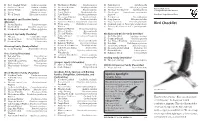
Gray-cheeked Thrush Catharus minimus Blackburnian Warbler Dendroica fusca Field Sparrow Spizella pusilla Swainson’s Thrush Catharus ustulatus American Redstart Setophaga ruticilla Swamp Sparrow Melospiza georgiana National Park Service Hermit Thrush Catharus guttatus Pine Warbler Dendroica pinus American Tree Sparrow Spizella arborea U.S. Department of the Interior Veery Catharus fuscescens Prairie Warbler Dendroica discolor Grasshopper Ammodramus savannarum Wood Thrush Hylocichla mustelina Palm Warbler Dendroica palmarum Sparrow New River Gorge National River Blue-winged Warbler Vermivora pinus Fox Sparrow Passeralla iliaca Mockingbird and Thrasher Family Yellow Warbler Dendroica petechia Song Sparrow Melospiza melodia (Mimidae) Swainson’s Warbler Limnothlypis swainsonii Vesper Sparrow Pooecetes gramineus Brown Thrasher Toxostoma rufum Worm-eating Helmitheros vermivorus Savannah Sparrow Passerculus sandwichensis Bird Checklist Gray Catbird Dumetella carolinensis Warbler Dark-eyed (“Slate-colored”) Junco hyemalis Northern Mockingbird Mimus polyglottos Tennessee Warbler Vermivora peregrina Junco Wilson’s Warbler Wilsonia pusilla Crow and Jay Family (Corvidae) Hooded Warbler Wilsonia citrina Blackbird and Oriole Family (Icteridae) Blue Jay Cyanocitta cristata Golden-winged Vermivora chrysoptera Rusty Blackbird Euphagus carolinus American Crow Corvus brachyrhynchos Warbler Common Grackle Quiscalus quiscula Common Raven Corvus corax Nashville Warbler Vermivora ruficapilla Red-winged Blackbird Agelaius phoeniceus Kentucky Warbler Oporornis -
Ecology, Morphology, and Behavior in the New World Wood Warblers
Ecology, Morphology, and Behavior in the New World Wood Warblers A dissertation presented to the faculty of the College of Arts and Sciences of Ohio University In partial fulfillment of the requirements for the degree Doctor of Philosophy Brandan L. Gray August 2019 © 2019 Brandan L. Gray. All Rights Reserved. 2 This dissertation titled Ecology, Morphology, and Behavior in the New World Wood Warblers by BRANDAN L. GRAY has been approved for the Department of Biological Sciences and the College of Arts and Sciences by Donald B. Miles Professor of Biological Sciences Florenz Plassmann Dean, College of Arts and Sciences 3 ABSTRACT GRAY, BRANDAN L., Ph.D., August 2019, Biological Sciences Ecology, Morphology, and Behavior in the New World Wood Warblers Director of Dissertation: Donald B. Miles In a rapidly changing world, species are faced with habitat alteration, changing climate and weather patterns, changing community interactions, novel resources, novel dangers, and a host of other natural and anthropogenic challenges. Conservationists endeavor to understand how changing ecology will impact local populations and local communities so efforts and funds can be allocated to those taxa/ecosystems exhibiting the greatest need. Ecological morphological and functional morphological research form the foundation of our understanding of selection-driven morphological evolution. Studies which identify and describe ecomorphological or functional morphological relationships will improve our fundamental understanding of how taxa respond to ecological selective pressures and will improve our ability to identify and conserve those aspects of nature unable to cope with rapid change. The New World wood warblers (family Parulidae) exhibit extensive taxonomic, behavioral, ecological, and morphological variation. -
Bird) Species List
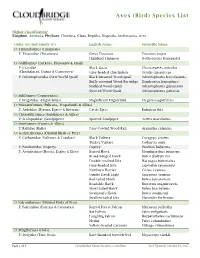
Aves (Bird) Species List Higher Classification1 Kingdom: Animalia, Phyllum: Chordata, Class: Reptilia, Diapsida, Archosauria, Aves Order (O:) and Family (F:) English Name2 Scientific Name3 O: Tinamiformes (Tinamous) F: Tinamidae (Tinamous) Great Tinamou Tinamus major Highland Tinamou Nothocercus bonapartei O: Galliformes (Turkeys, Pheasants & Quail) F: Cracidae Black Guan Chamaepetes unicolor (Chachalacas, Guans & Curassows) Gray-headed Chachalaca Ortalis cinereiceps F: Odontophoridae (New World Quail) Black-breasted Wood-quail Odontophorus leucolaemus Buffy-crowned Wood-Partridge Dendrortyx leucophrys Marbled Wood-Quail Odontophorus gujanensis Spotted Wood-Quail Odontophorus guttatus O: Suliformes (Cormorants) F: Fregatidae (Frigatebirds) Magnificent Frigatebird Fregata magnificens O: Pelecaniformes (Pelicans, Tropicbirds & Allies) F: Ardeidae (Herons, Egrets & Bitterns) Cattle Egret Bubulcus ibis O: Charadriiformes (Sandpipers & Allies) F: Scolopacidae (Sandpipers) Spotted Sandpiper Actitis macularius O: Gruiformes (Cranes & Allies) F: Rallidae (Rails) Gray-Cowled Wood-Rail Aramides cajaneus O: Accipitriformes (Diurnal Birds of Prey) F: Cathartidae (Vultures & Condors) Black Vulture Coragyps atratus Turkey Vulture Cathartes aura F: Pandionidae (Osprey) Osprey Pandion haliaetus F: Accipitridae (Hawks, Eagles & Kites) Barred Hawk Morphnarchus princeps Broad-winged Hawk Buteo platypterus Double-toothed Kite Harpagus bidentatus Gray-headed Kite Leptodon cayanensis Northern Harrier Circus cyaneus Ornate Hawk-Eagle Spizaetus ornatus Red-tailed -

Wood Warblers Wildlife Note
hooded warbler 47. Wood Warblers Like jewels strewn through the woods, Pennsylvania’s native warblers appear in early spring, the males arrayed in gleaming colors. Twenty-seven warbler species breed commonly in Pennsylvania, another four are rare breeders, and seven migrate through Penn’s Woods headed for breeding grounds farther north. In central Pennsylvania, the first species begin arriving in late March and early April. Louisiana waterthrush (Parkesia motacilla) and black and white warbler (Mniotilta varia) are among the earliest. The great mass of warblers passes through around mid-May, and then the migration trickles off until it ends in late May by which time the trees have leafed out, making it tough to spot canopy-dwelling species. In southern Pennsylvania, look for the migration to begin and end a few days to a week earlier; in northern Pennsylvania, it is somewhat later. As summer progresses and males stop singing on territory, warblers appear less often, making the onset of fall migration difficult to detect. Some species begin moving south as early as mid and late July. In August the majority specific habitat types and show a preference for specific of warblers start moving south again, with migration characteristics within a breeding habitat. They forage from peaking in September and ending in October, although ground level to the treetops and eat mainly small insects stragglers may still come through into November. But by and insect larvae plus a few fruits; some warblers take now most species have molted into cryptic shades of olive flower nectar. When several species inhabit the same area, and brown: the “confusing fall warblers” of field guides. -
The Phylogenetic Relationships and Generic Limits of Finches
Molecular Phylogenetics and Evolution 62 (2012) 581–596 Contents lists available at SciVerse ScienceDirect Molecular Phylogenetics and Evolution journal homepage: www.elsevier.com/locate/ympev The phylogenetic relationships and generic limits of finches (Fringillidae) ⇑ Dario Zuccon a, , Robert Pryˆs-Jones b, Pamela C. Rasmussen c, Per G.P. Ericson d a Molecular Systematics Laboratory, Swedish Museum of Natural History, Box 50007, SE-104 05 Stockholm, Sweden b Bird Group, Department of Zoology, Natural History Museum, Akeman St., Tring, Herts HP23 6AP, UK c Department of Zoology and MSU Museum, Michigan State University, East Lansing, MI 48824, USA d Department of Vertebrate Zoology, Swedish Museum of Natural History, Box 50007, SE-104 05 Stockholm, Sweden article info abstract Article history: Phylogenetic relationships among the true finches (Fringillidae) have been confounded by the recurrence Received 30 June 2011 of similar plumage patterns and use of similar feeding niches. Using a dense taxon sampling and a com- Revised 27 September 2011 bination of nuclear and mitochondrial sequences we reconstructed a well resolved and strongly sup- Accepted 3 October 2011 ported phylogenetic hypothesis for this family. We identified three well supported, subfamily level Available online 17 October 2011 clades: the Holoarctic genus Fringilla (subfamly Fringillinae), the Neotropical Euphonia and Chlorophonia (subfamily Euphoniinae), and the more widespread subfamily Carduelinae for the remaining taxa. Keywords: Although usually separated in a different -

Taxonomic Relationships Among the American Redstarts
TAXONOMIC RELATIONSHIPS AMONG THE AMERICAN REDSTARTS KENNETH C. PARKES N recent years certain bird taxonomists have indulged in what might be I described as a veritable orgy of genus-lumping. Small genera, particularly monotypic genera, must, it seems, be somehow combined with one another, or shoehorned into larger genera (see, for example, the footnote on Uropsila, Paynter, 1960:430). To some extent this is a healthy trend, as many bird families are undeniably oversplit. Much of the recent lumping, however, has a fundamental shortcoming; the authors make little or no effort to re-evaluate the composition of the currently accepted genera before simply emptying the contents of two bureau drawers into one. It is possible, indeed probable, that some of our genera as they now stand are composite and artificial, not reflecting actual relationships. The answer to such problems is not simple lumping, but rather redefinition of genera, with the generic lines drawn in different places. An excellent example is provided by the case history of the North American forest thrushes. Ridgway (1907:19, 35) pointed out many years ago the close relationship between the thrushes generally placed in the two genera Hylocichlu and Cutharus. Ripley (1952), in a paper which advocated merging a number of genera of thrushes, formally proposed the lumping of Hylocichlu and Cutharus under the latter name, but without any analytical study of the species currently placed in these two genera. This proposition had already been made in several unpublished theses dealing with regional avifaunas (Loetscher, 1941:664; Phillips, 1946:309; Parkes, 1952:384), also as a straight lumping of the two genera. -

Unlocking the Black Box of Feather Louse Diversity: a Molecular Phylogeny of the Hyper-Diverse Genus Brueelia Q ⇑ Sarah E
Molecular Phylogenetics and Evolution 94 (2016) 737–751 Contents lists available at ScienceDirect Molecular Phylogenetics and Evolution journal homepage: www.elsevier.com/locate/ympev Unlocking the black box of feather louse diversity: A molecular phylogeny of the hyper-diverse genus Brueelia q ⇑ Sarah E. Bush a, , Jason D. Weckstein b,1, Daniel R. Gustafsson a, Julie Allen c, Emily DiBlasi a, Scott M. Shreve c,2, Rachel Boldt c, Heather R. Skeen b,3, Kevin P. Johnson c a Department of Biology, University of Utah, 257 South 1400 East, Salt Lake City, UT 84112, USA b Field Museum of Natural History, Science and Education, Integrative Research Center, 1400 S. Lake Shore Drive, Chicago, IL 60605, USA c Illinois Natural History Survey, University of Illinois, 1816 South Oak Street, Champaign, IL 61820, USA article info abstract Article history: Songbirds host one of the largest, and most poorly understood, groups of lice: the Brueelia-complex. The Received 21 May 2015 Brueelia-complex contains nearly one-tenth of all known louse species (Phthiraptera), and the genus Revised 15 September 2015 Brueelia has over 300 species. To date, revisions have been confounded by extreme morphological Accepted 18 September 2015 variation, convergent evolution, and periodic movement of lice between unrelated hosts. Here we use Available online 9 October 2015 Bayesian inference based on mitochondrial (COI) and nuclear (EF-1a) gene fragments to analyze the phylogenetic relationships among 333 individuals within the Brueelia-complex. We show that the genus Keywords: Brueelia, as it is currently recognized, is paraphyletic. Many well-supported and morphologically unified Brueelia clades within our phylogenetic reconstruction of Brueelia were previously described as genera. -

Birds Accipitridae COMMON NAME SCIENTIFIC NAME Osprey Pandion
Birds Accipitridae COMMON NAME SCIENTIFIC NAME Osprey Pandion haliaetus Northern Harrier Hawk Circus cyaneus Bald Eagle Haliaeetus leucocephalus Sharp-shinned Hawk Accipiter striatus Cooper’s Hawk Accipiter cooperii Red-shoulder Hawk Buteo jamaicensis Broad-winged Hawk Buteo platypterus Red-tailed Hawk Buteo jamaicensis Alcedinidae COMMON NAME SCIENTIFIC NAME Belted Kingfisher Ceryle alcyon Anatidae COMMON NAME SCIENTIFIC NAME Tundra Swan Cygnus columbianus Snow Goose Chen caerulescens Canada Goose Branta canadensis Wood Duck Aix sponsa Muscovy Duck Cairina moschata Mallard Anas platyrhynchos American Black Duck Anas rubripes Gadwall Anas strepera Green-winged Teal Anas crecca American Wigeon Anas americana Northern Pintail Anas acuta Northern Shoveler Anas clypeata Blue-winged Teal Anas discors Canvasback Aythya valisineria Redhead Aythya americana Ring-necked Duck Aythya collaris Greater Scaup Aythya marila Lesser Scaup Aythya affinis Bufflehead Bucephala albeola Red-breasted Merganser Mergus serrator Hooded Merganser Lophodytes cucullatus Ruddy Duck Oxyura jamaicensis Anhingidae COMMON NAME SCIENTIFIC NAME Anhinga Anhinga anhinga Apodidae COMMON NAME SCIENTIFIC NAME Chimney Swift Chaetura pelagica Ardeidae COMMON NAME SCIENTIFIC NAME Black-crowned Night-Heron Nycticorax nycticorax Green Heron Butorides virescens Little Blue Heron Egretta caerulea Cattle Egret Bubulcus ibis Snowy Egret Egretta thula Great Egret Ardea alba Great Blue Heron Ardea herodias Bombycillidae COMMON NAME SCIENTIFIC NAME Cedar Waxwing Bombycilla cedrorum Caprimulgidae