Australia's Relations with South East Asia
Total Page:16
File Type:pdf, Size:1020Kb
Load more
Recommended publications
-

The Nature of Northern Australia
THE NATURE OF NORTHERN AUSTRALIA Natural values, ecological processes and future prospects 1 (Inside cover) Lotus Flowers, Blue Lagoon, Lakefield National Park, Cape York Peninsula. Photo by Kerry Trapnell 2 Northern Quoll. Photo by Lochman Transparencies 3 Sammy Walker, elder of Tirralintji, Kimberley. Photo by Sarah Legge 2 3 4 Recreational fisherman with 4 barramundi, Gulf Country. Photo by Larissa Cordner 5 Tourists in Zebidee Springs, Kimberley. Photo by Barry Traill 5 6 Dr Tommy George, Laura, 6 7 Cape York Peninsula. Photo by Kerry Trapnell 7 Cattle mustering, Mornington Station, Kimberley. Photo by Alex Dudley ii THE NATURE OF NORTHERN AUSTRALIA Natural values, ecological processes and future prospects AUTHORS John Woinarski, Brendan Mackey, Henry Nix & Barry Traill PROJECT COORDINATED BY Larelle McMillan & Barry Traill iii Published by ANU E Press Design by Oblong + Sons Pty Ltd The Australian National University 07 3254 2586 Canberra ACT 0200, Australia www.oblong.net.au Email: anuepress@anu.edu.au Web: http://epress.anu.edu.au Printed by Printpoint using an environmentally Online version available at: http://epress. friendly waterless printing process, anu.edu.au/nature_na_citation.html eliminating greenhouse gas emissions and saving precious water supplies. National Library of Australia Cataloguing-in-Publication entry This book has been printed on ecoStar 300gsm and 9Lives 80 Silk 115gsm The nature of Northern Australia: paper using soy-based inks. it’s natural values, ecological processes and future prospects. EcoStar is an environmentally responsible 100% recycled paper made from 100% ISBN 9781921313301 (pbk.) post-consumer waste that is FSC (Forest ISBN 9781921313318 (online) Stewardship Council) CoC (Chain of Custody) certified and bleached chlorine free (PCF). -
Index of Dates from Archaeological Sites in Queensland
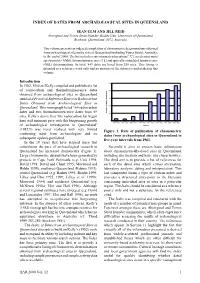
INDEX OF DATES FROM ARCHAEOLOGICAL SITES IN QUEENSLAND SEAN ULM AND JILL REID Aboriginal and Torres Strait Islander Studies Unit, University of Queensland, Brisbane, Queensland, 4072, Australia This volume presents an indexed compilation of chronometric determinations obtained from archaeological sites in the state of Queensland (including Torres Strait), Australia, to the end of 2000. The list includes conventional radiocarbon (14C), accelerator mass spectrometry (AMS), thermoluminescence (TL) and optically-stimulated luminescence (OSL) determinations. In total, 849 dates are listed from 258 sites. This listing is intended as a reference work only and no analysis of the dataset is undertaken in this volume. Introduction 250 In 1982, Michael Kelly compiled and published a list of radiocarbon and thermoluminescence dates 200 obtained from archaeological sites in Queensland entitled A Practical Reference Source to Radiocarbon 150 Dates Obtained from Archaeological Sites in Queensland. This monograph listed 164 radiocarbon 100 dates and two thermoluminescence dates from 69 Number of Dates Published 50 sites. Kelly’s desire that “the radiocarbon list begun here will maintain pace with the burgeoning growth 0 1961-1965 1966-1970 1971-1975 1976-1980 1981-1985 1986-1990 1991-1995 1996-2000 of archaeological investigation in Queensland” Period (1982:9) was never realised with very limited Figure 1. Rate of publication of chronometric continuing input from archaeologists and no dates from archaeological sites in Queensland in subsequent updates published. five-year intervals from 1961. In the 18 years that have elapsed since that compilation the pace of archaeological research in Secondly it aims to present basic information Queensland has increased dramatically (Figure 1). -
Notes to the Introduction I the Expansion of England
NOTES Abbreviations used in the notes: BDEE British Documents of the End of Empire Cab. Cabinet Office papers C.O. Commonwealth Office JICH journal of Imperial and Commonwealth History Notes to the Introduction 1. J. C. D. Clark, '"The Strange Death of British History?" Reflections on Anglo-American Scholarship', Historical journal, 40: 3 (1997), pp. 787-809 at pp. 803, 809. 2. S. R. Ashton and S. E. Stockwell (eds), British Documents of the End of Empire, series A, vol. I: Imperial Policy and Colonial Practice, 1925-1945, part I: Metro politan Reorganisation, Defence and International Relations, Political Change and Constitutional Reform (London: HMSO, 1996), p. xxxix. Some general state ments were collected, with statements on individual colonies, and submitted to Harold Macmillan, who dismissed them as 'scrappy, obscure and jejune, and totally unsuitable for publication' (ibid., pp. 169-70). 3. Clark,' "The Strange Death of British History"', p. 803. 4. Alfred Cobban, The Nation State and National Self-Determination (London: Fontana, 1969; first issued 1945 ), pp. 305-6. 5. Ibid., p. 306. 6. For a penetrating analysis of English constitutional thinking see William M. Johnston, Commemorations: The Cult of Anniversaries in Europe and the United States Today (New Brunswick and London: Transaction Publishers, 1991). 7. Elizabeth Mancke, 'Another British America: a Canadian Model for the Early Modern British Empire',]ICH, 25: 1 (January 1997), pp. 1-36, at p. 3. I The Expansion of England 1. R. A. Griffiths, 'This Royal Throne ofKings, this Scept'red Isle': The English Realm and Nation in the later Middle Ages (Swansea, 1983), pp. -
Carp (Cyprinus Carpio) As a Powerful Invader in Australian Waterways
See discussions, stats, and author profiles for this publication at: https://www.researchgate.net/publication/227894808 Carp (Cyprinus carpio) as a powerful invader in Australian waterways ARTICLE in FRESHWATER BIOLOGY · JUNE 2004 Impact Factor: 2.74 · DOI: 10.1111/j.1365-2427.2004.01232.x CITATIONS READS 191 317 1 AUTHOR: John D. Koehn Arthur Rylah Institute for Environmental Re… 106 PUBLICATIONS 1,621 CITATIONS SEE PROFILE All in-text references underlined in blue are linked to publications on ResearchGate, Available from: John D. Koehn letting you access and read them immediately. Retrieved on: 15 March 2016 Freshwater Biology (2004) 49, 882–894 Carp (Cyprinus carpio) as a powerful invader in Australian waterways JOHN D. KOEHN Cooperative Research Centre for Freshwater Ecology, Arthur Rylah Institute for Environmental Research, Heidelberg, Australia SUMMARY 1. The invasion of carp (Cyprinus carpio L.) in Australia illustrates how quickly an introduced fish species can spread and dominate fish communities. This species has become the most abundant large freshwater fish in south-east Australia, now distributed over more than 1 million km2. 2. Carp exhibit most of the traits predicted for a successful invasive fish species. In addition, degradation of aquatic environments in south-east Australia has given them a relative advantage over native species. 3. Derivation of relative measures of 13 species-specific attributes allowed a quantitative comparison between carp and abundant native fish species across five major Australian drainage divisions. In four of six geographical regions analysed, carp differed clearly from native species in their behaviour, resource use and population dynamics. 4. Climate matching was used to predict future range expansion of carp in Australia. -
1 the Wilson-Smuts Synthesis: Racial Self
The Wilson-Smuts Synthesis: Racial Self-Determination and the Institutionalization of World Order A thesis submitted by Scott L. Malcomson in partial fulfillment of the requirements for the degree of Master of Arts in International Relations Tufts University Fletcher School of International Law and Diplomacy January 2020 Adviser: Jeffrey W. Taliaferro ©2019, Scott L. Malcomson 1 Table of Contents I: Introduction 3 II: Two Paths to Paris. Jan Smuts 8 Woodrow Wilson 26 The Paths Converge 37 III: Versailles. Wilson Stays Out: Isolation and Neutrality 43 Lloyd George: Bringing the Empire on Board 50 Smuts Goes In: The Rise of the Dominions 54 The Wilson-Smuts Synthesis 65 Wilson Undone 72 The Racial Equality Bill 84 IV: Conclusion 103 Bibliography 116 2 I: Introduction When President Woodrow Wilson left the United States for Europe at the end of 1918, he intended to create a new structure for international relations, based on a League of Nations, that would replace the pre-existing imperialist world structure with one based on national and racial (as was said at the time) self-determination. The results Wilson achieved by late April 1919, after several months of near-daily negotiation in Paris, varied between partial success and complete failure.1 Wilson had had other important goals in Paris, including establishing a framework for international arbitration of disputes, advancing labor rights, and promoting free trade and disarmament, and progress was made on all of these. But in terms of his own biography and the distinctive mission of U.S. foreign policy as he and other Americans understood it, the anti- imperial and pro-self-determination goals were paramount. -

A Trial Separation: Australia and the Decolonisation of Papua New Guinea
A TRIAL SEPARATION A TRIAL SEPARATION Australia and the Decolonisation of Papua New Guinea DONALD DENOON Published by ANU E Press The Australian National University Canberra ACT 0200, Australia Email: anuepress@anu.edu.au This title is also available online at http://epress.anu.edu.au National Library of Australia Cataloguing-in-Publication entry Author: Denoon, Donald. Title: A trial separation : Australia and the decolonisation of Papua New Guinea / Donald Denoon. ISBN: 9781921862915 (pbk.) 9781921862922 (ebook) Notes: Includes bibliographical references and index. Subjects: Decolonization--Papua New Guinea. Papua New Guinea--Politics and government Dewey Number: 325.953 All rights reserved. No part of this publication may be reproduced, stored in a retrieval system or transmitted in any form or by any means, electronic, mechanical, photocopying or otherwise, without the prior permission of the publisher. Cover: Barbara Brash, Red Bird of Paradise, Print Printed by Griffin Press First published by Pandanus Books, 2005 This edition © 2012 ANU E Press For the many students who taught me so much about Papua New Guinea, and for Christina Goode, John Greenwell and Alan Kerr, who explained so much about Australia. vi ST MATTHIAS MANUS GROUP MANUS I BIS MARCK ARCH IPEL AGO WEST SEPIK Wewak EAST SSEPIKEPIK River Sepik MADANG NEW GUINEA ENGA W.H. Mt Hagen M Goroka a INDONESIA S.H. rk ha E.H. m R Lae WEST MOROBEMOR PAPUA NEW BRITAIN WESTERN F ly Ri ver GULF NORTHERNOR N Gulf of Papua Daru Port Torres Strait Moresby CENTRAL AUSTRALIA CORAL SEA Map 1: The provinces of Papua New Guinea vii 0 300 kilometres 0 150 miles NEW IRELAND PACIFIC OCEAN NEW IRELAND Rabaul BOUGAINVILLE I EAST Arawa NEW BRITAIN Panguna SOLOMON SEA SOLOMON ISLANDS D ’EN N TR E C A S T E A U X MILNE BAY I S LOUISIADE ARCHIPELAGO © Carto ANU 05-031 viii W ALLAC E'S LINE SUNDALAND WALLACEA SAHULLAND 0 500 km © Carto ANU 05-031b Map 2: The prehistoric continent of Sahul consisted of the continent of Australia and the islands of New Guinea and Tasmania. -

ANTS from THREE REMOTE OCEANIC ISLANDS by ROBERT W. TAYLOR and EDWARD O. WILSON Museum, Wellington, New Zealand, for Making Thes
ANTS FROM THREE REMOTE OCEANIC ISLANDS By ROBERT W. TAYLOR and EDWARD O. WILSON Biological Laboratories, Harvard University The three islands (Raoul, Clipperton, St. Helena) whose ant faunas are. described below have in common only extreme geographic isolation. That ants occur on them at all confirms the idea that these insects, with man's, help, have now populated every part of the earth capable of supporting them. These and other remote oceanic islands will undoubtedly attract more of the ecologist's attention in the future, since many animal taxa inhabiting them, including most or all of the ant species, have only arrived within historical times and present simple case histories of faunas in the first stages of local adaptation. We are grateful to Dr. J. S. Edwards, Dr. C. F. Harbinson, Mr. Arthur Loveridge and Dr. B. A. Holloway of the Dominion Museum, Wellington, New Zealand, for making these unusual collections available. The study has been supported in part by a research grant from the National Science Foundation. RAOUL ISLAND, KERMADEC ISLANDS The Kermadecs are a group of forest-clad volcanic islands lying in the South Pacitc between S. lat., 29.IO and 31.3o; and W. long., 77.45 and 79.00. The nearest sizable land mass is the North Island of New Zealand, about 650 miles to the southwest, and the nearest major Polynesian island is Tongatabu of the Tongan group, aboiat 700 miles to the north. Australia lies about 1,7oo miles to the west. The ants listed below were taken on Raoul or Sunday Island, the largest of the group (I.25 sq. -

The Nature of Northern Australia
THE NATURE OF NORTHERN AUSTRALIA Natural values, ecological processes and future prospects 1 (Inside cover) Lotus Flowers, Blue Lagoon, Lakefield National Park, Cape York Peninsula. Photo by Kerry Trapnell 2 Northern Quoll. Photo by Lochman Transparencies 3 Sammy Walker, elder of Tirralintji, Kimberley. Photo by Sarah Legge 2 3 4 Recreational fisherman with 4 barramundi, Gulf Country. Photo by Larissa Cordner 5 Tourists in Zebidee Springs, Kimberley. Photo by Barry Traill 5 6 Dr Tommy George, Laura, 6 7 Cape York Peninsula. Photo by Kerry Trapnell 7 Cattle mustering, Mornington Station, Kimberley. Photo by Alex Dudley ii THE NATURE OF NORTHERN AUSTRALIA Natural values, ecological processes and future prospects AUTHORS John Woinarski, Brendan Mackey, Henry Nix & Barry Traill PROJECT COORDINATED BY Larelle McMillan & Barry Traill iii Published by ANU E Press Design by Oblong + Sons Pty Ltd The Australian National University 07 3254 2586 Canberra ACT 0200, Australia www.oblong.net.au Email: anuepress@anu.edu.au Web: http://epress.anu.edu.au Printed by Printpoint using an environmentally Online version available at: http://epress. friendly waterless printing process, anu.edu.au/nature_na_citation.html eliminating greenhouse gas emissions and saving precious water supplies. National Library of Australia Cataloguing-in-Publication entry This book has been printed on ecoStar 300gsm and 9Lives 80 Silk 115gsm The nature of Northern Australia: paper using soy-based inks. it’s natural values, ecological processes and future prospects. EcoStar is an environmentally responsible 100% recycled paper made from 100% ISBN 9781921313301 (pbk.) post-consumer waste that is FSC (Forest ISBN 9781921313318 (online) Stewardship Council) CoC (Chain of Custody) certified and bleached chlorine free (PCF). -
Stephen Gwynn and the Failure Of
The Historical Journal , 53, 3 (2010), pp. 723–745 f Cambridge University Press 2010 doi:10.1017/S0018246X10000269 STEPHEN GWYNN AND THE FAILURE OF CONSTITUTIONAL NATIONALISM View metadata, citation and similar papers at core.ac.uk brought to you by CORE IN IRELAND , 1919 –1921 * provided by Northumbria Research Link COLIN REID NUI Maynooth ABSTRACT . The Irish Party, the organization which represented the constitutional nationalist demand for home rule for almost fifty years in Westminster, was the most notable victim of the revolution in Ireland, c. 1916–23. Most of the last generation of Westminster-centred home rule MPs played little part in public life following the party’s electoral destruction in 1918. This article probes the political thought and actions of one of the most prominent constitutional nationalists who did seek to alter Ireland’s direction during the critical years of the war of independence. Stephen Gwynn was a guiding figure behind a number of initiatives to ‘save’ Ireland from the excesses of revolution. Gwynn established the Irish Centre Party in 1919, which later merged with the Irish Dominion League. From the end of 1919, Gwynn became a leading advocate of the Government of Ireland Bill, the legislation that partitioned the island. Revolutionary idealism – and, more concretely, violence – did much to render his reconciliatory efforts impotent. Gwynn’s experiences between 1919 and 1921 also, however, reveal the paralysing divisions within constitutional nationalism, which did much to demoralize moderate sentiment further. As the Great War lurched towards its bloody climax in 1918, the Irish nationalist maverick, William O’Brien, published a pamphlet proclaiming the death of the home rule project in Ireland. -
Questions About Sovereignty Have Received Comparatively Little Attention in Australia
Macquarie Law Journal (2006) Vol 6 5 REVIVING INDIGENOUS SOVEREIGNTY? HENRY REYNOLDS* Questions about sovereignty have received comparatively little attention in Australia. There seems to be nothing much to be discussed; no contentions to be resolved. Unlike the North American Indians or the Maoris, at the time of the European arrival (and long after it), Australian Aborigines were thought to be without laws and government. There was, then, no need for a treaty or treaties. The tribes could never be considered domestic dependent nations with partial, subsidiary sovereignty. Nor had there been any need, as in America, to deal with prior, competing sovereignties – French, Spanish, Dutch, Russian, Mexican, Hawaiian – by means of conquest, cession or purchase. There were no land borders to dispute and delineate. Local history was reassuringly simple. Australia was a land without a sovereign – a territorium nullius - as well as a land where there was no tenure – a terra nullius. When Britain claimed sovereignty in 1788, 1824, 1829 and 1879, the Crown acquired an original title. She was the first sovereign – the only one there had ever been. What is more the Crown also became the beneficial owner of all the land which Australia comprised. Australia was, then, a continent without either frontiers or foreigners – a place where settlers and indigenous alike became subjects of the Crown. In a poem to the process of colonisation W K Hancock declared in 1930: For six generations they [the settlers] have swarmed inland from the sea, pressing forward to their economic frontiers which are the only frontiers Australia knows1 This passage captures so much about settler attitudes. -
E Oun a Le Ove Ent in Aris an T E Ise of a E Orl R Er After I
A. ONORIO COORN i ..v e oun ale oveent in aris an te ise of a e orl rer after I nro norio Astrat The Paris Peace Conference represented a turning point for the British Empire. Great Britain and its Dominions placed on the side of the Entente all their military might together with the most powerful navy. However, at the end of the war, Britain, in spite of being a victorious country, saw its world hegemony reduced and its control over the widest Empire in the history of the world irremediably affected. On the other side of the Atlantic, the United States turned out to be the real winner of the war and this gave them great leverage in Paris in shaping the new international order. However, the passage from the period of the Pa Britannia, which for almost a century granted stability in Europe, to the Pa meriana, was not so unexpected and painful for the British political establishment as we usually think. Among the British establishment, there was a movement that was able to shape the country’s foreign policy for more than twenty years and prepared the ground for the creation of the Anglo-American alliance. This article tries to focus on the circumstances that made possible this tranatio imerii and the role played by the Round Table movement in Paris in this respect. eors Paris peace conference, federalism, Round Table movement, British empire, world order, Atlanticism, Anglo-American relationship, ionel Curtis, Philip Kerr Introution ain te founations of a ne orl orer The Twentieth Century is in many ways the century that saw the United States rising to become a global power. -

Great Southern Land: the Maritime Exploration of Terra Australis
GREAT SOUTHERN The Maritime Exploration of Terra Australis LAND Michael Pearson the australian government department of the environment and heritage, 2005 On the cover photo: Port Campbell, Vic. map: detail, Chart of Tasman’s photograph by John Baker discoveries in Tasmania. Department of the Environment From ‘Original Chart of the and Heritage Discovery of Tasmania’ by Isaac Gilsemans, Plate 97, volume 4, The anchors are from the from ‘Monumenta cartographica: Reproductions of unique and wreck of the ‘Marie Gabrielle’, rare maps, plans and views in a French built three-masted the actual size of the originals: barque of 250 tons built in accompanied by cartographical Nantes in 1864. She was monographs edited by Frederick driven ashore during a Casper Wieder, published y gale, on Wreck Beach near Martinus Nijhoff, the Hague, Moonlight Head on the 1925-1933. Victorian Coast at 1.00 am on National Library of Australia the morning of 25 November 1869, while carrying a cargo of tea from Foochow in China to Melbourne. © Commonwealth of Australia 2005 This work is copyright. Apart from any use as permitted under the Copyright Act 1968, no part may be reproduced by any process without prior written permission from the Commonwealth, available from the Department of the Environment and Heritage. Requests and inquiries concerning reproduction and rights should be addressed to: Assistant Secretary Heritage Assessment Branch Department of the Environment and Heritage GPO Box 787 Canberra ACT 2601 The views and opinions expressed in this publication are those of the author and do not necessarily reflect those of the Australian Government or the Minister for the Environment and Heritage.