War for the English Throne Houston Area Model United Nations
Total Page:16
File Type:pdf, Size:1020Kb
Load more
Recommended publications
-

Anglo- Saxon England and the Norman Conquest, 1060-1066
1.1 Anglo- Saxon society Key topic 1: Anglo- Saxon England and 1.2 The last years of Edward the Confessor and the succession crisis the Norman Conquest, 1060-1066 1.3 The rival claimants for the throne 1.4 The Norman invasion The first key topic is focused on the final years of Anglo-Saxon England, covering its political, social and economic make-up, as well as the dramatic events of 1066. While the popular view is often of a barbarous Dark-Ages kingdom, students should recognise that in reality Anglo-Saxon England was prosperous and well governed. They should understand that society was characterised by a hierarchical system of government and they should appreciate the influence of the Church. They should also be aware that while Edward the Confessor was pious and respected, real power in the 1060s lay with the Godwin family and in particular Earl Harold of Wessex. Students should understand events leading up to the death of Edward the Confessor in 1066: Harold Godwinson’s succession as Earl of Wessex on his father’s death in 1053 inheriting the richest earldom in England; his embassy to Normandy and the claims of disputed Norman sources that he pledged allegiance to Duke William; his exiling of his brother Tostig, removing a rival to the throne. Harold’s powerful rival claimants – William of Normandy, Harald Hardrada and Edgar – and their motives should also be covered. Students should understand the range of causes of Harold’s eventual defeat, including the superior generalship of his opponent, Duke William of Normandy, the respective quality of the two armies and Harold’s own mistakes. -

Ancient Origins of Lordship
THE ANCIENT ORIGINS OF THE LORDSHIP OF BOWLAND Speculation on Anglo-Saxon, Anglo-Norse and Brythonic roots William Bowland The standard history of the lordship of Bowland begins with Domesday. Roger de Poitou, younger son of one of William the Conqueror’s closest associates, Roger de Montgomery, Earl of Shrewsbury, is recorded in 1086 as tenant-in-chief of the thirteen manors of Bowland: Gretlintone (Grindleton, then caput manor), Slatebourne (Slaidburn), Neutone (Newton), Bradeforde (West Bradford), Widitun (Waddington), Radun (Radholme), Bogeuurde (Barge Ford), Mitune (Great Mitton), Esingtune (Lower Easington), Sotelie (Sawley?), Hamereton (Hammerton), Badresbi (Battersby/Dunnow), Baschelf (Bashall Eaves). William Rufus It was from these holdings that the Forest and Liberty of Bowland emerged sometime after 1087. Further lands were granted to Poitou by William Rufus, either to reward him for his role in defeating the army of Scots king Malcolm III in 1091-2 or possibly as a consequence of the confiscation of lands from Robert de Mowbray, Earl of Northumbria in 1095. 1 As a result, by the first decade of the twelfth century, the Forest and Liberty of Bowland, along with the adjacent fee of Blackburnshire and holdings in Hornby and Amounderness, had been brought together to form the basis of what became known as the Honor of Clitheroe. Over the next two centuries, the lordship of Bowland followed the same descent as the Honor, ultimately reverting to the Crown in 1399. This account is one familiar to students of Bowland history. However, research into the pattern of land holdings prior to the Norman Conquest is now beginning to uncover origins for the lordship that predate Poitou’s lordship by many centuries. -
Anglo-Saxon 1
Anglo‐Saxon 1: AD 410‐AD 1066 Anglo—Saxon Age AD 410—AD 1066 The last Roman soldiers le Britain in AD 410, new selers arrived in ships , the Anglo‐Saxons. They were a mixture of tribes from Germany, Denmark and the Netherlands, the main three tribes were the Angles, Saxons and Jutes. The land they seled was called Angle‐land…. England. Each group of selers had a leader or war‐chief. Powerful leaders became cyning (king) and the strongest of these would claim to be bretwalda (sovereign of Britain). By around AD 600 there were five major kingdoms, somemes at peace and somemes at war with each other. From this me the pagan Anglo‐Saxons began to convert to Chrisanity. The early Anglo‐Saxons were pagans and believed in many gods, much like the Scandinavian Vikings. King of the Anglo‐Saxon gods was Woden (from this comes ‘Woden’s day’ or Wednesday). Thunor (Thursday) was the god of thunder, Frige (Friday) the goddess of love and Tiw (Tuesday), god of war. Burials can tell us a lot about these people. Warriors would be buried with their spear and shield although we may only find the bones and metal parts remaining during excavaon. The graves of women may include weaving tools and jewellry. The Lakenheath Warrior (le) was buried in a wooden coffin with his sword, shield and spear lain on top. He was also buried with his horse. The burial also contained food for the aerlife. The Suon Hoo cemetery site contains burial mounds. One of these, (believed to be Raedwald, King of East Anglia) contained a complete ship (only the outline and rivets survived), the ceremonial helmet (right), metalwork dress fings (below), weapons and silver plate from Byzanum. -
Harald Hardrada Invades
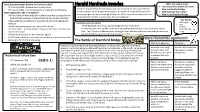
What happened when Edward the Confessor died? Harald Hardrada invades What do I need to know: • 5th January 1066 – Edward the Confessor dies The events of the Battles of Fulford • 6th January 1066 – Harold Godwinson crowned King of England From the moment that Harold Godwinson was crowned, he was aware that he Gate and Stamford Bridge What happened to the 4 contenders? faced a number of challenges to his throne. He marched south which part of his Why Hardrada won Fulford • William, Duke of Normandy claims the throne was promised to him army to prepare for an invasion by William. He left the rest of his army under the Why he lost Stamford Bridge. – he mobilises his troops in preparation for an invasion of Britain command of his brothers in law earls Edwin and Morcar. • Edgar Aethling considered too young to be King or challenge the Key Words: Harold prepares to strike! • Fulford gate decision • Fyrd • Harald Hardrada prepares to invade in the North • Haralf Hardrada of Norway invaded England in the September. • Hardrada • 8th September – peasant soldiers, known as the fyrd, sent home to • He sailed up the river Humber with 300 ships and landed 16 km (10 miles) from the city of • Stamford Bridge harvest the crops York. Earls Edwin and Morcar were waiting for him with the northern army and attempted to • Viking • Harald Hardrada invades the north of England prevent the Norwegian forces from advancing to York. • Earls Edwin and Morcar wait with the northern army to prevent the Were the battles significant? Norwegian forces from advancing The Battle of Stamford Bridge Significant because… However… The loss at Fulford meant that King Harold had to move quickly to deal with the Viking invasion. -

Harold Godwinson in 1066
Y7 Home Learning HT2 This term we are studying the Norman conquest of 1066 and onwards. An event which changed how England looked and worked for years to come. The tasks below relate to each week of study, and should only be completed depending on what your teacher asks. Week 1 Task 1 Watch this video: https://www.youtube.com/watch?v=-cKGz- st75w&ab_channel=BBCTeach Think: How different was Saxon England to today’s England? Answer these questions below: 1. What did the Saxons do for entertainment? 2. What did people do for medicine? 3. What is the main religion in Britain now? How different do you think Saxon Britain is compared to today? Answer in your books. Task 2 Read the information above to connect the correct descriptions to the correct job title in your books, using the words below. Job Titles: Descriptions: Peasant Farmers Old Wise men Slaves Bought and sold Thegns (pronounced Thane) Those who rent farms Earls Aristocrats The Monarchy Holds more land than peasants The Witan Advisors Is owed service Lives in a manor house Relationships are based on loyalty 10% of the population Decide the new King Week 2 Task 3 Look at the image below: This image is a tapestry, showing an image of King Harold Godwinson in 1066. There are 9 items in the tapestry that have been circled. Explain in your book how each of these 9 people/items show Harold as a powerful king. E.g. The orb shows Harold as powerful because… Task 4 Read the source of information about Harold Godwinson below. -

Magnus Barefoot from Wikipedia, the Free Encyclopedia
Magnus Barefoot From Wikipedia, the free encyclopedia This article is about the second Norwegian king named Magnus Olafsson. For the earlier Norwegian king, see Magnus the Good. Magnus Barefoot Drawing of a coin from the reign of Magnus Barefoot (with confused legend)[1] King of Norway Reign September 1093 – 24 August 1103 Predecessor Olaf III Successor Sigurd I, Eystein I and Olaf Magnusson Co-ruler Haakon Magnusson (until 1095) King of Dublin Reign 1102–1103 Predecessor Domnall Gerrlámhach Successor Domnall Gerrlámhach Born 1073 Norway Died 24 August 1103 (aged 29–30) near River Quoile, Downpatrick Ulster, Ireland Burial near St. Patrick's Church, Downpatrick, Ulster, Ireland Consort Margaret of Sweden Eystein I of Norway Issue Sigurd I of Norway Olaf Magnusson of Norway Ragnild Magnusdotter Tora Magnusdatter Harald IV Gille (claimed) Sigurd Slembe (claimed) Magnus Raude (claimed) Full name Magnús Óláfsson House Hardrada Father Olaf III of Norway Mother Tora?; disputed (see below) Religion Roman Catholicism Magnus Olafsson (Old Norse: Magnús Óláfsson, Norwegian: Magnus Olavsson; 1073 – 24 August 1103), better known as Magnus Barefoot (Old Norse: Magnús berfœttr, Norwegian: Magnus Berrføtt),[2] was King of Norway (as Magnus III) from 1093 until his death in 1103. His reign was marked by aggressive military campaigns and conquest, particularly in the Norse-dominated parts of the British Isles, where he extended his rule to the Kingdom of the Isles and Dublin. His daughter, Ragnhild, was born in 1090. As the only son of King Olaf Kyrre, Magnus was proclaimed king in southeastern Norway shortly after his father's death in 1093. In the north, his claim was contested by his cousin, Haakon Magnusson (son of King Magnus Haraldsson), and the two co-ruled uneasily until Haakon's death in 1095. -

The Anglo-Saxons
The Anglo-Saxons “In the case of the king, the resources and tools with which to rule are that he have his land fully manned: he must have praying men, fighting men and working men. You know also that without these tools no king may make his ability known.” King Alfred’s digressions in his translation of Boethius’s “Consolation of Philosophy” This module includes the following topics: ❖ Anglo-Saxon Timeline ❖ The Anglo-Saxons ❖ Anglo-Saxon Kingdoms ❖ Society and Structure ❖ Anglo-Saxon Kings End of Anglo-Saxon ❖ Depiction of an Anglo- Kingdom Saxon King with nobles LEARNING OBJECTIVES KEY WORDS At the end of the module, Anglo- Tithing you should be able to: Hundreds Trace the beginning and Saxon ❖ Normans end of the Anglo-Saxon Jutes Burghs period of England Saxons ❖ Map the Anglo-Saxon kingdoms Angles ❖ Be familiar with the rule Kingdoms and succession of Paganism Anglo-Saxon kings Christianity ❖ Analyse the life and society of the Anglo- Saxons ANGLO-SAXON TIMELINE In 410, after the By 793, Danish By 597, St. Augustine, an sacking of Rome by Viking raiders Italian monk, arrived in Alaric, King of the began attacking Kent and founded a Goths, Roman Lindisfarne, Jarrow, Benedictine monastery at legions departed and Iona. Canterbury and converted from Britannia. the King of Kent to Alfred the Great By 449, three Christianity. defeated the Danes shiploads of at Edington in 878. Saxon warriors In 635, Aidan founded a led by Hengist monastery in and Horsa arrived Lindisfarne, followed by in Kent. the Synod of Whitby in 664. According to legends, King Arthur defeated the Saxons at Mount Badon in 518. -

Family Information
Gen 24 FAMILY INFORMATION Father: King Olaf Kyrre (King Olaf III), King of Norway Date Place Birth c. 1050 Reign 1067-1093 Marriage Death 22 Sept 1093 Hakeby, Tanum, Sweden Burial Nidaros Cathedral Parents King Harald III Hardrada and Tora Torbergsdatter Mother (Maiden Name): ? Date Place Birth Marriage Death Parents Children: Name Event Date Place Magnus Barefoot Birth 1073 (Magnus III), King of Marriage Norway Death 1103 Spouse Birth Marriage Death Spouse Birth Marriage Death Spouse Pg. 1 Olaf III of Norway From Wikipedia, the free encyclopedia Olaf Kyrre (the Peaceful) Gerhard Munthe: illustration for Olav Kyrres saga in Heimskringla (1899) King of Norway Reign 1067 – 22 September 1093 Predecessor Magnus II Successor Magnus III (Barefoot), Haakon Magnusson Born c. 1050 Died 22 September 1093 (aged about 43) Haukbø, Rånrike, Norway (now Håkeby, Tanum, Sweden) Burial Nidaros Cathedral Consort Ingerid of Denmark Issue Magnus III (Barefoot) of Norway Pg. 2 Full name Óláfr Haraldsson House Hardrada Father Harald III of Norway Mother Tora Torbergsdatter Religion Roman Catholicism Olaf Haraldsson (Old Norse: Óláfr Haraldsson, Norwegian: Olav Haraldsson; c. 1050 – 22 September 1093), known as Olaf Kyrre (Old Norse: kyrri, English: Peaceful), ruled Norway as King Olaf III from 1067 until his death in 1093.[1] He was present at the Battle of Stamford Bridge in England in 1066 where his father, King Harald Hardrada, saw defeat and was killed in action, an event that directly preceded his kingship. During his rule, Olaf made peace with regards to earlier royal conflicts with the church, strengthened the power of the monarchy, and is traditionally credited with founding the city of Bergen circa 1070. -

War for the English Throne Houston Area Model United Nations
Houston Area Model United Nations Crisis Committee War for the English Throne The Kingdom of England Triple Joint Crisis Committee Houston Area Model United Nations 46 January 21-22, 2021 Hello Delegates, Welcome to the 46th Houston Area Model United Nations Conference! The war for the English Throne, which took place in 1066 was the cumulation of conflicts, which occurred after the Vikings came into contact with continental Europe and England. Here each one of will have a chance to participate in events that took place just before the swords were crossed. The three main participants will be the Kingdom of Norway, the Kingdom of England, and The Duchy of Normandy, along with some of their respective allies. The Kingdom of Norway is Directed by, Omama Ahmed, who is a current freshman at Lonestar college with plans to transfer to New York university. She is intending to study public health and has been a delegate in her high school Model UN in the past three years. She has always loved the program and was thrilled when given the opportunity to be a part of the crisis committees. She’s very excited to be working with two great Crisis directors for her first year and cannot wait to see how the conference goes. The Duchy of Normandy is directed by, Joel Varghese who is a sophomore currently attending Texas A&M University at College Station, studying Industrial Engineering. He has been a part of Model UN, since his sophomore year at high school and he plans on pursuing this passion until he graduates college. -

History Lower
History KNOWLEDGE ORGANISER Paper2: Anglo-Saxons and Normans L What’s in my knowledge Organiser? 1. Unit Sheets / Checklists This will help you know what is required at each stage of your learning. 2. Powerful Knowledge The key information you need to recall 3. Practice Pages Use the knowledge from section 2 to practise exam questions here. 4. Revision Tools Tasks to help you embed your knowledge. 1. Unit Sheets / Checklists This will help you know what is required at each stage of your learning. Confidence Levels KNOWLEDGE CHECKLIST Key Topic 1: Anglo-Saxon England and the Norman Conquest, 1060-66 ANGLO-SAXON SOCIETY Monarchy and government (Power and role of the King and the Witan) Earldoms, local government and the legal system. The economy The social structure (Pyramid of power and the roles within it) Features of towns and villages The role and power of the Church EDWARD THE CONFESSOR AND THE SUCCESSION CRISIS The Godwin family (Power, position and Harold) Harold Godwinson’s visit to Normandy and promise to William The Northumbrian uprising against Tostig and his exile. The death of Edward the Confessor and reasons this caused a succession crisis. THE RIVAL CLAIMANTS FOR THE THRONE The motives and claims of William of Normandy, Harald Hardrada, Harold Godwinson and Edgar the Aetheling. The coronation and reign of Harold Godwinson in 1066. The reasons for and significance of the outcome of the battles of Gate Fulford and Stamford Bridge. THE NORMAN INVASION The Battle of Hastings Reasons for William’s victory. (Leadership skills of Harold and William, Norman and English troops and tactics) Key Topic 2: William I in power: securing the kingdom, 1066-87 ESTABLISHING CONTROL The submission of the earls to William in 1066 and his coronation. -

Knowledge Organiser Focus: the Norman Conquest
Knowledge Organiser Focus: The Norman Conquest I should already know: Key Words How to plot and use a Cavalry Mounted soldiers on horseback timeline in chronological Claimant Someone believing they should be king order. Feigned Retreat Pretending to run away so that enemy is tricked into following Feudal System Hierarchy of society, with the King at the top I will learn: Fyrd Anglo-Saxon soldiers who joined the army at times of trouble. They • What life was like pre- were usually farmers and were poorly trained. 1066. • Why there was a Housecarls Full-time, well-trained Anglo-Saxon warriors succession crisis in 1066. Oath A very serious promise • The 3 main contenders for Shield Wall Overlapping shields in battle for protection the throne: Harold Godwinson, Harald Hardrada, William of Greater Depth Challenge Normandy How important was Tostig? • The events of the 3 main Tostig Godwinson: brother of battles: Gate Fulford, Harold Godwinson and Earl of Stamford Bridge, Hastings. Northumbria. He lost his • The effects of the Norman Earldom because of his Conquest including the tyrannical rule and joined Harrying of the North Edward the Confessor died in Hardrada. 1066 with no heirs, This will help in the future: leaving a disputed Further Reading succession and 3 Fact: https://www.bbc.com/bitesize Crime and Punishment through main claimants for /guides/zsjnb9q/revision/1 time the throne. This led Anglo-Saxon & Norman Britain to 3 battles taking Fiction: 1066 (I was there) by Jim place that year. Eldridge Knowledge Organiser Focus: The Norman Conquest Summarise your learning Chronology: what happened on these dates? 1043 Edward the Confessor crowned King of England Anglo- Anglo-Saxons England was Saxon a largely peaceful and 1064 Harold’s embassy to Normandy society prosperous kingdom. -

Vikings in Britain: AD793—AD1066 the Vikings Were Pagans from Denmark, Norway and Sweden Who Spoke Old Norse
Vikings in Britain: AD793—AD1066 The Vikings were pagans from Denmark, Norway and Sweden who spoke Old Norse. They were mainly farmers and skilled cra workers. They sailed in longships to trade with Europe, Russia and even Asia, exchanging furs, ivory, amber and slaves for luxury goods such as gold, silver, wine and glassware. With few natural resources in their homelands many Vikings migrated to sele in Britain, Iceland and Greenland and even Newfoundland. Viking raids began on the coasts of Britain and Ireland during the late 8th century including Lindisfarne in AD793. Danish Vikings began seling in eastern England and then moved west, invading Wessex in AD878. King Alfred of Wessex managed to defeat them in bale and England became divided in two with the Viking kingdom known as the Danelaw in the north and west of England. The most famous Danish king was King Cnut or Canute (le) (1016‐1035). During his reign and that of his son Harthacnut, Denmark, England and, for a while, Norway were polically united. The Vikings in Britain and Ireland established major towns at York (Jorvik) and Dublin. They issued coinage and became major trading centres. People lived in longhouses, these were made out of wood or stone with a thatched or turf roof and a central hearth. Beds and benches lined the walls with furs and skins for warmth. Vikings were skilled in making wooden objects, the bowls (below) have been turned on a lathe. At the top of Viking society was the king, under him came the nobles or jarls. Then there were the karls, the ordinary farmers and cra people and below them the thralls or slaves.