Trichoptera: Limnephilidae) from the Republic of Kosovo
Total Page:16
File Type:pdf, Size:1020Kb
Load more
Recommended publications
-

(Trichoptera: Limnephilidae) in Western North America By
AN ABSTRACT OF THE THESIS OF Robert W. Wisseman for the degree of Master ofScience in Entomology presented on August 6, 1987 Title: Biology and Distribution of the Dicosmoecinae (Trichoptera: Limnsphilidae) in Western North America Redacted for privacy Abstract approved: N. H. Anderson Literature and museum records have been reviewed to provide a summary on the distribution, habitat associations and biology of six western North American Dicosmoecinae genera and the single eastern North American genus, Ironoquia. Results of this survey are presented and discussed for Allocosmoecus,Amphicosmoecus and Ecclisomvia. Field studies were conducted in western Oregon on the life-histories of four species, Dicosmoecusatripes, D. failvipes, Onocosmoecus unicolor andEcclisocosmoecus scvlla. Although there are similarities between generain the general habitat requirements, the differences or variability is such that we cannot generalize to a "typical" dicosmoecine life-history strategy. A common thread for the subfamily is the association with cool, montane streams. However, within this stream category habitat associations range from semi-aquatic, through first-order specialists, to river inhabitants. In feeding habits most species are omnivorous, but they range from being primarilydetritivorous to algal grazers. The seasonal occurrence of the various life stages and voltinism patterns are also variable. Larvae show inter- and intraspecificsegregation in the utilization of food resources and microhabitatsin streams. Larval life-history patterns appear to be closely linked to seasonal regimes in stream discharge. A functional role for the various types of case architecture seen between and within species is examined. Manipulation of case architecture appears to enable efficient utilization of a changing seasonal pattern of microhabitats and food resources. -

The Effects of Electricity on Some Aquatic Invertebrates
The effects of electricity on some aquatic invertebrates Item Type text; Thesis-Reproduction (electronic) Authors Mesick, Carl Frederick Publisher The University of Arizona. Rights Copyright © is held by the author. Digital access to this material is made possible by the University Libraries, University of Arizona. Further transmission, reproduction or presentation (such as public display or performance) of protected items is prohibited except with permission of the author. Download date 26/09/2021 21:59:29 Link to Item http://hdl.handle.net/10150/558075 THE EFFECTS OF ELECTRICITY ON SOME AQUATIC INVERTEBRATES by Carl Frederick Mesick A Thesis Submitted to the Faculty of the SCHOOL OF RENEWABLE NATURAL RESOURCES In Partial Fulfillment of Requirements For the Degree of MASTER OF SCIENCE WITH A MAJOR IN FISHERIES SCIENCE In the Graduate College THE UNIVERSITY OF ARIZONA 1 9 7 9 STATEMENT BY AUTHOR This thesis has been submitted in partial fulfill ment of requirements for an advanced degree at The University of Arizona and is deposited in the University Library to be made available to borrowers under rules of the Libraryo Brief quotations from this thesis are allowable without special permission, provided that accurate acknowl edgment of source is made. Requests for permission for extended quotation from or reproduction of this manuscript in whole or in part may be granted by the head of the major department or the Dean of the Graduate College when in his judgment the proposed use of the material is in the inter ests of scholarship. In all other instances, however, permission must be obtained from the author, SIGNED i ' ^ V[ APPROVAL BY THESIS DIRECTOR This thesis has been approved on the date shown below: JERRY C . -
(Insecta, Trichoptera) of Four Adriatic Islands with a Note on Dna Barcoding
View metadata, citation and similar papers at core.ac.uk brought to you by CORE NAT. CROAT. VOL. 28 No 2 403-413 ZAGREB December 31, 2019 original scientific paper/ izvorni znanstveni rad DOI 10.20302/NC.2019.28.26 CADDISFLY FAUNA CHARACTERISTICS (INSECTA, TRICHOPTERA) OF FOUR ADRIATIC ISLANDS WITH A NOTE ON DNA BARCODING Mladen Kučinić1*, Anđela Ćukušić2, Hrvoje Plavec3, Miro Landeka4, Mladen Plantak5, Marijana Vuković6, Višnja Bukvić7, Milivoj Franjević8, Sanja Žalac9 & Gordan Lukač10 1Department of Biology (Laboratory for Entomology), Faculty of Science, University of Zagreb, Rooseveltov trg 6, 10000 Zagreb, Croatia 2Ministry of environment and energy, Radnička cesta 80/7, 10000 Zagreb, Croatia 3Grožnjanska 18, 10 000 Zagreb, Croatia 4 Marina Tartaglie 2, 10 000 Zagreb, Croatia 5Elektroprojekt d.d., Civil and Architectural Engineering Department, Water Resources, Nature and Environmental protection, Alexandera von Humboldta 4, 10000 Zagreb, Croatia 6Croatian Natural History Museum, Demetrova 1, 10000 Zagreb, Croatia 7University Hercegovina, Blajburških žrtava 100, 88000 Mostar, Bosnia and Herzegovina 8Department for forestry and wildlife management, Faculty of Forestry, Svetošimunska 25, University of Zagreb, 10000 Zagreb 9ZSC „Dr. Ivo Pevalek“, National park Plitvice Lakes, Josipa Jovića 19, 53231 Plitvička jezera, Croatia 10National park Paklenica, Dr. Franje Tuđmana 14a, 23244 Starigrad-Paklenica, Croatia Kučinić, M., Ćukušić, A., Plavec, H., Landeka, M., Plantak, M., Vuković, M., Bukvić, V., Franjević, M., Žalac, S. & Lukač, G.: Caddisfly fauna characteristics (Insecta, Trichoptera) of four Adriatic islands with a note on DNA barcoding. Nat. Croat., Vol. 28, No. 2., 403-413, 2019, Zagreb. To date, 13 species of Trichoptera from 11 genera and 8 families have been reported for the Adriatic islands of Cres, Krk, Pag and Hvar. -

Trichoptera Limnephilidae)
Biodiversity Journal, 2015, 6 (1): 3–6 First record of Mesophylax aspersus (Rambur, 1842) from the Republic of Kosovo (Trichoptera Limnephilidae) Halil Ibrahimi, Agim Gashi, Linda Grapci-Kotori*, Astrit Bilalli, Milaim Musliu & Ferdije Zhushi-Etemi Department of Biology, Faculty of Mathematical and Natural Sciences, University of Prishtina “Hasan Prishtina”, “Mother Theresa” p.n., 10 000 Prishtina, Republic of Kosovo *Corresponding author, e-mail: linda_grapci@yahoo.com ABSTRACT The distribution of Mesophylax aspersus Curtis, 1834 (Trichoptera Limnephilidae) ranges from Western Europe, Mediterranean region, Madeira, Canary Islands and up to South- western Asia. According to the present knowledge it is however almost absent from South- eastern Europe. In this paper we present first record of M. aspersus from the Republic of Kosovo. This is at the same time first country record of the genus. Unlike many countries where this species is present abundantly in our case it is extremely rare. A single adult male specimen of M. aspersus was found in an ultraviolet light trap at the Blinajë Hunting Reserve on August 23rd 2013. This has been a single specimen of this species caught at this locality during a one year monthly sampling of caddisflies with UV light traps and entomological net. Another male specimen has been caught on September 24th 2014 at the same locality. Streams and rivers in all parts of Kosovo were surveyed during the period 2009-2014 for Trichoptera species and currently the Blinajë Hunting Reserve is the only locality where this species has been found. The distributional area of this species has been considerably expan- ded by this record. -
Monitoring Wilderness Stream Ecosystems
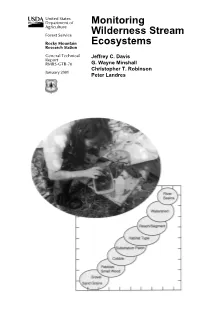
United States Department of Monitoring Agriculture Forest Service Wilderness Stream Rocky Mountain Ecosystems Research Station General Technical Jeffrey C. Davis Report RMRS-GTR-70 G. Wayne Minshall Christopher T. Robinson January 2001 Peter Landres Abstract Davis, Jeffrey C.; Minshall, G. Wayne; Robinson, Christopher T.; Landres, Peter. 2001. Monitoring wilderness stream ecosystems. Gen. Tech. Rep. RMRS-GTR-70. Ogden, UT: U.S. Department of Agriculture, Forest Service, Rocky Mountain Research Station. 137 p. A protocol and methods for monitoring the major physical, chemical, and biological components of stream ecosystems are presented. The monitor- ing protocol is organized into four stages. At stage 1 information is obtained on a basic set of parameters that describe stream ecosystems. Each following stage builds upon stage 1 by increasing the number of parameters and the detail and frequency of the measurements. Stage 4 supplements analyses of stream biotic structure with measurements of stream function: carbon and nutrient processes. Standard methods are presented that were selected or modified through extensive field applica- tion for use in remote settings. Keywords: bioassessment, methods, sampling, macroinvertebrates, production The Authors emphasize aquatic benthic inverte- brates, community dynamics, and Jeffrey C. Davis is an aquatic ecolo- stream ecosystem structure and func- gist currently working in Coastal Man- tion. For the past 19 years he has agement for the State of Alaska. He been conducting research on the received his B.S. from the University long-term effects of wildfires on of Alaska, Anchorage, and his M.S. stream ecosystems. He has authored from Idaho State University. His re- over 100 peer-reviewed journal ar- search has focused on nutrient dy- ticles and 85 technical reports. -
Diversity and Ecosystem Services of Trichoptera
Review Diversity and Ecosystem Services of Trichoptera John C. Morse 1,*, Paul B. Frandsen 2,3, Wolfram Graf 4 and Jessica A. Thomas 5 1 Department of Plant & Environmental Sciences, Clemson University, E-143 Poole Agricultural Center, Clemson, SC 29634-0310, USA; jmorse@clemson.edu 2 Department of Plant & Wildlife Sciences, Brigham Young University, 701 E University Parkway Drive, Provo, UT 84602, USA; paul_frandsen@byu.edu 3 Data Science Lab, Smithsonian Institution, 600 Maryland Ave SW, Washington, D.C. 20024, USA 4 BOKU, Institute of Hydrobiology and Aquatic Ecology Management, University of Natural Resources and Life Sciences, Gregor Mendelstr. 33, A-1180 Vienna, Austria; wolfram.graf@boku.ac.at 5 Department of Biology, University of York, Wentworth Way, York Y010 5DD, UK; jessicaathomas@gmail.com * Correspondence: jmorse@clemson.edu; Tel.: +1-864-656-5049 Received: 2 February 2019; Accepted: 12 April 2019; Published: 1 May 2019 Abstract: The holometabolous insect order Trichoptera (caddisflies) includes more known species than all of the other primarily aquatic orders of insects combined. They are distributed unevenly; with the greatest number and density occurring in the Oriental Biogeographic Region and the smallest in the East Palearctic. Ecosystem services provided by Trichoptera are also very diverse and include their essential roles in food webs, in biological monitoring of water quality, as food for fish and other predators (many of which are of human concern), and as engineers that stabilize gravel bed sediment. They are especially important in capturing and using a wide variety of nutrients in many forms, transforming them for use by other organisms in freshwaters and surrounding riparian areas. -

Bibliographia Trichopterorum
Entry numbers checked/adjusted: 23/10/12 Bibliographia Trichopterorum Volume 4 1991-2000 (Preliminary) ©Andrew P.Nimmo 106-29 Ave NW, EDMONTON, Alberta, Canada T6J 4H6 e-mail: carita.nybom@welho.net [As at 25/3/14] 2 LITERATURE CITATIONS [*indicates that I have a copy of the paper in question] 0001 Anon. 1993. Studies on the structure and function of river ecosystems of the Far East, 2. Rep. on work supported by Japan Soc. Promot. Sci. 1992. 82 pp. TN. 0002 * . 1994. Gunter Brückerman. 19.12.1960 12.2.1994. Braueria 21:7. [Photo only]. 0003 . 1994. New kind of fly discovered in Man.[itoba]. Eco Briefs, Edmonton Journal. Sept. 4. 0004 . 1997. Caddis biodiversity. Weta 20:40-41. ZRan 134-03000625 & 00002404. 0005 . 1997. Rote Liste gefahrdeter Tiere und Pflanzen des Burgenlandes. BFB-Ber. 87: 1-33. ZRan 135-02001470. 0006 1998. Floods have their benefits. Current Sci., Weekly Reader Corp. 84(1):12. 0007 . 1999. Short reports. Taxa new to Finland, new provincial records and deletions from the fauna of Finland. Ent. Fenn. 10:1-5. ZRan 136-02000496. 0008 . 2000. Entomology report. Sandnats 22(3):10-12, 20. ZRan 137-09000211. 0009 . 2000. Short reports. Ent. Fenn. 11:1-4. ZRan 136-03000823. 0010 * . 2000. Nattsländor - Trichoptera. pp 285-296. In: Rödlistade arter i Sverige 2000. The 2000 Red List of Swedish species. ed. U.Gärdenfors. ArtDatabanken, SLU, Uppsala. ISBN 91 88506 23 1 0011 Aagaard, K., J.O.Solem, T.Nost, & O.Hanssen. 1997. The macrobenthos of the pristine stre- am, Skiftesaa, Haeylandet, Norway. Hydrobiologia 348:81-94. -
The Zoogeomorphology of Case-Building Caddisfly Larvae
The zoogeomorphology of case-building caddisfly larvae by Richard Mason A Doctoral thesis submitted in partial fulfilment of the requirements for the award of Doctor of Philosophy of Loughborough University (June 2020) © Richard Mason 2020 i Abstract Caddisfly (Trichoptera) are an abundant and widespread aquatic insect group. Caddisfly larvae of most species build cases from silk and fine sediment at some point in their lifecycle. Case- building caddisfly have the potential to modify the distribution and transport of sediment by: 1) altering sediment properties through case construction, and 2) transporting sediment incorporated into cases over the riverbed. This thesis investigates, for the first time, the effects of bioconstruction by case-building caddisfly on fluvial geomorphology. The research was conducted using two flume experiments to understand the mechanisms of caddisfly zoogeomorphology (case construction and transporting sediment), and two field investigations that increase the spatial and temporal scale of the research. Caddisfly cases varied considerably in mass between species (0.001 g - 0.83 g) and grain sizes used (D50 = 0.17 mm - 4 mm). As a community, caddisfly used a wide range of grain-sizes in case construction (0.063 mm – 11 mm), and, on average, the mass of incorporated sediment was 38 g m-2, in a gravel-bed stream. This sediment was aggregated into biogenic particles (cases) which differed in size and shape from their constituent grains. A flume experiment determined that empty cases of some caddisfly species (tubular case-builders; Limnephilidae and Sericostomatidae) were more mobile than their incorporated sediment, but that dome shaped Glossosomatidae cases moved at the same entrainment threshold as their constituent grains, highlighting the importance of case design as a control on caddisfly zoogeomorphology. -

Butterflies of North America
Insects of Western North America 7. Survey of Selected Arthropod Taxa of Fort Sill, Comanche County, Oklahoma. 4. Hexapoda: Selected Coleoptera and Diptera with cumulative list of Arthropoda and additional taxa Contributions of the C.P. Gillette Museum of Arthropod Diversity Colorado State University, Fort Collins, CO 80523-1177 2 Insects of Western North America. 7. Survey of Selected Arthropod Taxa of Fort Sill, Comanche County, Oklahoma. 4. Hexapoda: Selected Coleoptera and Diptera with cumulative list of Arthropoda and additional taxa by Boris C. Kondratieff, Luke Myers, and Whitney S. Cranshaw C.P. Gillette Museum of Arthropod Diversity Department of Bioagricultural Sciences and Pest Management Colorado State University, Fort Collins, Colorado 80523 August 22, 2011 Contributions of the C.P. Gillette Museum of Arthropod Diversity. Department of Bioagricultural Sciences and Pest Management Colorado State University, Fort Collins, CO 80523-1177 3 Cover Photo Credits: Whitney S. Cranshaw. Females of the blow fly Cochliomyia macellaria (Fab.) laying eggs on an animal carcass on Fort Sill, Oklahoma. ISBN 1084-8819 This publication and others in the series may be ordered from the C.P. Gillette Museum of Arthropod Diversity, Department of Bioagricultural Sciences and Pest Management, Colorado State University, Fort Collins, Colorado, 80523-1177. Copyrighted 2011 4 Contents EXECUTIVE SUMMARY .............................................................................................................7 SUMMARY AND MANAGEMENT CONSIDERATIONS -

Tagungsband Münster 2007
DGL DEUTSCHE GESELLSCHAFT FÜR LIMNOLOGIE e.V. (German Limnological Society) Erweiterte Zusammenfassungen der Jahrestagung 2007 der Deutschen Gesellschaft für Limnologie (DGL) und der deutschen und österreichischen Sektion der Societas Internationalis Limnologiae (SIL) Münster, 24. - 28. September 2007 Impressum: Deutsche Gesellschaft für Limnologie e.V.: vertreten durch den Schriftführer; Dr. Ralf Köhler, Am Waldrand 16, 14542 Werder/Havel. Erweiterte Zusammenfassungen der Tagung in Münster 2007 Eigenverlag der DGL, Werder 2008 Redaktion und Layout: Geschäftsstelle der DGL, Dr. J. Bäthe, Dr. Eckhard Coring & Ralf Förstermann Druck: Hubert & Co. GmbH & Co. KG Robert-Bosch-Breite 6, 37079 Göttingen ISBN-Nr. 978-3-9805678-9-3 Bezug über die Geschäftsstelle der DGL: Lange Str. 9, 37181 Hardegsen Tel.: 05505-959046 Fax: 05505-999707 eMail: geschaeftsstelle@dgl-ev.de * www.dgl-ev.de Kosten inkl. Versand: als CD-ROM € 10.--; Druckversion: € 25.-- DGL - Erweiterte Zusammenfassungen der Jahrestagung 2007 (Münster) - Inhaltsverzeichnis INHALT, GESAMTVERZEICHNIS NACH THEMENGRUPPEN SEITE DGL NACHWUCHSPREIS: 1 FINK, P.: Schlechte Futterqualität und wie man damit umgehen kann: die Ernährungsökologie einer Süßwasserschnecke 2 SCHMIDT, M. B.: Einsatz von Hydroakustik zum Fischereimanagement und für Verhaltensstudien bei Coregonen 7 TIROK, K. & U. GAEDKE: Klimawandel: Der Einfluss von Globalstrahlung, vertikaler Durchmischung und Temperatur auf die Frühjahrsdynamik von Algen – eine datenbasierte Modellstudie 11 POSTERPRÄMIERUNG: 16 BLASCHKE, U., N. BAUER & S. HILT: Wer ist der Sensibelste? Vergleich der Sensitivität verschiedener Algen- und Cyanobakterien-Arten gegenüber Tanninsäure als allelopathisch wirksamer Substanz 17 GABEL, F., X.-F. GARCIA, M. BRAUNS & M. PUSCH: Steinschüttungen als Ersatzrefugium für litorales Makrozoobenthos bei schiffsinduziertem Wellenschlag? 22 KOPPE, C., L. KRIENITZ & H.-P. GROSSART: Führen heterotrophe Bakterien zu Veränderungen in der Physiologie und Morphologie von Phytoplankton? 27 PARADOWSKI, N., H. -
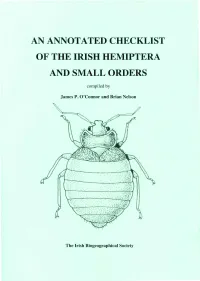
An Annotated Checklist of the Irish Hemiptera and Small Orders
AN ANNOTATED CHECKLIST OF THE IRISH HEMIPTERA AND SMALL ORDERS compiled by James P. O'Connor and Brian Nelson The Irish Biogeographical Society OTHER PUBLICATIONS AVAILABLE FROM THE IRISH BIOGEOGRAPHICAL SOCIETY OCCASIONAL PUBLICATIONS OF THE IRISH BIOGEOGRAPHICAL SOCIETY (A5 FORMAT) Number 1. Proceedings of The Postglacial Colonization Conference. D. P. Sleeman, R. J. Devoy and P. C. Woodman (editors). Published 1986. 88pp. Price €4 (Please add €4 for postage outside Ireland for each publication); Number 2. Biogeography of Ireland: past, present and future. M. J. Costello and K. S. Kelly (editors). Published 1993. 149pp. Price €15; Number 3. A checklist of Irish aquatic insects. P. Ashe, J. P. O’Connor and D. A. Murray. Published 1998. 80pp. Price €7; Number 4. A catalogue of the Irish Braconidae (Hymenoptera: Ichneumonoidea). J. P. O’Connor, R. Nash and C. van Achterberg. Published 1999. 123pp. Price €6; Number 5. The distribution of the Ephemeroptera in Ireland. M. Kelly-Quinn and J. J. Bracken. Published 2000. 223pp. Price €12; Number 6. A catalogue of the Irish Chalcidoidea (Hymenoptera). J. P. O’Connor, R. Nash and Z. Bouček. Published 2000. 135pp. Price €10; Number 7. A catalogue of the Irish Platygastroidea and Proctotrupoidea (Hymenoptera). J. P. O’Connor, R. Nash, D. G. Notton and N. D. M. Fergusson. Published 2004. 110pp. Price €10; Number 8. A catalogue and index of the publications of the Irish Biogeographical Society (1977-2004). J. P. O’Connor. Published 2005. 74pp. Price €10; Number 9. Fauna and flora of Atlantic islands. Proceedings of the 5th international symposium on the fauna and flora of the Atlantic islands, Dublin 24 -27 August 2004. -
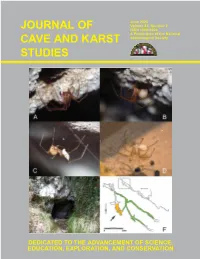
Journal of Cave and Karst Studies
June 2020 Volume 82, Number 2 JOURNAL OF ISSN 1090-6924 A Publication of the National CAVE AND KARST Speleological Society STUDIES DEDICATED TO THE ADVANCEMENT OF SCIENCE, EDUCATION, EXPLORATION, AND CONSERVATION Published By BOARD OF EDITORS The National Speleological Society Anthropology George Crothers http://caves.org/pub/journal University of Kentucky Lexington, KY Office george.crothers@utk.edu 6001 Pulaski Pike NW Huntsville, AL 35810 USA Conservation-Life Sciences Julian J. Lewis & Salisa L. Lewis Tel:256-852-1300 Lewis & Associates, LLC. nss@caves.org Borden, IN lewisbioconsult@aol.com Editor-in-Chief Earth Sciences Benjamin Schwartz Malcolm S. Field Texas State University National Center of Environmental San Marcos, TX Assessment (8623P) bs37@txstate.edu Office of Research and Development U.S. Environmental Protection Agency Leslie A. North 1200 Pennsylvania Avenue NW Western Kentucky University Bowling Green, KY Washington, DC 20460-0001 leslie.north@wku.edu 703-347-8601 Voice 703-347-8692 Fax field.malcolm@epa.gov Mario Parise University Aldo Moro Production Editor Bari, Italy mario.parise@uniba.it Scott A. Engel Knoxville, TN Carol Wicks 225-281-3914 Louisiana State University saecaver@gmail.com Baton Rouge, LA cwicks@lsu.edu Exploration Paul Burger National Park Service Eagle River, Alaska paul_burger@nps.gov Microbiology Kathleen H. Lavoie State University of New York Plattsburgh, NY lavoiekh@plattsburgh.edu Paleontology Greg McDonald National Park Service Fort Collins, CO The Journal of Cave and Karst Studies , ISSN 1090-6924, CPM greg_mcdonald@nps.gov Number #40065056, is a multi-disciplinary, refereed journal pub- lished four times a year by the National Speleological Society.