The Anglo-Saxon World: an Anthology Kindle
Total Page:16
File Type:pdf, Size:1020Kb
Load more
Recommended publications
-
The Battle with Grendel
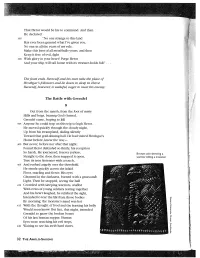
That Herot would be his to command. And then He declared: 385 ' "No one strange to this land Has ever been granted what I've given you, No one in all the years of my rule. Make this best of all mead-halls yours, and then Keep it free of evil, fight 390 With glory in your heart! Purge Herot And your ship will sail home with its treasure-holds full." . The feast ends. Beowulf and his men take the place of Hrothgar's followers and lie down to sleep in Herot. Beowulf, however, is wakeful, eager to meet his enemy. The Battle with Grendel 8 Out from the marsh, from the foot of misty Hills and bogs, bearing God's hatred, Grendel came, hoping to kill 395 Anyone he could trap on this trip to high Herot. He moved quickly through the cloudy night, Up from his swampland, sliding silently Toward that gold-shining hall. He had visited Hrothgar's Home before, knew the way— 4oo But never, before nor after that night, Found Herot defended so firmly, his reception So harsh. He journeyed, forever joyless, Bronze coin showing a Straight to the door, then snapped it open, warrior killing a monster. Tore its iron fasteners with a touch, 405 And rushed angrily over the threshold. He strode quickly across the inlaid Floor, snarling and fierce: His eyes Gleamed in the darkness, burned with a gruesomeX Light. Then he stopped, seeing the hall 4io Crowded with sleeping warriors, stuffed With rows of young soldiers resting together. And his heart laughed, he relished the sight, Intended to tear the life from those bodies By morning; the monster's mind was hot 415 With the thought of food and the feasting his belly Would soon know. -
The Cambridge Old English Reader
The Cambridge Old English Reader RICHARD MARSDEN School of English Studies University of Nottingham published by the press syndicate of the university of cambridge The Pitt Building, Trumpington Street, Cambridge, United Kingdom cambridge university press The Edinburgh Building, Cambridge, CB2 2RU, UK 40 West 20th Street, New York, NY 10011-4211, USA 477 Williamstown Road, Port Melbourne, VIC 3207, Australia Ruiz de Alarc´on 13, 28014 Madrid, Spain Dock House, The Waterfront, Cape Town 8001, South Africa http://www.cambridge.org c Cambridge University Press 2004 This book is in copyright. Subject to statutory exception and to the provisions of relevant collective licensing agreements, no reproduction of any part may take place without the written permission of Cambridge University Press. First published 2004 Printed in the United Kingdom at the University Press, Cambridge Typeface Times 10/13 pt System LATEX2ε [TB] A catalogue record for this book is available from the British Library Library of Congress Cataloguing in Publication data Marsden, Richard. The Cambridge Old English reader / Richard Marsden. p. cm. Includes bibliographical references and index. ISBN 0 521 45426 3 (hardback) – ISBN 0 521 45612 6 (paperback) 1. English language – Old English, ca. 450–1100 – Readers. 2. Anglo-Saxons – Literary collections. 3. Anglo-Saxons – Sources. I. Title. PE137.M46 2003 429.86421–dc21 2003043579 ISBN 0 521 45426 3 hardback ISBN 0 521 45612 6 paperback Contents Preface page ix List of abbreviations xi Introduction xv The writing and pronunciation -

An Examination of Scandinavian War Cults in Medieval Narratives of Northwestern Europe from the Late Antiquity to the Middle Ages
PETTIT, MATTHEW JOSEPH, M.A. Removing the Christian Mask: An Examination of Scandinavian War Cults in Medieval Narratives of Northwestern Europe From the Late Antiquity to the Middle Ages. (2008) Directed by Dr. Amy Vines. 85 pp. The aim of this thesis is to de-center Christianity from medieval scholarship in a study of canonized northwestern European war narratives from the late antiquity to the late Middle Ages by unraveling three complex theological frameworks interweaved with Scandinavian polytheistic beliefs. These frameworks are presented in three chapters concerning warrior cults, war rituals, and battle iconography. Beowulf, The History of the Kings of Britain, and additional passages from The Wanderer and The Dream of the Rood are recognized as the primary texts in the study with supporting evidence from An Ecclesiastical History of the English People, eighth-century eddaic poetry, thirteenth- century Icelandic and Nordic sagas, and Le Morte d’Arthur. The study consistently found that it is necessary to alter current pedagogical habits in order to better develop the study of theology in medieval literature by avoiding the conciliatory practice of reading for Christian hegemony. REMOVING THE CHRISTIAN MASK: AN EXAMINATION OF SCANDINAVIAN WAR CULTS IN MEDIEVAL NARRATIVES OF NORTHWESTERN EUROPE FROM THE LATE ANTIQUITY TO THE MIDDLE AGES by Matthew Joseph Pettit A Thesis Submitted to the Faculty of The Graduate School at The University of North Carolina at Greensboro in Partial Fulfillment of the Requirements for the Degree Master of Arts Greensboro 2008 Approved by ______________________________ Committee Chair APPROVAL PAGE This thesis has been approved by the following committee of the Faculty of The Graduate School at The University of North Carolina at Greensboro. -
Widsith Beowulf. Beowulf Beowulf
CHAPTER 1 OLD ENGLISH LITERATURE The Old English language or Anglo-Saxon is the earliest form of English. The period is a long one and it is generally considered that Old English was spoken from about A.D. 600 to about 1100. Many of the poems of the period are pagan, in particular Widsith and Beowulf. The greatest English poem, Beowulf is the first English epic. The author of Beowulf is anonymous. It is a story of a brave young man Beowulf in 3182 lines. In this epic poem, Beowulf sails to Denmark with a band of warriors to save the King of Denmark, Hrothgar. Beowulf saves Danish King Hrothgar from a terrible monster called Grendel. The mother of Grendel who sought vengeance for the death of her son was also killed by Beowulf. Beowulf was rewarded and became King. After a prosperous reign of some forty years, Beowulf slays a dragon but in the fight he himself receives a mortal wound and dies. The poem concludes with the funeral ceremonies in honour of the dead hero. Though the poem Beowulf is little interesting to contemporary readers, it is a very important poem in the Old English period because it gives an interesting picture of the life and practices of old days. The difficulty encountered in reading Old English Literature lies in the fact that the language is very different from that of today. There was no rhyme in Old English poems. Instead they used alliteration. Besides Beowulf, there are many other Old English poems. Widsith, Genesis A, Genesis B, Exodus, The Wanderer, The Seafarer, Wife’s Lament, Husband’s Message, Christ and Satan, Daniel, Andreas, Guthlac, The Dream of the Rood, The Battle of Maldon etc. -
Medievalism and the Shocks of Modernity: Rewriting Northern Legend from Darwin to World War II
Medievalism and the Shocks of Modernity: Rewriting Northern Legend from Darwin to World War II by Dustin Geeraert A Thesis submitted to the Faculty of Graduate Studies of The University of Manitoba In partial fulfilment of the requirements of the degree of DOCTOR OF PHILOSOPHY Department of English, Film, and Theatre University of Manitoba Winnipeg Copyright © 2016 by Dustin Geeraert 1 Abstract Literary medievalism has always been critically controversial; at various times it has been dismissed as reactionary or escapist. This survey of major medievalist writers from America, England, Ireland and Iceland aims to demonstrate instead that medievalism is one of the characteristic literatures of modernity. Whereas realist fiction focuses on typical, plausible or common experiences of modernity, medievalist literature is anything but reactionary, for it focuses on the intellectual circumstances of modernity. Events such as the Enlightenment, the Industrial Revolution, many political revolutions, the world wars, and the scientific discoveries of Isaac Newton (1643-1727) and above all those of Charles Darwin (1809-1882), each sent out cultural shockwaves that changed western beliefs about the nature of humanity and the world. Although evolutionary ideas remain controversial in the humanities, their importance has not been lost on medievalist writers. Thus, intellectual anachronisms pervade medievalist literature, from its Romantic roots to its postwar explosion in popularity, as some of the greatest writers of modern times offer new perspectives on old legends. The first chapter of this study focuses on the impact of Darwin’s ideas on Victorian epic poems, particularly accounts of natural evolution and supernatural creation. The second chapter describes how late Victorian medievalists, abandoning primitivism and claims to historicity, pushed beyond the form of the retelling by simulating medieval literary genres. -
Tolkien's Creative Technique: <I>Beowulf</I> and <I>The Hobbit</I>
Volume 15 Number 3 Article 1 Spring 3-15-1989 Tolkien's Creative Technique: Beowulf and The Hobbit Bonniejean Christensen Follow this and additional works at: https://dc.swosu.edu/mythlore Part of the Children's and Young Adult Literature Commons Recommended Citation Christensen, Bonniejean (1989) "Tolkien's Creative Technique: Beowulf and The Hobbit," Mythlore: A Journal of J.R.R. Tolkien, C.S. Lewis, Charles Williams, and Mythopoeic Literature: Vol. 15 : No. 3 , Article 1. Available at: https://dc.swosu.edu/mythlore/vol15/iss3/1 This Article is brought to you for free and open access by the Mythopoeic Society at SWOSU Digital Commons. It has been accepted for inclusion in Mythlore: A Journal of J.R.R. Tolkien, C.S. Lewis, Charles Williams, and Mythopoeic Literature by an authorized editor of SWOSU Digital Commons. An ADA compliant document is available upon request. For more information, please contact phillip.fitzsimmons@swosu.edu. To join the Mythopoeic Society go to: http://www.mythsoc.org/join.htm Mythcon 51: A VIRTUAL “HALFLING” MYTHCON July 31 - August 1, 2021 (Saturday and Sunday) http://www.mythsoc.org/mythcon/mythcon-51.htm Mythcon 52: The Mythic, the Fantastic, and the Alien Albuquerque, New Mexico; July 29 - August 1, 2022 http://www.mythsoc.org/mythcon/mythcon-52.htm Abstract Asserts that “The Hobbit, differing greatly in tone, is nonetheless a retelling of the incidents that comprise the plot and the digressions in both parts of Beowulf.” However, his retelling is from a Christian point of view. Additional Keywords Beowulf—Influence on The Hobbit; olkien,T J.R.R. -
Beowulf Timeline
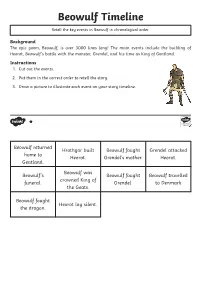
Beowulf Timeline Retell the key events in Beowulf in chronological order. Background The epic poem, Beowulf, is over 3000 lines long! The main events include the building of Heorot, Beowulf’s battle with the monster, Grendel, and his time as King of Geatland. Instructions 1. Cut out the events. 2. Put them in the correct order to retell the story. 3. Draw a picture to illustrate each event on your story timeline. Beowulf returned Hrothgar built Beowulf fought Grendel attacked home to Heorot. Grendel’s mother. Heorot. Geatland. Beowulf was Beowulf’s Beowulf fought Beowulf travelled crowned King of funeral. Grendel. to Denmark the Geats. Beowulf fought Heorot lay silent. the dragon. 1. Stick Text Here 3. Stick Text Here 5. Stick Text Here 7. Stick Text Here 9. Stick Text Here 2. Stick Text Here 4. Stick Text Here 6. Stick Text Here 8. Stick Text Here 10. Stick Text Here Beowulf Timeline Retell the key events in Beowulf in chronological order. Background The epic poem, Beowulf, is over 3000 lines long! The main events include the building of Heorot, Beowulf’s battle with the monster, Grendel, and his time as King of Geatland. Instructions 1. Cut out the events. 2. Put them in the correct order to retell the story. 3. Write an extra sentence or two about each event. 4. Draw a picture to illustrate each event on your story timeline. Beowulf returned Hrothgar built Beowulf fought Grendel attacked home to Geatland. Heorot. Grendel’s mother. Heorot. Beowulf was Beowulf’s funeral. Beowulf fought Beowulf travelled crowned King of Grendel. -
The Tale of Beowulf
The Tale of Beowulf William Morris The Tale of Beowulf Table of Contents The Tale of Beowulf............................................................................................................................................1 William Morris........................................................................................................................................2 ARGUMENT...........................................................................................................................................4 THE STORY OF BEOWULF.................................................................................................................6 I. AND FIRST OF THE KINDRED OF HROTHGAR.........................................................................7 II. CONCERNING HROTHGAR, AND HOW HE BUILT THE HOUSE CALLED HART. ALSO GRENDEL IS TOLD OF........................................................................................................................9 III. HOW GRENDEL FELL UPON HART AND WASTED IT..........................................................11 IV. NOW COMES BEOWULF ECGTHEOW'S SON TO THE LAND OF THE DANES, AND THE WALL−WARDEN SPEAKETH WITH HIM.............................................................................13 V. HERE BEOWULF MAKES ANSWER TO THE LAND−WARDEN, WHO SHOWETH HIM THE WAY TO THE KING'S ABODE................................................................................................15 VI. BEOWULF AND THE GEATS COME INTO HART...................................................................17 -

From Beowulf “Hail, Hrothgar! Higlac Is My Cousin and My King; the Days
From Beowulf “Hail, Hrothgar! Higlac is my cousin and my king; the days Of my youth have been filled with glory. Now Grendel’s Name has echoed in our land: Sailors Have brought us stories of Herot, the best Of all mead-halls, deserted and useless when the moon Hangs in skies the sun had lit, Light and life fleeing together. My people have said, the wisest, most knowing And best of them, that my duty was to go to the Danes’ Great King. They have seen my strength for themselves, Have watched me rise from the darkness of war, Dripping with my enemies’ blood. I drove Five great giants into chains, chased All of that race from the earth. I swam In the blackness of night, hunting monsters Out of the ocean, and killing them one By one; death was my errand and the fate They had earned. Now Grendel and I are called Together, and I’ve come. Grant me, then, Lord and protector of this noble place, A single request! I have come so far, Oh shelterer of warriors and your people’s loved friend, That this one favor you should not refuse me- That I, alone and with the help of my men, May purge all evil from this hall. I have heard, Too, that the monster’s scorn of men Is so great that he needs no weapons and fears none. Now will I. My lord Higlac Might think less of me if I let my sword Go where my feet were afraid to, if I hid Behind some broa linden shields: My hands Alone shall fight for me, struggle for life Against the monster. -
Intertextuality of Deor
Vol. 4(8), pp. 132-138, October, 2013 DOI: 10.5897/JLC11.080 Journal of Languages and Culture ISSN 2141-6540 © 2013 Academic Journals http://www.academicjournals.org/JLC Review Intertextuality of Deor Raimondo Murgia Tallinn University, Narva mnt 25, 10120 Tallinn, Estonia. Accepted 22 November, 2012 The Deor is a poem found in the Exeter Book and included in the Old English elegies. The main purpose of this contribution is to highlight the possible intertextual links of the poem. After an outline of the old English elegies and a brief review of the most significant passages from the elegies, this short poem will be analyzed stanza by stanza. An attempt will be made to demonstrate that the various interpretations of the text depend on particular keywords that require that the readers to share the same time and space coordinates as the author. The personal names are the most important clues for interpretation. The problem is that they have been emended differently according to the editors and that the reader is supposed to know the referent hinted by those particular names. Key words: Old English elegies, Exeter Book, Deor, intertextuality. INTRODUCTION OF THE OLD ENGLISH ELEGIES It must be underlined that the term „elegy‟ applying to old definition of Old English elegy is Greenfield‟s (1965): “a English (hereafter OE) poetry could be misleading since relatively short reflective or dramatic poem embodying a one would expect the meter of such poetry to be the contrastive pattern of loss and consolation, ostensibly same as the Greek and Latin Elegies, in which their based upon a specific personal experience or observa- elegiac distich (Pinotti, 2002) points out that in the fourth tion, and expressing an attitude towards that experience”. -
13 Reflections on Tolkien's Use of Beowulf
13 Reflections on Tolkien’s Use of Beowulf Arne Zettersten University of Copenhagen Beowulf, the famous Anglo-Saxon heroic poem, and The Lord of the Rings by J.R.R. Tolkien, “The Author of the Century”, 1 have been thor- oughly analysed and compared by a variety of scholars.2 It seems most appropriate to discuss similar aspects of The Lord of the Rings in a Festschrift presented to Nils-Lennart Johannesson with a view to his own commentaries on the language of Tolkien’s fiction. The immediate pur- pose of this article is not to present a problem-solving essay but instead to explain how close I was to Tolkien’s own research and his activities in Oxford during the last thirteen years of his life. As the article unfolds, we realise more and more that Beowulf meant a great deal to Tolkien, cul- minating in Christopher Tolkien’s unexpected edition of the translation of Beowulf, completed by J.R.R. Tolkien as early as 1926. Beowulf has always been respected in its position as the oldest Germanic heroic poem.3 I myself accept the conclusion that the poem came into existence around 720–730 A.D. in spite of the fact that there is still considerable debate over the dating. The only preserved copy (British Library MS. Cotton Vitellius A.15) was most probably com- pleted at the beginning of the eleventh century. 1 See Shippey, J.R.R. Tolkien: Author of the Century, 2000. 2 See Shippey, T.A., The Road to Middle-earth, 1982, Pearce, Joseph, Tolkien. -

Abstract Old English Elegies: Language and Genre
ABSTRACT OLD ENGLISH ELEGIES: LANGUAGE AND GENRE Stephanie Opfer, PhD Department of English Northern Illinois University, 2017 Dr. Susan E. Deskis, Director The Old English elegies include a group of poems found in the Exeter Book manuscript that have traditionally been treated as a single genre due to their general sense of lament – The Wanderer, The Seafarer, The Riming Poem, Deor, Wulf and Eadwacer, The Wife’s Lament, Resignation, Riddle 60, The Husband’s Message, and The Ruin. In this study, I conduct a linguistic stylistic analysis of all ten poems using systemic functional linguistics (SFL) and a variety of computational and linguistic tools: Lexomics, Voyant, and Microsoft Excel. My results focus on three characteristics of the poetry: (1) the similarity of the linguistic style within the poems, measured by Lexomics; (2) an oscillation between first- and third-person clausal Themes, measured using SFL analysis; and (3) themes in the lexical categorization, measured through detailed lexical analysis. In the end, my methodology creates a new and more nuanced definition of the elegy: a relatively short reflective or dramatic poem, similar in style and content to other elegiac poems, that alternates between first- and third-person perspectives and includes (1) themes of exile; (2) imagery of water or the sea, the earth, and/or the weather; and (3) words expressing both joy and sorrow. Ultimately, I argue for a recategorization of only five poems as “Old English elegies”: The Wanderer, The Seafarer, Wulf and Eadwacer, The Wife’s Lament, and The Riming Poem. NORTHERN ILLINOIS UNIVERSITY DE KALB, ILLINOIS MAY 2017 OLD ENGLISH ELEGIES: LANGUAGE AND GENRE BY STEPHANIE OPFER ©2017 Stephanie Opfer A DISSERTATION SUBMITTED TO THE GRADUATE SCHOOL IN PARTIAL FULFILLMENT OF THE REQUIREMENTS FOR THE DEGREE DOCTOR OF PHILOSOPHY DEPARTMENT OF ENGLISH Doctoral Director: Dr.