1 Supporting Information S7. Literature Review on Potential Sound
Total Page:16
File Type:pdf, Size:1020Kb
Load more
Recommended publications
-
Of Turkey Part II: the Genera Haetosmia, Osmia and Protosmia
Atatürk Üniv. Ziraat Fak. Derg., 44 (2): 121-143, 2013 Atatürk Univ., J. of the Agricultural Faculty, 44 (2): 121-143, 2013 ISSN : 1300-9036 Araştırma Makalesi/Research Article Distribution of the tribe Osmiini bees (Hymenoptera: Megachilidae) of Turkey Part II: the genera Haetosmia, Osmia and Protosmia Hikmet ÖZBEK Department of Plant Protection, Faculty of Agriculture, Atatürk Üniversity, Erzurum, Turkey (hozbek1940@yahoo.com.tr) Geliş Tarihi : 23.03.2014 Kabul Tarihi : 17.12.2014 ABSTRACT: In the present study, research materials consisting of approximately 1200 bee samples, which have been collected from almost the entire country since the 1960s, but mainly from the eastern Anatolia region of Turkey, were evaluated, a total of 101 species and subspecies in three genera, Haetosmia (1), Osmia (87) and Protosmia (13) were recognized. Of these, Osmia (Helicosmia) labialis Pérez, 1879 is new for Turkey as well Asian Continenet. For the known species new distribution records were provided and the plant species visited were included. Majority of the Turkish species, about 70%, are associated with Europe, mainly Mediterranean basin. Therefore, many species are in Mediterranean and East-Mediterranean chorotypes. Where as about 30% are associated with Asia, most of them are in the Southwest-Asiatic chorotype, 13 species could be accepted as Anatolian endemics. Two taxa, Osmia (Hoplosmia) bidentata pallens (Tkalcu, 1979) and Protosmia (Protosmia) monstrosa (Pérez, 1895) occur in Asia and North Africa. Key words: Hymenoptera: Megachilidae, Osmiini, Haetosmia, Osmia, Protosmia, fauna, new record, chorotype, Turkey. Türkiye’de Osmiini tribüsüne giren arı türleri (Hymenoptera: Megachilidae) Bölüm II: Haetosmia, Osmia and Protosmia cinsleri Özet: Bu çalışmada; Türkiye’nin hemen her yöresinden, özellikle de Doğu Anadolu Bölgesi’nden 1960’lı yıllardan buyana toplanan 1200 civarındaki arı örneği değerlendirilmiş ve Haetosmia (1), Osmia (87 ) ve Protosmia (13) cinslerine ait 101 tür ve alttürün bulunduğu belirlenmiştir. -
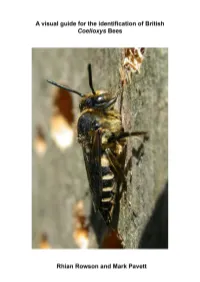
A Visual Guide for the Identification of British Coelioxys Bees
1 Introduction The Hymenoptera is an order of insects that includes bees, wasps, ants, ichneumons, sawflies, gall wasps and their relatives. The bees (family Apidae) can be recognised as such by the presence of feather-like hairs on their bodies, particularly near the wing bases. The genus Coelioxys Latreille belongs to the bee subfamily Megachilinae. There are six species of Coelioxys present in mainland Britain. Two other species are found in Guernsey but not mentioned in this pictorial key (C. afra Lepeletier and C. brevis Eversmann). Natural History Coelioxys (their various English names are: Sharp-tailed Bees, Sharp-abdomen Bees and Sharp-bellied Bees) are among those known as cuckoo bees because the larvae grow up on food stolen from Leaf-cutter Bees (Megachile Latreille) or Flower Bees (Anthophora Latreille). The genus Megachile probably includes the closest relatives of Coelioxys. Female Megachile construct nests of larval cells from leaves and provision each cell with a mixture of pollen and nectar for the young. A female Coelioxys will seek these out and apparently uses its sharp abdomen to pierce the cells. An egg is then laid in the Megachile cell. The egg of the Coelioxys hatches before that of the Megachile and the newly-hatched larva crushes the Megachile egg with its large jaws. The Coelioxys larva can then feed on the contents of the cell. Pupation occurs within a cocoon spun within the host cell where the larva overwinters as a prepupa. The genus Anthophora excavates nest burrows in sandy soil or rotting wood, where they may also become the hosts of Coelioxys larvae. -

Hymenovaria 15 Een Boekbespreking Te Maken Van Environmental Context
nummer 15 november 2017 Nieuwsbrief Sectie Hymenoptera Nederlandse Entomologische Vereniging In dit nummer onder meer: Meewerken aan de bijenatlas voor België Veldobservaties Bijen en wespen in het natte natuurgebied De Bruuk Ephialtes manifestator gekweekt uit nest van Ancistrocerus trifasciatus De Mexicaanse zwartsteel nestelt in mijn tuin Op zoek naar Leucospis dorsigera nr. 15, november 2017 ISSN 1387-1773 Foto voorpagina: Vespa velutina nigrithorax , werkster. Foto: Albert de Wilde. Nieuwsbrief sectie Hymenoptera van de Nederlandse Entomologische Vereniging Vormgeving: Jan Smit. Redactie J. D’Haeseleer, T. Peeters, J. Smit, E. van der Spek Redactieadres Voermanstraat 14, 6921 NP Duiven e-mail: smit.jan@hetnet.nl Website www.hymenovaria.nl Redactioneel Een redelijk gevuld en gevarieerd nummer. Bij ‘Literatuur’ de HymenoBiblio over 2016, twee Allereerst de aankondiging van de voorjaarsexcursie in boekbesprekingen door Theo Peeters en een 2018 naar de Peel in Brabant. Een verslag van de boekbespreking door Jan Smit. voorjaarsexcursie naar ’t Roegwold in Groningen, Bij ‘Oproepen’ de vraag om de bijdrage voor komend afgelopen voorjaar. Erik van der Spek doet verslag van jaar (2018) over te maken, gegevens op te sturen voor het Aculea-weekend, afgelopen zomer in België. Kort de rubriek ‘Leuke waarnemingen’ in HymenoVaria 16, verslag van de cursusdag ‘Bijen’, georganiseerd door de vraag om gegevens aan de deelnemers van de de NEV. En we hebben een viertal opmerkelijke excursie naar de Chaamse bossen, plus nog een ‘Veldobservaties’. oproep om medewerking aan De Wilde Bijenlinie. Bij ‘Artikelen’ vertelt Stijn Schreven over het Verder de aankondiging van de studiedag onderzoek in het natuurgebied De Bruuk, René ‘Goudwespen van de Chrysis ignita -groep’ op 13 januari Veenendaal kweekte een sluipwesp uit het nest van 2018, in Amsterdam. -

Christophe Praz Evolutionary Entomology University of Neuchatel 2000 Neuchâtel Born 20.08.1979 Christophe.Praz@Unine.Ch 2010-Pr
Christophe Praz Evolutionary Entomology University of Neuchatel 2000 Neuchâtel Born 20.08.1979 christophe.praz@unine.ch 2010-present Lecturer at University of Neuchatel 2008-2010 Postdoctoral fellow ("prospective researcher"), Department of Entomology, Cornell University, USA (Supervision Bryan Danforth). 2004-2008 PhD at ETH Zurich (Supervision Andreas Müller). 1999-2003 Master in biologie, University of Bern. Scientific publications 28. Lucchetti, M., V Kilchenmann, G Glauser, CJ Praz and C Kast 2018. Nursing protects honeybee larvae from secondary metabolites of pollen. Proceedings of the Royal Society B: in press. 27. Dorchin A., M Lopez-Uribe, CJ Praz, TL Griswold and BN Danforth, 2018. Phylogeny, new generic-level classification, and historical biogeography of the Eucera complex (Hymenoptera: Apidae). Molecular Phylogenetics and Evolution 119: 81-92. 26. Amiet F, A Müller and CJ Praz, 2017. Apidae 1 – Allgemeiner Teil, Gattungen, Apis, Bombus / Partie générale, genres, Apis, Bombus. Fauna Helvetica 29, info fauna CSCF & SEG, Neuchâtel, 187 pp. 25. Packer L, JR Litman and CJ Praz, 2017. Phylogenetic position of a remarkable new fideliine bee from northern Chile (Hymenoptera: Megachilidae). Systematic Entomology 42: 473-488. 24. Praz, CJ, 2017. Subgeneric classification and biology of the leafcutter and dauber bees (genus Megachile Latreille) of the western Palearctic (Hymenoptera, Apoidea, Megachilidae). Journal of Hymenoptera Research 55: 1-54. 23. Soltani, GS, D Bénon, N Alvarez and CJ Praz, 2017. When different contact zones tell different stories: putative ring species in the Megachile concinna species complex (Hymenoptera: Megachilidae). Biological Journal of the Linnean Society 121: 815-832. 22. Lucchetti MA, G Glauser , V Kilchenmann, A Dubecke, G Beckh, CJ Praz and C Kast, 2016. -
Decades of Native Bee Biodiversity Surveys at Pinnacles National Park Highlight the Importance of Monitoring Natural Areas Over Time
Utah State University DigitalCommons@USU All PIRU Publications Pollinating Insects Research Unit 1-17-2019 Decades of Native Bee Biodiversity Surveys at Pinnacles National Park Highlight the Importance of Monitoring Natural Areas Over Time Joan M. Meiners University of Florida Terry L. Griswold Utah State University Olivia Messinger Carril Independent Researcher Follow this and additional works at: https://digitalcommons.usu.edu/piru_pubs Part of the Life Sciences Commons Recommended Citation Meiners JM, Griswold TL, Carril OM (2019) Decades of native bee biodiversity surveys at Pinnacles National Park highlight the importance of monitoring natural areas over time. PLoS ONE 14(1): e0207566. https://doi.org/10.1371/journal. pone.0207566 This Article is brought to you for free and open access by the Pollinating Insects Research Unit at DigitalCommons@USU. It has been accepted for inclusion in All PIRU Publications by an authorized administrator of DigitalCommons@USU. For more information, please contact digitalcommons@usu.edu. RESEARCH ARTICLE Decades of native bee biodiversity surveys at Pinnacles National Park highlight the importance of monitoring natural areas over time 1 2 3 Joan M. MeinersID *, Terry L. Griswold , Olivia Messinger Carril 1 School of Natural Resources and Environment, University of Florida, Gainesville, Florida, United States of a1111111111 America, 2 USDA-ARS Pollinating Insects Research Unit (PIRU), Utah State University, Logan, Utah, United States of America, 3 Independent Researcher, Santa Fe, New Mexico, United States of America a1111111111 a1111111111 * joan.meiners@gmail.com a1111111111 a1111111111 Abstract Thousands of species of bees are in global decline, yet research addressing the ecology OPEN ACCESS and status of these wild pollinators lags far behind work being done to address similar impacts on the managed honey bee. -

Hymenoptera: Vespoidea) Filippo Ceccolini 1, Fabio Cianferoni 1,2,*
Fragmenta entomologica, 50 (2): 111-115 (2018) eISSN: 2284-4880 (online version) pISSN: 0429-288X (print version) Research article Submitted: September 2nd, 2018 - Accepted: November 29th, 2018 - Published: December 31st, 2018 Review of the distribution of Sapygidae in Italy and new records (Hymenoptera: Vespoidea) Filippo CECCOLINI 1, Fabio CIANFERONI 1,2,* 1 Natural History Museum of the University of Florence, Zoological Section “La Specola” - Via Romana 17, I-50125 Florence, Italy ceccolinif@virgilio.it; fabio.cianferoni@unifi.it 2 Research Institute on Terrestrial Ecosystems, CNR - National Research Council of Italy - Via Salaria km 29,300, I-00015 Monteroton- do (Rome), Italy * Corresponding author Abstract The distribution of the Italian species of Sapygidae is reviewed and new occurrence records for some species are given. Monosapyga clavicornis (Linnaeus, 1758) is recorded for the first time in Lazio and Abruzzo, Polochrum repandum Spinola, 1806 in Abruzzo, and Sapygina decemguttata (Jurine, 1807) in Veneto. Due to insufficient sampling efforts in Italy, all the Italian species of Sapygidae should be currently considered as Data Deficient (DD) according to the IUCN Red List Categories and Criteria. Key words: Sapygidae, Italy, faunistics, new records, IUCN categories of risk. Introduction The nomenclature adopted follows Generani et al. (2005). Existing synonymies used in the references quot- The family Sapygidae is a small group of either ectopara- ing Italian records are reported under the accepted name. sitoids or cleptoparasites (mainly of Apoidea) wasps, in- Abbreviations used in material examined: cluding about 70 species in the world (van Achterberg MZUF Natural History Museum of the University of 2014; Fernández & Sarmiento 2015) and 33 in the Palae- Florence, Italy. -
Revision of the Neotropical Subgenera Coelioxys (Platycoelioxys) Mitchell and C
Zootaxa 3941 (2): 151–203 ISSN 1175-5326 (print edition) www.mapress.com/zootaxa/ Article ZOOTAXA Copyright © 2015 Magnolia Press ISSN 1175-5334 (online edition) http://dx.doi.org/10.11646/zootaxa.3941.2.1 http://zoobank.org/urn:lsid:zoobank.org:pub:EADB0C53-EE0E-45CF-8E21-59143C5EC389 Revision of the Neotropical subgenera Coelioxys (Platycoelioxys) Mitchell and C. (Rhinocoelioxys) Mitchell (Hymenoptera; Megachilidae) with the description of one new species LÉO CORREIA DA ROCHA FILHO & LAURENCE PACKER York University, Department of Biology, 4700 Keele St, Toronto, ON M3J 1P3, Canada. E-mail: correiadarocha@yahoo.com.br; xeromelissa@mail.com Table of contents Abstract . 151 Resumo . 152 Resumen . 152 Introduction . 152 Material and methods . 153 Taxonomy . 155 Subgenus C. (Rhinocoelioxys) Mitchell . 155 Key to Females of C. (Rhinocoelioxys) . 156 Key to males of C. (Rhinocoelioxys) . 159 Coelioxys (Rhinocoelioxys) agilis Smith. 162 Coelioxys (Rhinocoelioxys) barbata Schwarz & Michener . 166 Coelioxys (Rhinocoelioxys) clypearis Friese. 170 Coelioxys (Rhinocoelioxys) nasidens Friese . 172 Coelioxys (Rhinocoelioxys) paraguayensis Schrottky . 176 Coelioxys (Rhinocoelioxys) platygnatha n. sp. 180 Coelioxys (Rhinocoelioxys) zapoteca Cresson . 182 Subgenus C. (Platycoelioxys) Mitchell . 193 Coelioxys (Platycoelioxys) alatiformis Friese . 197 Acknowledgements . 202 References . 202 Abstract Two Neotropical subgenera of Coelioxys Latreille are revised. The monotypic C. (Platycoelioxys) Mitchell and C. (Rhi- nocoelioxys) Mitchell has seven valid species; six of them (C. agilis Smith, C. barbata Schwarz & Michener, C. clypearis Friese, C. nasidens Friese, C. paraguayensis Schrottky and C. zapoteca Cresson) previously described, and one, C. platyg- natha Rocha-Filho & Packer n. sp. is new from Amazonas State, Brazil. Coelioxys nasidens, previously considered a ju- nior synonym of C. clypeata Smith, is resurrected. -

Leafcutting Bees, Megachilidae (Insecta: Hymenoptera: Megachilidae: Megachilinae)1 David Serrano2
EENY-342 Leafcutting Bees, Megachilidae (Insecta: Hymenoptera: Megachilidae: Megachilinae)1 David Serrano2 Introduction Distribution Leafcutting bees are important native pollinators of North Leafcutting bees are found throughout the world and America. They use cut leaves to construct nests in cavities are common in North America. In Florida there are ap- (mostly in rotting wood). They create multiple cells in the proximately 63 species (plus five subspecies) within seven nest, each with a single larva and pollen for the larva to eat. genera of leafcutter bees: Ashmeadiella, Heriades, Hoplitis, Leafcutting bees are important pollinators of wildflowers, Coelioxys, Lithurgus, Megachile, and Osmia. fruits, vegetables and other crops. Some leafcutting bees, Osmia spp., are even used as commercial pollinators (like Description honey bees) in crops such as alfalfa and blueberries. Most leafcutting bees are moderately sized (around the size of a honey bee, ranging from 5 mm to 24 mm), stout-bod- ied, black bees. The females, except the parasitic Coelioxys, carry pollen on hairs on the underside of the abdomen rather than on the hind legs like other bees. When a bee is carrying pollen, the underside of the abdomen appears light yellow to deep gold in color. Biology Leafcutting bees, as their name implies, use 0.25 to 0.5 inch circular pieces of leaves they neatly cut from plants to construct nests. They construct cigar-like nests that contain several cells. Each cell contains a ball or loaf of stored pollen and a single egg. Therefore, each cell will produce a Figure 1. A leafcutting bee, Megachile sp. single bee. -

The Very Handy Bee Manual
The Very Handy Manual: How to Catch and Identify Bees and Manage a Collection A Collective and Ongoing Effort by Those Who Love to Study Bees in North America Last Revised: October, 2010 This manual is a compilation of the wisdom and experience of many individuals, some of whom are directly acknowledged here and others not. We thank all of you. The bulk of the text was compiled by Sam Droege at the USGS Native Bee Inventory and Monitoring Lab over several years from 2004-2008. We regularly update the manual with new information, so, if you have a new technique, some additional ideas for sections, corrections or additions, we would like to hear from you. Please email those to Sam Droege (sdroege@usgs.gov). You can also email Sam if you are interested in joining the group’s discussion group on bee monitoring and identification. Many thanks to Dave and Janice Green, Tracy Zarrillo, and Liz Sellers for their many hours of editing this manual. "They've got this steamroller going, and they won't stop until there's nobody fishing. What are they going to do then, save some bees?" - Mike Russo (Massachusetts fisherman who has fished cod for 18 years, on environmentalists)-Provided by Matthew Shepherd Contents Where to Find Bees ...................................................................................................................................... 2 Nets ............................................................................................................................................................. 2 Netting Technique ...................................................................................................................................... -
A Supermatrix Approach to Apoid Phylogeny and Biogeography Shannon M Hedtke1*, Sébastien Patiny2 and Bryan N Danforth1
Hedtke et al. BMC Evolutionary Biology 2013, 13:138 http://www.biomedcentral.com/1471-2148/13/138 RESEARCH ARTICLE Open Access The bee tree of life: a supermatrix approach to apoid phylogeny and biogeography Shannon M Hedtke1*, Sébastien Patiny2 and Bryan N Danforth1 Abstract Background: Bees are the primary pollinators of angiosperms throughout the world. There are more than 16,000 described species, with broad variation in life history traits such as nesting habitat, diet, and social behavior. Despite their importance as pollinators, the evolution of bee biodiversity is understudied: relationships among the seven families of bees remain controversial, and no empirical global-level reconstruction of historical biogeography has been attempted. Morphological studies have generally suggested that the phylogeny of bees is rooted near the family Colletidae, whereas many molecular studies have suggested a root node near (or within) Melittidae. Previous molecular studies have focused on a relatively small sample of taxa (~150 species) and genes (seven at most). Public databases contain an enormous amount of DNA sequence data that has not been comprehensively analysed in the context of bee evolution. Results: We downloaded, aligned, concatenated, and analysed all available protein-coding nuclear gene DNA sequence data in GenBank as of October, 2011. Our matrix consists of 20 genes, with over 17,000 aligned nucleotide sites, for over 1,300 bee and apoid wasp species, representing over two-thirds of bee genera. Whereas the matrix is large in terms of number of genes and taxa, there is a significant amount of missing data: only ~15% of the matrix is populated with data. -

Terrestrial Arthropod Surveys on Pagan Island, Northern Marianas
Terrestrial Arthropod Surveys on Pagan Island, Northern Marianas Neal L. Evenhuis, Lucius G. Eldredge, Keith T. Arakaki, Darcy Oishi, Janis N. Garcia & William P. Haines Pacific Biological Survey, Bishop Museum, Honolulu, Hawaii 96817 Final Report November 2010 Prepared for: U.S. Fish and Wildlife Service, Pacific Islands Fish & Wildlife Office Honolulu, Hawaii Evenhuis et al. — Pagan Island Arthropod Survey 2 BISHOP MUSEUM The State Museum of Natural and Cultural History 1525 Bernice Street Honolulu, Hawai’i 96817–2704, USA Copyright© 2010 Bishop Museum All Rights Reserved Printed in the United States of America Contribution No. 2010-015 to the Pacific Biological Survey Evenhuis et al. — Pagan Island Arthropod Survey 3 TABLE OF CONTENTS Executive Summary ......................................................................................................... 5 Background ..................................................................................................................... 7 General History .............................................................................................................. 10 Previous Expeditions to Pagan Surveying Terrestrial Arthropods ................................ 12 Current Survey and List of Collecting Sites .................................................................. 18 Sampling Methods ......................................................................................................... 25 Survey Results .............................................................................................................. -

New European Bee Species of the Tribe Osmiini (Hymenoptera: Apoidea: Megachilidae)
Zootaxa 3355: 29–50 (2012) ISSN 1175-5326 (print edition) www.mapress.com/zootaxa/ Article ZOOTAXA Copyright © 2012 · Magnolia Press ISSN 1175-5334 (online edition) New European bee species of the tribe Osmiini (Hymenoptera: Apoidea: Megachilidae) ANDREAS MÜLLER ETH Zurich, Institute of Agricultural Sciences, Applied Entomology, Schmelzbergstrasse 9/LFO, 8092 Zurich, Switzerland E-mail: andreas.mueller@ipw.agrl.ethz.ch Abstract Bees of the tribe Osmiini (Megachilidae) are represented by about 230 described species in Europe. In this publication, 15 new European osmiine bee species are described and diagnosed: Hoplitis (Alcidamea) occidentalis spec. nov., Hoplitis (Anthocopa) peniculifera spec. nov., Hoplitis (Hoplitis) hilbera spec. nov., Hoplitis (Hoplitis) lithodorae spec. nov. and Hoplitis manuelae spec. nov. from Spain; Chelostoma (Chelostoma) siciliae spec. nov. from Sicily; Chelostoma (Foveosmia) incognitum spec. nov., Chelostoma (Foveosmia) longifacies spec. nov., Chelostoma (Gyrodromella) aegaeicum spec. nov., Hoplitis (Annosmia) monticola spec. nov., Hoplitis (Anthocopa) nicolaei spec. nov., Hoplitis (Anthocopa) serainae spec. nov. and Protosmia (Nano- smia) montana spec. nov. from Greece; Chelostoma (Chelostoma) comosum spec. nov. from Cyprus; and Hoplitis (Anthocopa) caucasicola spec. nov. from the Caucasus. Key words: Apiformes, Chelostoma, Hoplitis, Protosmia Introduction The osmiine bees constitute a monophyletic tribe within the family Megachilidae (Michener, 2007; Praz et al., 2008). They occur on all continents except South America (but see Gonzalez & Griswold, 2011), Australia and Antarctica and comprise 15 genera and about 1000 described species worldwide (Michener, 2007; Ungricht et al., 2008; Müller, 2012). They are especially diversified in mediterranean and desertic climates of southern Africa, southwestern North America and the Palaearctic. With 10 genera and almost 600 described species, the Palaearctic osmiine bee fauna is particularly diverse (Müller, 2012).