Willa Cather Pioneer Memorial Newsletter
Total Page:16
File Type:pdf, Size:1020Kb
Load more
Recommended publications
-

Willa Cather and American Arts Communities
University of Nebraska - Lincoln DigitalCommons@University of Nebraska - Lincoln Dissertations, Theses, and Student Research: Department of English English, Department of 8-2004 At the Edge of the Circle: Willa Cather and American Arts Communities Andrew W. Jewell University of Nebraska - Lincoln Follow this and additional works at: https://digitalcommons.unl.edu/englishdiss Part of the English Language and Literature Commons Jewell, Andrew W., "At the Edge of the Circle: Willa Cather and American Arts Communities" (2004). Dissertations, Theses, and Student Research: Department of English. 15. https://digitalcommons.unl.edu/englishdiss/15 This Article is brought to you for free and open access by the English, Department of at DigitalCommons@University of Nebraska - Lincoln. It has been accepted for inclusion in Dissertations, Theses, and Student Research: Department of English by an authorized administrator of DigitalCommons@University of Nebraska - Lincoln. AT THE EDGE OF THE CIRCLE: WILLA CATHER AND AMERICAN ARTS COMMUNITIES by Andrew W. Jewel1 A DISSERTATION Presented to the Faculty of The Graduate College at the University of Nebraska In Partial Fulfillment of Requirements For the Degree of Doctor of Philosophy Major: English Under the Supervision of Professor Susan J. Rosowski Lincoln, Nebraska August, 2004 DISSERTATION TITLE 1ather and Ameri.can Arts Communities Andrew W. Jewel 1 SUPERVISORY COMMITTEE: Approved Date Susan J. Rosowski Typed Name f7 Signature Kenneth M. Price Typed Name Signature Susan Be1 asco Typed Name Typed Nnme -- Signature Typed Nnme Signature Typed Name GRADUATE COLLEGE AT THE EDGE OF THE CIRCLE: WILLA CATHER AND AMERICAN ARTS COMMUNITIES Andrew Wade Jewell, Ph.D. University of Nebraska, 2004 Adviser: Susan J. -

A Wagner Matinee"
Willa Cather Newsletter & Review Fall2007 Volume LI, No. 2 ll th International Cather Seminar Explores Willa Cather: A Writer’s Worlds Marc Ch6netier makes a point during a speech delivered at the Sorbonne A.S. Byatt responds to Seminar Director Robert Thacker following a paper Nouvelle in Paris. Photograph by Betty Kort. session at the Abbaye St-Michel-de-Frigolet. Photograph by Betty Kort. Keynote addresses by Marc Chrnetier and A. S. Byatt One hundred fifty-one participants traveled to Paris in the highlighted the first Cather International Seminar to be held in latter part of June for the first portion of the seminar and then went France. Chrnetier, who is President of the European Association by train to Provence for the balance of the time in France. Charles of American Studies, has translated eight of Cather’s novels. He A. Peek, Professor of English at the University of Nebraska at is Professor of American Literature at the University of Paris Kearney and president of the Cather Foundation, set a standard 7 and a Senior member of the Institut Universitaire de France. of excellence when he opened the seminar in Paris with a paper Chrnetier spoke at the Sorbonne Nouvelle in Paris, discussing comparing the challenges facing the Cather Foundation today to the difficulties associated with completing translations and the challenges facing Cather’s fiction. A limited number of papers his reactions to the works of Cather. Byatt, who was made a followed at the Sorbonne Nouvelle in Paris, with the bulk of the Dame of the British Empire in 1999 in appreciation for her papers read at the Abbaye St-Michel-de-Ffigolet in Provence. -
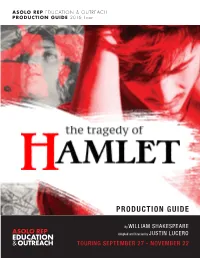
Hamlet-Production-Guide.Pdf
ASOLO REP EDUCATION & OUTREACH PRODUCTION GUIDE 2016 Tour PRODUCTION GUIDE By WILLIAM SHAKESPEARE ASOLO REP Adapted and Directed by JUSTIN LUCERO EDUCATION & OUTREACH TOURING SEPTEMBER 27 - NOVEMBER 22 ASOLO REP LEADERSHIP TABLE OF CONTENTS Producing Artistic Director WHAT TO EXPECT.......................................................................................1 MICHAEL DONALD EDWARDS WHO CAN YOU TRUST?..........................................................................2 Managing Director LINDA DIGABRIELE PEOPLE AND PLOT................................................................................3 FSU/Asolo Conservatory Director, ADAPTIONS OF SHAKESPEARE....................................................................5 Associate Director of Asolo Rep GREG LEAMING FROM THE DIRECTOR.................................................................................6 SHAPING THIS TEXT...................................................................................7 THE TRAGEDY OF HAMLET CREATIVE TEAM FACT IN THE FICTION..................................................................................9 Director WHAT MAKES A GHOST?.........................................................................10 JUSTIN LUCERO UPCOMING OPPORTUNITIES......................................................................11 Costume Design BECKI STAFFORD Properties Design MARLÈNE WHITNEY WHAT TO EXPECT Sound Design MATTHEW PARKER You will see one of Shakespeare’s most famous tragedies shortened into a 45-minute Fight Choreography version -
The Song of the Lark I
HE ONG OF THE ARK T S L BY WILLA CATHER © 2010 Tantor Media, Inc. © 2010 Tantor Media, Inc. © 2010 Tantor Media, Inc. © 2010 Tantor Media, Inc. © 2010 Tantor Media, Inc. © 2010 Tantor Media, Inc. © 2010 Tantor Media, Inc. © 2010 Tantor Media, Inc. © 2010 Tantor Media, Inc. © 2010 Tantor Media, Inc. © 2010 Tantor Media, Inc. © 2010 Tantor Media, Inc. © 2010 Tantor Media, Inc. © 2010 Tantor Media, Inc. © 2010 Tantor Media, Inc. © 2010 Tantor Media, Inc. © 2010 Tantor Media, Inc. © 2010 Tantor Media, Inc. © 2010 Tantor Media, Inc. © 2010 Tantor Media, Inc. © 2010 Tantor Media, Inc. © 2010 Tantor Media, Inc. © 2010 Tantor Media, Inc. © 2010 Tantor Media, Inc. © 2010 Tantor Media, Inc. © 2010 Tantor Media, Inc. © 2010 Tantor Media, Inc. © 2010 Tantor Media, Inc. © 2010 Tantor Media, Inc. © 2010 Tantor Media, Inc. © 2010 Tantor Media, Inc. © 2010 Tantor Media, Inc. © 2010 Tantor This PDF eBook was produced in the year 2010 by Tantor Media, Incorporated, which holds the copyright thereto. © 2010 Tantor Media, Inc. © 2010 Tantor Media, Inc. © 2010 Tantor Media, Inc. © 2010 Tantor Media, Inc. © 2010 Tantor Media, Inc. © 2010 Tantor Media, Inc. © 2010 Tantor Media, Inc. © 2010 Tantor Media, Inc. © 2010 Tantor Media, Inc. © 2010 Tantor Media, Inc. © 2010 Tantor Media, Inc. © 2010 Tantor Media, Inc. © 2010 Tantor Media, Inc. © 2010 Tantor Media, Inc. © 2010 Tantor Media, Inc. © 2010 Tantor Media, Inc. © 2010 Tantor Media, Inc. © 2010 Tantor Media, Inc. © 2010 Tantor Media, Inc. © 2010 Tantor Media, Inc. © 2010 Tantor Media, Inc. © 2010 Tantor Media, Inc. © 2010 Tantor Media, Inc. © 2010 Tantor Media, Inc. © 2010 Tantor Media, Inc. © 2010 Tantor Media, Inc. -

HAMLET: PRESS RESPONSES Almeida & West End (2017) Shakespeare
HAMLET: PRESS RESPONSES Almeida & West End (2017) Shakespeare www.roberticke.com FINANCIAL TIMES Ian Shuttleworth ★★★★★ I have been privileged to see several first-class Hamlets this century: Simon Russell Beale, Samuel West, David Tennant, Rory Kinnear, Maxine Peake, arguably Lars Eidinger. Andrew Scott is at least as outstanding as any of those, and right now I’m inclined to rank him in front. His Prince is almost always self-aware, but not self-understanding; on the contrary, his keynote is a kind of bemused wonder at goings-on both within and beyond his skin. The great soliloquies seem new-minted, every word a separate question. The playfulness at which Scott so excels (most notably as Moriarty in BBC-TV’s Sherlock) is here kept under a rigorously tight rein. I did not see this production when it opened at the Almeida a few months ago, but my impression is that neither Scott’s nor anyone else’s performance has been ramped up for a venue two and half times the size; the consequent occasional intelligibility problems are far outweighed by the sense of human scale. For this is the glory of Robert Icke’s production. It does not consist of a superlative Prince Hamlet, a clutch of fine supporting performances and a number of sharp directorial ideas stitched together into a plausible fabric; rather, it is whole and entire of itself. Angus Wright’s cool, disciplined Claudius, Juliet Stevenson’s besotted-then-horrified Gertrude, Jessica Brown Findlay’s Ophelia (at first at sea like Hamlet, finally psychologically shattered in a wheelchair), David Rintoul’s doubling of the Ghost and the Player King . -

Willa Cather and the Swedes
University of Nebraska - Lincoln DigitalCommons@University of Nebraska - Lincoln Great Plains Quarterly Great Plains Studies, Center for Fall 1984 Willa Cather And The Swedes Mona Pers University College at Vasteras Follow this and additional works at: https://digitalcommons.unl.edu/greatplainsquarterly Part of the Other International and Area Studies Commons Pers, Mona, "Willa Cather And The Swedes" (1984). Great Plains Quarterly. 1756. https://digitalcommons.unl.edu/greatplainsquarterly/1756 This Article is brought to you for free and open access by the Great Plains Studies, Center for at DigitalCommons@University of Nebraska - Lincoln. It has been accepted for inclusion in Great Plains Quarterly by an authorized administrator of DigitalCommons@University of Nebraska - Lincoln. WILLA CATHER AND THE SWEDES MONAPERS Willa Cather's immigrant characters, almost a able exaggeration when in 1921 she maintained literary anomaly at the time she created them, that "now all Miss Cather's books have been earned her widespread critical and popular ac translated into the Scandinavian," the Swedish claim, not least in the Scandinavian countries, a translations of 0 Pioneers! and The Song of market she was already eager to explore at the the Lark whetted the Scandinavian appetite beginning of her literary career. Sweden, the for more Cather. As the 1920s drew to a close, first Scandinavian country to "discover" her her reputation grew slowly but steadily. Her books, issued more translations of Cather fic friend George Seibel was probably guilty of tion than any other European country. In considerably less exaggeration than was Eva fact, Sweden was ten years ahead of any other Mahoney when he recalled "mentioning her Scandinavian country in publishing the transla name in the Gyldendal Boghandel in Copen tion of a Cather novel (see table). -
Hamlet on the Screen Prof
Scholars International Journal of Linguistics and Literature Abbreviated Key Title: Sch Int J Linguist Lit ISSN 2616-8677 (Print) |ISSN 2617-3468 (Online) Scholars Middle East Publishers, Dubai, United Arab Emirates Journal homepage: https://saudijournals.com/sijll Review Article Hamlet on the Screen Prof. Essam Fattouh* English Department, Faculty of Arts, University of Alexandria (Egypt) DOI: 10.36348/sijll.2020.v03i04.001 | Received: 20.03.2020 | Accepted: 27.03.2020 | Published: 07.04.2020 *Corresponding author: Prof. Essam Fattouh Abstract The challenge of adapting William Shakespeare‟s Hamlet for the screen has preoccupied cinema from its earliest days. After a survey of the silent Hamlet productions, the paper critically examines Asta Nielsen‟s Hamlet: The Drama of Vengeance by noting how her main character is really a woman. My discussion of the modern productions of Shakespeare begins with a critical discussion of Lawrence Olivier‟s seminal production of 1948. The Russian Hamlet of 1964, directed by Grigori Kozintsev, is shown to combine a psychological interpretation of the hero without disregarding its socio-political context. The action-film genre deployed by Franco Zeffirelli in his 1990 adaptation of the play, through a moving performance by Mel Gibson, is analysed. Kenneth Branagh‟s ambitious and well-financed production of 1996 is shown to be somewhat marred by its excesses. Michael Almereyda‟s attempt to present Shakespeare‟s hero in a contemporary setting is shown to have powerful moments despite its flaws. The paper concludes that Shakespeare‟s masterpiece will continue to fascinate future generations of directors, actors and audiences. Keywords: Shakespeare – Hamlet – silent film – film adaptations – modern productions – Russian – Olivier – Branagh – contemporary setting. -
Make Us Laugh at That: Hamlet's Gravediggers
“Make Us Laugh at That: Hamlet’s Gravediggers” LAURY MAGNUS Though the “Clownes” in 5.1.appear only once in Hamlet, Shakespeare’s Gravediggers’ Scene has been called “the most extraordinary scene in this extraordinary play” (CN3189, Hibbard, 1987), a valuation that is surely a function of the proud professional undertaker, the First Clown, whose quick wit shines out in dialogue but who is intently focused and in his own world when at his proper task of digging. Does this clown speak more lines than have been “set down for him?”1 Of course, such a question is one that textual evidence in itself can’t decide. But what it does point to is that even when intent on his digging, the Gravedigger enjoys the limelight and “performing” for himself and for any passers-by. What is also clear is that the Gravedigger’s singing at his tasks intrigues Hamlet at a critical point of passage in the play. As an outsider first introduced in this scene of the play, the Gravedigger could be seen as a choric figure. In his initial dialogue with Second Clown, he unwittingly comments on the prior actions of the prince and the court of Denmark that have led them to seek the consecrated “ground” of his professional turf. For his part, the prince, now also an “outsider” who stumbles upon this site, becomes a kind of correlative choric figure as he comments to Horatio on the Gravedigger’s song and accompanying gestures and then draws out the Gravedigger concerning his trade. From this dual choric perspective grows what is to be a direct duel of wits between clown and prince that is prelude to the mortal duel of 5.2. -
Identity and Role-Playing in Shakespeare's Hamlet
The Mask of Madness: Identity and Role-playing in Shakespeare’s Hamlet Treball de Fi de Grau Grau en Estudis Anglesos Supervisor: Dr Jordi Coral Escola Anna Fluvià Sabio June 2016 Acknowledgments Throughout the writing of this TFG, I have benefited from the advice of Dr Jordi Coral Escola. I am very grateful for his constant support, suggestions and corrections. I would also like to thank my family and friends for having been extremely supportive and encouraging during this process. Table of Contents Introduction ...................................................................................................................... 2 Madness as a Key Theme in Elizabethan Drama.......................................................... 3 The Spanish Tragedy and Hamlet ................................................................................. 4 Chapter 1: Madness .......................................................................................................... 6 1.1 Origins of his Madness ........................................................................................... 6 1.2 Assuming the Role of the Madman ...................................................................... 10 Chapter 2: Theatricality .................................................................................................. 13 2.1 Hamlet’s Role ....................................................................................................... 13 2.2 Metadramatic Elements in the Play ..................................................................... -

The Song of the Lark High School Curriculum
The Song of the Lark High School Curriculum Tracy Tucker, WCF Education Director, and Evelyn Funda, Utah State University Standards: LA 12.1 Students will learn and apply reading skills and strategies to comprehend text LA 12.1.5 Vocabulary: Students will build and use conversational, academic, and content-specific grade-level vocabulary LA 12.1.6 Comprehension: Students will construct meaning by applying prior knowledge, using text information, and monitoring comprehension while reading increasingly complex grade-level literary and informational text LA 12.2.2 Writing Modes: Student will write in multiple modes for a variety of purposes and audiences across disciplines LA 12.3.2 Listening: Students will develop and apply active listening skills across a variety of situations LA 12.4.1 Information Fluency: Students will evaluate, create, and communicate information in a variety of media and formats (textual, visual, and digital) Resources: http://www.virtualcather.org The Willa Cather Foundation’s Virtual Tour http://tinyurl.com/kwvf9rw The Willa Cather Foundation’s The Song of the Lark LiveBinder http://www.willacather.org The Willa Cather Foundation site http://www.cather.unl.edu The University of Nebraska’s Willa Cather Project Supplemental material: http://tinyurl.com/nu3qp3o Biography and photos of Olive Fremstad http://tinyurl.com/mh3bbkz Fremstad performs “Du bist der Lenz” from Wagner’s Die Walküre http://tinyurl.com/ome2ppm Libretto of Wagner’s Die Walküre http://tinyurl.com/pxsxj4q Virtual Tour of Walnut Canyon Pre-Reading Writing Activity (LA 12.2.2) 1. What is art? What are the goals and functions of art? Write a one-page essay on what inspires or defines art. -

The Song of the Lark
University of Nebraska - Lincoln DigitalCommons@University of Nebraska - Lincoln University of Nebraska Press -- Sample Books and Chapters University of Nebraska Press Spring 2013 The Song of the Lark Willa Cather Follow this and additional works at: https://digitalcommons.unl.edu/unpresssamples Cather, Willa, "The Song of the Lark" (2013). University of Nebraska Press -- Sample Books and Chapters. 183. https://digitalcommons.unl.edu/unpresssamples/183 This Article is brought to you for free and open access by the University of Nebraska Press at DigitalCommons@University of Nebraska - Lincoln. It has been accepted for inclusion in University of Nebraska Press -- Sample Books and Chapters by an authorized administrator of DigitalCommons@University of Nebraska - Lincoln. Buy the Book Buy the Book WILLA CATHER The Song of the Lark University of Nebraska Press Lincoln and London Buy the Book All rights reserved Manufactured in the United States of America Library of Congress Cataloging-in-Publication Data Cather, Willa, 1873–1947. The song of the lark / Willa Cather. pages; cm. isbn 978-0-8032-4572-3 (pbk.: alk. paper) 1. Women singers—Fiction. 2. Children of clergy—Fiction. 3. Swedish Americans—Fiction. 4. Chicago (Ill.)—Fiction. 5. Young women—Fiction. 6. Colorado— Fiction. 7. Opera—Fiction. 8. Musical fiction. I. Title. ps3505.a87s6 2013 813'.52—dc23 2013002057 Buy the Book To Isabelle McClung On uplands, At morning, The world was young, the winds were free; A garden fair, In that blue desert air, Its guest invited me to be. Buy the Book ‘‘It was a wond’rous lovely storm that drove me!’’ Lenau’s ‘‘Don Juan’’ Buy the Book CONTENTS n Part I Friends of Childhood 3 Part II The Song of the Lark 179 Part III Stupid Faces 277 Part IV The Ancient People 325 Part V Dr. -

Alas Poor Yorick. Hamlet and Kristeva's Maginary Father
E. Denbo / PsyArt 21 (2017) 143–158 ‘Alas Poor Yorick!’: Hamlet and Kristeva’s Imaginary Father Elise Denbo Queensborough Community College City University of New York Most psychological approaches interpret Shakespeare’s Hamlet within a Lacanian/Oedipal revenge narrative. This paper, however, explores Shakespeare’s Hamlet through theories of Julia Kristeva, who develops a term called ‘the imaginary father,’ which she revisions from Freud’s ‘father of individual prehistory.’ The notion of an archaic/imaginary father as a hybrid locus (a mother-father amalgam) within the semiotic domain not only introduces new perspectives to consider the role of fatherhood but also the affective (and material) nature of transference/countertransference in Shakespeare’s plays. The dramatization of Hamlet’s “inner mystery” as opposed to his outer “show” has not been explored as an intrapsychic activity regarding an archaic father of imaginary ambivalence. Despite the scene’s brevity (5.1), considering Yorick as Hamlet’s father of individual prehistory reconfigures symbolic mastery to explore the unfolding development of Shakespearean character as a metaphorical process, a presymbolic activity rather than fixed representation, dramatizing the corporeal struggle for psychic and creative space. To cite as Denbo, E., 2017, ‘‘Alas Poor Yorick!’: Hamlet and Kristeva’s Imaginary Father’, PsyArt 21, pp. 143–158. Most playgoers are familiar with the unique encounter between Hamlet and Yorick, the long departed court jester unearthed from his grave, that Shakespeare positions in counterpoint to the early appearance of King Hamlet’s ghost, an event which combined with his mother’s sudden marriage to his uncle sets the play in motion.