(Pisces: Osteichthyes) and Its Impact on the Eastern Weddell Sea Benthic System
Total Page:16
File Type:pdf, Size:1020Kb
Load more
Recommended publications
-

Keys to the Hawaiian Marine Gammaridea, 0-30 Meters
J. LAURENS BARNt Keys to the Hawaiian Marine Gammaridea, 0-30 Meters SMITHSONIAN CONTRIBUTIONS TO ZOOLOGY NUMBER 58 SERIAL PUBLICATIONS OF THE SMITHSONIAN INSTITUTION The emphasis upon publications as a means of diffusing knowledge was expressed by the first Secretary of the Smithsonian Institution. In his formal plan for the Insti- tution, Joseph Henry articulated a program that included the following statement: "It is proposed to publish a series of reports, giving an account of the new discoveries in science, and of the changes made from year to year in all branches of knowledge not strictly professional." This keynote of basic research has been adhered to over the years in the issuance of thousands of titles in serial publications under the Smithsonian imprint, commencing with Smithsonian Contributions to Knowledge in 1848 and continuing with the following active series: Smithsonian Annals of Flight Smithsonian Contributions to Anthropology Smithsonian Contributions to Astrophysics Smithsonian Contributions to Botany Smithsonian Contributions to the Earth Sciences Smithsonian Contributions to Paleobiology Smithsonian Contributions to Z0°l°iy Smithsonian Studies in History and Technology In these series, the Institution publishes original articles and monographs dealing with the research and collections of its several museums and offices and of professional colleagues at other institutions of learning. These papers report newly acquired facts, synoptic interpretations of data, or original theory in specialized fields. Each publica- tion is distributed by mailing lists to libraries, laboratories, institutes, and interested specialists throughout the world. Individual copies may be obtained from the Smith- sonian Institution Press as long as stocks are available. S. DILLON RIPLEY Secretary Smithsonian Institution SMITHSONIAN CONTRIBUTIONS TO ZOOLOGY NUMBER 58 j. -
3. Generic Partition in the Amphipod Family Cheluridae
12 PACIFIC NATURALIST VOL. I, No. 3-4 Miller, R. C. 1924. Wood-boring Crustacea from Hawaii and Samoa. Unil}. Calif. Pub. Zool. 26 (8): 159-164, ph. 12, 13. Philippi, A. 1839. Einige zoologische Notizen. Arch. Naturgesch. 5: 113-134, pIs. 3- 4. Sal's, G. O. 189'\. An account of the Crustacea of Norway with short descriptions and fif!,ures of all the species. Amphipoda, vol. 1. viii and 711 1'1'., 240 pIs., 8 supp!. pIs. Christiania and Copenhagen. Shiino, S 1948. Studies on marine crustaceans III. On a new boring amphipod, Chelura brc1'icauda sp. n. Misc. Rept. Res. Inst. Nat. Resources 12: 25-28, 3 figs. (in Japanese). 195'7. The marine wood-boring crustaceans of Japan. II. (Spaheromidae and Cheluridae.) Wasmann Juur. BioI. 15 (2): 161-197, figs. 1-15. Stebbing, T. R. R. [906. Amphipoda I. Gammaridea. Das 21, 806 pp., 127 figs. Sverdrup, H. U., M. W. Johnson and R. H. Fleming 1942. The Oceans . .. x and 10871'1'.,265 figs. Prentice-Hall, New York. White, A 1847. List of the specimens ()f Cmstacea in the collection of the British Museum, viii and 143 Pl'. E. Newman, London. LILJEBORGIID AMPHIPODS OF SOUTHERN CALIFORNIA COASTAL BOTTOMS WITH A REVISION OF THE FAMILY By J. LAURE1\S The benthic invertebrates of the coastal shelve" of southern California have been sampled quantitatively by a continuing program at the Allan Hancock Foundation. since 1952 (Hartman 1955. 1956 and Hartman and Barnard 1957). Much of the difficulty hampering the ecological analyses of these vast materials (amounting to more than 2,000 samples) has been the large number of undescribed species of polychaetes and crustaceans which com- prise the largest share of the fauna, more than 75% of the species of the bottom belonging to these two large groups. -

The 17Th International Colloquium on Amphipoda
Biodiversity Journal, 2017, 8 (2): 391–394 MONOGRAPH The 17th International Colloquium on Amphipoda Sabrina Lo Brutto1,2,*, Eugenia Schimmenti1 & Davide Iaciofano1 1Dept. STEBICEF, Section of Animal Biology, via Archirafi 18, Palermo, University of Palermo, Italy 2Museum of Zoology “Doderlein”, SIMUA, via Archirafi 16, University of Palermo, Italy *Corresponding author, email: sabrina.lobrutto@unipa.it th th ABSTRACT The 17 International Colloquium on Amphipoda (17 ICA) has been organized by the University of Palermo (Sicily, Italy), and took place in Trapani, 4-7 September 2017. All the contributions have been published in the present monograph and include a wide range of topics. KEY WORDS International Colloquium on Amphipoda; ICA; Amphipoda. Received 30.04.2017; accepted 31.05.2017; printed 30.06.2017 Proceedings of the 17th International Colloquium on Amphipoda (17th ICA), September 4th-7th 2017, Trapani (Italy) The first International Colloquium on Amphi- Poland, Turkey, Norway, Brazil and Canada within poda was held in Verona in 1969, as a simple meet- the Scientific Committee: ing of specialists interested in the Systematics of Sabrina Lo Brutto (Coordinator) - University of Gammarus and Niphargus. Palermo, Italy Now, after 48 years, the Colloquium reached the Elvira De Matthaeis - University La Sapienza, 17th edition, held at the “Polo Territoriale della Italy Provincia di Trapani”, a site of the University of Felicita Scapini - University of Firenze, Italy Palermo, in Italy; and for the second time in Sicily Alberto Ugolini - University of Firenze, Italy (Lo Brutto et al., 2013). Maria Beatrice Scipione - Stazione Zoologica The Organizing and Scientific Committees were Anton Dohrn, Italy composed by people from different countries. -

(Crustacea : Amphipoda) of the Lower Chesapeake Estuaries
W&M ScholarWorks Reports 1971 The distribution and ecology of the Gammaridea (Crustacea : Amphipoda) of the lower Chesapeake estuaries James Feely Virginia Institute of Marine Science Marvin L. Wass Virginia Institute of Marine Science Follow this and additional works at: https://scholarworks.wm.edu/reports Part of the Marine Biology Commons, Oceanography Commons, Terrestrial and Aquatic Ecology Commons, and the Zoology Commons Recommended Citation Feely, J., & Wass, M. L. (1971) The distribution and ecology of the Gammaridea (Crustacea : Amphipoda) of the lower Chesapeake estuaries. Special papers in marine science No.2. Virginia Institute of Marine Science, College of William and Mary. http://doi.org/10.21220/V5H01D This Report is brought to you for free and open access by W&M ScholarWorks. It has been accepted for inclusion in Reports by an authorized administrator of W&M ScholarWorks. For more information, please contact scholarworks@wm.edu. THE DISTRIBUTION AND ECOLOGY OF THE GAMMARIDEA (CRUSTACEA: AMPHIPODA) OF THE LOWER CHESAPEAKE ESTUARIES James B. Feeley and Marvin L. Wass SPECIAL PAPERS IN MARINE SCIENCE NO. 2 VIRGIN IA INSTITUTE OF MARINE SC IE NCE Gloucester Point, Virginia 23062 1971 THE DISTRIBUTION AND ECOLOGY OF THE GAMMARIDEA (CRUSTACEA: AMPHIPODA) OF THE LOWER 1 CHESAPEAKE ESTUARIES James B. Feeley and Marvin L. Wass SPECIAL PAPERS IN MARINE SCIENCE NO. 2 1971 VIRGINIA INSTITUTE OF MARINE SCIENCE Gloucester Point, Virginia 23062 This document is in part a thesis by James B. Feeley presented to the School of Marine Science of the College of William and Mary in Virginia in partial fulfillment of the requirements for the degree of Master of Arts. -

A Biodiversity Survey of Scavenging Amphipods in a Proposed Marine Protected Area: the Filchner Area in the Weddell Sea, Antarctica
Polar Biology https://doi.org/10.1007/s00300-018-2292-7 ORIGINAL PAPER A biodiversity survey of scavenging amphipods in a proposed marine protected area: the Filchner area in the Weddell Sea, Antarctica Charlotte Havermans1,2 · Meike Anna Seefeldt2,3 · Christoph Held2 Received: 17 October 2017 / Revised: 23 February 2018 / Accepted: 24 February 2018 © Springer-Verlag GmbH Germany, part of Springer Nature 2018 Abstract An integrative inventory of the amphipod scavenging fauna (Lysianassoidea), combining morphological identifcations with DNA barcoding, is provided here for the Filchner area situated in the south-eastern Weddell Sea. Over 4400 lysianassoids were investigated for species richness and relative abundances, covering 20 diferent stations and using diferent sampling devices, including the southernmost baited traps deployed so far (76°S). High species richness was observed: 29 morphos- pecies of which 5 were new to science. Molecular species delimitation methods were carried out with 109 cytochrome c oxidase I gene (COI) sequences obtained during this study as well as sequences from specimens sampled in other Antarctic regions. These distance-based analyses (trees and the Automatic Barcode Gap Discovery method) indicated the presence of 42 lineages; for 4 species, several (cryptic) lineages were found. More than 96% of the lysianassoids collected with baited traps belonged to the species Orchomenella pinguides s. l. The diversity of the amphipod scavenger guild in this ice-bound ecosystem of the Weddell Sea is discussed in the light of bottom–up selective forces. In this southernmost part of the Weddell Sea, harbouring spawning and nursery grounds for silverfsh and icefshes, abundant fsh and mammalian food falls are likely to represent the major food for scavengers. -
Vascular Morphometry of the Retina in Antarctic Fishes Is Dependent Upon the Level of Hemoglobin in Circulation Jody M
The University of Maine DigitalCommons@UMaine Electronic Theses and Dissertations Fogler Library 2006 Vascular Morphometry of the Retina in Antarctic Fishes is Dependent upon the Level of Hemoglobin in Circulation Jody M. Wujcik Follow this and additional works at: http://digitalcommons.library.umaine.edu/etd Part of the Ecology and Evolutionary Biology Commons, and the Oceanography Commons Recommended Citation Wujcik, Jody M., "Vascular Morphometry of the Retina in Antarctic Fishes is Dependent upon the Level of Hemoglobin in Circulation" (2006). Electronic Theses and Dissertations. 135. http://digitalcommons.library.umaine.edu/etd/135 This Open-Access Thesis is brought to you for free and open access by DigitalCommons@UMaine. It has been accepted for inclusion in Electronic Theses and Dissertations by an authorized administrator of DigitalCommons@UMaine. VASCULAR MORPHOMETRY OF THE RETINA IN ANTARCTIC FISHES IS DEPENDENT UPON THE LEVEL OF HEMOGLOBIN IN CIRCULATION BY Jody M. Wujcik B.S. East Stroudsburg University, 2004 A THESIS Submitted in Partial Fulfillment of the Requirements for the Degree of Master of Science (in Marine Biology) The Graduate School The University of Maine August, 2006 Advisory Committee: Bruce D. Sidell, Professor of Marine Sciences, Advisor Harold B. Dowse, Professor of Biological Sciences Seth Tyler, Professor of Zoology and Cooperating Professor of Marine Sciences VASCULAR MORPHOMETRY OF THE RETINA IN ANTARCTIC FISHES IS DEPENDENT UPON THE LEVEL OF HEMOGLOBIN IN CIRCULATION By Jody M. Wujcik Thesis Advisor: Dr. Bruce D. Side11 An Abstract of the Thesis Presented in Partial Fulfillment of the Requirements for the Degree of Master of Science (in Marine Biology) August, 2006 Antarctic notothenioids express the circulating oxygen-binding protein hemoglobin (Hb) over a broad range of blood concentrations. -

Gammaridean Amphipoda from the South China Sea
UC San Diego Naga Report Title Gammaridean Amphipoda from the South China Sea Permalink https://escholarship.org/uc/item/58g617zq Author Imbach, Marilyn Clark Publication Date 1967 eScholarship.org Powered by the California Digital Library University of California NAGA REPORT Volume 4, Part 1 Scientific Results of Marine Investigations of the South China Sea and the Gulf of Thailand 1959-1961 Sponsored by South Viet Natll, Thailand and the United States of Atnerica The University of California Scripps Institution of Oceanography La Jolla, California 1967 EDITORS: EDWARD BRINTON, MILNER B. SCHAEFER, WARREN S. WOOSTER ASSISTANT EDITOR: VIRGINIA A. WYLLIE Editorial Advisors: Jorgen Knu·dsen (Denmark) James L. Faughn (USA) Le van Thoi (Viet Nam) Boon Indrambarya (Thailand) Raoul Serene (UNESCO) Printing of this volume was made possible through the support of the National Science Foundation. The NAGA Expedition was supported by the International Cooperation Administration Contract ICAc-1085. ARTS & CRAFTS PRESS, SAN DIEGO, CALIFORNIA CONTENTS The portunid crabs (Crustacea : Portunidae) collected by theNAGA Expedition by W. Stephenson ------ 4 Gammaridean Amphipoda from the South China Sea by Marilyn Clark Inlbach ---------------- 39 3 GAMMARIDEAN AMPHIPODA FROM THE SOUTH CHINA SEA by MARILYN CLARK 1MBACH GAMMARIDEAN AMPHIPODA FROM THE SOUTH CHINA SEA CONTENTS Page Introduction 43 Acknowledgments 43 Chart I 44 Table I 46 Table 2 49 Systematics 53 LYSIANASSIDAE Lepidepecreum nudum new species 53 Lysianassa cinghalensis (Stebbing) 53 Socarnes -
Climate Change Direct Effects on Antarctic Fish and Indirect Effects on Ecosystems and Fisheries Management
PCAS 15 (2012/2013) Supervised Project Report (ANTA604) Climate change direct effects on Antarctic fish and indirect effects on ecosystems and fisheries management Beth Vanderhaven Student ID:42236339 Word count:4816 Abstract/executive summary (ca. 200 words): Climate change has direct effects on the physiology of Antarctic fish. These polar fish, predominantly from Notothenioidei, are well adapted for the stable, cold environmental conditions of the Southern Ocean. Physiological adaptations include antifreeze glycogen proteins (AFGP) and a narrow tolerance to temperature change. Climate change does not impact evenly around Antarctica, in areas of warming there are predicted negative effects on fish stock and survivability, habitats and indirectly ecosystems. In turn fisheries and their management must also take into account the direct impacts on the Antarctic fish they harvest. This critical review identifies specific areas of weakness of fish species, habitats and the Antarctic marine ecosystem. Whilst also identifying current fisheries issues that need to be addressed due to the direct influences on the Antarctic fish. Table of contents Introduction ……….………………………………………………………………………………………………page 3 Climate change………….…………………………………………………………………………………….…page 3-4 Antarctic fish…………………………………………………………………………………………………...…page 4-6 Direct effects on fish…………………………….………………………………………………………..….page 6-7 Ecosystem effects……………………………………………..………..…………………………..………...page 7-8 Management and Fisheries……….…………………………………………………………………….….page 8 Discussion and Conclusion…………………………………………………………………………………..page 9-10 References…………………………………………..…………………………………………..………………...page 10-13 Page nos. 1-13 Word count. 4816 Introduction Fisheries in the Southern Ocean are the longest continuous human activity in Antarctica and have had the greatest effect on the ecosystem up to this point (Croxall & Nicol, 2004). Now we are seeing the effects climate change is having on its ecosystem and fish, identifying it now as the current and future threat to them. -
Of RV Upolarsternu in 1998 Edited by Wolf E. Arntz And
The Expedition ANTARKTIS W3(EASIZ 11) of RV uPolarsternuin 1998 Edited by Wolf E. Arntz and Julian Gutt with contributions of the participants Ber. Polarforsch. 301 (1999) ISSN 0176 - 5027 Contents 1 Page INTRODUCTION........................................................................................................... 1 Objectives of the Cruise ................................................................................................l Summary Review of Results .........................................................................................2 Itinerary .....................................................................................................................10 Meteorological Conditions .........................................................................................12 RESULTS ...................................................................................................................15 Benthic Resilience: Effect of Iceberg Scouring On Benthos and Fish .........................15 Study On Benthic Resilience of the Macro- and Megabenthos by Imaging Methods .............................................................................................17 Effects of Iceberg Scouring On the Fish Community and the Role of Trematomus spp as Predator on the Benthic Community in Early Successional Stages ...............22 Effect of Iceberg Scouring on the Infauna and other Macrobenthos ..........................26 Begin of a Long-Term Experiment of Benthic Colonisation and Succession On the High Antarctic -
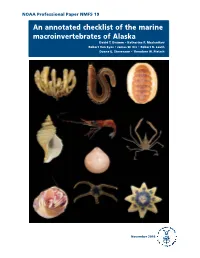
An Annotated Checklist of the Marine Macroinvertebrates of Alaska David T
NOAA Professional Paper NMFS 19 An annotated checklist of the marine macroinvertebrates of Alaska David T. Drumm • Katherine P. Maslenikov Robert Van Syoc • James W. Orr • Robert R. Lauth Duane E. Stevenson • Theodore W. Pietsch November 2016 U.S. Department of Commerce NOAA Professional Penny Pritzker Secretary of Commerce National Oceanic Papers NMFS and Atmospheric Administration Kathryn D. Sullivan Scientific Editor* Administrator Richard Langton National Marine National Marine Fisheries Service Fisheries Service Northeast Fisheries Science Center Maine Field Station Eileen Sobeck 17 Godfrey Drive, Suite 1 Assistant Administrator Orono, Maine 04473 for Fisheries Associate Editor Kathryn Dennis National Marine Fisheries Service Office of Science and Technology Economics and Social Analysis Division 1845 Wasp Blvd., Bldg. 178 Honolulu, Hawaii 96818 Managing Editor Shelley Arenas National Marine Fisheries Service Scientific Publications Office 7600 Sand Point Way NE Seattle, Washington 98115 Editorial Committee Ann C. Matarese National Marine Fisheries Service James W. Orr National Marine Fisheries Service The NOAA Professional Paper NMFS (ISSN 1931-4590) series is pub- lished by the Scientific Publications Of- *Bruce Mundy (PIFSC) was Scientific Editor during the fice, National Marine Fisheries Service, scientific editing and preparation of this report. NOAA, 7600 Sand Point Way NE, Seattle, WA 98115. The Secretary of Commerce has The NOAA Professional Paper NMFS series carries peer-reviewed, lengthy original determined that the publication of research reports, taxonomic keys, species synopses, flora and fauna studies, and data- this series is necessary in the transac- intensive reports on investigations in fishery science, engineering, and economics. tion of the public business required by law of this Department. -

Ancient Climate Change, Antifreeze, and the Evolutionary Diversification of Antarctic Fishes
Ancient climate change, antifreeze, and the evolutionary diversification of Antarctic fishes Thomas J. Neara,b,1, Alex Dornburgb, Kristen L. Kuhnb, Joseph T. Eastmanc, Jillian N. Penningtonb,d, Tomaso Patarnelloe, Lorenzo Zanef, Daniel A. Fernándezg, and Christopher D. Jonesh aPeabody Museum of Natural History and bDepartment of Ecology and Evolutionary Biology, Yale University, New Haven, CT 06520 cDepartment of Biomedical Sciences, College of Osteopathic Medicine, Ohio University, Athens, OH 45701; dEzra Stiles College, Yale University, New Haven, CT 06520 eDepartment of Public Health, Comparative Pathology and Veterinary Hygiene, Università di Padova, 35020 Legnaro, Italy; fDepartment of Biology, Università di Padova, 35131 Padua, Italy; gCentro Austral de Investigaciones Científicas, 9410 Ushuaia, Argentina; and hAntarctic Ecosystem Research Division, Southwest Fisheries Science Center, National Oceanic and Atmospheric Administration National Marine Fisheries Service, La Jolla, CA 92037 Edited by David M. Hillis, University of Texas, Austin, TX, and approved January 25, 2012 (received for review September 15, 2011) The Southern Ocean around Antarctica is among the most rapidly they are more species-rich than their non-Antarctic sister line- warming regions on Earth, but has experienced episodic climate age (approximately 100 vs. one species) (9). Molecular di- change during the past 40 million years. It remains unclear how vergence time analyses have attempted to correlate the origin of ancient periods of climate change have shaped Antarctic bio- the AFGP-bearing Antarctic notothenioids with a period of diversity. The origin of antifreeze glycoproteins (AFGPs) in Ant- global cooling and widespread glaciation of Antarctica that be- arctic notothenioid fishes has become a classic example of how the gan at the onset of the Eocene–Oligocene boundary (14, 15), evolution of a key innovation in response to climate change can approximately 35 Ma (16, 17), leading to the conclusion that the drive adaptive radiation. -

Zootaxa, Epimeriidae (Crustacea, Amphipoda)
Zootaxa 1847: 49–61 (2008) ISSN 1175-5326 (print edition) www.mapress.com/zootaxa/ ZOOTAXA Copyright © 2008 · Magnolia Press ISSN 1175-5334 (online edition) Epimeriidae (Crustacea, Amphipoda) from New Zealand with a description of a new species ANNE-NINA LÖRZ National Institute of Water & Atmospheric Research, Private Bag 14901, Kilbirnie Wellington, New Zealand. E-mail: a.loerz@niwa.co.nz Abstract Epimeria horsti sp. nov., collected from New Zealand seamounts at 970–1156 m depth, is described in detail. This increases the number of known species of New Zealand Epimeriidae to four. Additionally Epimeria bruuni Barnard, 1961, previously known only from the Kermadec Trench at 2470 m depth, is redescribed using new material collected from Young Nicks Seamount, Hikurangi Plateau. A key is provided for all New Zealand epimeriids. Epimeria horsti can be distinguished from similar species by the unique combination of the following characters: eyes present; dorsal carinae starting on pereon 6; epimera 1–2 posterolateral corner rounded; epimeron 3 posterolateral corner produced. Key words: New Zealand, seamounts, deep sea, taxonomy, new species, Epimeria, Epimeriidae, Amphipoda, Crustacea Introduction Recent New Zealand research voyages collected epimeriid Amphipoda. Examination of material collected on two seamounts to the east of New Zealand revealed at least one species new to science, which is described herein. Further samples, from the Kermadec Trench in over 2000 m depth revealed an adult specimen of Epimeria bruuni Barnard, 1961. The holotype of E. bruuni Barnard, 1961, from the Kermadec Trench is a juvenile and the only specimen known so far. A redescription of E. bruuni is given and the distinction between juvenile and adult specimens is discussed.