Kathleen Neal Cleaver Oral-History Interview, 2011
Total Page:16
File Type:pdf, Size:1020Kb
Load more
Recommended publications
-
Locking up Our Own: James Forman Jr. in Conversation with Khalil Gibran Muhammad"
TRANSCRIPT "LOCKING UP OUR OWN: JAMES FORMAN JR. IN CONVERSATION WITH KHALIL GIBRAN MUHAMMAD" A conversation with James Forman, Jr. and Khalil Gibran Muhammad Introduction: Leonard Noisette Recorded May 8, 2017 ANNOUNCER: You are listening to a recording of the Open Society Foundations, working to build vibrant and tolerant democracies worldwide. Visit us at OpenSocietyFoundations.org. LEONARD NOISETTE: Good afternoon. Thanks to the Open Society fellowship program for pulling this event together. And thank you all for joining us. I'm Lenny Noisette. I oversee the criminal justice portfolio here in U.S. programs as-- as part of the Open Society Foundations. So I am particularly pleased to be able to kick off what I am sure will be an engaging and informative discussion with James Forman and Khalil-Gibran Muhammad about James's compelling new book, Locking Up Our Own: Crime and Punishment in Black America. Just by way of instruction, James Forman Jr. is a professor of law at Yale Law School. He is a graduate of-- At-- Atlanta's Roosevelt High School, Brown University, and Yale Law School. And was a law clerk for Judge William Norris of the U.S. Court of Appeals for the Ninth Circuit and Justice Sandra Day O’Connor of the United States Supreme Court. After clerking, James joined the Public Defender Service in Washington, D-- D.C., where for six years he represented both youth and adults charged with crimes. During his time as a public defender, James became frustrated with the lack of TRANSCRIPT: LOCKING UP OUR OWN: JAMES FORMAN JR. -

The History of the Black Panther Party 1966-1972 : a Curriculum Tool for Afrikan American Studies
University of Massachusetts Amherst ScholarWorks@UMass Amherst Doctoral Dissertations 1896 - February 2014 1-1-1990 The history of the Black Panther Party 1966-1972 : a curriculum tool for Afrikan American studies. Kit Kim Holder University of Massachusetts Amherst Follow this and additional works at: https://scholarworks.umass.edu/dissertations_1 Recommended Citation Holder, Kit Kim, "The history of the Black Panther Party 1966-1972 : a curriculum tool for Afrikan American studies." (1990). Doctoral Dissertations 1896 - February 2014. 4663. https://scholarworks.umass.edu/dissertations_1/4663 This Open Access Dissertation is brought to you for free and open access by ScholarWorks@UMass Amherst. It has been accepted for inclusion in Doctoral Dissertations 1896 - February 2014 by an authorized administrator of ScholarWorks@UMass Amherst. For more information, please contact scholarworks@library.umass.edu. THE HISTORY OF THE BLACK PANTHER PARTY 1966-1972 A CURRICULUM TOOL FOR AFRIKAN AMERICAN STUDIES A Dissertation Presented By KIT KIM HOLDER Submitted to the Graduate School of the■ University of Massachusetts in partial fulfills of the requirements for the degree of doctor of education May 1990 School of Education Copyright by Kit Kim Holder, 1990 All Rights Reserved THE HISTORY OF THE BLACK PANTHER PARTY 1966 - 1972 A CURRICULUM TOOL FOR AFRIKAN AMERICAN STUDIES Dissertation Presented by KIT KIM HOLDER Approved as to Style and Content by ABSTRACT THE HISTORY OF THE BLACK PANTHER PARTY 1966-1971 A CURRICULUM TOOL FOR AFRIKAN AMERICAN STUDIES MAY 1990 KIT KIM HOLDER, B.A. HAMPSHIRE COLLEGE M.S. BANK STREET SCHOOL OF EDUCATION Ed.D., UNIVERSITY OF MASSACHUSETTS Directed by: Professor Meyer Weinberg The Black Panther Party existed for a very short period of time, but within this period it became a central force in the Afrikan American human rights/civil rights movements. -
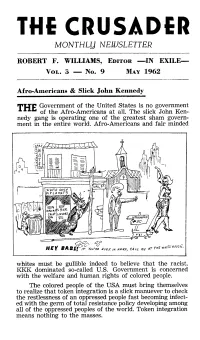
The Crusader Monthll,J Nelijsletter
THE CRUSADER MONTHLL,J NELIJSLETTER ROBERT F. WILLIAMS, EDITOR -IN EXILE- VoL . ~ - No. 9 MAY 1968 Afro-Americans & Slick John Kennedy Government of the United States is no government T~E of the Afro-Americans at all. The slick John Ken- nedy gang is operating one of the greatest sham govern- ment in the entire world. Afro-Americans and fair minded Od > ~- O THE wN«< /l~USL . lF Yov~Re EyER IN NE60, CALL ME AT whites must be gullible indeed to believe that the racist, KKK dominated so-called U.S. Government is concerned with the welfare and human rights of colored people. The colored people of the USA must bring themselves to realize that taken integration is a slick manuever to check the restlessness of an oppressed people fast becoming infect ed with the germ of total resistance policy developing among all of the oppressed peoples of the world. Token integration means nothing to the masses. Even an idiot should be able to see that so-called Token integration is no more than window dressing designed to lull the poor downtrodden Afro-American to sleep and to make the out side world think that the racist, savage USA is a fountainhead of social justice and democracy. The Afro-American in the USA is facing his greatest crisis since chattel slavery. All forms of violence and underhanded methods o.f extermination are being stepped up against our people. Contrary to what the "big daddies" and their "good nigras" would have us believe about all of the phoney progress they claim the race is making, the True status of the Afro-Ameri- can is s#eadily on the down turn. -

Stokely Carmichael______Toward Black Liberation the Massachusetts Review
National Humanities Center Resource Toolbox The Making of African American Identity: Vol. III, 1917-1968 Getty Images Stokely Carmichael_______ Toward Black Liberation The Massachusetts Review Autumn 1966____Excerpt* Stokely Carmichael came to the U.S. from Trinidad as a child in 1952, In 1966 he became chairman of the Student Nonviolent Coordinating Committee (SNCC). Later he became a leader of the Black Panther Party. Traditionally, for each new ethnic group, the route Stokely Carmichael, 1973 to social and political integration into America’s pluralistic society, has been through the organization of their own institutions with which to represent their communal needs within the larger society. This is simply stating what the advocates of Black Power are saying. The strident outcry, particularly from the liberal community, that has been evoked by this proposal can only be understood by examining the historic relationship between Negro and white power in this country. Negroes are defined by two forces, their blackness and their powerlessness. There have been traditionally two communities in America: the white community, which controlled and defined the forms that all institutions within the society would take; and the Negro community, which has been excluded from participation in the power decisions that shaped the society, and has traditionally been dependent upon, and subservient to, the white community. This has not been accidental. The history of every institution of this society indicates that a major concern in the ordering and structuring of the society has been the maintaining of the Negro community in its condition of dependence and oppression. This has not been on the level of individual acts of discrimination between individual whites against individual Negroes, but as total acts by the white community against the Negro community. -
Table of Content S
TABLE OF CONTENTS TABLE TABLE OF CONTENTS Strike Force Front Office 4 IFL Communications 29 Media Partners 7 Glossary of Terms 30 Game Day Information 8 2020 IFL Weekly Schedule 31 Media Guidelines 10 2019 IFL Season Recap 32 Dance Team Coach 11 2015 IFL Honors & Awards 32 Football Ops Staff 12 2019 IFL Individual Leaders 34 Strike Force Medical Team 15 2019 IFL Team Leaders 35 2020 Alphabetical Roster 16 Tickets 36 2020 Numerical Roster 17 Season Tickets 36 Player Bios 18 Group Tickets 37 2019-20 Transactions 27 Game Day Suites 38 About the IFL 28 Notes Page 39 FRONT OFFICE & FACILITIES FRONT OFFICE PRACTICE LOCATIONS 3636 Camino Del Rio North Suite 120 Note: Practice schedules are published weekly and San Diego, CA 92108 available on www.sdstrikeforce.com. Contact the Front Office for the latest schedule and updates on Phone: 619-340-1300 potential changes. Email: info@sdstrikeforce.com www.sdstrikeforce.com Otay Ranch Town Center 2015 Birch Road Facebook.com/sdstrikeforce Chula Vista, CA 91915 Twitter: @sdstrikeforce Instagram: @sdstrikeforce LinkedIn: sandiegostrikeforce 3 GENERAL MANAGER RYAN EUCKER C: 509-954-4041 | E: ryan@sdstrikeforce.com Ryan will enter his 10th season of working in professional sports in 2020 and first full season working with the Strike Force after joining the team midway through their inaugural season. He started the 2019 IFL season with the Cedar Rapids River Kings (also owned by Roy Choi). In 2017-18, he worked with the Normal CornBelters of the independent Fron- tier League in Bloomington-Normal, Illinois. Ryan’s sports career began in his home state of Washington with the Spokane Shock of the Arena Football League in 2011 and continued for seven seasons, including Spokane’s move to the IFL in 2016. -
Black Panthers Hold Forth at Camoius Pally , Identifies BARBARA AUTHIOR
Eldridge Cleaver FBI File #100-HQ-447251 Section 29 4* -:i-, Assoc. Dir. Dep. AD Adm. LAW OFFICES Dep. AD Iny. WALD, HARKRADER & ROSS Asst. Dir.: Adm. Serv. Ext. Affairs ROBERT L.WALD CARLETON A.HARKRADER WM.WARFIELD ROSS 910 SEVENTEEN THOMAS H. TRUITT ROBERT M. LICHTMAN STEPHEN B.IVESJR. Fin.& Pers. WASHINGTON, DONALD H. GREEN NEAL P. RUTLEDGE GEORGE A. AVERY THOMAS C. MATTHEWS, JR. THOMAS J.SCHWAB JOEL E. HOFFMAN Gen. Inv. (202) 87, TERRY F. LENZNER DANIEL F;O KEEFE,JR, DONALD T. BUCKLIN Ident. JERRY D.ANKER CHARLES C.ABELES ROBERT E. NAGLE CABLE ADORE ALEXANDER W.SIERCK TERRENCE ROCHE MURPHY WILLIAM R.WEISSMAN TELEX: 2 I ntell. STEPHEN M.TRUITT, TONI K.GOLDEN KEITH S.WATSON JAMES DOUGLAS WELCH ROBERT A. SKITOL STEVEN K.YABLONSKI SELMA M. LEVI] THOMAS W. BRUNNER C.COLEMAN BIRD GREER S. GOLDMAN Plan. & In GERALD B. WETLAUFER LEWIS M. POPPER MARK SCHATTNER OF COU Rec. RICHARD A. BROWN AVRUM M. GOLDBERG DENNIS D. CLARK Mgt. PHILIP I DAVID R. BERZ CAROL KINSBOURNE LESLIE S. BRETZ S.& T. Serve. ROBERT B. CORNELL DAVID B. WEINBERG ANTHONY L.YOUNG CHARLES F, ROBERT M.COHAN STEVEN M. GOTTLIEB STEVEN E. SILVERMAN Spec. Inv. NANCY H. HENDRY SHEILA JACKSON LEE + JAMES R. MYERS Training . GLORIA PHARES STEWART RANGELEY WALLACE * ON LEAVE Telephone Rm. Director's Sec'y February 14, 191 DELIVERED BY HAND FBI/DOJ OUTSIDE .,OLE ALL INFOTOTAT: CONTAIN Mr. Clarence M. Kelley HERMIN IS TN b Director DAT 09-11-2( U/P/EL b7C Federal Bureau of Investigation United States Department of Justice Washington, D.C. -

Waveland, Mississippi, November 1964: Death of Sncc, Birth of Radicalism
WAVELAND, MISSISSIPPI, NOVEMBER 1964: DEATH OF SNCC, BIRTH OF RADICALISM University of Wisconsin – Eau Claire: History Department History 489: Research Seminar Professor Robert Gough Professor Selika Ducksworth – Lawton, Cooperating Professor Matthew Pronley University of Wisconsin – Eau Claire May 2008 Abstract: The Student Nonviolent Coordinating Committee (SNCC, pronounced Snick) was a nonviolent direct action organization that participated in the civil rights movement in the 1960s. After the Freedom Summer, where hundreds of northern volunteers came to participate in voter registration drives among rural blacks, SNCC underwent internal upheaval. The upheaval was centered on the future direction of SNCC. Several staff meetings occurred in the fall of 1964, none more important than the staff retreat in Waveland, Mississippi, in November. Thirty-seven position papers were written before the retreat in order to reflect upon the question of future direction of the organization; however, along with answers about the future direction, these papers also outlined and foreshadowed future trends in radical thought. Most specifically, these trends include race relations within SNCC, which resulted in the emergence of black self-consciousness and an exodus of hundreds of white activists from SNCC. ii Table of Contents: Abstract ii Historiography 1 Introduction to Civil Rights and SNCC 5 Waveland Retreat 16 Position Papers – Racial Tensions 18 Time after Waveland – SNCC’s New Identity 26 Conclusion 29 Bibliography 32 iii Historiography Research can both answer questions and create them. Initially I discovered SNCC though Taylor Branch’s epic volumes on the Civil Right Movements in the 1960s. Further reading revealed the role of the Student Nonviolent Coordinating Committee (SNCC, pronounced Snick) in the Civil Right Movement and opened the doors into an effective and controversial organization. -

Book Review the Black Police: Policing Our Own
BOOK REVIEW THE BLACK POLICE: POLICING OUR OWN LOCKING UP OUR OWN: CRIME AND PUNISHMENT IN BLACK AMERICA. By James Forman Jr. New York, N.Y.: Farrar, Straus and Giroux. 2017. Pp. 306. $27.00. Reviewed by Devon W. Carbado∗ & L. Song Richardson∗∗ INTRODUCTION Since Darren Wilson shot and killed Michael Brown in 2014,1 the problem of police violence against African Americans has been a rela- tively salient feature of nationwide discussions about race. Across the ideological spectrum, people have had to engage the question of whether, especially in the context of policing, it’s fair to say that black lives are undervalued. While there is both a racial and a political divide with respect to how Americans have thus far answered that question, the emergence of Black Lives Matter movements2 has made it virtually im- possible to be a bystander in the debate. Separate from whether racialized policing against African Americans is, in fact, a social phenomenon, is the contestable question about solu- tions: Assuming that African Americans are indeed the victims of over- policing, meaning that by some metric they end up having more inter- actions with the police and more violent encounters than is normatively warranted, what can we do about it? And here, the answers range from abolishing police officers altogether, to training them, to diversifying po- lice departments. It is on the last of these proposed solutions — the diversification of police departments — that we focus in this essay. The central question we ask is: What are the dynamics that might shape how African American police officers police other African Americans? Asked another way, what do existing theories about race and race relations, ––––––––––––––––––––––––––––––––––––––––––––––––––––––––––––– ∗ Associate Vice Chancellor of BruinX for Equity, Diversity and Inclusion, the Honorable Harry Pregerson Professor of Law, University of California, Los Angeles School of Law. -
'The Only Position for Women in SNCC Is Prone'
‘The Only Position for Women in SNCC is Prone’ 29 ‘The Only Position for Women in SNCC is Prone’: Stokely Carmichael and the Perceived Patriarchy of Civil Rights Organisations in America 1 Sabina Peck Second Year Undergraduate, 1 University of New South Wales There is the danger in our culture that because a person is called upon to give public statements and is acclaimed by the establishment, such a person gets to the point of believing that he is the movement ... There are those, some of the young people [of SNCC] especially, who have said to me that if I had not been a woman I would have been well known in certain places, and perhaps held certain kinds of positions. – Ella Baker, 19702 Until relatively recently, historiography concerning the Civil Rights movement and its organisations has been fairly devoid of the study of the participation of women, focusing instead on certain charismatic, notably black male individuals such as Martin Luther King Jnr., Stokely Carmichael and Malcolm X.3 Steven Lawson, for example, has traced the evolution of 1 Note the following abbreviations are used throughout the article: CORE- Congress of Racial Equality MFDP – Mississippi Freedom Democratic Party NAACP – National Association for the Advancement of Coloured People SCLC – Southern Christian Leadership Conference SNCC – Student Non-violent Co-ordinating Committee 2 Ella Baker, Developing Community Leadership, Taped interview with Gerda Lerner (December 1970) paragraphs 15 and 14, respectively. 3 Joan C. Browning explores the extent to which women’s activities have been glossed over in Civil Rights Historiography in her article, ‘Invisible Revolutionaries: White Women in Civil Rights Historiography’ Journal of Women’s History, Vol. -

The Unknown Origins of the March on Washington: Civil Rights Politics and the Black Working Class
The Unknown Origins of the March on Washington: Civil Rights Politics and the Black Working Class William P. Jones The very decade which has witnessed the decline of legal Jim Crow has also seen the rise of de facto segregation in our most fundamental socioeconomic institutions,” vet- eran civil rights activist Bayard Rustin wrote in 1965, pointing out that black work- ers were more likely to be unemployed, earn low wages, work in “jobs vulnerable to automation,” and live in impoverished ghettos than when the U.S. Supreme Court banned legal segregation in 1954. Historians have attributed that divergence to a nar- rowing of African American political objectives during the 1950s and early 1960s, away from demands for employment and economic reform that had dominated the agendas of civil rights organizations in the 1940s and later regained urgency in the late 1960s. Jacquelyn Dowd Hall and other scholars emphasize the negative effects of the Cold War, arguing that the National Association for the Advancement of Colored People (NAACP) and other civil rights organizations responded to domestic anticom- munism by distancing themselves from organized labor and the Left and by focusing on racial rather than economic forms of inequality. Manfred Berg and Adam Fair- clough offer the more positive assessment that focusing on racial equality allowed civil rights activists to appropriate the democratic rhetoric of anticommunism and solidify alliances with white liberals during the Cold War, although they agree that “anti- communist hysteria retarded the struggle for racial justice and narrowed the political Research for this article was supported by a National Endowment for the Humanities/Newhouse Fellowship at the New York Public Library’s Schomburg Center for Research in Black Culture and the Graduate School at the University of Wisconsin, Madison. -
James Forman Papers [Finding Aid]. Library of Congress
James Forman Papers A Finding Aid to the Collection in the Library of Congress Manuscript Division, Library of Congress Washington, D.C. 2014 Revised 2014 December Contact information: http://hdl.loc.gov/loc.mss/mss.contact Additional search options available at: http://hdl.loc.gov/loc.mss/eadmss.ms010125 LC Online Catalog record: http://lccn.loc.gov/mm2007085371 Prepared by Connie L. Cartledge with the assistance of Tracey Barton, Maria Farmer, Sherralyn McCoy, Dan Oleksiw, and Carolyn Ray Revised and expanded by Connie L. Cartledge Collection Summary Title: James Forman Papers Span Dates: 1848-2005 Bulk Dates: (bulk 1961-2001) ID No.: MSS85371 Creator: Forman, James, 1928-2005 Extent: 79,000 items ; 255 containers plus 2 oversize ; 100.2 linear feet ; 1 digital file (1.09 MB) Language: Collection material in English, French, and Spanish Location: Manuscript Division, Library of Congress, Washington, D.C. Summary: Author, journalist, and civil rights activist. Correspondence, memoranda, diaries, subject files, speeches and writings, family papers, appointment books and calendars, and other papers relating primarily to Forman's activities as executive secretary of the Student Nonviolent Coordinating Committee and president of the Unemployment and Poverty Action Committee. Selected Search Terms The following terms have been used to index the description of this collection in the Library's online catalog. They are grouped by name of person or organization, by subject or location, and by occupation and listed alphabetically therein. People Al-Amin, Jamil, 1943- Belafonte, Harry, 1927- --Correspondence. Bellamy, Fay--Correspondence. Braden, Anne, 1924-2006--Correspondence. Carmichael, Stokely--Correspondence. Carmichael, Stokely. Clinton, Bill, 1946- --Correspondence. -

A Dramatic Exploration of Women and Their Agency in the Black Panther Party
Kennesaw State University DigitalCommons@Kennesaw State University Master of Arts in American Studies Capstones Interdisciplinary Studies Department Spring 5-2017 Revolutionary Every Day: A Dramatic Exploration of Women and Their Agency in The lB ack Panther Party. Kristen Michelle Walker Kennesaw State University Follow this and additional works at: http://digitalcommons.kennesaw.edu/mast_etd Part of the African American Studies Commons, American Studies Commons, Playwriting Commons, Women's History Commons, and the Women's Studies Commons Recommended Citation Walker, Kristen Michelle, "Revolutionary Every Day: A Dramatic Exploration of Women and Their Agency in The lB ack Panther Party." (2017). Master of Arts in American Studies Capstones. 12. http://digitalcommons.kennesaw.edu/mast_etd/12 This Capstone is brought to you for free and open access by the Interdisciplinary Studies Department at DigitalCommons@Kennesaw State University. It has been accepted for inclusion in Master of Arts in American Studies Capstones by an authorized administrator of DigitalCommons@Kennesaw State University. For more information, please contact digitalcommons@kennesaw.edu. REVOLUTIONARY EVERY DAY: A DRAMATIC EXPLORATION OF WOMEN AND THEIR AGENCY IN THE BLACK PANTHER PARTY A Creative Writing Capstone Presented to The Academic Faculty by Kristen Michelle Walker In Partial Fulfillment Of the Requirements for the Degree Master of Arts in American Studies Kennesaw State University May 2017 1 TABLE OF CONTENTS Introduction…………………………………...…………………………………………...…….