Tax Competition with Parasitic Tax Havens
Total Page:16
File Type:pdf, Size:1020Kb
Load more
Recommended publications
-

The Disclosure of State Corporate Income Tax Data: Turning the Clock Back to the Future Richard Pomp University of Connecticut School of Law
University of Connecticut OpenCommons@UConn Faculty Articles and Papers School of Law Spring 1993 The Disclosure of State Corporate Income Tax Data: Turning the Clock Back to the Future Richard Pomp University of Connecticut School of Law Follow this and additional works at: https://opencommons.uconn.edu/law_papers Part of the Taxation-Federal Commons, and the Taxation-State and Local Commons Recommended Citation Pomp, Richard, "The Disclosure of State Corporate Income Tax Data: Turning the Clock Back to the Future" (1993). Faculty Articles and Papers. 121. https://opencommons.uconn.edu/law_papers/121 +(,121/,1( Citation: 22 Cap. U. L. Rev. 373 1993 Content downloaded/printed from HeinOnline (http://heinonline.org) Mon Aug 15 17:19:23 2016 -- Your use of this HeinOnline PDF indicates your acceptance of HeinOnline's Terms and Conditions of the license agreement available at http://heinonline.org/HOL/License -- The search text of this PDF is generated from uncorrected OCR text. -- To obtain permission to use this article beyond the scope of your HeinOnline license, please use: https://www.copyright.com/ccc/basicSearch.do? &operation=go&searchType=0 &lastSearch=simple&all=on&titleOrStdNo=0198-9693 THE DISCLOSURE OF STATE CORPORATE INCOME TAX DATA: TURNING THE CLOCK BACK TO THE FUTURE RICHARD D. POMP* INTRODUCTION .............................................. 374 I. THE DISCLOSURE OF INCOME TAX INFORMATION AT THE FEDERAL LEVEL: AN HISTORICAL PERSPECTIVE .......... 378 A. The Civil War Income Taxes: 1861-1872 ............... 379 B. The 1894 Income Tax ................................ 384 C. The Tariff Act of 1909 ............................... 386 D . 1913-1923 .......................................... 389 E. The 1924 and 1926 Acts ............................... 391 F. The Pink Slip Provisions: 1934-1935 ................ -

Financial Transaction Tax and Economic Crisis: Is It Time for a Tax on International Transactions?
RDTI Atual 05 IBDT | INSTITUTO BRASILEIRO DE DIREITO TRIBUTÁRIO Revista Direito Tributário Internacional Atual e-ISSN 2595-7155 FINANCIAL TRANSACTION TAX AND ECONOMIC CRISIS: IS IT TIME FOR A TAX ON INTERNATIONAL TRANSACTIONS? IMPOSTO SOBRE TRANSAÇÕES FINANCEIRAS E CRISE ECONÔMICA: É CHEGADA A HORA DE UM IMPOSTO SOBRE TRANSAÇÕES INTERNACIONAIS? Pedro Adamy Professor da Escola de Direito da Pontifícia Universidade Católica do Rio Grande do Sul (PUCRS). Doutorando em Direito na Universidade de Heidelberg, Alemanha. Mestre em Direito pela Universidade Federal do Rio Grande do Sul (UFRGS). E-mail: pedro@pedroadamy.com.br Recebido em: 15-04-2019 Aprovado em: 04-06-2019 ABSTRACT This paper aims at the legal problems that arise concerning the introduction of a financial transaction tax. The article analyzes the impact, characteristics and challenges of a tax on international financial transactions and its relationship to economic crises. KEYWORDS: FINANCIAL TRANSACTION TAX, ECONOMIC CRISIS, INTERNATIONAL TAXATION, REGULATORY MEASURES RESUMO Este artigo visa os problemas jurídicos que surgem com a introdução de um imposto sobre transações financeiras. O artigo analisa o impacto, as características e os desafios de um imposto sobre transações financeiras internacionais e sua relação com crises econômicas. PALAVRAS-CHAVE: IMPOSTO SOBRE TRANSAÇÕES FINANCEIRAS, CRISES ECONÔMICAS, TRIBUTAÇÃO INTERNACIONAL, MEDIDAS ADMINISTRATIVAS 157 Revista Direito Tributário Internacional Atual nº 05 p.157-171 - 2019 RDTI Atual 05 IBDT | INSTITUTO BRASILEIRO DE DIREITO TRIBUTÁRIO Revista Direito Tributário Internacional Atual e-ISSN 2595-7155 1. INTRODUCTORY REMARKS “Crisis is not the best advisor on formulating rules for normal times.”1 In the event of a financial crisis two phenomena will certainly occur: first, money will flow from unstable and poorer countries into more stable and richer ones; second, the discussion about a financial transaction tax (henceforth FTT) will be revived and gain attention among the press, economists, tax law professionals and oppositional politicians2. -

Tax Competition and Tax Coordination in the European Union: a Survey
A Service of Leibniz-Informationszentrum econstor Wirtschaft Leibniz Information Centre Make Your Publications Visible. zbw for Economics Keuschnigg, Christian; Loretz, Simon; Winner, Hannes Working Paper Tax competition and tax coordination in the European Union: A survey Working Papers in Economics and Finance, No. 2014-04 Provided in Cooperation with: Department of Social Sciences and Economics, University of Salzburg Suggested Citation: Keuschnigg, Christian; Loretz, Simon; Winner, Hannes (2014) : Tax competition and tax coordination in the European Union: A survey, Working Papers in Economics and Finance, No. 2014-04, University of Salzburg, Department of Social Sciences and Economics, Salzburg This Version is available at: http://hdl.handle.net/10419/122170 Standard-Nutzungsbedingungen: Terms of use: Die Dokumente auf EconStor dürfen zu eigenen wissenschaftlichen Documents in EconStor may be saved and copied for your Zwecken und zum Privatgebrauch gespeichert und kopiert werden. personal and scholarly purposes. Sie dürfen die Dokumente nicht für öffentliche oder kommerzielle You are not to copy documents for public or commercial Zwecke vervielfältigen, öffentlich ausstellen, öffentlich zugänglich purposes, to exhibit the documents publicly, to make them machen, vertreiben oder anderweitig nutzen. publicly available on the internet, or to distribute or otherwise use the documents in public. Sofern die Verfasser die Dokumente unter Open-Content-Lizenzen (insbesondere CC-Lizenzen) zur Verfügung gestellt haben sollten, If the documents have been made available under an Open gelten abweichend von diesen Nutzungsbedingungen die in der dort Content Licence (especially Creative Commons Licences), you genannten Lizenz gewährten Nutzungsrechte. may exercise further usage rights as specified in the indicated licence. www.econstor.eu TAX COMPETITION AND TAX COORDINATION IN THE EUROPEAN UNION: A SURVEY CHRISTIAN KEUSCHNIGG, SIMON LORETZ AND HANNES WINNER WORKING PAPER NO. -

Taxation of Land and Economic Growth
economies Article Taxation of Land and Economic Growth Shulu Che 1, Ronald Ravinesh Kumar 2 and Peter J. Stauvermann 1,* 1 Department of Global Business and Economics, Changwon National University, Changwon 51140, Korea; uknowlook@gmail.com 2 School of Accounting, Finance and Economics, Laucala Campus, The University of the South Pacific, Suva 40302, Fiji; ronald.kumar@usp.ac.fj * Correspondence: pjsta@changwon.ac.kr; Tel.: +82-55-213-3309 Abstract: In this paper, we theoretically analyze the effects of three types of land taxes on economic growth using an overlapping generation model in which land can be used for production or con- sumption (housing) purposes. Based on the analyses in which land is used as a factor of production, we can confirm that the taxation of land will lead to an increase in the growth rate of the economy. Particularly, we show that the introduction of a tax on land rents, a tax on the value of land or a stamp duty will cause the net price of land to decline. Further, we show that the nationalization of land and the redistribution of the land rents to the young generation will maximize the growth rate of the economy. Keywords: taxation of land; land rents; overlapping generation model; land property; endoge- nous growth Citation: Che, Shulu, Ronald 1. Introduction Ravinesh Kumar, and Peter J. In this paper, we use a growth model to theoretically investigate the influence of Stauvermann. 2021. Taxation of Land different types of land tax on economic growth. Further, we investigate how the allocation and Economic Growth. Economies 9: of the tax revenue influences the growth of the economy. -
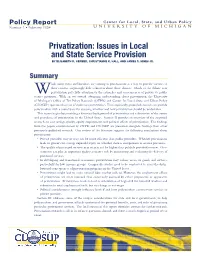
Privatization: Issues in Local and State Service Provision by ELISABETH R
Center for Local, State, and Urban Policy Policy Report Number 1 • February 2004 UNIVERSITY OF MICHIGAN Privatization: Issues in Local and State Service Provision BY ELISABETH R. GERBER, CHRISTIANNE K. HALL, AND JAMES R. HINES JR. Summary hile many states and localities are turning to privatization as a way to provide services to their citizens, surprisingly little is known about these choices. Much of the debate over Wprivatization pays little attention to the rationales and consequences of private vs. public service provision. With an eye toward advancing understanding about privatization, the University of Michigan’s Offi ce of Tax Policy Research (OTPR) and Center for Local, State, and Urban Policy (CLOSUP) sponsored a series of studies on privatization. This empirically grounded research can provide policymakers with a sound basis for assessing whether and how privatization should be undertaken. This report begins by providing a historical background of privatization and a discussion of the nature and prevalence of privatization in the United States. Section II provides an overview of the empirical research on cost savings, quality, equity, employment, and political effects of privatization. The fi ndings from the papers commissioned by OTPR and CLOSUP are presented alongside fi ndings from other previously published research. Our review of the literature suggests the following conclusions about privatization: • Private providers may or may not be more effi cient than public providers. Whether privatization leads to greater cost savings depends largely on whether there is competition in service provision. • The quality of privatized services may or may not be higher than publicly provided services. Gov- ernments can play an important quality assurance role by monitoring and evaluating the delivery of privatized services. -
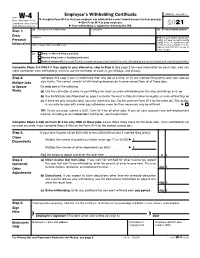
Form W-4, Employee's Withholding Certificate
Employee’s Withholding Certificate OMB No. 1545-0074 Form W-4 ▶ (Rev. December 2020) Complete Form W-4 so that your employer can withhold the correct federal income tax from your pay. ▶ Department of the Treasury Give Form W-4 to your employer. 2021 Internal Revenue Service ▶ Your withholding is subject to review by the IRS. Step 1: (a) First name and middle initial Last name (b) Social security number Enter Address ▶ Does your name match the Personal name on your social security card? If not, to ensure you get Information City or town, state, and ZIP code credit for your earnings, contact SSA at 800-772-1213 or go to www.ssa.gov. (c) Single or Married filing separately Married filing jointly or Qualifying widow(er) Head of household (Check only if you’re unmarried and pay more than half the costs of keeping up a home for yourself and a qualifying individual.) Complete Steps 2–4 ONLY if they apply to you; otherwise, skip to Step 5. See page 2 for more information on each step, who can claim exemption from withholding, when to use the estimator at www.irs.gov/W4App, and privacy. Step 2: Complete this step if you (1) hold more than one job at a time, or (2) are married filing jointly and your spouse Multiple Jobs also works. The correct amount of withholding depends on income earned from all of these jobs. or Spouse Do only one of the following. Works (a) Use the estimator at www.irs.gov/W4App for most accurate withholding for this step (and Steps 3–4); or (b) Use the Multiple Jobs Worksheet on page 3 and enter the result in Step 4(c) below for roughly accurate withholding; or (c) If there are only two jobs total, you may check this box. -

Tax Policies in Open Economies
Tax Policies in Open Economies by Rishi R. Sharma A dissertation submitted in partial fulfillment of the requirements for the degree of Doctor of Philosophy (Economics) in the University of Michigan 2016 Doctoral Committee: Professor Alan V. Deardorff, Co-Chair Professor James R. Hines, Jr., Co-Chair Assistant Professor Kyle Handley Professor Joel B. Slemrod ACKNOWLEDGEMENTS I am extremely grateful to Alan Deardorff, Jim Hines, Kyle Handley and Joel Slemrod for their advice and guidance throughout this dissertation. ii TABLE OF CONTENTS ACKNOWLEDGEMENTS ii LIST OF APPENDICES iv CHAPTER I. Introduction 1 II. Incentives to Tax Foreign Investors 3 Introduction 3 Model 5 Optimal Taxation 9 Additional Discussion 11 Conclusion 15 III. Taxing and Subsidizing Foreign Investors 16 Introduction 16 Model 18 Inframarginal Taxes and Marginal Subsidies 22 Further Discussion 25 Conclusion 27 IV. Optimal Tariffs with Inframarginal Exporters 28 Introduction 28 Model 30 Tariff Analysis 32 Additional Considerations 35 Conclusion 37 Appendices 38 References 49 iii LIST OF APPENDICES APPENDIX A. Appendix to Chapter II 38 B. Appendix to Chapter III 44 C. Appendix to Chapter IV 47 iv Chapter I Introduction This dissertation consists of three papers that use economic theory to study tax policies in open economies. The first two papers study fiscal policies towards inbound foreign direct investment (FDI), while the third studies international trade policy. These papers together contribute to our understanding of government incentives to use fiscal instruments to improve domestic welfare in open economy settings. Chapter II studies a small country’s incentives to tax foreign investors. A central result in the theory of international taxation argues that small countries should not impose taxes on inbound FDI (Gordon, 1986). -

The Financial Transactions Tax Versus (?) the Financial Activities Tax
The Financial Transactions Tax Versus (?) the Financial Activities Tax Daniel Shaviro NYU Law School Stanford Law School, February 21, 2012 1 Intervening in a horse race Prepared for conference (Amsterdam 12/9/11) discussing recent European Commission (EC) proposal to enact an FTT (financial transactions tax). Natural contrast to Int’l Monetary Fund (IMF) staff proposal to enact any of 3 variants of an FAT (financial activities tax). Key difference: gross tax on certain sales, vs. net tax on a broader range of activities. Discussion is organized around (but not chained to) stated rationales for taxing financial firms. Main conclusions: (1) I favor a hybridized version of the 3 FATs discussed by the IMF (and generally reject stated rationales for the FTT). (2) A possible FTT rationale (not identified by the EC) might conceivably support its enactment, whether or not an FAT is enacted. 2 Why has the European Commission proposed an FTT? The main stated grounds are (1) to ensure a fair contribution by the financial sector, (2) to respond to under-taxation of the sector, and (3) it “might be an appropriate tool to reduce excessive risk-taking.” Other possible grounds: harmonize FTT-like taxes that EU countries may be doing anyway; political feasibility & revenue? Grounds for rejecting FAT unclear. FTT’s greater revenue potential & direct impact on risks from excessive trading outweigh higher risks of relocation of transactions,” negative effects on GDP & employment? Possible unstated political feasibility rationale? (From FTT’s nominally lower rate, popular identification as the “Robin Hood tax.”) 3 FTT: History and Rationale > 200 years old (U.K. -

International Tax Cooperation and Capital Mobility
CEPAL CEPALREVIEW REVIEW 77 • AUGUST 77 2002 65 International tax cooperation and capital mobility Valpy FitzGerald University of Oxford The international mobility of capital and the geographical edmond.fitzgerald @st-antonys.oxford.ac.uk dispersion of firms have clear advantages for the growth and modernization of Latin America and the Caribbean, but they also pose great challenges. Modern principles of capital taxation for open developing economies indicate the need to find the correct balance between the encouragement of private investment and the financing of social infrastructure, both of which are necessary for sustainable growth. This balance can be sub-optimal when countries compete for foreign investment by granting tax incentives or applying conflicting principles in determining the tax base. The fiscal authorities of the region could obtain a more equitable share of capital tax revenue, without depressing investment and growth, through more effective regional tax rules, double taxation treaties, information sharing and treatment of offshore financial centres along the lines already promoted for OECD members. INTERNATIONAL TAX COOPERATIONAUGUST AND CAPITAL 2002 MOBILITY • VALPY FITZGERALD 66 CEPAL REVIEW 77 • AUGUST 2002 I Introduction Globalization involves increasing freedom of capital for developing as well as developed countries. Latin movement: both for firms from industrialized countries America and the Caribbean have been at the forefront investing in developing countries, and for financial asset of the liberalization -

Tax Amnesty and Political Participation *
TAX AMNESTY AND POLITICAL PARTICIPATION * ABSTRACT In many countries thinking about a (new) tax amnesty is currently in vogue. However, cross-national ex- perience shows that the financial success of such a tax amnesty is not granted. Furthermore, it is debated whether in the long run tax amnesties undermine tax compliance. To measure the long run effects of an amnesty on compliance, experiments in different countries were conducted. In contrast to other experi- ments, we conduct an experiment in which the relationship between tax compliance and subjects’ possibil- ity to vote for or against an amnesty is analyzed. The results obtained from two experiments done in Costa Rica and Switzerland suggest that tax compliance only increases after voting, when people get the oppor- tunity to discuss prior to ballots. Thus, voting with discussion induces a kind of civic duty, as taxpayers become aware of the importance to contribute to the provision of public goods. JEL classification: H260, 9160 Keywords: tax amnesty, tax compliance, voting behavior, democracy * Benno Torgler, Georgia State University, Andrew Young School o f Policy Studies, Atlanta (USA), Center for Research in Economics, Management and the Arts (Switzerland), emails: ecobtx@langate.gsu.edu , benno.torgler@unibas.ch; Christoph A. Schaltegger, Swiss Federal Tax Administration, FTA, University o f St. Gallen, SIAW-HSG (Switzerland) and Center for Research in Economics, Management and the Arts (Switzerland), email: Christoph.Schaltegger@estv.admin.ch. We wish to express our gratitude to Alberto Trejos (INCAE), Roderick MacGregor (INCAE) and Jesús Merino Serna (Universidad Fidélitas) who gave us the possibility to con- duct the laboratory experiment in Costa Rica and Markus Schaffner, who has done the experimental programming with z-Tree and has assisted the experiment. -

Optimal Benefit-Based Corporate Income
Optimal Benefit-Based Corporate Income Tax Simon M Naitram∗ Adam Smith Business School, University of Glasgow June 26, 2019 Abstract I derive an optimal benefit-based corporate tax rate formula as a function of the public input elasticity of profits and the (net of) tax elasticity of profits. I argue that the existence of the corporate income tax should be justified by the benefit-based view of taxation: firms should pay tax according to the benefits they receive from the use of the public input. I argue that benefit-based corporate taxation is normatively fair. Since the public input is a location-specific factor, a positive benefit-based corporate tax rate is also feasible even in a small open economy. The benefit-based view gives three clear principles of corporate tax design. First, we should tax corporate profits at source. Second, the optimal tax base is location-specific rents. Third, profit shifting is normatively wrong. An empirical application of the formula suggests the optimal benefit-based corporate tax rate on public corporations in the United States lies in the range of 35 to 52 percent. JEL: H21; H25; H32; H41 Keywords: benefit principle; optimal corporate tax; public input 1 Introduction The view that `corporations must pay their fair share' dominates public opinion. In 2017, Amer- icans' biggest complaint about the federal tax system was the feeling that some corporations do not pay their fair share of tax. Sixty-two percent of respondents said they were bothered `a lot' by corporations who did not pay their fair share (Pew Research Center, 2017a). -

Child Tax Credit & Credit for Other Dependents
Child Tax Credit & Credit for Other Dependents Introduction The child tax credit is unique because if a taxpayer cannot benefit from the nonrefundable credit, the taxpayer may be able to qualify for the refundable additional child tax credit on Schedule 8812, Additional Child Tax Credit. In this chapter, we will learn about both credits and their relationship to each other. Some taxpayers may not be aware of these credits. Your time, effort, and understanding of this credit may result in a lower tax for the taxpayer. The child tax credit, credit for other dependents, and the additional child tax credit are entered on Form 1040. The intake and interview sheet, along with the Volunteer Resource Guide, Tab G, Nonrefundable Credits are critical tools needed to determine eligibility for the credit. Don’t confuse these credits with the child and dependent care credit! Objectives What do I need? At the end of this lesson, using your resource materials, you will be able to: □ Form 13614-C • Determine the taxpayer’s eligibility for the credit(s) □ Publication 4012 □ Publication 17 • Determine which taxpayer can claim the credits □ Publication 972 □ Schedule 8812 What is the child tax credit? Optional: The child tax credit is a nonrefundable credit that allows taxpayers to □ Form 1040 Instructions claim a tax credit of up to $2,000 per qualifying child, which reduces their □ Schedule 8812 Instructions tax liability. What is the additional child tax credit? Taxpayers who are not able to claim the full amount of the child tax credit may be able to take the refundable additional child tax credit.