Korngold's Influence on Film Scores Michelle L
Total Page:16
File Type:pdf, Size:1020Kb
Load more
Recommended publications
-

Pre-Assessment
Name: _________________________________________________ Date: ____________________________ Film Music Unit Pretest 6th Grade Music Multiple Choice 1. What is a melody? a. The main line in music b. The background line in music c. A song that we sing d. The rhythmic drive in music. 2. The line of music associated with Luke Skywalker in the movie Star Wars is called a ___________________. a. Sequence b. Ostinato c. Leitmotif d. Melody 3. What was the first movie with an entire original score? a. Gone with the Wind b. King Kong c. Casablanca d. Star Wars 4. What year did synthesizers become introduced as a part of film music? a. 1958 b. 1968 c. 1978 d. 1980 True or False 5. Music was included as a part of film starting with the first motion picture. True False 6. Film composers are not always well-respected in their careers. True False 7. Film music is played by a symphony. True False 8. Ascending melodies are generally happy, while descending melodies are generally sad. True False Matching Match each film with the composer who wrote the film score. 9. ___________ Star Trek a) Hans Zimmer 10. ___________ Edward Scissorhands b) Jerry Goldsmith 11. ___________ Titanic c) Max Steiner 12. ___________ The Lion King d) Danny Elfman 13. ___________ The Pink Panther e) John Williams 14. ___________ King Kong f) James Horner 15. ___________ Star Wars g) Henry Mancini Name: _________________________________________________ Date: ____________________________ Fill in the Blank Insert the best word into each blank. Not all words will be used. character consonance dissonance geographic harmony historic piano tension timbre 16. -

John Barry • Great Movie Sounds of John Barry
John Barry - Great Movie Sounds of John Barry - The Audio Beat - www.TheAudioBeat.Com 29.10.18, 1431 Music Reviews John Barry • Great Movie Sounds of John Barry Columbia/Speakers Corner S BPG 62402 180-gram LP 1963 & 1966/2018 Music Sound by Guy Lemcoe | October 26, 2018 uring his fifty-year career, composer John Barry won five Oscars and four Grammys. Among the scores he produced is my favorite, and what I consider his magnum opus, Dances with Wolves. Barry's music is characterized by bombast tempered with richly harmonious, "loungey," often sensuous melodies. Added to those are dramatic accents of brass, catchy Latin rhythms and creative use of flute, harp, timpani and exotic percussion (such as the talking drums, which feature prominently in the score from Born Free). The Kentonesque brass writing (trumpets reaching for the sky and bass trombones plumbing the lower registers), which helps define the Bond sound, no doubt stems from Barry’s studies with Stan Kenton arranger Bill Russo. I also hear traces of Max Steiner and Bernard Hermann in Barry's scores. When he used vocals, the songs often became Billboard hits. Witness Shirley Bassey’s work on Goldfinger, Tom Jones’s Thunderball, Matt Monro’s From Russia With Love and Born Free, Nancy Sinatra’s You Only Live Twice and Louis Armstrong’s On Her Majesty's Secret Service. Side one of Great Movie Sounds of John Barry features a half-dozen Bond-film flag-wavers -- two each from Thunderball and From Russia With Love and one each from Goldfinger and Dr. -

Track 1 Juke Box Jury
CD1: 1959-1965 CD4: 1971-1977 Track 1 Juke Box Jury Tracks 1-6 Mary, Queen Of Scots Track 2 Beat Girl Track 7 The Persuaders Track 3 Never Let Go Track 8 They Might Be Giants Track 4 Beat for Beatniks Track 9 Alice’s Adventures In Wonderland Track 5 The Girl With The Sun In Her Hair Tracks 10-11 The Man With The Golden Gun Track 6 Dr. No Track 12 The Dove Track 7 From Russia With Love Track 13 The Tamarind Seed Tracks 8-9 Goldfinger Track 14 Love Among The Ruins Tracks 10-17 Zulu Tracks 15-19 Robin And Marian Track 18 Séance On A Wet Afternoon Track 20 King Kong Tracks 19-20 Thunderball Track 21 Eleanor And Franklin Track 21 The Ipcress File Track 22 The Deep Track 22 The Knack... And How To Get It CD5: 1978-1983 CD2: 1965-1969 Track 1 The Betsy Track 1 King Rat Tracks 2-3 Moonraker Track 2 Mister Moses Track 4 The Black Hole Track 3 Born Free Track 5 Hanover Street Track 4 The Wrong Box Track 6 The Corn Is Green Track 5 The Chase Tracks 7-12 Raise The Titanic Track 6 The Quiller Memorandum Track 13 Somewhere In Time Track 7-8 You Only Live Twice Track 14 Body Heat Tracks 9-14 The Lion In Winter Track 15 Frances Track 15 Deadfall Track 16 Hammett Tracks 16-17 On Her Majesty’s Secret Service Tracks 17-18 Octopussy CD3: 1969-1971 CD6: 1983-2001 Track 1 Midnight Cowboy Track 1 High Road To China Track 2 The Appointment Track 2 The Cotton Club Tracks 3-9 The Last Valley Track 3 Until September Track 10 Monte Walsh Track 4 A View To A Kill Tracks 11-12 Diamonds Are Forever Track 5 Out Of Africa Tracks 13-21 Walkabout Track 6 My Sister’s Keeper -
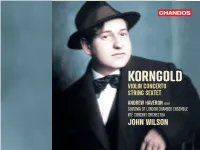
Korngold Violin Concerto String Sextet
KORNGOLD VIOLIN CONCERTO STRING SEXTET ANDREW HAVERON VIOLIN SINFONIA OF LONDON CHAMBER ENSEMBLE RTÉ CONCERT ORCHESTRA JOHN WILSON The Brendan G. Carroll Collection Erich Wolfgang Korngold, 1914, aged seventeen Erich Wolfgang Korngold (1897 – 1957) Violin Concerto, Op. 35 (1937, revised 1945)* 24:48 in D major • in D-Dur • en ré majeur Dedicated to Alma Mahler-Werfel 1 I Moderato nobile – Poco più mosso – Meno – Meno mosso, cantabile – Più – Più – Tempo I – Poco meno – Tempo I – [Cadenza] – Pesante / Ritenuto – Poco più mosso – Tempo I – Meno, cantabile – Più – Più – Tempo I – Meno – Più mosso 9:00 2 II Romanze. Andante – Meno – Poco meno – Mosso – Poco meno (misterioso) – Avanti! – Tranquillo – Molto cantabile – Poco meno – Tranquillo (poco meno) – Più mosso – Adagio 8:29 3 III Finale. Allegro assai vivace – [ ] – Tempo I – [ ] – Tempo I – Poco meno (maestoso) – Fließend – Più tranquillo – Più mosso. Allegro – Più mosso – Poco meno 7:13 String Sextet, Op. 10 (1914 – 16)† 31:31 in D major • in D-Dur • en ré majeur Herrn Präsidenten Dr. Carl Ritter von Wiener gewidmet 3 4 I Tempo I. Moderato (mäßige ) – Tempo II (ruhig fließende – Festes Zeitmaß – Tempo III. Allegro – Tempo II – Etwas rascher (Tempo III) – Tempo II – Allmählich fließender – Tempo III – Wieder Tempo II – Tempo III – Drängend – Tempo I – Tempo III – Subito Tempo I (Doppelt so langsam) – Allmählich fließender werdend – Festes Zeitmaß – Tempo I – Tempo II (fließend) – Festes Zeitmaß – Tempo III – Ruhigere (Tempo II) – Etwas rascher (Tempo III) – Sehr breit – Tempo II – Subito Tempo III 9:50 5 II Adagio. Langsam – Etwas bewegter – Steigernd – Steigernd – Wieder nachlassend – Drängend – Steigernd – Sehr langsam – Noch ruhiger – Langsam steigernd – Etwas bewegter – Langsam – Sehr breit 8:27 6 III Intermezzo. -

The Role of Contemporary Music in Instrumental Education
The role of contemporary music in instrumental education Mark Rayen Candasmy Supervisor Per Kjetil Farstad This Master’s Thesis is carried out as a part of the education at the University of Agder and is therefore approved as a part of this education. However, this does not imply that the University answers for the methods that are used or the conclusions that are drawn. University of Agder, 2011 Faculty of fine arts Department of music Abstract The role of contemporary music in instrumental education discusses the necessity of renewing the curriculum of all musical studies that emphasize performance and the development of the student's instrumental abilities. A portrait of Norwegian composer Ørjan Matre is included to help exemplify the views expressed, as well as the help of theoretical analysis. Key words: contemporary music, education, musicology, ørjan matre, erich wolfgang korngold, pedagogy The role of contemporary music in instrumental education is divided into six chapters. Following the introduction, the second chapter discusses the state of musical critique and musicology, describing the first waves of modernism at the turn of the century (19 th /20 th ) and relating it to the present reality and state of contemporary music. Conclusively, it suggests possibilities of bettering the situation. The third chapter discusses the controversial aspects of Erich Wolfgang Korngold's music and life, relating it to the turbulence of the musical life during his lifetime. Studying Korngold is a unique way to outline the contradictions within Western art music that were being established during his career. The fourth chapter is a portrait of Norwegian composer Ørjan Matre and includes an analysis of his work " Handel Mixtape s". -

Student Honors Recital
BUTI ADMINISTRATION Phyllis Hoffman, Executive and Artistic Director; Shirley Leiphon, Administrative Director Lisa Naas, Director of Operations and Student Life; David Faleris, Program Administrator Emily Culler, Development, Alumni Relations, and Outreach Officer Boston University Grace Kennerly, Publications Coordinator; Manda Shepherd, Office Coordinator; Mandy Kelly, Office Intern Ben Fox, Private Lessons Coordinator; Travis Dobson, Stage Crew Manager Tanglewood Institute Matthew Lemmel, Greg Mitrokostas, Andres Trujillo, Matt Visconti, Stage Crew Michael Culler & Shane McMahon, Recording Engineers; Xiaodan Liu, Piano Technician presents YOUNG ARTISTS ORCHESTRA FACULTY AND STAFF Ryan McAdams & Paul Haas, Conductors Miguel Perez-Espejo Cardenas, Violin Coach, String Chamber Music Coordinator Caroline Pliszka, Klaudia Szlachta, Hsin-Lin Tsai, Violin Coaches, String Chamber Music Mark Berger and Laura Manko, Viola Coaches, String Chamber Music Ariana Falk and Hyun Min Lee, Cello Coaches, String Chamber Music Brian Perry, Double Bass Coach, String Chamber Music Samuel Solomon, Percussion Coordinator and Coach; Michael Israelievitch, Percussion Coach David Krauss, Brass Coach, Brass Chamber Music; Kai-yun Lu, Winds Coach, Wind Chamber Music Student Honors Recital Clara Shin, Piano Chamber Music Coach Thomas Weaver, Staff Pianist Tiffany Chang, Orchestra and Chamber Music Manager Kory Major, Orchestra Librarian and Assistant Manager YOUNG ARTISTS WIND ENSEMBLE FACULTY AND STAFF David Martins & H. Robert Reynolds, Conductors Jennifer Bill, -

Bruno Walter (Ca
[To view this image, refer to the print version of this title.] Erik Ryding and Rebecca Pechefsky Yale University Press New Haven and London Frontispiece: Bruno Walter (ca. ). Courtesy of Österreichisches Theatermuseum. Copyright © by Yale University. All rights reserved. This book may not be reproduced, in whole or in part, including illustrations, in any form (beyond that copying permitted by Sections and of the U.S. Copyright Law and except by reviewers for the public press), without written permission from the publishers. Designed by Sonia L. Shannon Set in Bulmer type by The Composing Room of Michigan, Grand Rapids, Mich. Printed in the United States of America by R. R. Donnelley,Harrisonburg, Va. Library of Congress Cataloging-in-Publication Data Ryding, Erik S., – Bruno Walter : a world elsewhere / by Erik Ryding and Rebecca Pechefsky. p. cm. Includes bibliographical references, filmography,and indexes. ISBN --- (cloth : alk. paper) . Walter, Bruno, ‒. Conductors (Music)— Biography. I. Pechefsky,Rebecca. II. Title. ML.W R .Ј—dc [B] - A catalogue record for this book is available from the British Library. The paper in this book meets the guidelines for permanence and durability of the Committee on Production Guidelines for Book Longevity of the Council on Library Resources. For Emily, Mary, and William In memoriam Rachel Kemper and Howard Pechefsky Contents Illustrations follow pages and Preface xi Acknowledgments xv Bruno Schlesinger Berlin, Cologne, Hamburg,– Kapellmeister Walter Breslau, Pressburg, Riga, Berlin,‒ -
0425 Program Notes
Berkshire Symphony Orchestra Saturday, April 25, 2009 8:00 p.m. Program Notes Wolfgang Amadeus Mozart: Piano Concerto No. 23 in A Major, K. 488 Wolfgang Amadeus Mozart (1756-1791) is widely considered to be one of the most important Classical composers in music history. Many know of his style as playful and elegant, but he also wrote various works that were moodier and contained a Sturm und Drang quality. His 23rd Piano Concerto, K. 488 written in 1786 displays his more playful and cheerful style. The first movement is written in the double exposition form, meaning that the orchestra plays all of the major themes of the movement in the tonic key, A Major. When the pianist later comes in, Mozart fleshes out all of the themes and modulates to various keys. Mozart prominently displays the mature Classical Period stylistic qualities in this first movement. With the rise of the middle class, composers found that pieces that had a simple but melodic line with a tuneful quality to them were widely accepted by the public. One of Mozart’s most characteristic traits is his tendency to create small variations when repeating a phrase or a theme. This transformative quality is especially apparent in many themes of this concerto. Mozart himself probably played this concerto directly after it was written. In 1781 he paved a new road for composers because he decided to become a free-lance artist. Rebelling against the patronage system, Mozart wrote concertos that he would debut to the public to make a living. I chose this piece because I feel it is the best representation of Mozart’s elegant and deceptively simplistic style. -

Contemporary Film Music
Edited by LINDSAY COLEMAN & JOAKIM TILLMAN CONTEMPORARY FILM MUSIC INVESTIGATING CINEMA NARRATIVES AND COMPOSITION Contemporary Film Music Lindsay Coleman • Joakim Tillman Editors Contemporary Film Music Investigating Cinema Narratives and Composition Editors Lindsay Coleman Joakim Tillman Melbourne, Australia Stockholm, Sweden ISBN 978-1-137-57374-2 ISBN 978-1-137-57375-9 (eBook) DOI 10.1057/978-1-137-57375-9 Library of Congress Control Number: 2017931555 © The Editor(s) (if applicable) and The Author(s) 2017 The author(s) has/have asserted their right(s) to be identified as the author(s) of this work in accordance with the Copyright, Designs and Patents Act 1988. This work is subject to copyright. All rights are solely and exclusively licensed by the Publisher, whether the whole or part of the material is concerned, specifically the rights of translation, reprinting, reuse of illustrations, recitation, broadcasting, reproduction on microfilms or in any other physical way, and transmission or information storage and retrieval, electronic adaptation, computer software, or by similar or dissimilar methodology now known or hereafter developed. The use of general descriptive names, registered names, trademarks, service marks, etc. in this publication does not imply, even in the absence of a specific statement, that such names are exempt from the relevant protective laws and regulations and therefore free for general use. The publisher, the authors and the editors are safe to assume that the advice and information in this book are believed to be true and accurate at the date of publication. Neither the publisher nor the authors or the editors give a warranty, express or implied, with respect to the material contained herein or for any errors or omissions that may have been made. -

Gcse Music Film Music
FACTFILE: GCSE MUSIC FILM MUSIC Film Music Background The idea of music as an accompaniment to film came about in the silent film era. Originally it was used as a way to cover the sound that the projector would make when watching a silent film and as a way to create a particular mood or atmosphere for the action taking place. Often in house pianists or an orchestra would play at the venue either improvising or reading from a score. Silent films soon became obsolete as production and technology allowed for recorded sound to be synchronised with the film. These types of films were called sound films, talking picture or ‘talkies’. In the beginning, the music used was often western classical compositions (e.g. Wagner’s Ride of the Valkyries in Birth of a Nation, 1915) but in the 1930’s the role of the film composer was emerging and original compositions were made as part of the film’s narrative (e.g. Max Steiner’s score to King Kong, 1933). Choice of instrumentation is very important in film music as it contributes to the style and genre of the film, changing throughout the decades. Film Music Chronology 1900s – 1920s The silent movie era. Music was introduced to accompany film by live performances by a pianist or orchestra. Late 1920s Introduction of the ‘talking picture’ and the use of the late Romantic idea of the leitmotif. 1930s – 1960s The ‘Golden Age’ of film music begins. Use of ‘mickey mousing’ technique to synchronise what is happening on screen with the music. -
Adventures in Film Music Redux Composer Profiles
Adventures in Film Music Redux - Composer Profiles ADVENTURES IN FILM MUSIC REDUX COMPOSER PROFILES A. R. RAHMAN Elizabeth: The Golden Age A.R. Rahman, in full Allah Rakha Rahman, original name A.S. Dileep Kumar, (born January 6, 1966, Madras [now Chennai], India), Indian composer whose extensive body of work for film and stage earned him the nickname “the Mozart of Madras.” Rahman continued his work for the screen, scoring films for Bollywood and, increasingly, Hollywood. He contributed a song to the soundtrack of Spike Lee’s Inside Man (2006) and co- wrote the score for Elizabeth: The Golden Age (2007). However, his true breakthrough to Western audiences came with Danny Boyle’s rags-to-riches saga Slumdog Millionaire (2008). Rahman’s score, which captured the frenzied pace of life in Mumbai’s underclass, dominated the awards circuit in 2009. He collected a British Academy of Film and Television Arts (BAFTA) Award for best music as well as a Golden Globe and an Academy Award for best score. He also won the Academy Award for best song for “Jai Ho,” a Latin-infused dance track that accompanied the film’s closing Bollywood-style dance number. Rahman’s streak continued at the Grammy Awards in 2010, where he collected the prize for best soundtrack and “Jai Ho” was again honoured as best song appearing on a soundtrack. Rahman’s later notable scores included those for the films 127 Hours (2010)—for which he received another Academy Award nomination—and the Hindi-language movies Rockstar (2011), Raanjhanaa (2013), Highway (2014), and Beyond the Clouds (2017). -

Martin Denny and the Sounds of Exotica
Martin Denny and the Sounds of Exotica This in an updated version of an article originally published in Film Score Monthly (Vol. 2, No. 4, June 1997). A look at the unique circumstances of Forbidden Island. The mysteries of the tropics await! by Kerry J. Byrnes, Okemos High Class of 1963 Some twenty years ago John Bender=s article (“First Dive...Into the Dark Pool of ‘Soundtrack Related’”) published in Film Score Monthly (FSM#69) prompted me to pick up the I, Swinger CD by the musical group Combustible Edison, especially as Bender had referred to the CD as a “knock off” of a number of musicians, including Martin Denny, one of my all-time favorites. But I was most intrigued by Bender’s statement that Denny had “even managed to get one film score under his belt.” Bender=s next sentence added the needed clarification: “Let’s hope Denny=s music for Forbidden Island isn’t as hopelessly lost as the film itself seems to be.” But Forbidden Island, as later clarified, is not lost (though not yet commercially available on DVD). Produced by C.B. Griffith in 1959, Forbidden Island was shown on cable’s TNT in August of 1992 as part of a package of films TNT licensed from Columbia, now owned by Sony (film not included in the current package of newer films Sony has licensed to TNT). Fortunately, a video of TNT’s screening of Forbidden Island was preserved by none other than the Maestro of Exotica – Martin Denny – who kindly loaned his copy so I could make a dub.