Malindi (Kenya)
Total Page:16
File Type:pdf, Size:1020Kb
Load more
Recommended publications
-
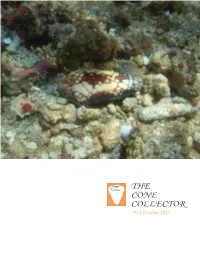
The Cone Collector N°23
THE CONE COLLECTOR #23 October 2013 THE Note from CONE the Editor COLLECTOR Dear friends, Editor The Cone scene is moving fast, with new papers being pub- António Monteiro lished on a regular basis, many of them containing descrip- tions of new species or studies of complex groups of species that Layout have baffled us for many years. A couple of books are also in André Poremski the making and they should prove of great interest to anyone Contributors interested in Cones. David P. Berschauer Pierre Escoubas Our bulletin aims at keeping everybody informed of the latest William J. Fenzan developments in the area, keeping a record of newly published R. Michael Filmer taxa and presenting our readers a wide range of articles with Michel Jolivet much and often exciting information. As always, I thank our Bernardino Monteiro many friends who contribute with texts, photos, information, Leo G. Ros comments, etc., helping us to make each new number so inter- Benito José Muñoz Sánchez David Touitou esting and valuable. Allan Vargas Jordy Wendriks The 3rd International Cone Meeting is also on the move. Do Alessandro Zanzi remember to mark it in your diaries for September 2014 (defi- nite date still to be announced) and to plan your trip to Ma- drid. This new event will undoubtedly be a huge success, just like the two former meetings in Stuttgart and La Rochelle. You will enjoy it and of course your presence is indispensable! For now, enjoy the new issue of TCC and be sure to let us have your opinions, views, comments, criticism… and even praise, if you feel so inclined. -
References Please Help Making This Preliminary List As Complete As Possible!
Cypraeidae - important references Please help making this preliminary list as complete as possible! ABBOTT, R.T. (1965) Cypraea arenosa Gray, 1825. Hawaiian Shell News 14(2):8 ABREA, N.S. (1980) Strange goings on among the Cypraea ziczac. Hawaiian Shell News 28 (5):4 ADEGOKE, O.S. (1973) Paleocene mollusks from Ewekoro, southern Nigeria. Malacologia 14:19-27, figs. 1-2, pls. 1-2. ADEGOKE, O.S. (1977) Stratigraphy and paleontology of the Ewekoro Formation (Paleocene) of southeastern Nigeria. Bulletins of American Paleontology 71(295):1-379, figs. 1-6, pls. 1-50. AIKEN, R. P. (2016) Description of two undescribed subspecies and one fossil species of the Genus Cypraeovula Gray, 1824 from South Africa. Beautifulcowries Magazine 8: 14-22 AIKEN, R., JOOSTE, P. & ELS, M. (2010) Cypraeovula capensis - A specie of Diversity and Beauty. Strandloper 287 p. 16 ff AIKEN, R., JOOSTE, P. & ELS, M. (2014) Cypraeovula capensis. A species of diversity and beauty. Beautifulcowries Magazine 5: 38–44 ALLAN, J. (1956) Cowry Shells of World Seas. Georgian House, Melbourne, Australia, 170 p., pls. 1-15. AMANO, K. (1992) Cypraea ohiroi and its associated molluscan species from the Miocene Kadonosawa Formation, northeast Japan. Bulletin of the Mizunami Fossil Museum 19:405-411, figs. 1-2, pl. 57. ANCEY, C.F. (1901) Cypraea citrina Gray. The Nautilus 15(7):83. ANONOMOUS. (1971) Malacological news. La Conchiglia 13(146-147):19-20, 5 unnumbered figs. ANONYMOUS. (1925) Index and errata. The Zoological Journal. 1: [593]-[603] January. ANONYMOUS. (1889) Cypraea venusta Sowb. The Nautilus 3(5):60. ANONYMOUS. (1893) Remarks on a new species of Cypraea. -

Download Book (PDF)
M o Manual on IDENTIFICATION OF SCHEDULE MOLLUSCS From India RAMAKRISHN~~ AND A. DEY Zoological Survey of India, M-Block, New Alipore, Kolkota 700 053 Edited by the Director, Zoological Survey of India, Kolkata ZOOLOGICAL SURVEY OF INDIA KOLKATA CITATION Ramakrishna and Dey, A. 2003. Manual on the Identification of Schedule Molluscs from India: 1-40. (Published : Director, Zool. Surv. India, Kolkata) Published: February, 2003 ISBN: 81-85874-97-2 © Government of India, 2003 ALL RIGHTS RESERVED • No part of this publication may be reproduced, stored in a retrieval system or transmitted, in any from or by any means, electronic, mechanical, photocopying, recording or otherwise without the prior permission of the publisher. • -This book is sold subject to the condition that it shall not, by way of trade, be lent, resold hired out or otherwise disposed of without the publisher's consent, in any form of binding or cover other than that in which it is published. • The correct price of this publication is the price printed on this page. Any revised price indicated by a rubber stamp or by a sticker or by any other means is incorrect and should be unacceptable. PRICE India : Rs. 250.00 Foreign : $ (U.S.) 15, £ 10 Published at the Publication Division by the Director, Zoological Survey of India, 234/4, AJ.C. Bose Road, 2nd MSO Building (13th Floor), Nizam Palace, Kolkata -700020 and printed at Shiva Offset, Dehra Dun. Manual on IDENTIFICATION OF SCHEDULE MOLLUSCS From India 2003 1-40 CONTENTS INTRODUcrION .............................................................................................................................. 1 DEFINITION ............................................................................................................................ 2 DIVERSITY ................................................................................................................................ 2 HA.B I,.-s .. .. .. 3 VAWE ............................................................................................................................................ -

The Hawaiian Species of Conus (Mollusca: Gastropoda)1
The Hawaiian Species of Conus (Mollusca: Gastropoda) 1 ALAN J. KOHN2 IN THECOURSE OF a comparative ecological currents are factors which could plausibly study of gastropod mollus ks of the genus effect the isolation necessary for geographic Conus in Hawaii (Ko hn, 1959), some 2,400 speciation . specimens of 25 species were examined. Un Of the 33 species of Conus considered in certainty ofthe correct names to be applied to this paper to be valid constituents of the some of these species prompted the taxo Hawaiian fauna, about 20 occur in shallow nomic study reported here. Many workers water on marine benches and coral reefs and have contributed to the systematics of the in bays. Of these, only one species, C. ab genus Conus; nevertheless, both nomencla breviatusReeve, is considered to be endemic to torial and biological questions have persisted the Hawaiian archipelago . Less is known of concerning the correct names of a number of the species more characteristic of deeper water species that occur in the Hawaiian archi habitats. Some, known at present only from pelago, here considered to extend from Kure dredging? about the Hawaiian Islands, may (Ocean) Island (28.25° N. , 178.26° W.) to the in the future prove to occur elsewhere as island of Hawaii (20.00° N. , 155.30° W.). well, when adequate sampling methods are extended to other parts of the Indo-West FAUNAL AFFINITY Pacific region. As is characteristic of the marine fauna of ECOLOGY the Hawaiian Islands, the affinities of Conus are with the Indo-Pacific center of distribu Since the ecology of Conus has been dis tion . -

Mollusca: Gastropoda) from Bay of Bengal, Arabian Sea 4No Western Indian Ocean-2
J. mar. biol. Ass. India. 1977, 19 (]) : 21 - 34 ON THE COLLECTION OF STROMBIDAE (MOLLUSCA: GASTROPODA) FROM BAY OF BENGAL, ARABIAN SEA 4NO WESTERN INDIAN OCEAN-2. GENERA LAMBIS- TEREBELLUM, TIBIA AND RIMELLA N. V. SuBBA RAO Zoological Survey of India, Calcutta ABSTRACT This paper is the concluding part on the Strombidae of Indian Soas and the first comprehensive report on tlie species of this region. Fourteen species belonging to four genera namely, Lambis, Tibia, Terebellum and Rimella are recorded from the Indian Ocean. Two species of Rimella are reported here for the first time from Indian Seas. INTRODUCTION THE FAMILY STROMBIDAE is represented by five genera namely, Strombus, Lambis, Terebellum, Tibia and Rimella in the Indian Seas. The collections in the Zoological Survey of India are well represented in having all the genera. The genus Strombus was dealt with in a previous paper (Subba Rao, 1971). The present paper deals with the remaining four genera namely, Lambis, Tibia, Terebellum and Rimella. The author is grateful to Dr. S. Khera, Joint Director-in-Charge, Zoological Survey of India for the necessary facilities. Thanks are due to Dr. R. Tucker Abbott, du Pont chair of Malacology, Delaware Museum of Natural History, Delaware, U.S.A. for supplying the necessary reprints and for encouragement. Abbreviations used: Coll. - Collector or collected by; ex (s)- example (s);Reg. No. - Register Number; Sta. - Station; Z.S.I. - Zoological Survey of India. SYSTEMATIC ACCOUNT Genus Lambis RSding, 1798 Lambis Roding, 1798. Museum Boltenianum pt. 2. p. 16 (Type by absolute tautonomy: Lambis lambis Gmelin = Linnaeus). Lambis hhbon, 1961. -

Radular Morphology of Conus (Gastropoda: Caenogastropoda: Conidae) from India
Molluscan Research 27(3): 111–122 ISSN 1323-5818 http://www.mapress.com/mr/ Magnolia Press Radular morphology of Conus (Gastropoda: Caenogastropoda: Conidae) from India J. BENJAMIN FRANKLIN, 1, 3 S. ANTONY FERNANDO, 1 B. A. CHALKE, 2 K. S. KRISHNAN. 2, 3* 1.Centre of Advanced Study in Marine Biology, Annamalai University, Parangipettai-608 502, Cuddalore, Tamilnadu, India. 2.Tata Institute of Fundamental Research, Homi Bhabha Road, Colaba, Mumbai-400 005, India. 3.National Centre for Biological Sciences, TIFR, Old Bellary Road, Bangalore-560 065, India.* Corresponding author E-mail: (K. S. Krishnan): ksk@ncbs.res.in. Abstract Radular morphologies of 22 species of the genus Conus from Indian coastal waters were analyzed by optical and scanning elec- tron microscopy. Although the majority of species in the present study are vermivorous, all three feeding modes known to occur in the genus are represented. Specific radular-tooth structures consistently define feeding modes. Species showing simi- lar feeding modes also show fine differences in radular structures. We propose that these structures will be of value in species identification in cases of ambiguity in other characteristics. Examination of eight discrete radular-tooth components has allowed us to classify the studied species of Conus into three groups. We see much greater inter-specific differences amongst vermivorous than amongst molluscivorous and piscivorous species. We have used these differences to provide a formula for species identification. The radular teeth of Conus araneosus, C. augur, C. bayani, C. biliosus, C. hyaena, C. lentiginosus, C. loroisii, and C. malacanus are illustrated for the first time. In a few cases our study has also enabled the correction of some erroneous descriptions in the literature. -

The Marine Biodiversity and Fisheries Catches of the Pitcairn Island Group
The Marine Biodiversity and Fisheries Catches of the Pitcairn Island Group THE MARINE BIODIVERSITY AND FISHERIES CATCHES OF THE PITCAIRN ISLAND GROUP M.L.D. Palomares, D. Chaitanya, S. Harper, D. Zeller and D. Pauly A report prepared for the Global Ocean Legacy project of the Pew Environment Group by the Sea Around Us Project Fisheries Centre The University of British Columbia 2202 Main Mall Vancouver, BC, Canada, V6T 1Z4 TABLE OF CONTENTS FOREWORD ................................................................................................................................................. 2 Daniel Pauly RECONSTRUCTION OF TOTAL MARINE FISHERIES CATCHES FOR THE PITCAIRN ISLANDS (1950-2009) ...................................................................................... 3 Devraj Chaitanya, Sarah Harper and Dirk Zeller DOCUMENTING THE MARINE BIODIVERSITY OF THE PITCAIRN ISLANDS THROUGH FISHBASE AND SEALIFEBASE ..................................................................................... 10 Maria Lourdes D. Palomares, Patricia M. Sorongon, Marianne Pan, Jennifer C. Espedido, Lealde U. Pacres, Arlene Chon and Ace Amarga APPENDICES ............................................................................................................................................... 23 APPENDIX 1: FAO AND RECONSTRUCTED CATCH DATA ......................................................................................... 23 APPENDIX 2: TOTAL RECONSTRUCTED CATCH BY MAJOR TAXA ............................................................................ -
An Annotated Checklist of the Marine Macroinvertebrates of Alaska David T
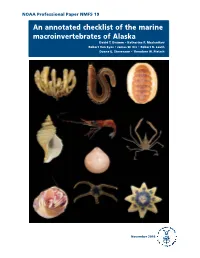
NOAA Professional Paper NMFS 19 An annotated checklist of the marine macroinvertebrates of Alaska David T. Drumm • Katherine P. Maslenikov Robert Van Syoc • James W. Orr • Robert R. Lauth Duane E. Stevenson • Theodore W. Pietsch November 2016 U.S. Department of Commerce NOAA Professional Penny Pritzker Secretary of Commerce National Oceanic Papers NMFS and Atmospheric Administration Kathryn D. Sullivan Scientific Editor* Administrator Richard Langton National Marine National Marine Fisheries Service Fisheries Service Northeast Fisheries Science Center Maine Field Station Eileen Sobeck 17 Godfrey Drive, Suite 1 Assistant Administrator Orono, Maine 04473 for Fisheries Associate Editor Kathryn Dennis National Marine Fisheries Service Office of Science and Technology Economics and Social Analysis Division 1845 Wasp Blvd., Bldg. 178 Honolulu, Hawaii 96818 Managing Editor Shelley Arenas National Marine Fisheries Service Scientific Publications Office 7600 Sand Point Way NE Seattle, Washington 98115 Editorial Committee Ann C. Matarese National Marine Fisheries Service James W. Orr National Marine Fisheries Service The NOAA Professional Paper NMFS (ISSN 1931-4590) series is pub- lished by the Scientific Publications Of- *Bruce Mundy (PIFSC) was Scientific Editor during the fice, National Marine Fisheries Service, scientific editing and preparation of this report. NOAA, 7600 Sand Point Way NE, Seattle, WA 98115. The Secretary of Commerce has The NOAA Professional Paper NMFS series carries peer-reviewed, lengthy original determined that the publication of research reports, taxonomic keys, species synopses, flora and fauna studies, and data- this series is necessary in the transac- intensive reports on investigations in fishery science, engineering, and economics. tion of the public business required by law of this Department. -

2000 Through 2009)
TRITON No 19 March 2009 Supplement 4 CONCHOLOGICAL INFORMATION PUBLISHED IN TRITON 1-19 (2000 THROUGH 2009) 2. AUTHOR INDEX This index is arranged in the alphabetical order. If there are several authors of a publication their names are listed exactly as in their works published. Prepared by E.L. Heiman 1 TRITON No 19 March 2009 Supplement 4 2. AUTHOR INDEX authors year article issue Bar Zeev, U & THE MICRO-SHELL COLLECTION OF KALMAN HERTZ IS DONATED TO 2006 14:6 Singer, S. TEL AVIV UNIVERSITY Bonomolo, G. & DESCRIPTION OF A NEW MURICID FOR THE MEDITERRANEAN SEA: 2006 OCINEBRINA PADDEUI 13:1-4 Buzzurro G. (MOLLUSCA, GASTROPODA, MURICIDAE, OCENEBRINAE) Buzzurro, G. & 2008 UNCOMMON FORM OF EROSARIA TURDUS (LAMARCK, 1810) 17:24 Heiman, E.L. Buzzurro, G. 2005 FUSINUS ROLANI: A NEW MEDITERRANEAN SPECIES 11:1-3 & Ovalis, P. Buzzurro, G. & A NEW SPECIES OF ALVANIA 2007 (GASTROPODA:PROSOBRANCHIA:RISSOIDAE) FROM CROATIAN 15:5-9 Prkić, J. COASTS OF DALMATIA 2001 FUSINUS DALPIAZI (COEN, 1918), A CONTROVERSIAL SPECIES 4:1-3 NOTES AND COMMENTS ON THE MEDITERRANEAN SPECIES OF THE Buzzurro, G. GENUS DIODORA GRAY, 1821 2004 10:1-9 & Russo, P. (ARCHEOGASTROPODA:FISSURELLIDAE) WITH A DESCRIPTION OF A NEW SPECIES 2008 A NEW REPLACEMENT NAME FOR FUSUS CRASSUS PALARY, 1901 17:7 Chadad, H., Heiman, E.L. & 2007 A GIANT SHELLS OF MAURITIA ARABICA GRAYANA 15:10 M. Kovalis Charter M. & SNAILS IN PELLETS AND PREY REMAINS OF KESTRE (FALCO 2005 12:31-32 Mienis H.K. TINNUNCULUS) IN ISRAEL ADDITIONS TO THE KNOWLEDGE OF IACRA (BIVALVIA; SEMELIDAE) Dekker, H. -

THE FESTIVUS Page Iii
ISSN 0738-9388 ISSN 0738-9388 TH E F E S T I VU S T H E F E S T I VU S A publication of the San Diego Shell Club A publication of the San Diego Shell Club Volume XXXIX September 9, 2007 Supplement Volume XXXIX September 9, 2007 Supplement The Recent Molluscan Fauna of Île Clipperton The Recent Molluscan Fauna of Île Clipperton (Tropical Eastern Pacific) (Tropical Eastern Pacific) Kirstie L. Kaiser Kirstie L. Kaiser US US Vol. XXXIX: Supplement THE FESTIV Page i Vol. XXXIX: Supplement THE FESTIV Page i ISSN 0738-9388 ISSN 0738-9388 THE RECENT MOLLUSCAN FAUNA OF ÎLE CLIPPERTON THE RECENT MOLLUSCAN FAUNA OF ÎLE CLIPPERTON (TROPICAL EASTERN PACIFIC) (TROPICAL EASTERN PACIFIC) KIRSTIE L. KAISER KIRSTIE L. KAISER Research Associate, Santa Barbara Museum of Natural History Research Associate, Santa Barbara Museum of Natural History 2559 Puesta del Sol Road, Santa Barbara, California 93105, USA 2559 Puesta del Sol Road, Santa Barbara, California 93105, USA Email: kirstie.kaiser@gmail.com Email: kirstie.kaiser@gmail.com September 9, 2007 September 9, 2007 Front Cover: Sunrise at Clipperton. Looking East-SE across the lagoon to Clipperton Rock. Photograph taken by Camille Front Cover: Sunrise at Clipperton. Looking East-SE across the lagoon to Clipperton Rock. Photograph taken by Camille Fresser on 14 January 2005 at 7:49 a.m. Fresser on 14 January 2005 at 7:49 a.m. Front (inside) Cover: Bathymetric chart of Île Clipperton. Copyright: Septième Continent – Jean-Louis Etienne, Expédition Front (inside) Cover: Bathymetric chart of Île Clipperton. Copyright: Septième Continent – Jean-Louis Etienne, Expédition Clipperton. -

Cone Shell, (Conus Marmoreus) Rembrandt Van Rijn 1650, Etching, Engraving and Drypoint
CONE SHELLS Cone Shell, (Conus marmoreus) Rembrandt van Rijn 1650, Etching, engraving and drypoint. Rijksmuseum, Amsterdam, Holland. Introduction ● Cone shell animals are a group of carnivorous marine gastropods. ● Worldwide there are about 300 species. There are about 80 species within Australian coastal waters. ● These animals can cause potentially lethal envenomation. ● They are prized by shell collectors the world over because of their intricate patterning and beauty, (see appendix 1 below). Description Their scientific taxonomy is: Kingdom: Animalia Phylum: Mollusca. Class: Gastropoda. Subclass: Orthogastropoda. Superorder: Caenogastropoda. Order: Sorbeoconcha. Suborder: Hypsogastropoda. Infraorder: Neogastropoda. Superfamily: Conoidea. Family: Conidae Conus textile (photo by Bruce Livett, University of Melbourne) Habitat ● The cone shell gastropods are nocturnal feeders, rarely being seen during daylight hours. ● During the day they generally lie buried beneath the sand. ● Australian species inhabit warm tropical and subtropical coastal waters. ● They are shallow water dwellers mainly inhabiting tidal reefs. ● They are especially seen around the Great Barrier Reef. ● Colder southern waters have smaller worm eating species which are not dangerous. Classification The cone shell species as a group are readily recognized by their conic shape. They may be classified according to their prey and size. The larger species prey on fish, while the intermediate sized species prey on molluscs and the smaller species on worms. The large species may grow up to 25 cm in length. 1. Piscivorous: Fish eaters, including: ● Conus striatus ● Conus geographus ● Conus magnus ● Conus catus ● Conus tulipa 2. Molluscivorous: Mollusk eaters, including: ● Conus textile ● Conus marmoreus ● Conus pennaceus 3. Vermivorous: Worm eaters. ● There are many including: C.imperialis/ C.eburneus / C.quercinus / C.lividus / C.tessulatus / C.ventricosus / C.parvatus / C.rattus / C.flavidus / C.generalis / C.arenatus Venom All species are venomous to varying degrees. -

44-Sep-2016.Pdf
Page 2 Vol. 44, No. 3 In 1972, a group of shell collectors saw the need for a national organization devoted to the interests of shell collec- tors; to the beauty of shells, to their scientific aspects, and to the collecting and preservation of mollusks. This was the start of COA. Our member- AMERICAN CONCHOLOGIST, the official publication of the Conchol- ship includes novices, advanced collectors, scientists, and shell dealers ogists of America, Inc., and issued as part of membership dues, is published from around the world. In 1995, COA adopted a conservation resolution: quarterly in March, June, September, and December, printed by JOHNSON Whereas there are an estimated 100,000 species of living mollusks, many PRESS OF AMERICA, INC. (JPA), 800 N. Court St., P.O. Box 592, Pontiac, IL 61764. All correspondence should go to the Editor. ISSN 1072-2440. of great economic, ecological, and cultural importance to humans and Articles in AMERICAN CONCHOLOGIST may be reproduced with whereas habitat destruction and commercial fisheries have had serious ef- proper credit. We solicit comments, letters, and articles of interest to shell fects on mollusk populations worldwide, and whereas modern conchology collectors, subject to editing. Opinions expressed in “signed” articles are continues the tradition of amateur naturalists exploring and documenting those of the authors, and are not necessarily the opinions of Conchologists the natural world, be it resolved that the Conchologists of America endors- of America. All correspondence pertaining to articles published herein es responsible scientific collecting as a means of monitoring the status of or generated by reproduction of said articles should be directed to the Edi- mollusk species and populations and promoting informed decision making tor.