The Consortium on Revolutionary Europe Proceedings 1980
Total Page:16
File Type:pdf, Size:1020Kb
Load more
Recommended publications
-
UNIVERSITY of BELGRADE FACULTY of POLITICAL SCIENCE Regional Master's Program in Peace Studies MASTER's THESIS Revisiting T
UNIVERSITY OF BELGRADE FACULTY OF POLITICAL SCIENCE Regional Master’s Program in Peace Studies MASTER’S THESIS Revisiting the Orange Revolution and Euromaidan: Pro-Democracy Civil Disobedience in Ukraine Academic supervisor: Student: Associate Professor Marko Simendić Olga Vasilevich 9/18 Belgrade, 2020 1 Content Introduction ………………………………………………………………………………………3 1. Theoretical section……………………………………………………………………………..9 1.1 Civil disobedience…………………………………………………………………………9 1.2 Civil society……………………………………………………………………………... 19 1.3 Nonviolence……………………………………………………………………………... 24 Conclusion……………………………………………………………………………………… 31 2. Analytical section……………………………………………………………………………..33 2.1 The framework for disobedience………………………………………………….…….. 33 2.2 Orange Revolution………………………………………………………………………. 40 2.3 Euromaidan……………………………………………………………………………… 47 Conclusion……………………………………………………………………………………… 59 Conclusion……………………………………………………………………………………… 62 References……………………………………………………………………………………….67 2 INTRODUCTION The Orange Revolution and the Revolution of Dignity have precipitated the ongoing Ukraine crisis. According to the United Nations Rights Office, the latter has claimed the lives of 13,000 people, including those of unarmed civilian population, and entailed 30,000 wounded (Miller 2019). The United Nations High Commissioner for Refugees adds to that 1.5 million internally displaced persons (IDPs), 100,000 refugees and asylum-seekers (UNHCR 2014). The armed conflict is of continued relevance to Russia, Europe, as well as the United States. During the first 10 months, -

The Ionian Islands in British Official Discourses; 1815-1864
1 Constructing Ionian Identities: The Ionian Islands in British Official Discourses; 1815-1864 Maria Paschalidi Department of History University College London A thesis submitted for the degree of Doctor of Philosophy to University College London 2009 2 I, Maria Paschalidi, confirm that the work presented in this thesis is my own. Where information has been derived from other sources, I confirm that this has been indicated in the thesis. 3 Abstract Utilising material such as colonial correspondence, private papers, parliamentary debates and the press, this thesis examines how the Ionian Islands were defined by British politicians and how this influenced various forms of rule in the Islands between 1815 and 1864. It explores the articulation of particular forms of colonial subjectivities for the Ionian people by colonial governors and officials. This is set in the context of political reforms that occurred in Britain and the Empire during the first half of the nineteenth-century, especially in the white settler colonies, such as Canada and Australia. It reveals how British understandings of Ionian peoples led to complex negotiations of otherness, informing the development of varieties of colonial rule. Britain suggested a variety of forms of government for the Ionians ranging from authoritarian (during the governorships of T. Maitland, H. Douglas, H. Ward, J. Young, H. Storks) to representative (under Lord Nugent, and Lord Seaton), to responsible government (under W. Gladstone’s tenure in office). All these attempted solutions (over fifty years) failed to make the Ionian Islands governable for Britain. The Ionian Protectorate was a failed colonial experiment in Europe, highlighting the difficulties of governing white, Christian Europeans within a colonial framework. -

The French Revolution and the Origins of Human Rights
2/11/2016 The French Revolution and the Origins of Human Rights So many revolutions, so little time … • The Greek War of Independence, 1821‐1829 • Irish Rebellion of 1641 • Decembrist Revolt (Russia, 1825) • First Russian Revolution, 1905 • English Revolution, 1642‐1660 • Albanian Revolution (Ottoman, 1910) • The Naples Revolt, 1647 • July Revolution (France, 1830) • Easter Rising In Dublin, 1916 • The Khmelnytsky Uprising, 1648 • Belgian Revolution, 1830 • Irish War of Independence (1916‐1923) • February Revolution (Russia, 1917) • The Fronde (France, 1648‐1653) • November Uprising (Poland, 1830‐1831) • October Revolution (a.k.a. Bolshevik) , • Moscow Uprising of Streltsy Regiments, 1688 • The Bosnian Uprising (Ottoman, 1831‐1832) 1917 • The Glorious Revolution (England, 1688) • Ukrainian Revolution, 1917‐1921 • June Rebellion (France, 1832) • Finnish Civil War, 1918 • The Streltsy Uprising (Russia, 1698) • Revolutions of 1848‐1849 (Italian, German, Danish • German Revolution, 1918 • The Camisard Rebellion (France, 1702‐1715) States; Hungarian; Ireland; Wallachia; Moldavia • The Rakoczi Uprising (Habsburg Empire, 1703‐1711) • Herzegovinia Uprising (Ottoman, 1852‐1862) • The First Jacobite Rebellion (England, 1715) • • The Fourth Dalecarlian Rebellion (Sweden, 1743) Second Italian War for Independence (1859) • Jacobite Rising (Scotland, 1745‐1746) • January Uprising/Polish Uprising (Russia, 1863‐ 1865) • Pugachev Rebellion (Russia, 1773‐1775) • • The French Revolution, 1789‐1799 The Fenian Rising (Ireland, 1867) • Saxon Peasants’ Revolut, -

The Rise of Bulgarian Nationalism and Russia's Influence Upon It
University of Louisville ThinkIR: The University of Louisville's Institutional Repository Electronic Theses and Dissertations 5-2014 The rise of Bulgarian nationalism and Russia's influence upon it. Lin Wenshuang University of Louisville Follow this and additional works at: https://ir.library.louisville.edu/etd Part of the Arts and Humanities Commons Recommended Citation Wenshuang, Lin, "The rise of Bulgarian nationalism and Russia's influence upon it." (2014). Electronic Theses and Dissertations. Paper 1548. https://doi.org/10.18297/etd/1548 This Doctoral Dissertation is brought to you for free and open access by ThinkIR: The University of Louisville's Institutional Repository. It has been accepted for inclusion in Electronic Theses and Dissertations by an authorized administrator of ThinkIR: The University of Louisville's Institutional Repository. This title appears here courtesy of the author, who has retained all other copyrights. For more information, please contact thinkir@louisville.edu. THE RISE OF BULGARIAN NATIONALISM AND RUSSIA‘S INFLUENCE UPON IT by Lin Wenshuang B. A., Beijing Foreign Studies University, China, 1997 M. A., Beijing Foreign Studies University, China, 2002 A Dissertation Submitted to the Faculty of the College of Arts and Sciences of the University of Louisville in Partial Fulfillment of the Requirements for the Degree of Doctor of Philosophy Department of Humanities University of Louisville Louisville, Kentucky May 2014 Copyright © 2014 by Lin Wenshuang All Rights Reserved THE RISE OF BULGARIAN NATIONALISM AND RUSSIA‘S INFLUENCE UPON IT by Lin Wenshuang B. A., Beijing Foreign Studies University, China, 1997 M. A., Beijing Foreign Studies University, China, 2002 A Dissertation Approved on April 1, 2014 By the following Dissertation Committee __________________________________ Prof. -
Ahif Po L I C Y J O U R N
AHIF P O L I C Y J O U R N A L Spring 2015 Kapodistrias and the Making of Modern Europe and Modern Greece Patrick Theros n 1998, Theodoros Pangalos, Greece’s Foreign Minister attended an EU Conference of I otherwise little note in Brussels. He was half asleep during the sessions until the then President of the Dutch Parliament rose to speak about the common European heritage. The Dutchman proclaimed that a common cultural history united Europe: beginning with feudalism, followed by the Renaissance, the Reformation, the Counter- reformation, the Enlightenment and the French Revolution. This history differentiated Europeans from non-Europeans, a category which the unctuous Dutchman obviously deemed unworthy of membership. Pangalos suddenly came awake and leaped to his feet to state, in his normal colorful fashion, that the Dutchman had just insulted Greece. Greece had indeed lived through feudalism. It had come to Greece in the form of the Fourth Crusade, the sacking of Constantinople, and the dismembering of the country that virtually depopulated Greece. Pangalos apparently went on to eviscerate the Dutchman. He described the Renaissance as created by Greek scholars who fled the Turkish conquest. As for the Reformation and Counter Reformation; those were internal civil wars of the Papacy. No one seems to have memorialized Pangalos’ comments on the Enlightenment and the French Revolution as his Greek diplomats cringed and mostly tried to quiet him down. Pangalos’ ranting was more or less on point and, in fact, historically quite accurate. But the EU officials present, locked into the notion that Western civilization (quite narrowly defined) provided the gold standard for the world to try to emulate while the history and culture of others rated only academic interest made fun of Pangalos to the other Greeks present. -

The Historical Review/La Revue Historique
CORE Metadata, citation and similar papers at core.ac.uk Provided by MUCC (Crossref) The Historical Review/La Revue Historique Vol. 13, 2016 The resilience of Philhellenism Tolias George http://dx.doi.org/10.12681/hr.11556 Copyright © 2017 George Tolias To cite this article: Tolias, G. (2017). The resilience of Philhellenism. The Historical Review/La Revue Historique, 13, 51-70. doi:http://dx.doi.org/10.12681/hr.11556 http://epublishing.ekt.gr | e-Publisher: EKT | Downloaded at 12/01/2020 21:33:32 | THE RESILIENCE OF PHILHELLENISM ’Tis Greece, but living Greece no more! So coldly sweet, so deadly fair, We start, for soul is wanting there… Lord Byron, The Giaour, 1813 George Tolias ABStraCT: This essay aims to survey certain key aspects of philhellenism underpinned by the recent and past bibliography on the issue. By exploring the definitions of the related terms, their origins and their various meanings, the paper underscores the notion of “revival” as a central working concept of philhellenic ideas and activities and explores its transformations, acceptances or rejections in Western Europe and in Greece during the period from 1770 to 1870. Philhellenisms “TheF rench are by tradition philhellenes.” With this phrase, the authors of Le Petit Robert exemplified the modern usage of the wordphilhellène , explaining that it denotes those sympathetic to Greece. Although the chosen example refers to a tradition, the noun “philhellene” entered the French vocabulary in 1825 as a historical term which denoted someone who championed the cause of Greek independence. According to the same dictionary, the term “philhellenism” started to be used in French in 1838. -

The Serbian Paradox: the Cost of Integration Into the European Union
The Serbian Paradox: The Cost of Integration into the European Union Preston Huennekens Thesis submitted to the faculty of the Virginia Polytechnic Institute and State University in partial fulfillment of the requirements for the degree of Master of Arts In Political Science Yannis A. Stivachtis, Chair Besnik Pula Glenn R. Bugh April 17, 2018 Blacksburg, VA Keywords: Serbia, European Union, historical memory, nationalism, Balkan politics The Serbian Paradox: The Cost of Integration into the European Union Preston Huennekens Abstract This project addresses the Republic of Serbia’s current accession negotiations with the European Union, and asks how the country’s long and often turbulent history affects that dialogue. Using Filip Ejdus’ concept of historical memory and Benedict Anderson’s “imagined community” theory of nationalism, this paper discusses how Serbia has reached a critical moment in its history by pursuing European integration. This contradicts their historical pull towards their longtime ally Russia. What role does historical memory play in these negotiations, and is integration truly possible? Additionally, how is Serbia’s powerful president, Aleksandar Vucic, using the Europeanization process to strengthen his hand domestically? Abstract (General Audience) This thesis addresses the Republic of Serbia’s current accession negotiations with the European Union, and asks how the country’s long and often turbulent history affects that dialogue. I argue that Serbia is at a crossroads in its history: on one hand, it wishes to join the European Union, but on the other is continually pulled to the east with their historical ally, Russia. I argue that President Aleksandar Vucic is using the EU negotiations to enhance his own power and that if the EU admits Serbia into the body they will be trading regional stability for Serbian democracy. -
93323765-Mack-Ridge-Language-And
Language and National Identity in Greece 1766–1976 This page intentionally left blank Language and National Identity in Greece 1766–1976 PETER MACKRIDGE 1 3 Great Clarendon Street, Oxford ox2 6DP Oxford University Press is a department of the University of Oxford. It furthers the University’s objective of excellence in research, scholarship, and education by publishing worldwide in Oxford New York Auckland Cape Town Dar es Salaam Hong Kong Karachi Kuala Lumpur Madrid Melbourne Mexico City Nairobi New Delhi Shanghai Taipei Toronto With offices in Argentina Austria Brazil Chile Czech Republic France Greece Guatemala Hungary Italy Japan Poland Portugal Singapore South Korea Switzerland Thailand Turkey Ukraine Vietnam Oxford is a registered trade mark of Oxford University Press in the UK and in certain other countries Published in the United States by Oxford University Press Inc., New York © Peter Mackridge 2009 The moral rights of the author have been asserted Database right Oxford University Press (maker) First published 2009 All rights reserved. No part of this publication may be reproduced, stored in a retrieval system, or transmitted, in any form or by any means, without the prior permission in writing of Oxford University Press, or as expressly permitted by law, or under terms agreed with the appropriate reprographics rights organization. Enquiries concerning reproduction outside the scope of the above should be sent to the Rights Department, Oxford University Press, at the address above You must not circulate this book in any other binding or cover and you must impose the same condition on any acquirer British Library Cataloguing in Publication Data Data available Library of Congress Cataloging-in-Publication Data Mackridge, Peter. -
Print This Article
The Historical Review/La Revue Historique Vol. 13, 2016 The resilience of Philhellenism Tolias George https://doi.org/10.12681/hr.11556 Copyright © 2017 George Tolias To cite this article: Tolias, G. (2017). The resilience of Philhellenism. The Historical Review/La Revue Historique, 13, 51-70. doi:https://doi.org/10.12681/hr.11556 http://epublishing.ekt.gr | e-Publisher: EKT | Downloaded at 30/09/2021 09:18:55 | THE RESILIENCE OF PHILHELLENISM ’Tis Greece, but living Greece no more! So coldly sweet, so deadly fair, We start, for soul is wanting there… Lord Byron, The Giaour, 1813 George Tolias ABStraCT: This essay aims to survey certain key aspects of philhellenism underpinned by the recent and past bibliography on the issue. By exploring the definitions of the related terms, their origins and their various meanings, the paper underscores the notion of “revival” as a central working concept of philhellenic ideas and activities and explores its transformations, acceptances or rejections in Western Europe and in Greece during the period from 1770 to 1870. Philhellenisms “TheF rench are by tradition philhellenes.” With this phrase, the authors of Le Petit Robert exemplified the modern usage of the wordphilhellène , explaining that it denotes those sympathetic to Greece. Although the chosen example refers to a tradition, the noun “philhellene” entered the French vocabulary in 1825 as a historical term which denoted someone who championed the cause of Greek independence. According to the same dictionary, the term “philhellenism” started to be used in French in 1838. It too was a historical term denoting interest in the Greek cause and support of the Greek struggle for national independence. -
Understanding Revolution
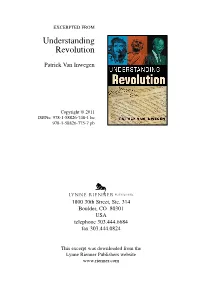
EXCERPTED FROM Understanding Revolution Patrick Van Inwegen Copyright © 2011 ISBNs: 978-1-58826-748-1 hc 978-1-58826-775-7 pb 1800 30th Street, Ste. 314 Boulder, CO 80301 USA telephone 303.444.6684 fax 303.444.0824 This excerpt was downloaded from the Lynne Rienner Publishers website www.rienner.com Contents List of Tables and Figures vii Acknowledgments ix 1 Understanding Revolution 1 2 The “Life Course” of a Revolution 21 3 The Structural Causes of Revolution 35 4 The Role of Ideology, Part 1: Liberalism and Nationalism 57 5 The Role of Ideology, Part 2: Marxism and Religious Thought 77 6 The Sources of Revolutionary Leadership 103 7 Mobilizing the Masses 127 8 The Outcomes of Revolution 147 9 The Study of Revolution 175 Appendix: Case Studies 183 American Revolution (1776–1788) 184 French Revolution (1789–1799) 190 Mexican Revolution (1910–1920) 196 Russian Revolution (1917) 201 Chinese Revolution (1949) 207 Cuban Revolution (1959) 213 Nicaraguan Revolution (1979) 217 Iranian Revolution (1979) 222 v vi Contents Philippine Revolution (1986) 228 Tiananmen Square Prodemocracy Movement (1989) 233 South African Revolution (1994) 239 Rwandan Revolution (1994) 245 Serbian Revolution (2001) 249 East Timorese Independence (1974–2002) 253 Nepalese Revolution (1996–2008) 259 Bibliography 263 Index 273 About the Book 289 1 Understanding Revolution Revolution is the sex of politics. —H. L. Mencken H. L. Mencken’s famous statement on revolutions is illuminating in two re- spects. First, revolutions can be viewed as the sex of politics in the sense that they give birth to nations. Out of revolutionary periods are born the coun- tries that populate the modern international system. -
Nicholas Biddle, Anacharsis, and the Grand Tour
Nicholas Biddle, Anacharsis, and the Grand Tour HEN NICHOLAS BlDDLE (1786-1844) TRAVELED in Europe in the years 1804 to 1807, he kept a series of notebooks in which Whe recorded both his movements and his thoughts on the sights he saw and the people he met. The recovery of these notebooks in 1976 and the recent publication of two of them enable us to get a better picture of his early character and to place him within the context of the history of American travelers. Why did he go to the Aegean of all places?1 To answer this question, I begin by way of a fictional detour. In E. M. Forster's novel A Room with a View, the Reverend Mr. Beebe, speaking of the Miss Alans' proposed visit to Athens and Constantinople, says: I haven't been to Greece myself, and I don't mean to go, and I can't imagine any of my friends going. It is altogether too big for our little lot. Don't you think so? Italy is just about as much as we can manage. Italy is heroic, but Greece is godlike or devilish—I am not sure which, and in either case absolute- ly out of our suburban focus.... I was saying, if our poor little Cockney lives must have a background, let it be Italian. Big enough in all conscience. The ceiling of the Sistine Chapel for me. There the contrast is just as much as I can realize. But not the Parthenon, not the frieze of Phidias at any price.. -

Philosophy and War World War II in the Balkans
PHILOSOPHY AND WAR World War II in the Balkans Athens • Crete • Corfu • Albania • Dubrovnik September 22 – October 2, 2019 aboard the Iconic Sea Cloud Featuring Robert M. Citino, PhD Save up to $2,000 per couple when booked by March 31, 2019 Extend your journey with an optional two-night post-tour in Dubrovnik, Croatia Dear friend of the Museum and fellow traveler, Travel on the Iconic Sea Cloud, A Historical Journey a living legend and sailing icon. No other place in the world illustrates the intricate inter-relationship between war and politics in World War II With carefully restored original as does the Balkan Peninsula. This ancient region, famous as the birthplace of participatory democracy, lies On a Legendary Vessel cabins and magnificent marble at the crossroads of global politics, between Europe, the Middle East, and Africa. Any would-be conqueror fireplaces, this larger than life must control the Balkans in order to control the world. Alexander the Great knew it, Hitler knew it, and so vessel sets the perfect stage for too did Stalin, Churchill, and FDR. our exploration of The Balkans, an area where for centuries As a result, the region saw constant fighting. Greece, Yugoslavia, and Albania were the targets of large Axis civilizations have clashed, offensives. All of these countries developed active armed resistance to their German and Italian occupiers, democracy was born, and some inflicted punishing losses on Axis troops and material, and eventually found themselves plunged into civil of World War II’s most harrow- war once the occupiers left. Studying World War II without knowledge of the Balkans is inconceivable.