Memoirs of the Queensland Museum
Total Page:16
File Type:pdf, Size:1020Kb
Load more
Recommended publications
-

APLL Conference Abstracts
13th International Austronesian and Papuan Languages and Linguistics Conference (APLL13) https://www.ed.ac.uk/ppls/linguistics-and-english-language/events/apll13-2021-06-10 The purpose of the APLL conferences is to provide a venue for presentation of the best current research on Austronesian and Papuan languages and linguistics, and to promote collaboration and research in this area. APLL13 follows a successful online instantiation of APLL, hosted by the University of Oslo, as well as previous APLL conferences held in Leiden, Surrey, Paris and London, and the Austronesian Languages and Linguistics (ALL) conferences held at SOAS and St Catherine's College, Oxford. Language and Culture Research Centre (James Cook University) representative Robert Bradshaw gave a Poster presentation on ‘Frustrative in Doromu-Koki’ (LINK TO POSTER) Additionally, LCRC Associates Dr René van den Berg (SIL International) gave a talk on ‘Un- Austronesian features of Malol, an Oceanic language of Papua New Guinea’ Dr Hannah Sarvasy presented ‘Nungon Switch-Reference: Processing and Acquisition’ and Dr Dineke Schokkin, University of Canterbury in association with Kate L. Lindsey, Boston University presented ‘A new type of auxiliary: Evidence from Pahoturi River complex predicates’ Abstracts of those sessions are presented below Frustrative in Doromu-Koki Robert L. Bradshaw Language and Culture Research Centre – James Cook University The category of frustrative, defined as ‘…a grammatical marker that expresses the nonrealization of some expected outcome implied by the proposition expressed in the marked clause (Overall 2017:479)’, has been identified in a few languages of the world, including those of Amazonia. A frustrative, translated as ‘in vain’, typically expresses an unrealised expectation and lack of accomplishment, as well as negative evaluation. -

Sociality and Locality in a Torres Strait Community
Past Visions, Present Lives: sociality and locality in a Torres Strait community. Thesis submitted by Julie Lahn BA (Hons) (JCU) November 2003 for the degree of Doctor of Philosophy in the School of Anthropology, Archaeology and Sociology Faculty of Arts, Education and Social Sciences James Cook University Statement of Access I, the undersigned, the author of this thesis, understand that James Cook University will make it available for use within the University Library and, by microfilm or other means, allow access to users in other approved libraries. All users consulting this thesis will have to sign the following statement: In consulting this thesis I agree not to copy or closely paraphrase it in whole or in part without the written consent of the author; and to make proper public written acknowledgment for any assistance that I have obtained from it. Beyond this, I do not wish to place any restriction on access to this thesis. _________________________________ __________ Signature Date ii Statement of Sources Declaration I declare that this thesis is my own work and has not been submitted in any form for another degree or diploma at any university or other institution of tertiary education. Information derived from the published or unpublished work of others has been acknowledged in the text and a list of references is given. ____________________________________ ____________________ Signature Date iii Acknowledgments My main period of fieldwork was conducted over fifteen months at Warraber Island between July 1996 and September 1997. I am grateful to many Warraberans for their assistance and generosity both during my main fieldwork and subsequent visits to the island. -

OK-FLY SOCIAL MONITORING PROJECT REPORT No
LOWER FLY AREA STUDY “You can’t buy another life from a store” OK-FLY SOCIAL MONITORING PROJECT REPORT No. 9 for Ok Tedi Mining Limited Original publication details: Reprint publication details: David Lawrence David Lawrence North Australia Research Unit Resource Management in Asia-Pacific Program Lot 8688 Ellengowan Drive Research School of Pacific and Asian Studies Brinkin NT 0810 Australian National University ACT 0200 Australia John Burton (editor) Pacific Social Mapping John Burton (editor) 49 Wentworth Avenue Resource Management in Asia-Pacific Program CANBERRA ACT 2604 Research School of Pacific and Asian Studies Australia Australian National University ACT 0200 Australia Unisearch PNG Pty Ltd Box 320 UNIVERSITY NCD Papua New Guinea May 1995 reprinted October 2004 EDITOR’S PREFACE This volume is the ninth in a series of reports for the Ok-Fly Social Monitoring Project. Colin Filer’s Baseline documentation. OFSMP Report No. 1 and my own The Ningerum LGC area. OFSMP Report No. 2, appeared in 1991. My Advance report summary for Ningerum-Awin area study. OFSMP Report No. 3, David King’s Statistical geography of the Fly River Development Trust. OFSMP Report No. 4, and the two major studies from the 1992 fieldwork, Stuart Kirsch’s The Yonggom people of the Ok Tedi and Moian Census Divisions: an area study. OFSMP Report No. 5 and my Development in the North Fly and Ningerum-Awin area study. OFSMP Report No. 6, were completed in 1993. I gave a precis of our findings to 1993 in Social monitoring at the Ok Tedi project. Summary report to mid- 1993. -
EALD Information (PDF, 434
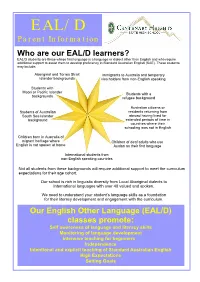
EAL/D Parent Information Who are our EAL/D learners? EAL/D students are those whose first language is a language or dialect other than English and who require additional support to assist them to develop proficiency in Standard Australian English (SAE). These students may include: Aboriginal and Torres Strait Immigrants to Australia and temporary Islander backgrounds visa holders from non-English speaking Students with Maori or Pacific Islander Students with a backgrounds refugee background Australian citizens or Students of Australian residents returning from South Sea islander abroad having lived for background extended periods of time in countries where their schooling was not in English Children born in Australia of migrant heritage where Children of deaf adults who use English is not spoken at home Auslan as their first language International students from non-English speaking countries Not all students from these backgrounds will require additional support to meet the curriculum expectations for their age cohort. Our school is rich in linguistic diversity from Local Aboriginal dialects to International languages with over 40 valued and spoken. We need to understand your student’s language skills as a foundation for their literacy development and engagement with the curriculum. Our English Other Language (EAL/D) classes promote: Self awareness of language and literacy skills Monitoring of language development Intensive teaching for beginners Independence Intentional and explicit teaching of Standard Australian English High Expectations Setting Goals When schools know students speak other languages they can support students in engaging in their learning to reach their educational potential. The information on these questions allows for the right support for your student. -
Abstract of Counting Systems of Papua New Guinea and Oceania
Abstract of http://www.uog.ac.pg/glec/thesis/ch1web/ABSTRACT.htm Abstract of Counting Systems of Papua New Guinea and Oceania by Glendon A. Lean In modern technological societies we take the existence of numbers and the act of counting for granted: they occur in most everyday activities. They are regarded as being sufficiently important to warrant their occupying a substantial part of the primary school curriculum. Most of us, however, would find it difficult to answer with any authority several basic questions about number and counting. For example, how and when did numbers arise in human cultures: are they relatively recent inventions or are they an ancient feature of language? Is counting an important part of all cultures or only of some? Do all cultures count in essentially the same ways? In English, for example, we use what is known as a base 10 counting system and this is true of other European languages. Indeed our view of counting and number tends to be very much a Eurocentric one and yet the large majority the languages spoken in the world - about 4500 - are not European in nature but are the languages of the indigenous peoples of the Pacific, Africa, and the Americas. If we take these into account we obtain a quite different picture of counting systems from that of the Eurocentric view. This study, which attempts to answer these questions, is the culmination of more than twenty years on the counting systems of the indigenous and largely unwritten languages of the Pacific region and it involved extensive fieldwork as well as the consultation of published and rare unpublished sources. -

Cultural Heritage Series
VOLUME 4 PART 2 MEMOIRS OF THE QUEENSLAND MUSEUM CULTURAL HERITAGE SERIES 17 OCTOBER 2008 © The State of Queensland (Queensland Museum) 2008 PO Box 3300, South Brisbane 4101, Australia Phone 06 7 3840 7555 Fax 06 7 3846 1226 Email qmlib@qm.qld.gov.au Website www.qm.qld.gov.au National Library of Australia card number ISSN 1440-4788 NOTE Papers published in this volume and in all previous volumes of the Memoirs of the Queensland Museum may be reproduced for scientific research, individual study or other educational purposes. Properly acknowledged quotations may be made but queries regarding the republication of any papers should be addressed to the Editor in Chief. Copies of the journal can be purchased from the Queensland Museum Shop. A Guide to Authors is displayed at the Queensland Museum web site A Queensland Government Project Typeset at the Queensland Museum CHAPTER 4 HISTORICAL MUA ANNA SHNUKAL Shnukal, A. 2008 10 17: Historical Mua. Memoirs of the Queensland Museum, Cultural Heritage Series 4(2): 61-205. Brisbane. ISSN 1440-4788. As a consequence of their different origins, populations, legal status, administrations and rates of growth, the post-contact western and eastern Muan communities followed different historical trajectories. This chapter traces the history of Mua, linking events with the family connections which always existed but were down-played until the second half of the 20th century. There are four sections, each relating to a different period of Mua’s history. Each is historically contextualised and contains discussions on economy, administration, infrastructure, health, religion, education and population. Totalai, Dabu, Poid, Kubin, St Paul’s community, Port Lihou, church missions, Pacific Islanders, education, health, Torres Strait history, Mua (Banks Island). -
A Grammar of Komnzo
A grammar of Komnzo Christian Döhler language Studies in Diversity Linguistics 22 science press Studies in Diversity Linguistics Editor: Martin Haspelmath In this series: 1. Handschuh, Corinna. A typology of marked-S languages. 2. Rießler, Michael. Adjective attribution. 3. Klamer, Marian (ed.). The Alor-Pantar languages: History and typology. 4. Berghäll, Liisa. A grammar of Mauwake (Papua New Guinea). 5. Wilbur, Joshua. A grammar of Pite Saami. 6. Dahl, Östen. Grammaticalization in the North: Noun phrase morphosyntax in Scandinavian vernaculars. 7. Schackow, Diana. A grammar of Yakkha. 8. Liljegren, Henrik. A grammar of Palula. 9. Shimelman, Aviva. A grammar of Yauyos Quechua. 10. Rudin, Catherine & Bryan James Gordon (eds.). Advances in the study of Siouan languages and linguistics. 11. Kluge, Angela. A grammar of Papuan Malay. 12. Kieviet, Paulus. A grammar of Rapa Nui. 13. Michaud, Alexis. Tone in Yongning Na: Lexical tones and morphotonology. 14. Enfield, N. J. (ed.). Dependencies in language: On the causal ontology of linguistic systems. 15. Gutman, Ariel. Attributive constructions in North-Eastern Neo-Aramaic. 16. Bisang, Walter & Andrej Malchukov (eds.). Unity and diversity in grammaticalization scenarios. 17. Stenzel, Kristine & Bruna Franchetto (eds.). On this and other worlds: Voices from Amazonia. 18. Paggio, Patrizia and Albert Gatt (eds.). The languages of Malta. 19. Seržant, Ilja A. & Alena Witzlack-Makarevich (eds.). Diachrony of differential argument marking. 20. Hölzl, Andreas. A typology of questions in Northeast Asia and beyond: An ecological perspective. 21. Riesberg, Sonja, Asako Shiohara & Atsuko Utsumi (eds.). Perspectives on information structure in Austronesian languages. 22. Döhler, Christian. A grammar of Komnzo. ISSN: 2363-5568 A grammar of Komnzo Christian Döhler language science press Döhler, Christian. -

0=AFRICAN Geosector
2= AUSTRALASIA geosector Observatoire Linguistique Linguasphere Observatory page 123 2=AUSTRALASIA geosector édition princeps foundation edition DU RÉPERTOIRE DE LA LINGUASPHÈRE 1999-2000 THE LINGUASPHERE REGISTER 1999-2000 publiée en ligne et mise à jour dès novembre 2012 published online & updated from November 2012 This geosector covers 223 sets of languages (1167 outer languages, composed of 2258 inner languages) spoken or formerly spoken by communities in Australasia in a geographic sequence from Maluku and the Lesser Sunda islands through New Guinea and its adjacent islands, and throughout the Australian mainland to Tasmania. They comprise all languages of Australasia (Oceania) not covered by phylosectors 3=Austronesian or 5=Indo-European. Zones 20= to 24= cover all so-called "Papuan" languages, spoken on Maluku and the Lesser Sunda islands and the New Guinea mainland, which have been previously treated within the "Trans-New Guinea" hypothesis: 20= ARAFURA geozone 21= MAMBERAMO geozone 22= MANDANGIC phylozone 23= OWALAMIC phylozone 24= TRANSIRIANIC phylozone Zones 25= to 27= cover all other so-called "Papuan" languages, on the New Guinea mainland, Bismarck archipelago, New Britain, New Ireland and Solomon islands, which have not been treated within the "Trans-New Guinea" hypothesis: 25= CENDRAWASIH geozone 26= SEPIK-VALLEY geozone 27= BISMARCK-SEA geozone Zones 28= to 29= cover all languages spoken traditionally across the Australian mainland, on the offshore Elcho, Howard, Crocodile and Torres Strait islands (excluding Darnley island), and formerly on the island of Tasmania. An "Australian" hypothesis covers all these languages, excluding the extinct and little known languages of Tasmania, comprising (1.) an area of more diffuse and complex relationships in the extreme north, covered here by geozone 28=, and (2.) a more closely related affinity (Pama+ Nyungan) throughout the rest of Australia, covered by 24 of the 25 sets of phylozone 29=. -
Notes on the Gulf Province Languages Overview
Notes on the Gulf Province languages Karl Franklin (Data Collected 1968-1973; this report collated 2011) Information compiled here is from notes that I collected between 1968 and 1973. Following the completion of my Ph.D. degree at the Australian National University in 1969, I was awarded a post-doctoral fellowship in 1970 to conduct a linguistic survey of the Gulf Province. In preparation for the survey I wrote a paper that was published as: Franklin, Karl J. 1968. Languages of the Gulf District: A Preview. Pacific Linguistics, Series A, 16.19-44. As a result of the linguistic survey in1970, I edited a book with ten chapters, written by eight different scholars (Franklin, Lloyd, MacDonald, Shaw, Wurm, Brown, Voorhoeve and Dutton). From this data I proposed a classification scheme for 33 languages. For specific details see: Franklin, Karl J. 1973 (ed.) The linguistic situation in the Gulf District and adjacent areas, Papua New Guinea. Pacific Linguistics, Series C, 26, x + 597 pp. Overview There are three sections in this paper. The first is a table that briefly outlines information on languages, dialects and villages of the Gulf Province. (Note that I cannot verify the spelling of each village/language due to differences between various sources.) The second section of the paper is an annotated bibliography and the third is an Appendix with notes from Annual Reports of the Territory of Papua. Source Notes Author/Language Woodward Annual pp. 19-22 by Woodward notes that: Report (AR) Four men of Pepeha were murdered by Kibeni; there is 1919-20:19- now friendly relations between Kirewa and Namau; 22 information on patrols to Ututi, Sirebi, and Kumukumu village on a whaleboat. -

99. the Agiba Cult of the Kerewa Culture Author(S): A
99. The Agiba Cult of the Kerewa Culture Author(s): A. C. Haddon Source: Man, Vol. 18 (Dec., 1918), pp. 177-183 Published by: Royal Anthropological Institute of Great Britain and Ireland Stable URL: http://www.jstor.org/stable/2788511 Accessed: 26-06-2016 05:21 UTC Your use of the JSTOR archive indicates your acceptance of the Terms & Conditions of Use, available at http://about.jstor.org/terms JSTOR is a not-for-profit service that helps scholars, researchers, and students discover, use, and build upon a wide range of content in a trusted digital archive. We use information technology and tools to increase productivity and facilitate new forms of scholarship. For more information about JSTOR, please contact support@jstor.org. Wiley, Royal Anthropological Institute of Great Britain and Ireland are collaborating with JSTOR to digitize, preserve and extend access to Man This content downloaded from 128.110.184.42 on Sun, 26 Jun 2016 05:21:30 UTC All use subject to http://about.jstor.org/terms Dec., 1918.] MAN. [No. 99. ORIGINAL ARTIOLES. With Plate M. Gulf of Papua: Ethnography. Haddon. The Agiba Cult of the Kerewa Culture. By A. C. Haddon. n_ In the Gulf of Papua there may be distinguished foiir cultures, UU which, from east to west, may be termed the Elema, the Namau, the Urama, and the Kerewa; of these the three first are distinctly inter-related, but the last is more distinct. Without doubt these cultures have reached the coast from the interior of the island, though we are as yet ignorant of the routes they have traversed. -

Kiwai Grammar
LA TROBE UNIVERSITY THE BORChARDT LIBRARY A Grammar of the Kiwai Language, Fly Delta, Papua By SIDNEY H. RAY, M.A., F.R.A.I. with a Kiwai Vocabulary By the late Rev. E. BAXTER RILEY (London Missionary Society) ep Port Moresby, Papua: EDWARD GEORGE BAKER, Government Printer. M^A -? Q?^-y LA TR09E UNIVERSITY THE hOrCr-.^DT LIBRARY GPGC PREFACE. 0 1893 and 1897 Dr. Haddon and I published an account of all that was then known of the languages spoken by the people of the Torres Straits Islands and the adjacent mainland of New Guinea known to the islanders as Daudai. The language de scribed as Daudai was substantially the language abo of the island of Kiwai in the Fly Delta. With this work as a foundation, during my stay with the late Eev. James Chalmers at Saguane on Kiwai Island in 1898, I made a short but intensive study of the structure of the language which was printed in the Reports of the Cambridge Anthropological Expedition in 1907. Chalmers was much interested in my work, for he regarded it as the first stage in the fulfilment of his daily prayer that the people of the Fly River might read the Gospel in their own tongue. After the death of Chalmers there was very little opportunity for studying the language and it was not until the Rev. E. Baxter Riley was appointed to the Fly River in 1902, and had begun to learn the language that work was resumed. Mr. Riley published a small school book in 1907, and my Grammar appeared in the same year in the Cambridge Report. -
Wipi Grammar Essentials
1 Wipi Grammar Essentials Written by Anne Dondorp and Jae-Wook Shim, January 1997 Formatted for online publishing by Ruth Wester, November 2013 2 1. INTRODUCTION ............................................................................................................................ 7 1.1 General Information ................................................................................................................................... 7 1.2 Conventions Used ....................................................................................................................................... 8 1.3 Abbreviations ............................................................................................................................................. 8 2. PHONOLOGICAL DESCRIPTION ............................................................................................. 10 2.1 Tentative Orthography ............................................................................................................................. 10 2.2 Morphophonemics ................................................................................................................................... 11 2.2.1 Epenthesis ................................................................................................................................................ 11 2.2.2 Deletion .................................................................................................................................................... 11 2.2.3 Assimilation .............................................................................................................................................