Carrie Chapman Catt 1859-1947
Total Page:16
File Type:pdf, Size:1020Kb
Load more
Recommended publications
-
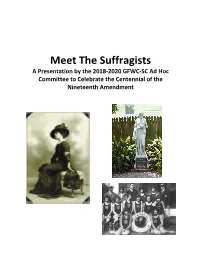
Meet the Suffragists (Pdf)
Meet The Suffragists A Presentation by the 2018-2020 GFWC-SC Ad Hoc Committee to Celebrate the Centennial of the Nineteenth Amendment Meet the Suffragists Susan B. Anthony Champion of temperance, abolition, the rights of labor, and equal pay for equal work, Susan Brownell Anthony became one of the most visible leaders of the women’s suffrage movement. Born on February 15, 1820 in Adams, Massachusetts, Susan was inspired by the Quaker belief that everyone was equal under God. That idea guided her throughout her life. She had seven brothers and sisters, many of whom became activists for justice and emancipation of slaves. In 1851, Anthony met Elizabeth Cady Stanton. The two women became good friends and worked together for over 50 years fighting for women’s rights. They traveled the country and Anthony gave speeches demanding that women be given the right to vote. In 1872, Anthony was arrested for voting. She was tried and fined $100 for her crime. This made many people angry and brought national attention to the suffrage movement. In 1876, she led a protest at the 1876 Centennial of our nation’s independence. She gave a speech—“Declaration of Rights”— written by Stanton and another suffragist, Matilda Joslyn Gage. Anthony died in 1906, 14 years before women were given the right to vote with the passage of the 19th Amendment in 1920. Submitted by Janet Watkins Carrie Chapman Carrie Chapman Catt was born January 9, 1859 in Ripon, Wisconsin. She attended Iowa State University. She was married to Leo Chapman (1885-1886); George Catt (1890-1905); partner Mary Garret Hay. -

CAMBRIDGE SUFFRAGE HISTORY CAMBRIDGE SUFFRAGE HISTORY a Long March for Suffrage
CAMBRIDGE SUFFRAGE HISTORY CAMBRIDGE SUFFRAGE HISTORY A long march for suffrage. Margaret Fuller was born in Cambridge in1810. By her late teens, she was considered a prodigy and equal or superior in intelligence to her male friends. As an adult she hosted “Conversations” for men and women on topics that ranged from women’s rights to philosophy. She joined Ralph Waldo Emerson in editing and writing for the Transcendentalist journal, The Dial from 1840-1842. It was in this publication that she wrote an article about women’s rights titled, “The Great Lawsuit,” which she would go on to expand into a book a few years later. In 1844, she moved to NYC to write for the New York Tribune. Her book, Woman in the Nineteenth Century was published in1845. She traveled to Europe as the Tribune’s foreign correspondent, the first woman to hold such a role. She died in a shipwreck off the coast of NY in July 1850 just as she was returning to life in the U.S. Her husband and infant also perished. It was hoped that she would be a leader in the equal rights and suffrage movements but her life was tragically cut short. 02 SARAH BURKS, CAMBRIDGE HISTORICAL COMMISSION December 2019 CAMBRIDGE SUFFRAGE HISTORY A long march for suffrage. Harriet A. Jacobs (1813-1897) was born into slavery in Edenton, NC. She escaped her sexually abusive owner in 1835 and lived in hiding for seven years. In 1842 she escaped to the north. She eventually was able to secure freedom for her children and herself. -

19Th Amendment Conference | CLE Materials
The 19th Amendment at 100: From the Vote to Gender Equality Center for Constitutional Law at The University of Akron School of Law Friday, Sept. 20, 2019 CONTINUING EDUCATION MATERIALS More information about the Center for Con Law at Akron available on the Center website, https://www.uakron.edu/law/ccl/ and on Twitter @conlawcenter 001 Table of Contents Page Conference Program Schedule 3 Awakening and Advocacy for Women’s Suffrage Tracy Thomas, More Than the Vote: The 19th Amendment as Proxy for Gender Equality 5 Richard H. Chused, The Temperance Movement’s Impact on Adoption of Women’s Suffrage 28 Nicole B. Godfrey, Suffragist Prisoners and the Importance of Protecting Prisoner Protests 53 Amending the Constitution Ann D. Gordon, Many Pathways to Suffrage, Other Than the 19th Amendment 74 Paula A. Monopoli, The Legal and Constitutional Development of the Nineteenth Amendment in the Decade Following Ratification 87 Keynote: Ellen Carol DuBois, The Afterstory of the Nineteth Amendment, Outline 96 Extensions and Applications of the Nineteenth Amendment Cornelia Weiss The 19th Amendment and the U.S. “Women’s Emancipation” Policy in Post-World War II Occupied Japan: Going Beyond Suffrage 97 Constitutional Meaning of the Nineteenth Amendment Jill Elaine Hasday, Fights for Rights: How Forgetting and Denying Women’s Struggles for Equality Perpetuates Inequality 131 Michael Gentithes, Felony Disenfranchisement & the Nineteenth Amendment 196 Mae C. Quinn, Caridad Dominguez, Chelsea Omega, Abrafi Osei-Kofi & Carlye Owens, Youth Suffrage in the United States: Modern Movement Intersections, Connections, and the Constitution 205 002 THE CENTER FOR CONSTITUTIONAL LAW AT AKRON th The 19 Amendment at 100: From the Vote to Gender Equality Friday, September 20, 2019 (8am to 5pm) The University of Akron School of Law (Brennan Courtroom 180) The focus of the 2019 conference is the 100th anniversary of the 19th Amendment. -

View of the Many Ways in Which the Ohio Move Ment Paralled the National Movement in Each of the Phases
INFORMATION TO USERS This was produced from a copy of a document sent to us for microfilming. While tf.; most advanced technological means to photograph and reproduce this document have been used, the quality is heavily dependent upon the quality of the material submitted. The following explanation of techniques is provided to help you understand markings or notations which may appear on this reproduction. 1. The sign or "target” for pages apparently lacking from the document photographed is "Missing Page(s)”. If it was possible to obtain the missing page(s) or section, they are spliced into the film along with adjacent pages. This may have necessitated cutting through an image and duplicating adjacent pages to assure you of complete continuity. 2. When an image on the film is obliterated with a round black mark it is an indication that the film inspector noticed either blurred copy because of movement during exposure, or duplicate copy. Unless we meant to delete copyrighted materials that should not have been filmed, you will find a good image of the page in the adjacent frame. If copyrighted materials were deleted you will find a target note listing the pages in the adjacent frame. 3. When a map, drawing or chart, etc., is part of the material being photo graphed the photographer has followed a definite method in "sectioning” the material. It is customary to begin filming at the upper left hand corner of a large sheet and to continue from left to right in equal sections with small overlaps. If necessary, sectioning is continued again—beginning below the first row and continuing on until complete. -

The 19Th Amendment
National Park Service U.S. Department of the Interior Women Making History: The 19th Amendment Women The right of citizens of the United States to vote shall not be denied or abridged by the United States or by any State on account of sex. Congress shall have power to enforce this article by appropriate legislation. —19th Amendment to the United States Constitution In 1920, after decades of tireless activism by countless determined suffragists, American women were finally guaranteed the right to vote. The year 2020 marks the 100th anniversary of the 19th Amendment. It was ratified by the states on August 18, 1920 and certified as an amendment to the US Constitution on August 26, 1920. Developed in partnership with the National Park Service, this publication weaves together multiple stories about the quest for women’s suffrage across the country, including those who opposed it, the role of allies and other civil rights movements, who was left behind, and how the battle differed in communities across the United States. Explore the complex history and pivotal moments that led to ratification of the 19th Amendment as well as the places where that history happened and its continued impact today. 0-31857-0 Cover Barcode-Arial.pdf 1 2/17/20 1:58 PM $14.95 ISBN 978-1-68184-267-7 51495 9 781681 842677 The National Park Service is a bureau within the Department Front cover: League of Women Voters poster, 1920. of the Interior. It preserves unimpaired the natural and Back cover: Mary B. Talbert, ca. 1901. cultural resources and values of the National Park System for the enjoyment, education, and inspiration of this and All rights reserved, including the right to reproduce this work future generations. -

THE LEAGUE of WOMEN VOTERS® of CENTRAL NEW MEXICO 2501 San Pedro Dr. NE, Suite 216 Albuquerque, NM 87110-4158
August 2020 The VOTER Vol. 85 No. 8 ® THE LEAGUE OF WOMEN VOTERS OF CENTRAL NEW MEXICO 2501 San Pedro Dr. NE, Suite 216 Albuquerque, NM 87110-4158 19th Amendment to the Constitution of the United States The right of citizens of the United States to vote shall not be denied or abridged by the United States or any State because of sex. On this occasion of the 100th anniversary of women securing the right to vote in the United States, the League of Women Voters of Central New Mexico proudly dedicates this issue to all of the women and men who fought for over 70 years to achieve women’s suffrage...a right which women today should never take for granted… a right which we should recognize took many more years to be equally available to women of color… and a right which even today is being suppressed in many States. As we re-dedicate ourselves to righting those wrongs, let us celebrate this milestone during this 100th anniversary month. SEE PAGE 12 FOR INFORMATION ABOUT THE AUGUST 13, 2020 ZOOM UNIT MEETING FEATURING PRESENTATIONS ABOUT THE FIGHT FOR WOMEN SUFFRAGE BY MEREDITH MACHEN AND JEANNE LOGSDON. THE VOTER page 2 A SUFFRAGE TIMELINE from the New Mexico perspective 1848 First Women's Rights Convention held in Seneca Falls, NY passes resolution calling for full voting rights for women. Elizabeth Cady Stanton authors the Declaration of Sentiments. 1868 The 14th amendment ratified, using “male” in the Constitution, thereby deny- ing women the right to vote. 1869 National Woman Suffrage Association works state by state to get women the vote. -

Inez Milholland “Gave Her Life to the Fight for Suffrage” August 6, 1886 – November 25, 1916
Inez Milholland “Gave her life to the fight for suffrage” August 6, 1886 – November 25, 1916 Inez Milholland was born on August 6, 1886 in Brooklyn, New York to wealthy parents. Milholland grew up in New York City and London. She met militant suffragist Emmeline Pankhurst in England, who converted Milholland into a political radical, a transfor- mation that would define her life. Milholland attended Vassar College, where she continued to be politically active. The school had a rule that banned discussion of suffrage on campus, so Milholland organized meetings in a local cemetery. Milholland was also very active in extracurriculars at school, performing as Romeo in Romeo and Juliet, as well as numerous roles in other productions. She was also a member of the Current Topics Club, the German Club, the debate team, and the unrecognized but very present Socialist Club. Additionally, Milholland played basketball, tennis, golf, and field hockey. She broke Vassar’s shot-put record in her sophomore year and won the college cup for best all-around athlete as a junior. After her graduation from Vassar in 1909, Milholland began to work as a suffrage orator in New York City, also advocating for women’s labor rights and was arrested for picketing alongside female workers during strikes in 1909 and 1910. During these strikes, Milholland used her status and resources as a mem- ber of the upper-class to pay bail for strikers and organize fundraisers. As a woman, she was rejected from several law schools but earned a law degree from New York University in 1912. -

Iowa's Role in the Suffrage Movement
Lesson #5 Commemorating the Centennial Of the 19th Amendment Designed for Grades 9-12 6 Lesson Unit/Each Lesson 2 Days Based on Iowa Social Studies Standards Iowa’s Role in the Suffrage Movement Unit Question: What is the 19th Amendment, and how has it influenced the United States? Supporting Question: How was Iowa involved in the promotion of and passage of the 19th Amendment? Lesson Overview The lesson will highlight suffrage leaders with Iowa ties and events in the state leading up to the passage of the 19th Amendment. Lesson Objectives and Targets Students will… 1. take note of key events in Iowa’s path to achieve women’s enfranchisement. 2. read provided biographical entries on selected Iowa suffrage leaders. 3. read and review the University of Iowa Library Archives selections on suffrage, selections from the Carrie Chapman Catt Center for Women and Politics website, and the Iowa Women’s Hall of Fame coverage about Iowa suffragists and contemporary Iowa women leaders.. Useful Terms and Background ● Iowa Organizations - Iowa Woman Suffrage Association (IWSA), Iowa Equal Suffrage Association (IESA) along with several local and state clubs of support ● National suffrage leaders with Iowa roots - Amelia Jenks Bloomer & Carrie Chapman Catt ● Noted Iowa suffragists included in the Iowa Women’s Hall of Fame ● Suffrage activities throughout the state ● Early state attempts for amendments along with Iowa ratification of the 19th Amendment Lesson Procedure Day 1 Teacher Notes for Day 1 1. Point out that lesson materials have been selected from three unique Iowa sources: the University of Iowa Library Archives and the websites for Iowa State University’s Carrie Chapman Catt Center for Women and Politics and the Iowa Women’s Hall of Fame. -

Annie Belle Boss Papers (League of Women Voters) 1914-1931 (3 Hollinger Legal Size Boxes) (1 Flat Box with 1 Scrapbook (16” X 10 1/2” X 4”), with Deed of Gift)
IUSB Archives Inventory of Collections Annie Belle Boss Papers (League of Women Voters) 1914-1931 (3 Hollinger legal size boxes) (1 Flat Box with 1 Scrapbook (16” X 10 1/2” X 4”), with Deed of Gift). The papers pertain to the Woman’s Franchise League of Indiana and its successor, the Indiana League of Women Voters, and especially to the activities of Annie Belle Rittel Boss (Mrs. John C. Boss) (circa 1874-1946), a middle-class woman of Elkhart, Indiana who was active in these organizations on the local, district and state levels. Mrs. Boss’s papers became the property of her daughter, Helen K. Boss Winterhoff, and upon Mrs. Winterhoff’s death were obtained by members of the League of Women Voters of Elkhart. They presented the collection to IUSB in 1984. These papers include publications, correspondence, internal records and other memorabilia of the Woman’s Franchise League of Indiana (1915-1920) and the Indiana League of Women Voters (1920-1931) as well as a history of the latter organization compiled in 1977. Some of the materials concern the local Elkhart branch of the two organizations. Many of the items originated with Helen Beardsley of Elkhart, who founded the Elkhart chapter of the Woman’s Franchise League of Indiana in April, 1913. Serving on the board of the state organization, she became the first president of the Indiana League of Women Voters in 1920. During her years as president (1920 - 1922), the state headquarters was at Elkhart, after which time it was moved to Indianapolis. Mrs. Beardsley was the wife of Andrew Hubble Beardsley, a leading Elkhart businessman, who as a state legislator included woman suffrage in his platform and was influential in the passage of suffrage legislation in Indiana. -

Pathfinder for Women's History Research in the National Archives and Records Administration Library
DOCUMENT RESUME ED 387 137 IR 055 664 AUTHOR Faulkner, Carol, Comp. TITLE Pathfinder for Women's History Research in the National Archives and Records Administration Library. Pathfinders: Guides to Research in NARA Library Resources, Number 1, Pathfinder Series. INSTITUTION National Archives and Records Services (GSA), College Park, MD. Archives Library Information Center. PUB DATE Aug 94 NOTE 21p. PUB TYPE Reference Materials Bibliographies (131) EDRS PRICE MF01/PC01 Plus Postage. DESCRIPTORS Annotated Bibliographies; History; *Library Collections; *Library Materials; Womens Studies IDENTIFIERS *National Archives and Records Administration; *Womens History ABSTRACT The subdiscipline of women's history began in the 1960s. Both the feminist movement and the new study of social history contributed to the development of women's history. Because of these connections, women's history generally expounds a certain political viewpoint and focuses on a specific type of history. The women's history collection in the library of the National Archives and Records Administration (NARA)is small and concentrates on works that are relevant to NARA's record holdings. This pathfinder to 125 documents is organized into seven categories: bibliographies; reference works/biographical sources; journals; collections of primary materials; monographs and anthologies; archival research; and guides to archives. Monographs and anthologies are further subdivided thematically. The themes are: overviews; African-American women; family and children; revolutionary women; suffrage; temperance; theory; women and labor; women and reform; women and society; women and war; and women and the West. Some of the major themes and problems in women's history are conveyed through the descriptions of works. Each entry includes: author; title; publisher information; a short description/summary of the document; and Library of Congress call number. -

Carrie Chapman Catt's Address to the United States Congress
http://gos.sbc.edu/c/catt2.html Address To The United States Congress by Carrie Chapman Catt President of the National American Woman Suffrage Association Washington, D.C., November, 1917 Woman suffrage is inevitable. Suffragists knew it before November 6, 1917; opponents afterward. Three distinct causes make it inevitable. 1. The history of our country. Ours is a nation born of revolution; of rebellion against a system of government so securely entrenched in the customs and traditions of human society that in 1776 it seemed impregnable. From the beginning of things nations had been ruled by kings and for kings, while the people served and paid the cost. The American Revolutionists boldly proclaimed the heresies: "Taxation without representation is tyranny." "Governments derive their just powers from the consent of the governed." The colonists won and the nation which was established as a result of their victory has held unfailingly that these two fundamental principles of democratic government are not only the spiritual source of our national existence but have been our chief historic pride and at all times the sheet anchor of our liberties. Eighty years after the Revolution Abraham Lincoln welded those two maxims into a new: "Ours is a government of the people, by the people and for the people." Fifty years more passed and the President of the United States, Woodrow Wilson, in a mighty crisis of the nation, proclaimed to the world: "We are fighting for the things which we have always carried nearest our hearts--for democracy, for the right of those who submit to authority to have a voice in their own government." All the way between these immortal aphorisms political leaders have declared unabated faith in their truth. -

Northeast Ohio: the Birthplace for Women's Suffrage?
Northeast Ohio: The Birthplace for Women’s Suffrage? For the March 29, 1976 edition of “The New Yorker” magazine, artist Saul Steinberg depicts the World as viewed from Manhattan. This magazine cover, turned into a popular poster, is dominated by the skyline of 9th and 10th Avenue, and an overly expansive Hudson River, especially when compared to “Jersey,” the Rocky Mountains, and the Pacific Ocean. One of the few mentions of the Midwest is a small dot for Chicago, a vast improvement over the eastern seaboard and the City of Boston that, perhaps unsurprisingly, gets no mention at all. The rest of the World gets it; from the New York perspective nearly everything began and ended in the borders of New York State. Five years ago, my wife was elected to judicial office, the first woman in our rural Ohio County so elected to this particular seat. To pay homage to those who won women the Vote, and paved the trail for my wife’s election, we made a pilgrimage to New York State and the location of the First Women’s Suffrage Convention at Seneca Falls. We enjoyed the Museum and the surrounding area thoroughly, as a tour of Seneca Falls has several impressive historical locations. Within a tour that is easily experienced in a single day, one can visit the home of Elizabeth Cady Stanton, the main organizer of the 1848 Convention. A short distance away from the Stanton home is the M’Clintock House where the Convention was planned, and the Declaration of Sentiments were drafted, a document largely credited to Lucretia Mott.