The Leiden Collection Catalogue, 3Rd Ed
Total Page:16
File Type:pdf, Size:1020Kb
Load more
Recommended publications
-

Northern Italianate Landscape Painters
Northern Italianate Landscape Painters ... Northern artists had long spent time in Italy – hence the work of Pieter de Kempeneer (1503-1580) (Room 9) and Frans Floris (1516-1570) in the sixteenth century, who drew their inspiration from the Antique and contemporary masters. Landscape painters Paul Bril (1554-1626) and Adam Elsheimer (1574/78-1610/20) (Room 10), settled there from the end of the sixteenth century and were to influence the Italian school profoundly. However, from around 1620, the Northern Diaspora gave rise to a novel way of representing the towns and countryside of Italy. Cornelis van Poelenburgh (1595/96-1667) went to Rome in 1617 and around 1623 was among the founder members of the Bentvueghels “birds of a feather”, an association of mutual support for Northern artists, goldsmiths and “art lovers” – not only Flemish and Dutch, but Room also Germans and even a few French. He painted shepherds in the ruins and plains of Latium where the harsh light creates strong shadows. Around 1625, the Dutch painter Pieter van Berchem Laer (1599-1642 ?), nicknamed Il Bamboccio, invented the bambocciate, a different take on Caravaggesque scenes of realism showing moments of contemporary Italian low-life in ... the open air and bringing a modern feel to the subject matter. The bambocciate met with considerable success. Flemish and From these two trends – pastoral landscapes suffused with light, and racy at times Dutch Painting vulgar scenes of daily life – was to develop a whole chapter in European painting, dominated by Northern artists but also marked by Italians such as Michelangelo Cerquozzi (1602-1660) and French painters like Sébastien Bourdon (1616-1671). -

The Drawings of Cornelis Visscher (1628/9-1658) John Charleton
The Drawings of Cornelis Visscher (1628/9-1658) John Charleton Hawley III Jamaica Plain, MA M.A., History of Art, Institute of Fine Arts – New York University, 2010 B.A., Art History and History, College of William and Mary, 2008 A Dissertation presented to the Graduate Faculty of the University of Virginia in Candidacy for the Degree of Doctor of Philosophy Department of Art and Architectural History University of Virginia May, 2015 _______________________________________ _______________________________________ _______________________________________ _______________________________________ Table of Contents Abstract ............................................................................................................................................. i Acknowledgements.......................................................................................................................... ii Introduction ..................................................................................................................................... 1 Chapter 1: The Life of Cornelis Visscher .......................................................................................... 3 Early Life and Family .................................................................................................................... 4 Artistic Training and Guild Membership ...................................................................................... 9 Move to Amsterdam ................................................................................................................. -
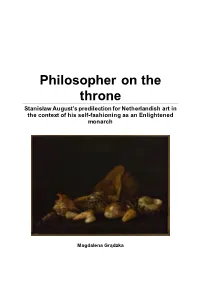
Open Access Version Via Utrecht University Repository
Philosopher on the throne Stanisław August’s predilection for Netherlandish art in the context of his self-fashioning as an Enlightened monarch Magdalena Grądzka Philosopher on the throne Magdalena Grądzka Philosopher on the throne Stanisław August’s predilection for Netherlandish art in the context of his self-fashioning as an Enlightened monarch Magdalena Grądzka 3930424 March 2018 Master Thesis Art History of the Low Countries in its European Context University of Utrecht Prof. dr. M.A. Weststeijn Prof. dr. E. Manikowska 1 Philosopher on the throne Magdalena Grądzka Index Introduction p. 4 Historiography and research motivation p. 4 Theoretical framework p. 12 Research question p. 15 Chapters summary and methodology p. 15 1. The collection of Stanisław August 1.1. Introduction p. 18 1.1.1. Catalogues p. 19 1.1.2. Residences p. 22 1.2. Netherlandish painting in the collection in general p. 26 1.2.1. General remarks p. 26 1.2.2. Genres p. 28 1.2.3. Netherlandish painting in the collection per stylistic schools p. 30 1.2.3.1. The circle of Rubens and Van Dyck p. 30 1.2.3.2. The circle of Rembrandt p. 33 1.2.3.3. Italianate landscapists p. 41 1.2.3.4. Fijnschilders p. 44 1.2.3.5. Other Netherlandish artists p. 47 1.3. Other painting schools in the collection p. 52 1.3.1. Paintings by court painters in Warsaw p. 52 1.3.2. Italian paintings p. 53 1.3.3. French paintings p. 54 1.3.4. German paintings p. -
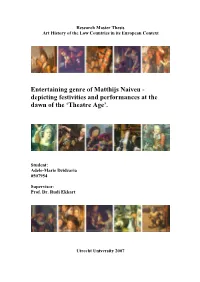
Entertaining Genre of Matthijs Naiveu - Depicting Festivities and Performances at the Dawn of the ‘Theatre Age’
Research Master Thesis Art History of the Low Countries in its European Context Entertaining genre of Matthijs Naiveu - depicting festivities and performances at the dawn of the ‘Theatre Age’. Student: Adele-Marie Dzidzaria 0507954 Supervisor: Prof. Dr. Rudi Ekkart Utrecht University 2007 Table of contents Introduction....................................................................................................................3 1 Biography/Overview of Naiveu’s oeuvre ..............................................................5 1.1 From Leiden to Amsterdam...........................................................................5 1.2 From early genre to theatrical compositions..................................................8 1.3 Portraiture ....................................................................................................14 2 Historiographic context/ Theatricality in genre painting.....................................19 3 Naiveu’s genre paintings – innovating on old subjects and specialising in festivities..............................................................................................................24 4 Theatrical paintings - thematic sources and pictorial models..............................32 4.1 Out-door festivities and performances.........................................................32 4.2 In-door celebrations and amusements..........................................................56 5 Conclusion ...........................................................................................................62 -

Dutch and Flemish Art in Russia
Dutch & Flemish art in Russia Dutch and Flemish art in Russia CODART & Foundation for Cultural Inventory (Stichting Cultuur Inventarisatie) Amsterdam Editors: LIA GORTER, Foundation for Cultural Inventory GARY SCHWARTZ, CODART BERNARD VERMET, Foundation for Cultural Inventory Editorial organization: MARIJCKE VAN DONGEN-MATHLENER, Foundation for Cultural Inventory WIETSKE DONKERSLOOT, CODART English-language editing: JENNIFER KILIAN KATHY KIST This publication proceeds from the CODART TWEE congress in Amsterdam, 14-16 March 1999, organized by CODART, the international council for curators of Dutch and Flemish art, in cooperation with the Foundation for Cultural Inventory (Stichting Cultuur Inventarisatie). The contents of this volume are available for quotation for appropriate purposes, with acknowledgment of author and source. © 2005 CODART & Foundation for Cultural Inventory Contents 7 Introduction EGBERT HAVERKAMP-BEGEMANN 10 Late 19th-century private collections in Moscow and their fate between 1918 and 1924 MARINA SENENKO 42 Prince Paul Viazemsky and his Gothic Hall XENIA EGOROVA 56 Dutch and Flemish old master drawings in the Hermitage: a brief history of the collection ALEXEI LARIONOV 82 The perception of Rembrandt and his work in Russia IRINA SOKOLOVA 112 Dutch and Flemish paintings in Russian provincial museums: history and highlights VADIM SADKOV 120 Russian collections of Dutch and Flemish art in art history in the west RUDI EKKART 128 Epilogue 129 Bibliography of Russian collection catalogues of Dutch and Flemish art MARIJCKE VAN DONGEN-MATHLENER & BERNARD VERMET Introduction EGBERT HAVERKAMP-BEGEMANN CODART brings together museum curators from different institutions with different experiences and different interests. The organisation aims to foster discussions and an exchange of information and ideas, so that professional colleagues have an opportunity to learn from each other, an opportunity they often lack. -

An Italian Courtyard with a Gateway and Seated Figure
Thomas Wyck (Beverwijk near Haarlem 1616 - Haarlem 1677) An Italian Courtyard with a Gateway and Seated Figure bears various inscriptions in pen and brown ink, verso, mostly illegible, but including the word ‘Pynacker’, and inscription in red chalk: ‘W....m’ brush and gray wash over indications in black chalk 20.8 x 20.1 cm (8⅛ x 7⅞ in) Thomas Wyck is best known for his depictions of backstreet and courtyard scenes featuring Italianate architecture and picturesque figures. An Italian Courtyard with a Gateway and Seated Figure is highly typical of Wyck’s draughtsmanship, with its expressive line and use of a wash to render the effect of light and shadow. It is similar in style and subject matter to Italian Courtyard with a Well in the Rijksmuseum, which also depicts a typical feature of an enclosed space, desolate except for the solitary figure of a man in one corner. The addition of pen and ink in the Rijksmuseum work gives the image sharper definition but the brown and gray wash conveys the same soft impression of illumination. Wyck, who is known to have lived in Italy, was, like many of his Dutch contemporaries, very much influenced by the warm Mediterranean quality of light he perceived there and the rustic romanticism of the architecture and landscape. He further developed these elements in his paintings and drawings after returning to the Netherlands, often working up his life studies from Rome. His finished paintings, like his sketches, are set apart from those of other Dutch Italianate artists in that they focus on modest architectural views instead of grand Classical or Renaissance monuments. -

305 BOEKBESPREKINGEN/BOEK REVIEWS Ronald Forsyth Millen
BOEKBESPREKINGEN/BOEK REVIEWS Ronald Forsyth Millen and Robert Erich Wolf, Heroic Deedsand sequently, they see in Mercury's pose a metaphor of fate thrusting Mystic Figures: A New Readingof Rubens' Life of Maria de' Medici, 'the freight of future responsibility on a girl as yet unwarned of Princeton University Press, 1989.1 griefs to come, of dilemmas and burdens to be resolved only through this gift of peacemaking and peacekeeping.' Likewise, in This book broadens and deepens in several ways our understand- The Death of Henryi v and the Proclamationo/?lhe the picture ing of Rubens's series of twenty-four paintings depicting the life which contains the peripeteia of the story and which is given the of Maria de' Medici, executed for the Grand Gallery of the Queen greatest visual prominence both through its double size and its Mother's new Luxembourg Palace between i 6 z and The position alone at the end of the gallery, Millen and Wolf fix their authors assume that every aspect of each picture is pregnant with attention on the Caduceus held by Mercury, one of the group of meaning and consequently organize their chapters as a sequence Olympians in the upper background who admit the apothcosized of exhaustive picture-by-picture analyses. They argue that the King among their number. Their analysis separates the attribute series as a whole and each picture is an intricate revision of histo- from the god and places the Caduceus - as emblem of peace - at a ry, constructed to reflect and justify the life and actions of the convergence of diagonals.In the authors' eyes the Caduceus be- Queen Mother from the vantage point of her policies and senti- comes the visual and symbolic center of the whole series, but this ments current at the inception of the project late in 1 6zi and view strikes me as exaggerated and contrived. -

Catalogue Designer: Laura Scivoli Exhibition Material Visual Design: He Zhao
Index Silent Narratives. Curatorial Concept - Mei Huang .................................................................................... 7 Silent Narratives: A Polyphony Of Stories And Journeys - Dr. Laia Manonelles Moner ................................... 20 Interview on the Exhibition Silent Narratives - Wang Hui ............................................................................. 24 Chinese Hall ............................................................................................................................. 33 Wu Guanzhen .......................................................................................................................... 35 Liu Jianhua ............................................................................................................................... 42 Wang Sishun ............................................................................................................................ 44 Shen Ruijun .............................................................................................................................. 50 Zong Ning ............................................................................................................................... 52 Ding Shiwei .............................................................................................................................. 56 European Hall ......................................................................................................................... 99 Yang Song .............................................................................................................................. -
Courant 7/December 2003
codart Courant 7/December 2003 codartCourant contents Published by Stichting codart P.O. Box 76709 2 A word from the director 12 The influence and uses of Flemish painting nl-1070 ka Amsterdam 3 News and notes from around the world in colonial Peru The Netherlands 3 Australia, Melbourne, National Gallery 14 Preview of upcoming exhibitions info@codart.nl of Victoria 15 codartpublications: A window on www.codart.nl 3 Around Canada Dutch cultural organizations for Russian 4 France, Paris, Institut Néerlandais, art historians Managing editor: Rachel Esner Fondation Custodia 15 codartactivities in fall 2003 e resner@xs4all.nl 4 Germany, Dresden, Staatliche Kunst- 15 Study trip to New England, sammlungen Dresden, Gemäldegalerie 29 October-3 November 2003 Editors: Wietske Donkersloot, Alte Meister 23 codartactivities in 2004 Gary Schwartz 5 Germany, Munich, Staatliche 23 codart zevencongress: Dutch t +31 (0)20 305 4515 Graphische Sammlung and Flemish art in Poland, Utrecht, f +31 (0)20 305 4500 6 Italy, Bert W. Meijer’s influential role in 7-9 March 2004 e wietske@codart.nl study and research projects on Dutch 23 Study trip to Gdan´sk, Warsaw and and Flemish art in Italy Kraków, 18-25 April 2004 codart board 8 Around Japan 32 Appointments Henk van der Walle, chairman 8 Romania, Sibiu, Brukenthal Museum 32 codartmembership news Wim Jacobs, controller of the Instituut 9 Around the United Kingdom and 33 Membership directory Collectie Nederland, secretary- Ireland 44 codartdates treasurer 10 A typical codartstory Rudi Ekkart, director of the Rijksbureau voor Kunsthistorische Documentatie Jan Houwert, director of the Wegener Publishing Company Paul Huvenne, director of the Koninklijk Museum voor Schone Kunsten, Antwerp Jeltje van Nieuwenhoven, member of the Dutch Labor Party faction codartis an international council for curators of Dutch and Flemish art. -
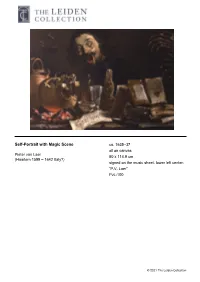
Self-Portrait with Magic Scene Ca
Self-Portrait with Magic Scene ca. 1635–37 oil on canvas Pieter van Laer 80 x 114.9 cm (Haarlem 1599 – 1642 Italy?) signed on the music sheet, lower left center: “P.V. Laer” PvL-100 © 2021 The Leiden Collection Self-Portrait with Magic Scene Page 2 of 15 How to cite Liedtke, Walter A. and Arthur K. Wheelock Jr. “Self-Portrait with Magic Scene” (2017). Revised by Alexa J. McCarthy (2019). In The Leiden Collection Catalogue, 3rd ed. Edited by Arthur K. Wheelock Jr. and Lara Yeager-Crasselt. New York, 2020–. https://theleidencollection.com/artwork/self-portrait-with-magic-scene/ (accessed September 26, 2021). A PDF of every version of this entry is available in this Online Catalogue's Archive, and the Archive is managed by a permanent URL. New versions are added only when a substantive change to the narrative occurs. © 2021 The Leiden Collection Powered by TCPDF (www.tcpdf.org) Self-Portrait with Magic Scene Page 3 of 15 In one of the most remarkable self-portraits ever created, Pieter van Laer Comparative Figures reacts with horror to the frightening claws of the devil that have suddenly come to claim him. Dressed in the black cloak and cap of a magician, the artist, with bulging eyes and open mouth, has witnessed this apparition while standing behind a table filled with books, some with alchemical notations, a variety of vessels, a snuffed-out candle, and a skull resting on hot coals. To emphasize the personal character of this dramatic image, Van Laer prominently signed this work on the musical score lying in the foreground, its lyrics warning that “the devil doesn’t jest.” Clearly, in his conjuring up a world of occult forces, the magician has unleashed realms far beyond his control, and he is about to suffer the consequences of his audacity. -

BAMBOCCIANTI SCHOOL (Before 1650)
THOS. AGNEW & SONS LTD. 6 ST. JAMES’S PLACE, LONDON, SW1A 1NP Tel: +44 (0)20 7491 9219. www.agnewsgallery.com BAMBOCCIANTI SCHOOL (before 1650) A Shepherd Boy in a Landscape Oil on canvas 70 x 60 cm PROVENANCE Baron Vetter von der Lilie, Hautzenbichl Castle, Knittenfeld, Austria; from whom purchased by the previous owner in 1950 The Bamboccianti were genre painters active in Rome from about 1625 until the end of the seventeenth century. Most were Dutch and Flemish artists, including Andries and Jan Both, Karel Dujardin, Jan Miel and Johannes Lingelbach, who brought existing traditions of depicting peasant subjects from sixteenth-century Netherlandish art with them to Italy. The name, meaning ‘ugly doll’, derived from the nickname of Pieter van Laer, credited with initiating the Bamboccianti School, due to his ungainly proportions. In Rome during this period, the work of the Bamboccianti School served as an important countermovement which eschewed the lofty subject matter and grand scale of the conventional art of the time. Artists such as Salvator Rosa lamented that the city had been invaded by a group of painters whose works represented “nothing but rogues, cheats, pickpockets, bands of drunks and gluttons, scabby tobacconists, barbers, and other sordid subjects”1. Rosa was outraged that 1 Levine, David A. (December 1988). "The Roman Limekilns of the Bamboccianti". The Art Bulletin (College Art Association) 70 (4): 569–589 Thos Agnew & Sons Ltd, registered in England No 00267436 at 21 Bunhill Row, London EC1Y 8LP VAT Registration No 911 4479 34 THOS. AGNEW & SONS LTD. 6 ST. JAMES’S PLACE, LONDON, SW1A 1NP Tel: +44 (0)20 7491 9219. -

Asselijn, Jan Also Known As Krabbetje Crabbetje Asselyn, Jan Dutch, C
National Gallery of Art NATIONAL GALLERY OF ART ONLINE EDITIONS Dutch Paintings of the Seventeenth Century Asselijn, Jan Also known as Krabbetje Crabbetje Asselyn, Jan Dutch, c. 1610 - 1652 BIOGRAPHY Jan Asselijn was a prominent landscape painter and draftsman in the Dutch Italianate tradition. Born in the French town of Dieppe, France, as a child Asselijn moved with his family to Amsterdam in 1621. There he studied with Jan Martszen the Younger (c. 1609–after 1647), a specialist in battle scenes, and produced two cavalry scenes, dated 1634 and 1635. Like many Dutch painters seeking to perfect their art, Asselijn traveled to Italy after his early training, probably after November 1635.[1] The experience would influence his painting for the rest of his life. In Rome, he became a member of the Bentvueghels (Dutch for “Birds of a Feather”), an association of northern artists who painted views of the sun-drenched Roman countryside, as well as picturesque scenes of everyday urban life. The group bestowed the nickname Crabbetje, or “little crab,” on Asselijn because of his deformed left hand.[2] Although no dated paintings survive from Asselijn’s time in Italy, his later works show the influence of the low-life street scenes of Pieter van Laer (Dutch, c. 1592 - 1642), as well as the light-infused landscapes of Jan Both (Dutch, 1615/1618 - 1652), both also members of the Bentvueghels. The renowned German writer Joachim von Sandrart praised the many “fine landscapes, small scenes, and animals,” that Asselijn made in Italy, while the Florentine art historian and biographer Filippo Baldinucci praised Asselijn’s renditions of capricci (“fantasies”) and his battle scenes.[3] Asselijn was also a prolific draughtsman, and produced many landscape drawings populated with ruins, animals, and peasants during outings in the Roman countryside with his colleagues.