Snowflake Size
Total Page:16
File Type:pdf, Size:1020Kb
Load more
Recommended publications
-
Table 7: Species Changing IUCN Red List Status (2014-2015)
IUCN Red List version 2015.4: Table 7 Last Updated: 19 November 2015 Table 7: Species changing IUCN Red List Status (2014-2015) Published listings of a species' status may change for a variety of reasons (genuine improvement or deterioration in status; new information being available that was not known at the time of the previous assessment; taxonomic changes; corrections to mistakes made in previous assessments, etc. To help Red List users interpret the changes between the Red List updates, a summary of species that have changed category between 2014 (IUCN Red List version 2014.3) and 2015 (IUCN Red List version 2015-4) and the reasons for these changes is provided in the table below. IUCN Red List Categories: EX - Extinct, EW - Extinct in the Wild, CR - Critically Endangered, EN - Endangered, VU - Vulnerable, LR/cd - Lower Risk/conservation dependent, NT - Near Threatened (includes LR/nt - Lower Risk/near threatened), DD - Data Deficient, LC - Least Concern (includes LR/lc - Lower Risk, least concern). Reasons for change: G - Genuine status change (genuine improvement or deterioration in the species' status); N - Non-genuine status change (i.e., status changes due to new information, improved knowledge of the criteria, incorrect data used previously, taxonomic revision, etc.); E - Previous listing was an Error. IUCN Red List IUCN Red Reason for Red List Scientific name Common name (2014) List (2015) change version Category Category MAMMALS Aonyx capensis African Clawless Otter LC NT N 2015-2 Ailurus fulgens Red Panda VU EN N 2015-4 -
TAG Operational Structure
PARROT TAXON ADVISORY GROUP (TAG) Regional Collection Plan 5th Edition 2020-2025 Sustainability of Parrot Populations in AZA Facilities ...................................................................... 1 Mission/Objectives/Strategies......................................................................................................... 2 TAG Operational Structure .............................................................................................................. 3 Steering Committee .................................................................................................................... 3 TAG Advisors ............................................................................................................................... 4 SSP Coordinators ......................................................................................................................... 5 Hot Topics: TAG Recommendations ................................................................................................ 8 Parrots as Ambassador Animals .................................................................................................. 9 Interactive Aviaries Housing Psittaciformes .............................................................................. 10 Private Aviculture ...................................................................................................................... 13 Communication ........................................................................................................................ -

1 AOS Classification Committee – North and Middle America Proposal Set 2020-A 4 September 2019 No. Page Title 01 02 Change Th
AOS Classification Committee – North and Middle America Proposal Set 2020-A 4 September 2019 No. Page Title 01 02 Change the English name of Olive Warbler Peucedramus taeniatus to Ocotero 02 05 Change the generic classification of the Trochilini (part 1) 03 11 Change the generic classification of the Trochilini (part 2) 04 18 Split Garnet-throated Hummingbird Lamprolaima rhami 05 22 Recognize Amazilia alfaroana as a species not of hybrid origin, thus moving it from Appendix 2 to the main list 06 26 Change the linear sequence of species in the genus Dendrortyx 07 28 Make two changes concerning Starnoenas cyanocephala: (a) assign it to the new monotypic subfamily Starnoenadinae, and (b) change the English name to Blue- headed Partridge-Dove 08 32 Recognize Mexican Duck Anas diazi as a species 09 36 Split Royal Tern Thalasseus maximus into two species 10 39 Recognize Great White Heron Ardea occidentalis as a species 11 41 Change the English name of Checker-throated Antwren Epinecrophylla fulviventris to Checker-throated Stipplethroat 12 42 Modify the linear sequence of species in the Phalacrocoracidae 13 49 Modify various linear sequences to reflect new phylogenetic data 1 2020-A-1 N&MA Classification Committee p. 532 Change the English name of Olive Warbler Peucedramus taeniatus to Ocotero Background: “Warbler” is perhaps the most widely used catch-all designation for passerines. Its use as a meaningful taxonomic indicator has been defunct for well over a century, as the “warblers” encompass hundreds of thin-billed, insectivorous passerines across more than a dozen families worldwide. This is not itself an issue, as many other passerine names (flycatcher, tanager, sparrow, etc.) share this common name “polyphyly”, and conventions or modifiers are widely used to designate and separate families that include multiple groups. -

SPLITS, LUMPS and SHUFFLES Splits, Lumps and Shuffles Alexander C
>> SPLITS, LUMPS AND SHUFFLES Splits, lumps and shuffles Alexander C. Lees This series focuses on recent taxonomic proposals—be they entirely new species, splits, lumps or reorganisations—that are likely to be of greatest interest to birders. This latest instalment includes a new Scytalopus tapaculo and a new subspecies of Three-striped Warbler, reviews of species limits in Grey-necked Wood Rails and Pearly Parakeets and comprehensive molecular studies of Buff-throated Woodcreepers, Sierra Finches, Red-crowned Ant Tanagers and Siskins. Get your lists out! Splits proposed for Grey- Pearly Parakeet is two species necked Wood Rails The three subspecies of Pearly Parakeet Pyrrhura lepida form a species complex with Crimson- The Grey-necked Wood Rail Aramides cajaneus bellied Parakeet P. perlata and replace each other is both the most widespread (occurring from geographically across a broad swathe of southern Mexico to Argentina) and the only polytypic Amazonia east of the Madeira river all the way member of its genus. Although all populations to the Atlantic Ocean. Understanding the nature are ‘diagnosable’ in having an entirely grey neck of this taxonomic variation is an important task, and contrasting chestnut chest, there is much as collectively their range sits astride much of variation in the colours of the nape, lower chest the Amazonian ‘Arc of Deforestation’ and the and mantle, differences amongst which have led to broadly-defined Brazilian endemic Pearly Parakeet the recognition of nine subspecies. Marcondes and is already considered to be globally Vulnerable. Silveira (2015) recently explored the taxonomy of Somenzari and Silveira (2015) recently investigated Grey-necked Wood Rails based on morphological the taxonomy of the three lepida subspecies (the and vocal characteristics using a sample of 800 nominate P. -
TRAFFIC Bird’S-Eye View: REPORT Lessons from 50 Years of Bird Trade Regulation & Conservation in Amazon Countries
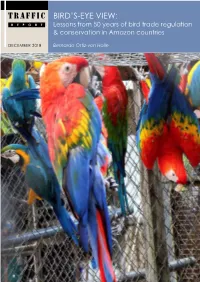
TRAFFIC Bird’s-eye view: REPORT Lessons from 50 years of bird trade regulation & conservation in Amazon countries DECEMBER 2018 Bernardo Ortiz-von Halle About the author and this study: Bernardo Ortiz-von Halle, a biologist and TRAFFIC REPORT zoologist from the Universidad del Valle, Cali, Colombia, has more than 30 years of experience in numerous aspects of conservation and its links to development. His decades of work for IUCN - International Union for Conservation of Nature and TRAFFIC TRAFFIC, the wildlife trade monitoring in South America have allowed him to network, is a leading non-governmental organization working globally on trade acquire a unique outlook on the mechanisms, in wild animals and plants in the context institutions, stakeholders and challenges facing of both biodiversity conservation and the conservation and sustainable use of species sustainable development. and ecosystems. Developing a critical perspective The views of the authors expressed in this of what works and what doesn’t to achieve lasting conservation goals, publication do not necessarily reflect those Bernardo has put this expertise within an historic framework to interpret of TRAFFIC, WWF, or IUCN. the outcomes of different wildlife policies and actions in South America, Reproduction of material appearing in offering guidance towards solutions that require new ways of looking at this report requires written permission wildlife trade-related problems. Always framing analysis and interpretation from the publisher. in the midst of the socioeconomic and political frameworks of each South The designations of geographical entities in American country and in the region as a whole, this work puts forward this publication, and the presentation of the conclusions and possible solutions to bird trade-related issues that are material, do not imply the expression of any linked to global dynamics, especially those related to wildlife trade. -
On Birds of Santander-Bio Expeditions, Quantifying The
Facultad de Ciencias ACTA BIOLÓGICA COLOMBIANA Departamento de Biología http://www.revistas.unal.edu.co/index.php/actabiol Sede Bogotá ARTÍCULO DE INVESTIGACIÓN / RESEARCH ARTICLE ZOOLOGÍA ON BIRDS OF SANTANDER-BIO EXPEDITIONS, QUANTIFYING THE COST OF COLLECTING VOUCHER SPECIMENS IN COLOMBIA Sobre las aves de las expediciones Santander-Bio, cuantificando el costo de colectar especímenes en Colombia Enrique ARBELÁEZ-CORTÉS1 *, Daniela VILLAMIZAR-ESCALANTE1 , Fernando RONDÓN-GONZÁLEZ2 1Grupo de Estudios en Biodiversidad, Escuela de Biología, Universidad Industrial de Santander, Carrera 27 Calle 9, Bucaramanga, Santander, Colombia. 2Grupo de Investigación en Microbiología y Genética, Escuela de Biología, Universidad Industrial de Santander, Carrera 27 Calle 9, Bucaramanga, Santander, Colombia. *For correspondence: enriquearbelaez@gmail.com Received: 23th January 2019, Returned for revision: 26th March 2019, Accepted: 06th May 2019. Associate Editor: Diego Santiago-Alarcón. Citation/Citar este artículo como: Arbeláez-Cortés E, Villamizar-Escalante D, and Rondón-González F. On birds of Santander-Bio Expeditions, quantifying the cost of collecting voucher specimens in Colombia. Acta biol. Colomb. 2020;25(1):37-60. DOI: http://dx.doi.org/10.15446/abc. v25n1.77442 ABSTRACT Several scientific reasons support continuing bird collection in Colombia, a megadiverse country with modest science financing. Despite the recognized value of biological collections for the rigorous study of biodiversity, there is scarce information on the monetary costs of specimens. We present results for three expeditions conducted in Santander (municipalities of Cimitarra, El Carmen de Chucurí, and Santa Barbara), Colombia, during 2018 to collect bird voucher specimens, quantifying the costs of obtaining such material. After a sampling effort of 1290 mist net hours and occasional collection using an airgun, we collected 300 bird voucher specimens, representing 117 species from 30 families. -

Sonoran Joint Venture Bird Conservation Plan Version 1.0
Sonoran Joint Venture Bird Conservation Plan Version 1.0 Sonoran Joint Venture 738 N. 5th Avenue, Suite 102 Tucson, AZ 85705 520-882-0047 (phone) 520-882-0037 (fax) www.sonoranjv.org May 2006 Sonoran Joint Venture Bird Conservation Plan Version 1.0 ____________________________________________________________________________________________ Acknowledgments We would like to thank all of the members of the Sonoran Joint Venture Technical Committee for their steadfast work at meetings and for reviews of this document. The following Technical Committee meetings were devoted in part or total to working on the Bird Conservation Plan: Tucson, June 11-12, 2004; Guaymas, October 19-20, 2004; Tucson, January 26-27, 2005; El Palmito, June 2-3, 2005, and Tucson, October 27-29, 2005. Another major contribution to the planning process was the completion of the first round of the northwest Mexico Species Assessment Process on May 10-14, 2004. Without the data contributed and generated by those participants we would not have been able to successfully assess and prioritize all bird species in the SJV area. Writing the Conservation Plan was truly a group effort of many people representing a variety of agencies, NGOs, and universities. Primary contributors are recognized at the beginning of each regional chapter in which they participated. The following agencies and organizations were involved in the plan: Arizona Game and Fish Department, Audubon Arizona, Centro de Investigación Cientifica y de Educación Superior de Ensenada (CICESE), Centro de Investigación de Alimentación y Desarrollo (CIAD), Comisión Nacional de Áreas Naturales Protegidas (CONANP), Instituto del Medio Ambiente y el Desarrollo (IMADES), PRBO Conservation Science, Pronatura Noroeste, Proyecto Corredor Colibrí, Secretaría de Medio Ambiente y Recursos Naturales (SEMARNAT), Sonoran Institute, The Hummingbird Monitoring Network, Tucson Audubon Society, U.S. -

BIRDS of COLOMBIA - MP3 Sound Collection List of Recordings
BIRDS OF COLOMBIA - MP3 sound collection List of recordings 0003 1 Tawny-breasted Tinamou 1 Song 0:07 Nothocercus julius (26/12/1993 , Podocarpus Cajanuma, Loja, Ecuador, 04.20S,79.10W) © Peter Boesman 0003 2 Tawny-breasted Tinamou 2 Song 0:23 Nothocercus julius (26/5/1996 06:30h, Páramo El Angel (Pacific slope), Carchi, Ecuador, 00.45N,78.03W) © Niels Krabbe 0003 3 Tawny-breasted Tinamou 3 Song () 0:30 Nothocercus julius (12/8/2006 14:45h, Betania area, Tachira, Venezuela, 07.29N,72.24W) © Nick Athanas. 0004 1 Highland Tinamou 1 Song 0:28 Nothocercus bonapartei (26/3/1995 07:15h, Rancho Grande area, Aragua, Venezuela, 10.21N,67.42W) © Peter Boesman 0004 2 Highland Tinamou 2 Song 0:23 Nothocercus bonapartei (10/3/2006 , Choroni road, Aragua, Venezuela, 10.22N,67.35W) © David Van den Schoor 0004 3 Highland Tinamou 3 Song 0:45 Nothocercus bonapartei (March 2009, Rancho Grande area, Aragua, Venezuela, 10.21N,67.42W) © Hans Matheve. 0004 4 Highland Tinamou 4 Song 0:40 Nothocercus bonapartei bonapartei. RNA Reinita Cielo Azul, San Vicente de Chucurí, Santander, Colombia, 1700m, 06:07h, 02-12-2007, N6.50'47" W73.22'30", song. also: Spotted Barbtail, Andean Emerald, Green Violetear © Nick Athanas. 0006 1 Gray Tinamou 1 Song 0:43 Tinamus tao (15/8/2007 18:30h, Nirgua area, San Felipe, Venezuela, 10.15N,68.30W) © Peter Boesman 0006 2 Gray Tinamou 2 Song 0:32 Tinamus tao (4/6/1995 06:15h, Palmichal area, Carabobo, Venezuela, 10.21N,68.12W) (background: Rufous-and-white Wren). © Peter Boesman 0006 3 Gray Tinamou 3 Song 0:04 Tinamus tao (1/2/2006 , Cerro Humo, Sucre, Venezuela, 10.41N,62.37W) © Mark Van Beirs. -

Empidonax Traillii) in Ecuador and Northern Mexico
Winter Distribution of the Willow Flycatcher (Empidonax traillii) in Ecuador and Northern Mexico Submitted to: U.S. Bureau of Reclamation Boulder City, AZ Prepared by: Catherine Nishida and Mary J. Whitfield Southern Sierra Research Station P.O. Box 1316 Weldon, CA, 93283 (760) 378-2402 March 2006 EXECUTIVE SUMMARY Concern for the southwestern willow flycatcher (Empidonax traillii extimus) has stimulated increased research, management, and conservation of the species on its North American breeding grounds. To supplement current knowledge of breeding populations, recent studies in Latin America (Koronkiewicz et al. 1998; Koronkiewicz and Whitfield 1999; Koronkiewicz and Sogge 2000; Lynn and Whitfield 2000, 2002; Nishida and Whitfield 2003, 2004) have focused on wintering ecology. We extended these efforts by surveying for willow flycatchers from 8–24 December, 2004 in northern Mexico and 18–28 January, 2005 in Ecuador. Our goals were to identify territories occupied by wintering willow flycatchers, describe habitat in occupied areas, collect blood and feather samples, collect colorimeter readings, relocate banded individuals, and identify threats to willow flycatcher populations on the wintering grounds. We spent a total of 103.7 survey hours at 30 survey sites in northern Mexico and Ecuador. In northern Mexico, we surveyed four new locations and revisited three locations from our initial 2002 surveys of Mexico. We detected a minimum of 52 willow flycatchers (Sinaloa = 2, Nayarit = 50). In Mexico, occupied habitat was found along the Pacific coast lowlands. In Ecuador, we revisited locations that had been surveyed annually since 2003 (except Sani, which was surveyed 2004–2005) and found high willow flycatcher densities at a new location along the Río Coca. -

Colombia Trip Report Andean Endemics 8Th to 25Th November 2014 (18 Days)
RBT Colombia: Andean Endemics Trip Report - 2014 1 Colombia Trip Report Andean Endemics 8th to 25th November 2014 (18 days) Flame-winged Parakeet by Clayton Burne Trip report compiled by tour leader: Clayton Burne RBT Colombia: Andean Endemics Trip Report - 2014 2 Our tour of Colombia's Andes kicked off at a typical birding hour - too early! Departing Bogota in the dark, we reached Laguna Pedro Palo just after dawn. Situated some 1000m lower than Bogota on the western slopes of the Eastern Cordillera, Laguna Pedro Palo offers an excellent introduction to many Neotropical species, as well as a few Colombian endemics for good measure. The morning started off with a number of commoner tanagers, a pair of Red-faced Spinetail, Rufous-browed Peppershrike, a dashing Green Hermit, White-vented Plumeleteer and the rather scarce Sooty Grassquit. We continued in this good vein adding the spectacular Blue-naped Chlorophonia, a few North American migrants including Black-and-white and Mourning Warblers as well as a host of good tanagers such as Scrub, Bay-headed, Blue-necked, Beryl-spangled and Black-capped. The morning then kicked into high drama as the major target species of the day, the endemic Black Inca, put in a show. The miniscule Olivaceous Piculet offered excellent views before we had brief, but very close views of a male and female Red-headed Barbet. The darker undergrowth gave up decent views of Moustached and Chestnut-capped Brush Finches, but Rusty-breasted Antpitta and Whiskered Wren were less co-operative, the Black Inca by Clayton Burne trips first 'heard only' birds. -

Aves De Las Inmediaciones De La Universidad Técnica De Babahoyo
Quevedo, Los Ríos, ECUADOR Aves de las inmediaciones de la Universidad Técnica de Babahoyo-extensión Quevedo 1 Gonzalo Peñafiel Nivela1 & Jaime Arellano Merino2 1Docente de la Universidad Técnica de Babahoyo extensión Quevedo & 2 Consultor Turístico Independiente Fotos: Dr. Gonzalo Peñafiel Nivela & Lic. Jaime Arellano Merino Producido por: Dr. Gonzalo Peñafiel Nivela & Lic. Jaime Arellano Merino. Con el apoyo de la Universidad técnica de Babahoyo extensión Quevedo © Dr. Gonzalo Peñafiel Nivela (gapenafiel@yahoo.com)– Lic. Jaime Arellano Merino (jargllano@hotmail.com). (M) Macho, (H) Hembra y (Juv.) Juvenil [fieldguides.fieldmuseum.org] [1104] versión 1 2/2019 1 Pearl Kite 2 Rock Pigeon 3 Pale-vented Pigeon 4 Ecuadorian Ground Dove (H) Elanio Perla Paloma Doméstica Paloma Ventripálida Tortolita Ecuatoriana Gampsonyx swainsonii Columba livia Patagioenas cayennensis Columbina buckleyi ACCIPITRIDAE COLUMBIDAE COLUMBIDAE COLUMBIDAE 5 Smooth-billed Ani 6 Amazilia Hummingbird 7 Black-cheeked Woodpecker (H) 8 Golden-olive Woodpecker (M) Garrapatero Pico Liso Amazilia Ventrirufo Carpintero Cara Negra Carpintero Olividorado Crotophaga ani Amazilia amazilia Melanerpes pucherani Colaptes rubiginosus CUCULIDAE TROCHILIDAE PICIDAE PICIDAE 9 Pacific Parrotlet 10 Pale-legged Hornero 11 Vermilion Flycatcher (M) 12 Social Flycatcher Periquito del Pacífico Hornero Patipálido Pájaro Brujo Mosquero Social Forpus coelestis Furnarius leucopus Pyrocephalus rubinus Myiozetetes similis PSITTACIDAE FURNARIIDAE TYRANNIDAE TYRANNIDAE 13 Tropical Kinbgbird 14 Blue-and-white -

N° English Name Scientific Name Status Day 1
FUNDACIÓN JOCOTOCO CHECK-LIST OF THE BIRDS OF YUNGUILLA N° English Name Scientific Name Status Day 1 Day 2 Day 3 1 Tawny-breasted Tinamou Nothocercus julius R 2 Andean Tinamou Nothoprocta pentlandii U 3 Andean Guan Penelope montagnii U 4 Turkey Vulture Cathartes aura U 5 Black Vulture Coragyps atratus U 6 Plain-breasted Hawk Accipiter striatus FC 7 Harris's Hawk Parabuteo unicinctus U 8 Black-chested Buzzard-Eagle Geranoaetus melanoleucus U 9 Broad-winged Hawk Buteo platypterus U 10 Andean Gull Chroicocephalus serranus 11 Band-tailed Pigeon Patagioenas fasciata FC 12 Ecuadorian Ground-Dove Columbina buckleyi 13 Croaking Ground-Dove Columbina cruziana 14 Eared Dove Zenaida auriculata FC 15 Maroon-chested Ground-Dove Claravis mondetoura R 16 White-tipped Dove Leptotila verreauxi C 17 White-throated Quail-Dove Zentrygon frenata U 18 Squirrel Cuckoo Piaya cayana U 19 Dark-billed Cuckoo Coccyzus melacoryphus R 20 Black-billed Cuckoo Coccyzus erythrophthalmus R 21 Striped Cuckoo Tapera naevia C 22 Smooth-billed Ani Crotophaga ani 23 Groove-billed Ani Crotophaga sulcirostris FC 24 Barn Owl Tyto alba U 25 White-throated Screech-Owl Megascops albogularis U 26 Pacific Pygmy-Owl Glaucidium peruanum FC 27 Buff-fronted Owl Aegolius harrisii 28 Mottled Owl Ciccaba virgata FC 29 Striped Owl Asio clamator R 30 Buff-fronted Owl Aegolius harrisii U 31 Common Potoo Nyctibius griseus R 32 Short-tailed Nighthawk Lurocalis semitorquatus R 33 Pauraque Nyctidromus albicollis U 34 Band-winged Nightjar Systellura longirostri U 35 White-collared Swift Streptoprocne