OCTOBER 16, 1968 Thought
Total Page:16
File Type:pdf, Size:1020Kb
Load more
Recommended publications
-

Broadcasting Taste: a History of Film Talk, International Criticism, and English-Canadian Media a Thesis in the Department of Co
Broadcasting Taste: A History of Film Talk, International Criticism, and English-Canadian Media A Thesis In the Department of Communication Studies Presented in Partial Fulfillment of the Requirements For the Degree of Doctor of Philosophy (Communication Studies) at Concordia University Montreal, Quebec, Canada December 2016 © Zoë Constantinides, 2016 CONCORDIA UNIVERSITY SCHOOL OF GRADUATE STUDIES This is to certify that the thesis prepared By: Zoë Constantinides Entitled: Broadcasting Taste: A History of Film Talk, International Criticism, and English- Canadian Media and submitted in partial fulfillment of the requirements for the degree of PhD in Communication Studies complies with the regulations of the University and meets the accepted standards with respect to originality and quality. Signed by the final examining committee: __________________________________________ Beverly Best Chair __________________________________________ Peter Urquhart External Examiner __________________________________________ Haidee Wasson External to Program __________________________________________ Monika Kin Gagnon Examiner __________________________________________ William Buxton Examiner __________________________________________ Charles R. Acland Thesis Supervisor Approved by __________________________________________ Yasmin Jiwani Graduate Program Director __________________________________________ André Roy Dean of Faculty Abstract Broadcasting Taste: A History of Film Talk, International Criticism, and English- Canadian Media Zoë Constantinides, -
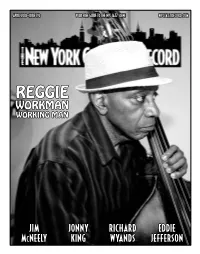
Reggie Workman Working Man
APRIL 2018—ISSUE 192 YOUR FREE GUIDE TO THE NYC JAZZ SCENE NYCJAZZRECORD.COM REGGIE WORKMAN WORKING MAN JIM JONNY RICHARD EDDIE McNEELY KING WYANDS JEFFERSON Managing Editor: Laurence Donohue-Greene Editorial Director & Production Manager: Andrey Henkin To Contact: The New York City Jazz Record 66 Mt. Airy Road East APRIL 2018—ISSUE 192 Croton-on-Hudson, NY 10520 United States Phone/Fax: 212-568-9628 New York@Night 4 Laurence Donohue-Greene: Interview : JIM Mcneely 6 by ken dryden ldgreene@nycjazzrecord.com Andrey Henkin: ahenkin@nycjazzrecord.com Artist Feature : JONNY KING 7 by donald elfman General Inquiries: info@nycjazzrecord.com ON The COver : REGGIE WORKMAN 8 by john pietaro Advertising: advertising@nycjazzrecord.com Encore : RICHARD WYANDS by marilyn lester Calendar: 10 calendar@nycjazzrecord.com VOXNews: Lest WE Forget : EDDIE JEFFERSON 10 by ori dagan voxnews@nycjazzrecord.com LAbel Spotlight : MINUS ZERO by george grella US Subscription rates: 12 issues, $40 11 Canada Subscription rates: 12 issues, $45 International Subscription rates: 12 issues, $50 For subscription assistance, send check, cash or vOXNEWS 11 by suzanne lorge money order to the address above or email info@nycjazzrecord.com Obituaries by andrey henkin Staff Writers 12 David R. Adler, Clifford Allen, Duck Baker, Stuart Broomer, FESTIvAL REPORT Robert Bush, Thomas Conrad, 13 Ken Dryden, Donald Elfman, Phil Freeman, Kurt Gottschalk, Tom Greenland, Anders Griffen, CD REviews 14 Tyran Grillo, Alex Henderson, Robert Iannapollo, Matthew Kassel, Marilyn Lester, Suzanne -

Payton Jordan.Pdf
p.1 STANFORD UNIVERSITY PROJECT: Bob Murphy Interviews INTERVIEWEE: Payton Jordan Robert W. Murphy, Jr.: [0:00] Hello again everybody, Bob Murphy here and a very special chapter in Stanford sports today because one of the dearest friend I've ever had in my life and one of my great pals, Payton Jordan, is with us. Payton, this was scheduled long before you hit your little speed bump a week or so ago. So we'll tell the folks about that, but as we start doing this, I think of you and I sharing the better part of the last 50 years telling stories to one another. Laughing with one another. Laughing at one another. [laughter] Murphy: [0:38] But here we are to recap this. Tell the folks about your little speed bump, you're doing fine, you look great, things are gonna be fine. Payton Jordan: [0:46] I'm sure everything will be fine, I had a slight bump in road, had a little lump on my neck. And they found out it was a very rare cancer and we had to do a little cutting and we'll be doing some radiation and in no time at all, I'll be back up and at them. Murphy: [1:00] They didn't give you a face lift, too, because you're looking so pretty here. [both laugh] Jordan: [1:05] They kind of knit my nerves on one side a little bit, but I'm going to be OK. Murphy: [1:09] We're going to have fun talking about this, we're in no hurry, we're just gonna kind of ramble on. -

From Real Time to Reel Time: the Films of John Schlesinger
From Real Time to Reel Time: The Films of John Schlesinger A study of the change from objective realism to subjective reality in British cinema in the 1960s By Desmond Michael Fleming Submitted in total fulfilment of the requirements of the degree of Doctor of Philosophy November 2011 School of Culture and Communication Faculty of Arts The University of Melbourne Produced on Archival Quality Paper Declaration This is to certify that: (i) the thesis comprises only my original work towards the PhD, (ii) due acknowledgement has been made in the text to all other material used, (iii) the thesis is fewer than 100,000 words in length, exclusive of tables, maps, bibliographies and appendices. Abstract The 1960s was a period of change for the British cinema, as it was for so much else. The six feature films directed by John Schlesinger in that decade stand as an exemplar of what those changes were. They also demonstrate a fundamental change in the narrative form used by mainstream cinema. Through a close analysis of these films, A Kind of Loving, Billy Liar, Darling, Far From the Madding Crowd, Midnight Cowboy and Sunday Bloody Sunday, this thesis examines the changes as they took hold in mainstream cinema. In effect, the thesis establishes that the principal mode of narrative moved from one based on objective realism in the tradition of the documentary movement to one which took a subjective mode of narrative wherein the image on the screen, and the sounds attached, were not necessarily a record of the external world. The world of memory, the subjective world of the mind, became an integral part of the narrative. -

How the Black Power Protest at the 1968 Olympics Killed Careers
https://www.history.com/news/1968-mexico-city-olympics-black-power-protest-backlash UPDATED: OCT 19, 2018 ORIGINAL: FEB 22, 2018 How the Black Power Protest at the 1968 Olympics Killed Careers ERIN BLAKEMORE It’s an iconic image: Two athletes raise their fists on the Olympic podium. The photograph, taken after the 200 meter race at the 1968 Summer Olympics in Mexico City, turned African-American athletes Tommie Smith and John Carlos from track-and-field stars into the center of a roiling controversy over their raised-fist salute, a symbol of black power and the human rights movement at large. But look in the photo and you’ll see another man as well: silver medalist Peter Norman, a white Australian runner. Norman didn’t raise his fist that day, but he stood with Smith and Carlos. Though his show of solidarity ended up destroying Norman’s career, the three athletes’ actions that day would be just one in a line of protests on the athletic stage. 2 U.S. athletes Tommie Smith, center, and John Carlos raise gloved hands skyward during the playing of the Star Spangled Banner after Smith reCeived the gold and Carlos the bronze for the 200 meter run at the Summer Olympic Games in MexiCo City, 1968. AP Photo Smith and Carlos, who had won gold and bronze, respectively, agreed to use their medal wins as an opportunity to highlight the social issues roiling the United States at the time. Racial tensions were at a height, and the Civil Rights movement had given way to the Black Power movement. -
Outdoor Track and Field DIVISION I
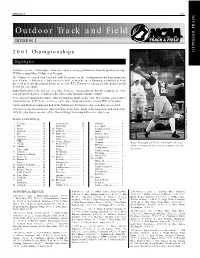
DIVISION I 103 Outdoor Track and Field DIVISION I 2001 Championships OUTDOOR TRACK Highlights Volunteers Are Victorious: Tennessee used a strong performance from its sprinters to edge TCU by a point May 30-June 2 at Oregon. The Volunteers earned their third title with 50 points, as the championship-clinching point was scored by the 1,600-meter relay team in the final event of the meet. Knowing it only had to finish the event to secure the point to break the tie with TCU, Tennessee’s unit passed the baton careful- ly and placed eighth. Justin Gatlin played the key role in getting Tennessee into position to win by capturing the 100- and 200-meter dashes. Gatlin was the meet’s only individual double winner. Sean Lambert supported Gatlin’s effort by finishing fourth in the 100. His position was another important factor in Tennessee’s victory, as he placed just ahead of a pair of TCU competitors. Gatlin and Lambert composed half of the Volunteers’ 400-meter relay team that was second. TCU was led by Darvis Patton, who was third in the 200, fourth in the long jump and sixth in the 100. He also was a member of the Horned Frogs’ victorious 400-meter relay team. TEAM STANDINGS 1. Tennessee ..................... 50 Colorado St. ................. 10 Missouri........................ 4 2. TCU.............................. 49 Mississippi .................... 10 N.C. A&T ..................... 4 3. Baylor........................... 361/2 28. Florida .......................... 9 Northwestern St. ........... 4 4. Stanford........................ 36 29. Idaho St. ...................... 8 Purdue .......................... 4 5. LSU .............................. 32 30. Minnesota ..................... 7 Southern Miss. .............. 4 6. Alabama...................... -

University International
INFORMATION TO USERS This was produced from a copy of a document sent to us for microfilming. While the most advanced technological means to photograph and reproduce this document have been used, the quality is heavily dependent upon the quality of the material submitted. The following explanation of techniques is provided to help you understand markings or notations which may appear on this reproduction. 1. The sign or “target” for pages apparently lacking from the document photographed is “Missing Page(s)”. If it was possible to obtain the missing page(s) or section, they are spliced into the film along with adjacent pages. This may have necessitated cutting through an image and duplicating adjacent pages to assure you of complete continuity. 2. When an image on the film is obliterated with a round black mark it is an indication that the film inspector noticed either blurred copy because of movement during exposure, or duplicate copy. Unless we meant to delete copyrighted materials that should not have been filmed, you will find a good image of the page in the adjacent frame. 3. When a map, drawing or chart, etc., is part of the material being photo graphed the photographer has followed a definite method in “sectioning” the material. It is customary to begin filming at the upper left hand comer of a large sheet and to continue from left to right in equal sections with small overlaps. If necessary, sectioning is continued again—beginning below the first row and continuing on until complete. 4. For any illustrations that cannot be reproduced satisfactorily by xerography, photographic prints can be purchased at additional cost and tipped into your xerographic copy. -

Celebrity and Authorial Integrity in the Films of Woody Men %Y
CELEBRITY AND AUTHORIAL INTEGRITY IN THE FILMS OF WOODY ALLEN BY FAYE MCINTYRE A Thesis Submitted to the Facul@ of Graduate Studies in Partial Fulfillment of the Requirements for the Degree of DOCTOR OF PHILOSOPHY Department of English University of Manitoba Winnipeg, Manitoba (c) January, 200 1 National Library BibIiothèque nationale du Canada Acquisitions and Acquisitions et Bibliographic Services services bibliographiques 395 Wellington Street 395. rue Wellington Ottawa ON Ki A ON4 Ottawa ON KI A ON4 Canada Canada rour rïk vom rbw~ Our fi& Notre rtifBrence The author has granted a non- L'auteur a accordé une licence non exclusive licence allowing the exclusive permettant à la National Lïbrary of Canada to Bibliothèque nationale du Canada de reproduce, loan, distribute or seU reproduire, prêter, distribuer ou copies of this thesis in microform, vendre des copies de cette thèse sous paper or electronic formats. la forme de microfiche/film, de reproduction sur papier ou sur format électronique. The author retains ownership of the L'auteur conserve la propriété du copyright in this thesis. Neither the droit d'auteur qui protège cette thèse. thesis nor substantid extracts fÏom it Ni la thèse ni des extraits substantiels may be printed or othemise de celle-ci ne doivent être imprimés reproduced without the author's ou autrement reproduits sans son permission. autorisation. THE UNIVERSITY OF MANITOBA FACULTY OF GRADUATE STUDIES *f *f * COPYRIGHT PERMISSION PAGE Celebrity and Authorial Integrity in the Films of Woody Men %Y Faye McIntyre A Thesis/Practicum submitted to the Faculty of Graduate Studies of The University of Manitoba in partial fulNlment of the requirements of the degree of Doctor of Philosophy FAYE MCINTYRE O 2001 Permission has been granted to the Library of The University of Manitoba to Iend or seU copies of this thesis/practicum, to the National Library of Canada to microfilm this thesis/practicum and to lend or sell copies of the film, and to Dissertations Abstracts International to publish an abstract of this thesis/practicum. -

Playbill Feb
2014–2015 SEASON PLAYBILL FEB. 5–FEB. 28 © The &oca&ola &ompany Ľ&okeľ and the &ontour Bottle are trademarks of The &oca&ola &ompany 2 /`ba 1S\bS` C;Oaa 4W\S ]T bVS ac^^]`bS` Wa O ^`]cR 1]QO1]ZO1 0`Od]0 / C ] a Wa A Notable Lifestyle Celebrating lifelong enjoyment of the arts Discover gracious, refined independent living in a social and dynamic environment. Meet passionate, enlightened residents–from academics to artists–that will inspire you. The Loomis Communities offer an unparalleled lifestyle with superior amenities and services—with the added peace of mind for the future that comes from access to LiveWell@Loomis. APPLEWOOD LOOMIS VILLAGE Amherst, MA South Hadley, MA 413-253-9833 413-532-5325 The Western Massachusetts www.loomiscommunities.org Pioneer in Senior Living 3 Insuring The Arts Play Onn Local Insurance Agency Local Insurance Agency InsuringYourWay.com 'MPSFODFt&BTUIBNQUPO Can Study Abroad! YOU Scholarships available Education Abroad Advising Center ,QWHUQDWLRQDO3URJUDPV2I¼FH 5P+LOOV6RXWK DFURVVIURP6WXGLR$UWV%XLOGLQJ www.ipo.umass.eduip d 2SHQ0®)AM–4 PM 4 5 Good thinking. NEW ENGLAND PUBLIC RADIO News. Classical. Jazz. Amherst / Springfield / Hartford .................................. WFCR 88.5 FM North Adams .................................................................................. 101.1 FM Great Barrington ............................................................................98.7 FM Lee ....................................................................................................98.3 FM Pittsfield / -

Allen Rostron, the Law and Order Theme in Political and Popular Culture
OCULREV Fall 2012 Rostron 323-395 (Do Not Delete) 12/17/2012 10:59 AM OKLAHOMA CITY UNIVERSITY LAW REVIEW VOLUME 37 FALL 2012 NUMBER 3 ARTICLES THE LAW AND ORDER THEME IN POLITICAL AND POPULAR CULTURE Allen Rostron I. INTRODUCTION “Law and order” became a potent theme in American politics in the 1960s. With that simple phrase, politicians evoked a litany of troubles plaguing the country, from street crime to racial unrest, urban riots, and unruly student protests. Calling for law and order became a shorthand way of expressing contempt for everything that was wrong with the modern permissive society and calling for a return to the discipline and values of the past. The law and order rallying cry also signified intense opposition to the Supreme Court’s expansion of the constitutional rights of accused criminals. In the eyes of law and order conservatives, judges needed to stop coddling criminals and letting them go free on legal technicalities. In 1968, Richard Nixon made himself the law and order candidate and won the White House, and his administration continued to trumpet the law and order theme and blame weak-kneed liberals, The William R. Jacques Constitutional Law Scholar and Professor of Law, University of Missouri–Kansas City School of Law. B.A. 1991, University of Virginia; J.D. 1994, Yale Law School. The UMKC Law Foundation generously supported the research and writing of this Article. 323 OCULREV Fall 2012 Rostron 323-395 (Do Not Delete) 12/17/2012 10:59 AM 324 Oklahoma City University Law Review [Vol. 37 particularly judges, for society’s ills. -

Ruth Prawer Jhabvala's Adapted Screenplays
Absorbing the Worlds of Others: Ruth Prawer Jhabvala’s Adapted Screenplays By Laura Fryer Submitted in fulfilment of the requirements of a PhD degree at De Montfort University, Leicester. Funded by Midlands 3 Cities and the Arts and Humanities Research Council. June 2020 i Abstract Despite being a prolific and well-decorated adapter and screenwriter, the screenplays of Ruth Prawer Jhabvala are largely overlooked in adaptation studies. This is likely, in part, because her life and career are characterised by the paradox of being an outsider on the inside: whether that be as a European writing in and about India, as a novelist in film or as a woman in industry. The aims of this thesis are threefold: to explore the reasons behind her neglect in criticism, to uncover her contributions to the film adaptations she worked on and to draw together the fields of screenwriting and adaptation studies. Surveying both existing academic studies in film history, screenwriting and adaptation in Chapter 1 -- as well as publicity materials in Chapter 2 -- reveals that screenwriting in general is on the periphery of considerations of film authorship. In Chapter 2, I employ Sandra Gilbert’s and Susan Gubar’s notions of ‘the madwoman in the attic’ and ‘the angel in the house’ to portrayals of screenwriters, arguing that Jhabvala purposely cultivates an impression of herself as the latter -- a submissive screenwriter, of no threat to patriarchal or directorial power -- to protect herself from any negative attention as the former. However, the archival materials examined in Chapter 3 which include screenplay drafts, reveal her to have made significant contributions to problem-solving, characterisation and tone. -
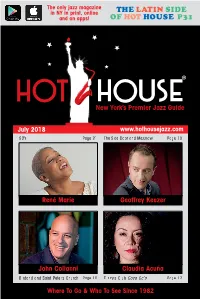
July 2018 92Y Page 21 the Side Door and Mezzrow Page 10
193398_HH_July_0 6/25/18 12:30 PM Page 1 DE The only jazz magazine THE LATIN SIDE in NY in print, online P32 and on apps! OF HOT HOUSE P31 July 2018 www.hothousejazz.com 92Y Page 21 The Side Door and Mezzrow Page 10 René Marie Geoffrey Keezer John Colianni Claudia Acuña Birdand and Saint Peter's Church Page 10 Dizzy's Club Coca-Cola Page 17 Where To Go & Who To See Since 1982 193398_HH_July_0 6/25/18 12:30 PM Page 2 2 193398_HH_July_0 6/25/18 12:30 PM Page 3 3 193398_HH_July_0 6/25/18 12:30 PM Page 4 4 193398_HH_July_0 6/25/18 12:30 PM Page 5 5 193398_HH_July_0 6/25/18 12:30 PM Page 6 6 193398_HH_July_0 6/25/18 12:30 PM Page 7 7 193398_HH_July_0 6/25/18 12:30 PM Page 8 8 193398_HH_July_0 6/25/18 12:30 PM Page 9 9 193398_HH_July_0 6/25/18 12:30 PM Page 10 WINNING SPINS By George Kanzler WO PIANISTS IN THE PRIME OF time suspending style of the late Shirley their careers bring fresh ideas to their Horn. Tlatest albums, featured in this Winning Gillian delivers her own lyrics on the Spins. Both reach beyond the usual piano pair's collaborative song, "You Stay with trio format—one by collaborating with a Me," and reveals her prowess as a scat vocalist on half the tracks, the other by set- singer on the bubbly "Guanajuato," anoth- ting his piano in the context of a swinging er collaboration with improvised sextet.