Centre for Enviroment, Fisheries and Aquaculture
Total Page:16
File Type:pdf, Size:1020Kb
Load more
Recommended publications
-

Research Article Genetic Diversity of Freshwater Leeches in Lake Gusinoe (Eastern Siberia, Russia)
Hindawi Publishing Corporation e Scientific World Journal Volume 2014, Article ID 619127, 11 pages http://dx.doi.org/10.1155/2014/619127 Research Article Genetic Diversity of Freshwater Leeches in Lake Gusinoe (Eastern Siberia, Russia) Irina A. Kaygorodova,1 Nadezhda Mandzyak,1 Ekaterina Petryaeva,1,2 and Nikolay M. Pronin3 1 Limnological Institute, 3 Ulan-Batorskaja Street, Irkutsk 664033, Russia 2 Irkutsk State University, 5 Sukhe-Bator Street, Irkutsk 664003, Russia 3 Institute of General and Experimental Biology, 6 Sakhyanova Street, Ulan-Ude 670047, Russia Correspondence should be addressed to Irina A. Kaygorodova; irina@lin.irk.ru Received 30 July 2014; Revised 7 November 2014; Accepted 7 November 2014; Published 27 November 2014 Academic Editor: Rafael Toledo Copyright © 2014 Irina A. Kaygorodova et al. This is an open access article distributed under the Creative Commons Attribution License, which permits unrestricted use, distribution, and reproduction in any medium, provided the original work is properly cited. The study of leeches from Lake Gusinoe and its adjacent area offered us the possibility to determine species diversity. Asa result, an updated species list of the Gusinoe Hirudinea fauna (Annelida, Clitellata) has been compiled. There are two orders and three families of leeches in the Gusinoe area: order Rhynchobdellida (families Glossiphoniidae and Piscicolidae) and order Arhynchobdellida (family Erpobdellidae). In total, 6 leech species belonging to 6 genera have been identified. Of these, 3 taxa belonging to the family Glossiphoniidae (Alboglossiphonia heteroclita f. papillosa, Hemiclepsis marginata,andHelobdella stagnalis) and representatives of 3 unidentified species (Glossiphonia sp., Piscicola sp., and Erpobdella sp.) have been recorded. The checklist gives a contemporary overview of the species composition of leeches and information on their hosts or substrates. -

Notes on Starfish on an Essex Oyster Bed
J. mar. biol. Ass. U.K. (1958) 37, 565-589 Printed in Great Britain NOTES ON STARFISH ON AN ESSEX OYSTER BED By D. A. HANCOCK Fisheries Laboratory, Burnham-on-Crouch (Text-figs. 1-9) In a previous paper (Hancock, 1955) an account was given of the feeding behaviour of the starfish Asterias rubens L. and the common sunstar Solaster papposus (L.) on Essex oyster beds. In discussion, it was stated that there was no evidence that, in the conditions described, a cultivated oyster ground provided a greater attraction than an uncultivated one. The present work was undertaken to provide information on this subject, and also on the movements, growth and ecological relationships of starfish. Further experiments were made on feeding behaviour, particularly of the young starfish. Samples required to give information on the growth and distribution of starfish were obtained from regular surveys of an oyster bed, by a series of parallel dredge hauls covering both cultivated and derelict bottoms. In November 1954, a section of oyster ground, 125 m wide, and stretching from one bank to the other (Fig. 1),was marked out at the Southward Laying, River Crouch. The first dredge haul was made with two 4 ft. 6in. dredges over the 125 m width, parallel to the edge of the north shore at L.W.a.S.T. and 10 m from it. Buoys were used to mark distances offshore, and subsequent dredge hauls were made parallel with each other 20 m apart, and, when time permitted, were continued as far as the south shore, giving a total of twenty-six stations. -

Arhynchobdellida (Annelida: Oligochaeta: Hirudinida): Phylogenetic Relationships and Evolution
MOLECULAR PHYLOGENETICS AND EVOLUTION Molecular Phylogenetics and Evolution 30 (2004) 213–225 www.elsevier.com/locate/ympev Arhynchobdellida (Annelida: Oligochaeta: Hirudinida): phylogenetic relationships and evolution Elizabeth Bordaa,b,* and Mark E. Siddallb a Department of Biology, Graduate School and University Center, City University of New York, New York, NY, USA b Division of Invertebrate Zoology, American Museum of Natural History, New York, NY, USA Received 15 July 2003; revised 29 August 2003 Abstract A remarkable diversity of life history strategies, geographic distributions, and morphological characters provide a rich substrate for investigating the evolutionary relationships of arhynchobdellid leeches. The phylogenetic relationships, using parsimony anal- ysis, of the order Arhynchobdellida were investigated using nuclear 18S and 28S rDNA, mitochondrial 12S rDNA, and cytochrome c oxidase subunit I sequence data, as well as 24 morphological characters. Thirty-nine arhynchobdellid species were selected to represent the seven currently recognized families. Sixteen rhynchobdellid leeches from the families Glossiphoniidae and Piscicolidae were included as outgroup taxa. Analysis of all available data resolved a single most-parsimonious tree. The cladogram conflicted with most of the traditional classification schemes of the Arhynchobdellida. Monophyly of the Erpobdelliformes and Hirudini- formes was supported, whereas the families Haemadipsidae, Haemopidae, and Hirudinidae, as well as the genera Hirudo or Ali- olimnatis, were found not to be monophyletic. The results provide insight on the phylogenetic positions for the taxonomically problematic families Americobdellidae and Cylicobdellidae, the genera Semiscolex, Patagoniobdella, and Mesobdella, as well as genera traditionally classified under Hirudinidae. The evolution of dietary and habitat preferences is examined. Ó 2003 Elsevier Inc. All rights reserved. -
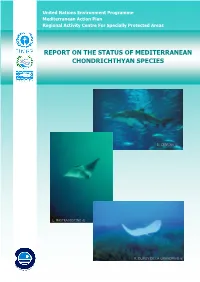
Report on the Status of Mediterranean Chondrichthyan Species
United Nations Environment Programme Mediterranean Action Plan Regional Activity Centre For Specially Protected Areas REPORT ON THE STATUS OF MEDITERRANEAN CHONDRICHTHYAN SPECIES D. CEBRIAN © L. MASTRAGOSTINO © R. DUPUY DE LA GRANDRIVE © Note : The designations employed and the presentation of the material in this document do not imply the expression of any opinion whatsoever on the part of UNEP concerning the legal status of any State, Territory, city or area, or of its authorities, or concerning the delimitation of their frontiers or boundaries. © 2007 United Nations Environment Programme Mediterranean Action Plan Regional Activity Centre for Specially Protected Areas (RAC/SPA) Boulevard du leader Yasser Arafat B.P.337 –1080 Tunis CEDEX E-mail : car-asp@rac-spa.org Citation: UNEP-MAP RAC/SPA, 2007. Report on the status of Mediterranean chondrichthyan species. By Melendez, M.J. & D. Macias, IEO. Ed. RAC/SPA, Tunis. 241pp The original version (English) of this document has been prepared for the Regional Activity Centre for Specially Protected Areas (RAC/SPA) by : Mª José Melendez (Degree in Marine Sciences) & A. David Macías (PhD. in Biological Sciences). IEO. (Instituto Español de Oceanografía). Sede Central Spanish Ministry of Education and Science Avda. de Brasil, 31 Madrid Spain oceanografia@ma.ieo.es 2 INDEX 1. INTRODUCTION 3 2. CONSERVATION AND PROTECTION 3 3. HUMAN IMPACTS ON SHARKS 8 3.1 Over-fishing 8 3.2 Shark Finning 8 3.3 By-catch 8 3.4 Pollution 8 3.5 Habitat Loss and Degradation 9 4. CONSERVATION PRIORITIES FOR MEDITERRANEAN SHARKS 9 REFERENCES 10 ANNEX I. LIST OF CHONDRICHTHYAN OF THE MEDITERRANEAN SEA 11 1 1. -

Parasites from the Red Lionfish, Pterois Volitans from the Gulf of Mexico
Gulf and Caribbean Research Volume 27 Issue 1 2016 Parasites from the Red Lionfish, Pterois volitans from the Gulf of Mexico Alexander Q. Fogg Florida Fish and Wildlife Conservation Commission, fogg.alex@gmail.com Carlos F. Ruiz Auburn University, cfr0006@tigermail.auburn.edu Stephen S. Curran The University of Southern Mississippi, stephen.curran@usm.edu Stephen A. Bullard Auburn University, sab0019@auburn.edu Follow this and additional works at: https://aquila.usm.edu/gcr Part of the Biodiversity Commons, Marine Biology Commons, and the Zoology Commons Recommended Citation Fogg, A. Q., C. F. Ruiz, S. S. Curran and S. A. Bullard. 2016. Parasites from the Red Lionfish, Pterois volitans from the Gulf of Mexico. Gulf and Caribbean Research 27 (1): SC1-SC5. Retrieved from https://aquila.usm.edu/gcr/vol27/iss1/7 DOI: https://doi.org/10.18785/gcr.2701.07 This Short Communication is brought to you for free and open access by The Aquila Digital Community. It has been accepted for inclusion in Gulf and Caribbean Research by an authorized editor of The Aquila Digital Community. For more information, please contact Joshua.Cromwell@usm.edu. VOLUME 25 VOLUME GULF AND CARIBBEAN Volume 25 RESEARCH March 2013 TABLE OF CONTENTS GULF AND CARIBBEAN SAND BOTTOM MICROALGAL PRODUCTION AND BENTHIC NUTRIENT FLUXES ON THE NORTHEASTERN GULF OF MEXICO NEARSHORE SHELF RESEARCH Jeffrey G. Allison, M. E. Wagner, M. McAllister, A. K. J. Ren, and R. A. Snyder....................................................................................1—8 WHAT IS KNOWN ABOUT SPECIES RICHNESS AND DISTRIBUTION ON THE OUTER—SHELF SOUTH TEXAS BANKS? Harriet L. Nash, Sharon J. Furiness, and John W. -
APPENDIX 1 Classified List of Fishes Mentioned in the Text, with Scientific and Common Names
APPENDIX 1 Classified list of fishes mentioned in the text, with scientific and common names. ___________________________________________________________ Scientific names and classification are from Nelson (1994). Families are listed in the same order as in Nelson (1994), with species names following in alphabetical order. The common names of British fishes mostly follow Wheeler (1978). Common names of foreign fishes are taken from Froese & Pauly (2002). Species in square brackets are referred to in the text but are not found in British waters. Fishes restricted to fresh water are shown in bold type. Fishes ranging from fresh water through brackish water to the sea are underlined; this category includes diadromous fishes that regularly migrate between marine and freshwater environments, spawning either in the sea (catadromous fishes) or in fresh water (anadromous fishes). Not indicated are marine or freshwater fishes that occasionally venture into brackish water. Superclass Agnatha (jawless fishes) Class Myxini (hagfishes)1 Order Myxiniformes Family Myxinidae Myxine glutinosa, hagfish Class Cephalaspidomorphi (lampreys)1 Order Petromyzontiformes Family Petromyzontidae [Ichthyomyzon bdellium, Ohio lamprey] Lampetra fluviatilis, lampern, river lamprey Lampetra planeri, brook lamprey [Lampetra tridentata, Pacific lamprey] Lethenteron camtschaticum, Arctic lamprey] [Lethenteron zanandreai, Po brook lamprey] Petromyzon marinus, lamprey Superclass Gnathostomata (fishes with jaws) Grade Chondrichthiomorphi Class Chondrichthyes (cartilaginous -

Ivermectin Binding Sites in Human and Invertebrate Cys-Loop Receptors
1 Ivermectin binding sites in human and invertebrate Cys-loop receptors 2 Timothy Lynagh1, Joseph W. Lynch2 3 4 1 Neurosensory Systems Group, Technical University of Darmstadt, Schnittspahnstrasse 3, 64287 5 Darmstadt, Germany 6 2 Queensland Brain Institute and School of Biomedical Sciences, The University of Queensland, 7 Brisbane, QLD 4072, Australia 8 9 Corresponding author: Lynch, J.W. (j.lynch@uq.edu.au). Phone: +617 33466375 10 11 1 12 Abstract 13 Ivermectin is a gold-standard antiparasitic drug that has been used successfully to treat billions of 14 humans, livestock and pets. Until recently, the binding site on its Cys-loop receptor target had 15 been a mystery. Recent protein crystal structures, site-directed mutagenesis data and molecular 16 modelling now explain how ivermectin binds to these receptors and reveal why it is selective for 17 invertebrate members of the Cys-loop receptor family. Combining this with emerging genomic 18 information, we are now in a position to predict species sensitivity to ivermectin and better 19 understand the molecular basis of ivermectin resistance. An understanding of the molecular 20 structure of the ivermectin binding site, which is formed at the interface of two adjacent subunits 21 in the transmembrane domain of the receptor, should also aid the development of new lead 22 compounds as both anthelmintics and as therapies for a wide variety of human neurological 23 disorders. 24 25 New insight into a wonder drug 26 Orally- or topically-administered ivermectin is used to eliminate parasitic nematodes and 27 arthropods from animals and humans[1]. It is effective yet well-tolerated due to the potency with 28 which it activates a uniquely invertebrate member of the Cys-loop receptor family of ligand-gated 29 ion channels[2]. -

The Marine Fauna of Lundy Ecidnodermata
Rep. Lundy Fld Soc. 29 (1978) THE MARINE FAUNA OF LUNDY ECIDNODERMATA P. A. TYLER Department of Oceanography, University College, Swansea, S. Wales, U.K. INTRODUCTION The five classes of echinoderms are a conspicuous element of the fauna in truly marine areas. The British echinoderm fauna has been treated in detail by Mortensen (1927). In shelf sea areas they are usually found below LWN tide level with occasional species moving up into the littoral zone. Examples of the dominant extant groups are found in all types of substrates, the ophiuroids and the heart urchins being particularly important in the determination of soft substrate benthic communities (Thorson, 1947). SOURCES OF MATERIAL The collections made by divers during marine surveys of Lundy have pro duced a considerable record particularly of the conspicuous epifaunal asteroids, regular echinoids and holothurians. Observations of the less conspicuous in faunal ophiuroids and irregular echinoids have been obtained by divers and by benthic surveys using R.V. 'Ocean Crest'. THE LUNDY FAUNA- GENERAL CONSIDERATIONS To date, 24 species of echinoderm have been recorded around Lundy. Of these species only 8 were recorded by Harvey (1950, 1951) at Lundy. The most noteable exceptions to the fauna are Acrocnida brachiata and Spatangus purpureus, both of which have been found further up the Bristol Channel and may be supposed to be found round Lundy where a suitable substrate exists for these infaunal species. A number of species appear to be common all round the island. These include Asterias rubens, Marthasterias glacia/is, Luidia ciliaris, Echinus esculentus and Holothuria forskali. The very rare sea cucumber Lepto synapta decaria has been reported as occurring round Lundy (Hoare & Wilson, 1976). -

Training Manual Series No.15/2018
View metadata, citation and similar papers at core.ac.uk brought to you by CORE provided by CMFRI Digital Repository DBTR-H D Indian Council of Agricultural Research Ministry of Science and Technology Central Marine Fisheries Research Institute Department of Biotechnology CMFRI Training Manual Series No.15/2018 Training Manual In the frame work of the project: DBT sponsored Three Months National Training in Molecular Biology and Biotechnology for Fisheries Professionals 2015-18 Training Manual In the frame work of the project: DBT sponsored Three Months National Training in Molecular Biology and Biotechnology for Fisheries Professionals 2015-18 Training Manual This is a limited edition of the CMFRI Training Manual provided to participants of the “DBT sponsored Three Months National Training in Molecular Biology and Biotechnology for Fisheries Professionals” organized by the Marine Biotechnology Division of Central Marine Fisheries Research Institute (CMFRI), from 2nd February 2015 - 31st March 2018. Principal Investigator Dr. P. Vijayagopal Compiled & Edited by Dr. P. Vijayagopal Dr. Reynold Peter Assisted by Aditya Prabhakar Swetha Dhamodharan P V ISBN 978-93-82263-24-1 CMFRI Training Manual Series No.15/2018 Published by Dr A Gopalakrishnan Director, Central Marine Fisheries Research Institute (ICAR-CMFRI) Central Marine Fisheries Research Institute PB.No:1603, Ernakulam North P.O, Kochi-682018, India. 2 Foreword Central Marine Fisheries Research Institute (CMFRI), Kochi along with CIFE, Mumbai and CIFA, Bhubaneswar within the Indian Council of Agricultural Research (ICAR) and Department of Biotechnology of Government of India organized a series of training programs entitled “DBT sponsored Three Months National Training in Molecular Biology and Biotechnology for Fisheries Professionals”. -

Age and Growth of Two Sympatric Squid Loligo Vulgaris and Loligo Forbesi, in Galician Waters (North-West Spain)
J. Mar. Biol. Ass. U.K. (1999), 79, 697^707 Printed in the United Kingdom Age and growth of two sympatric squid Loligo vulgaris and Loligo forbesi, in Galician waters (north-west Spain) F. Rocha and A. Guerra Instituto de Investigaciones Marinas (CSIC), Eduardo Cabello 6, 36208 Vigo, Spain Age and growth of Loligo vulgaris and L. forbesi were studied by the examination of growth increments in 96 and 135 selected (white zone 510%) statoliths, respectively. Squid were obtained by monthly sampling from the catches of commercial trawling and hand-jigs in Galician waters (north-west Spain) between February 1991 and October 1993. Mantle length (ML) of L. vulgaris ranged from 70 to 480 mm and varied between 70 and 685 mm in L. forbesi. A negative allometry between statolith length and ML or body weight (BW) was found in both species. Sexual dimorphism was apparent in both species, males grew faster and longer than females. The statolith analysis suggests that growth patterns of L. vulgaris and L. forbesi in Galician waters are di¡erent. The exploited population of L. vulgaris was composed of two groups: one formed by individuals hatched in winter^spring and another by specimens hatched in summer^autumn. Squid hatched in winter^spring reached larger sizes at the same age than those hatched in summer^autumn. These two groups were also observed in L. forbesi. However, squid of this species hatched in winter^spring were smaller than those hatched in summer^autumn at the same age. Reasons for this discrepancy are discussed. The life span of L. -
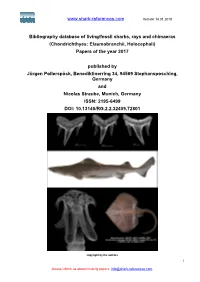
Database of Bibliography of Living/Fossil
www.shark-references.com Version 16.01.2018 Bibliography database of living/fossil sharks, rays and chimaeras (Chondrichthyes: Elasmobranchii, Holocephali) Papers of the year 2017 published by Jürgen Pollerspöck, Benediktinerring 34, 94569 Stephansposching, Germany and Nicolas Straube, Munich, Germany ISSN: 2195-6499 DOI: 10.13140/RG.2.2.32409.72801 copyright by the authors 1 please inform us about missing papers: info@shark-references.com www.shark-references.com Version 16.01.2018 Abstract: This paper contains a collection of 817 citations (no conference abstracts) on topics related to extant and extinct Chondrichthyes (sharks, rays, and chimaeras) as well as a list of Chondrichthyan species and hosted parasites newly described in 2017. The list is the result of regular queries in numerous journals, books and online publications. It provides a complete list of publication citations as well as a database report containing rearranged subsets of the list sorted by the keyword statistics, extant and extinct genera and species descriptions from the years 2000 to 2017, list of descriptions of extinct and extant species from 2017, parasitology, reproduction, distribution, diet, conservation, and taxonomy. The paper is intended to be consulted for information. In addition, we provide data information on the geographic and depth distribution of newly described species, i.e. the type specimens from the years 1990 to 2017 in a hot spot analysis. New in this year's POTY is the subheader "biodiversity" comprising a complete list of all valid chimaeriform, selachian and batoid species, as well as a list of the top 20 most researched chondrichthyan species. Please note that the content of this paper has been compiled to the best of our abilities based on current knowledge and practice, however, possible errors cannot entirely be excluded. -

Farne Islands Surveys 2005-2008
Species Recorded Phylum Common Name Number Common Species The table to the right shows the of species number of species recorded in each Porifera Sponges 4 Myxilla incrustans phylum and indentifies the more Cnidaria Anemones, corals, 22 Kelp fur Obelia geniculata hydroids, jellyfish Dead men's fingers Alcyonium digitatum common species. Only one of the Dahlia anemone Urticina felina species is a Biodiveristy Action Plan Plumose anemone Metridium senile Elegant anemone Sagartia elegans (BAP) species, the crawfish, Palinurus Devonshire cup coral Caryophyllia smithii elephas, but a number of others are Annelida Segmented worms 5 Keelworms Pomatoceros spp. nationally or locally scarce or rare. Sprial worms Spirorbis spp. Crustacea Crabs, lobsters, barnacles 17 Greater acorn barnacle Balanus balanus Sponges Humpback prawn Pandalus montagui Lobster Homarus gammarus All of the sponges identified were low Hermit crab Pagurus bernhardus growing species with no massive or Spiny squat lobster Galathea srtigosa Edible crab Cancer pagurus branching sponges present. Velvet swimming crab Necora puber Mollusca Shells, sea slugs, cuttlefish 28 Grey topshell Gibbula cinerea Hydroids, anemones and corals Painted topshell Calliostoma zizyphinum This coast is notable for the very large Dead men’s finger sea slug Tritonia hombergi numbers of dead men’s fingers, Orange clubbed sea slug Limacia clavigera Bryozoa Sea mats 12 Sea mat Membranipora membranacea Alcyonium digitatum and these Hornwrack Flustra foliacea occurred in all of the rocky sites (cover Bryozoan crusts indet. mid left). Echinodermata Starfish, sea urchins, 12 Common feather star Antedon bifida Common sunstar Crossaster papposus Species which have a north-easterly Bloody Henry Henricia spp. distribution included the deeplet sea Common starfish Asterias rubens Black brittlestar Ophiocomina nigra anemone, Bolocera tuediae (rare).