Mollusca Polyplacophora : Deep-Water Chitons from New Caledonia
Total Page:16
File Type:pdf, Size:1020Kb
Load more
Recommended publications
-

Enrico SCHWABE Zoologische Staatssammlung Muenchen
. , E. SCHWABE NOVAPEX 6 (4): 89-105, 10 décembre 2005 A catalogue of Récent and fossil chitons (MoUusca: Polyplacophora) Addenda Enrico SCHWABE Zoologische Staatssammlung Muenchen, Muenchhausenstrasse 2 1 D-81247 Muenchen, Germany enrico.schwabe@zsm.mwn.de KEYWORDS. MoUusca, Polyplacophora, taxon list, bibliography ABSTRACT. This paper lists species-group names of Récent and fossil Polyplacophora (MoUusca) that were published after 1998 (for the Récent species) and 1987 (for the fossil species). A total of 171 species were since then introduced, of which 123 are attributed to valid fossil taxa and 48 to valid Récent taxa. The authorship and complète références are provided for each species-group name. INTRODUCTION Considerazioni suUa famiglia Leptochitonidae Dali, 1889 (MoUusca: Polyplacophora). III. Le species Taxonomic work is impossible without an overview of terziarie e quatemarie Europee, con note sistematiche the scientific names existing in the particular taxon e filogenetiche. - Atti délia prima Giornata di Studi group. Catalogues generally are a great tool to obtain Malacologici Centra lîaliano di Studi Malacologici such overviews, as they often summarize information (1989): 19-140 (: 79; pi. 26). otherwise hard to gather and master. Type locality: Pezzo, near Villa S. Giovanni (Reggio Of the nearly 2600 taxa introduced on species level Calabria prov.); in material of upper Pleistocene, but within the Polyplacophora, 368 fossils and 914 Récent presumably originated from adjacent deposits of lower species are considered as valid (closing date: Pleistocene of bathyal faciès [Pezzo, presso Villa S. 31/10/2005). Giovanni (RC); in materiale del Pleistocene superiore, In the past, excellent catalogues of species-group ma presumibilmente originato da contigui depositi del names in Polyplacophora were compiled by Kaas & Pleistocene inferiore di faciès batiale]. -

Terenochiton (Mollusca: Polyplacophora) with a Genus Diagnosis Emendation
Ruthenica, 2019, vol. 29, No. 3: 121-127. © Ruthenica, 2019 Published online June17, 2019 http: www.ruthenica.com Reinstatement of the genus Terenochiton (Mollusca: Polyplacophora) with a genus diagnosis emendation Boris SIRENKO Zoological Institute, Russian Academy of Sciences, Universitetskaya nab.1, St. Petersburg, 199034, RUSSIAN FEDERATION; E-mail: marine@zin.ru ABSTRACT. It is proposed to restore the old name of (2 spms, from Lord Howe Island). Norfolk specimen the genus, Terenochiton for Leptochiton norfolcensis and one of the Lord Howe specimens were prepared (Hedley et Hull, 1912). We also provide a new descrip- for scanning electron microscopy (SEM) and for tion for the genus since the old description does not light microscopy. They were boiled in 7% KOH for reflect the main features associated with the develop- 5–10 minutes, then boiled twice in fresh water. ment of the articulamentum. All valves of the genus Several valves (usually the valves I, II, IV, V and have rudimentary unslitted insertion plates. Similar ru- dimentary insertion plates have evolved independent- VIII), a large section of the radular ribbon and a ly in different families of the primitive chitons. portion of the girdle were then chosen for a scanning electron microscope FEI SEM Quanta 250 Scan. The remains of the radula and the girdle were dried Introduction and put in Canada balsam for examination under the light microscope. While studying the New Zealand chitons re- Abbreviations: AM, Australian Museum, Syd- ceived from Bruce Marshall (NMNZ), I was sur- ney; BL, body length; spm(s), specimen(s); MZUSP, prised to see the rudimentary insertion plates at all Museum of Zoology of the University of São Paulo; valves in Leptochiton norfolcensis (Hedley et Hull, NMNZ, Te Papa Tongarewa Museum of New Zea- 1912). -
Fossil and Recent Molluscan Types in the Auckland War Memorial Museum
Fossil and Recent molluscan types in the Auckland War Memorial Museum. Part 2: Polyplacophora and Scaphopoda Wilma M. Blom Auckland War Memorial Museum Abstract The Marine Department of Auckland War Memorial Museum has nearly 1800 primary types and a further 1811 paratypes and paralectotypes types in its collections. The majority are molluscan and this second part of a catalogue of these collections reviews the types for 14 chiton and two scaphopod species. It deals with seven primary types and 12 secondary type lots, which are split between 12 Recent taxa and four fossil taxa. All of the holotypes reviewed here have been illustrated. KEYWORDS Auckland Museum, name–bearing types, Mollusca, Polyplacophora, Scaphopoda. INTRODUCTION Iredale & Mestayer 1908; Webster 1908; Ashby 1926; Finlay 1926; Laws 1932). Each would have drawn on The Marine Department of Auckland War Memorial the expertise of the others despite living widely apart. Museum (AWMM) holds nearly 1800 lots of name– As chance would have it, four of the seven – Ashby, bearing primary types, in the form of holotypes, neotypes, Iredale, Mestayer and Webster – were born in England syntypes and lectotypes, and a further 1811 iconotypes, before moving to Australia or New Zealand, or both. paratypes and paralectotypes. These are spread across E. (Edwin) Ashby (1861–1941) was born in several phyla, but the great majority are Mollusca. They England and for health reasons moved to South Australia include terrestrial as well as marine species, and fossil as as a young man, where he became an estate agent well as extant taxa. and naturalist. He collected flowering plants, birds, Auckland Museum’s first list of biological primary and insects, but was particularly interested in Recent types, which included the molluscs, was published by and fossil chitons on which he published 60 papers Powell (1941) and he followed this with a supplement (Winckworth 1942). -

(Polyplacophora: Leptochitonidae) and Its Phylogenetic Affinities
Journal of Systematic Palaeontology 5 (2): 123–132 Issued 25 May 2007 doi:10.1017/S1477201906001982 Printed in the United Kingdom C The Natural History Museum First record of a chiton from the Palaeocene of Denmark (Polyplacophora: Leptochitonidae) and its phylogenetic affinities Julia D. Sigwart National Museum of Ireland, Natural History Division, Merrion Street, Dublin 2, Ireland & School of Biology and Biochemistry, Queens University Belfast, BT7 1NN, UK Søren Bo Andersen Department of Earth Sciences, Aarhus University, DK – 8000 Aarhus C, Denmark Kai Ingemann Schnetler Fuglebakken 14, Stevnstrup, DK – 8870 Lang˚a, Denmark SYNOPSIS A new species of fossil polyplacophoran from the Danian (Lower Palaeocene) of Denmark is described from over 450 individual disarticulated plates. The polyplacophorans originate from the ‘nose-chalk’ in the classical Danish locality of Fakse Quarry, an unconsolidated coral limestone in whicharagoniticmolluscshellsarepreserved throughtransformation intocalcite.In platearchitecture and sculpture, the new Danish material is similar to Recent Leptochiton spp., but differs in its underdeveloped apophyses and high dorsal elevation (height/width ca. 0.54). Cladistic analysis of 55 original shell characters coded for more than 100 Recent and fossil species in the order Lepidopleurida shows very high resolution of interspecific relationships, but does not consistently recover traditional genera or subgenera. Inter-relationships within the suborder Lepidopleurina are of particular interest as it is often considered the most ‘basal’ neoloricate lineage. In a local context, the presence of chitons in the faunal assemblage of Fakse contributes evidence of shallow depositional depth for at least some elements of this Palaeocene seabed, a well-studied formation of azooxanthellic coral limestones. -

THE NAUTILUS (Quarterly)
americanmalacologists, inc. PUBLISHERS OF DISTINCTIVE BOOKS ON MOLLUSKS THE NAUTILUS (Quarterly) MONOGRAPHS OF MARINE MOLLUSCA STANDARD CATALOG OF SHELLS INDEXES TO THE NAUTILUS {Geographical, vols 1-90; Scientific Names, vols 61-90) REGISTER OF AMERICAN MALACOLOGISTS JANUARY 30, 1984 THE NAUTILUS ISSN 0028-1344 Vol. 98 No. 1 A quarterly devoted to malacology and the interests of conchologists Founded 1889 by Henry A. Pilsbry. Continued by H. Burrington Baker. Editor-in-Chief: R. Tucker Abbott EDITORIAL COMMITTEE CONSULTING EDITORS Dr. William J. Clench Dr. Donald R. Moore Curator Emeritus Division of Marine Geology Museum of Comparative Zoology School of Marine and Atmospheric Science Cambridge, MA 02138 10 Rickenbacker Causeway Miami, FL 33149 Dr. William K. Emerson Department of Living Invertebrates Dr. Joseph Rosewater The American Museum of Natural History Division of Mollusks New York, NY 10024 U.S. National Museum Washington, D.C. 20560 Dr. M. G. Harasewych 363 Crescendo Way Dr. G. Alan Solem Silver Spring, MD 20901 Department of Invertebrates Field Museum of Natural History Dr. Aurele La Rocque Chicago, IL 60605 Department of Geology The Ohio State University Dr. David H. Stansbery Columbus, OH 43210 Museum of Zoology The Ohio State University Dr. James H. McLean Columbus, OH 43210 Los Angeles County Museum of Natural History 900 Exposition Boulevard Dr. Ruth D. Turner Los Angeles, CA 90007 Department of Mollusks Museum of Comparative Zoology Dr. Arthur S. Merrill Cambridge, MA 02138 c/o Department of Mollusks Museum of Comparative Zoology Dr. Gilbert L. Voss Cambridge, MA 02138 Division of Biology School of Marine and Atmospheric Science 10 Rickenbacker Causeway Miami, FL 33149 EDITOR-IN-CHIEF The Nautilus (USPS 374-980) ISSN 0028-1344 Dr. -
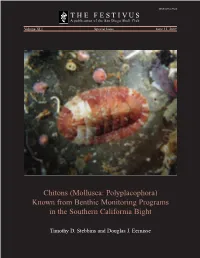
Chitons (Mollusca: Polyplacophora) Known from Benthic Monitoring Programs in the Southern California Bight
ISSN 0738-9388 THE FESTIVUS A publication of the San Diego Shell Club Volume XLI Special Issue June 11, 2009 Chitons (Mollusca: Polyplacophora) Known from Benthic Monitoring Programs in the Southern California Bight Timothy D. Stebbins and Douglas J. Eernisse COVER PHOTO Live specimen of Lepidozona sp. C occurring on a piece of metal debris collected off San Diego, southern California at a depth of 90 m. Photo provided courtesy of R. Rowe. Vol. XLI(6): 2009 THE FESTIVUS Page 53 CHITONS (MOLLUSCA: POLYPLACOPHORA) KNOWN FROM BENTHIC MONITORING PROGRAMS IN THE SOUTHERN CALIFORNIA BIGHT TIMOTHY D. STEBBINS 1,* and DOUGLAS J. EERNISSE 2 1 City of San Diego Marine Biology Laboratory, Metropolitan Wastewater Department, San Diego, CA, USA 2 Department of Biological Science, California State University, Fullerton, CA, USA Abstract: About 36 species of chitons possibly occur at depths greater than 30 m along the continental shelf and slope of the Southern California Bight (SCB), although little is known about their distribution or ecology. Nineteen species are reported here based on chitons collected as part of long-term, local benthic monitoring programs or less frequent region-wide surveys of the entire SCB, and these show little overlap with species that occur at depths typically encountered by scuba divers. Most chitons were collected between 30-305 m depths, although records are included for a few from slightly shallower waters. Of the two extant chiton lineages, Lepidopleurida is represented by Leptochitonidae (2 genera, 3 species), while Chitonida is represented by Ischnochitonidae (2 genera, 6-9 species) and Mopaliidae (4 genera, 7 species). -
Liolophura Species Discrimination with Geographical Distribution Patterns and Their Divergence and Expansion History on the Nort
www.nature.com/scientificreports OPEN Liolophura species discrimination with geographical distribution patterns and their divergence and expansion history on the northwestern Pacifc coast Eun Hwa Choi1,2,5, Mi Yeong Yeo1,5, Gyeongmin Kim1,3,5, Bia Park1,2,5, Cho Rong Shin1, Su Youn Baek1,2 & Ui Wook Hwang1,2,3,4* The chiton Liolophura japonica (Lischke 1873) is distributed in intertidal areas of the northwestern Pacifc. Using COI and 16S rRNA, we found three genetic lineages, suggesting separation into three diferent species. Population genetic analyses, the two distinct COI barcoding gaps albeit one barcoding gap in the 16S rRNA, and phylogenetic relationships with a congeneric species supported this fnding. We described L. koreana, sp. nov. over ca. 33°24′ N (JJ), and L. sinensis, sp. nov. around ca. 27°02′–28°00′ N (ZJ). We confrmed that these can be morphologically distinguished by lateral and dorsal black spots on the tegmentum and the shape of spicules on the perinotum. We also discuss species divergence during the Plio-Pleistocene, demographic expansions following the last interglacial age in the Pleistocene, and augmentation of COI haplotype diversity during the Pleistocene. Our study sheds light on the potential for COI in examining marine invertebrate species discrimination and distribution in the northwestern Pacifc. Chitons (Polyplacophora, Neoloricata, and Chitonida) are marine mollusks of the class Polyplacophora that possess a dorsal shell, which is composed of eight separate calcium carbonate plates1. Nearly a thousand extant chiton species are distributed worldwide, and over 430 fossil species have been reported, stretching back ca. 300 million years, from the late Ordovician to the Early Periman age 1,2; some have been dated as early as 500 million years old3,4. -
Mollusca, Polyplacophora) Movement Behaviour, with Comparison Between Habitats Differing in Complexity
The first observations of Ischnochiton (Mollusca, Polyplacophora) movement behaviour, with comparison between habitats differing in complexity Kiran Liversage1 and Kirsten Benkendorff2 1 Estonian Marine Institute, University of Tartu, Tallinn, Estonia 2 Marine Ecology Research Centre, Southern Cross University, Lismore, NSW, Australia ABSTRACT Most species of Ischnochiton are habitat specialists and are almost always found underneath unstable marine hard-substrata such as boulders. The difficulty of experimenting on these chitons without causing disturbance means little is known about their ecology despite their importance as a group that often contributes greatly to coastal species diversity. In the present study we measured among-boulder distributional patterns of Ischnochiton smaragdinus, and used time-lapse photography to quantify movement behaviours within different habitat types (pebble substrata and rock-platform). In intertidal rock-pools in South Australia, I. smaragdinus were significantly overdispersed among boulders, as most boulders had few individuals but a small proportion harboured large populations. I. smaragdinus individuals emerge from underneath boulders during nocturnal low-tides and move amongst the inter-boulder matrix (pebbles or rock-platform). Seventy-two percent of chitons in the pebble matrix did not move from one pebble to another within the periods of observation (55–130 min) but a small proportion moved across as many as five pebbles per hour, indicating a capacity for adults to migrate among disconnected habitat -

Polyplacophora : Mollusca) in Port Phillip
Patullo, B. (2012) List of chitons (Polyplacophora : Mollusca) in Port Phillip. Museum Victoria, Melbourne. This list is based on Museum Victoria collection records and knowledge of local experts. It includes all species in Port Phillip and nearby waters that are known to these sources. Number of species listed: 32. Species (Author) Higher Classification Acanthochitona bednalli (Pilsbry, 1894) Acanthochitonidae : Neoloricata : Polyplacophora : Mollusca Acanthochitona gatliffi (Ashby, 1919) Acanthochitonidae : Neoloricata : Polyplacophora : Mollusca Acanthochitona granostriata (Pilsbry, 1894) Acanthochitonidae : Neoloricata : Polyplacophora : Mollusca Acanthochitona kimberi (Torr, 1912) Acanthochitonidae : Neoloricata : Polyplacophora : Mollusca Acanthochitona pilsbryi (Sykes, 1896) Acanthochitonidae : Neoloricata : Polyplacophora : Mollusca Acanthochitona retrojecta (Pilsbry, 1894) Acanthochitonidae : Neoloricata : Polyplacophora : Mollusca Bassethullia glypta (Sykes, 1896) Acanthochitonidae : Neoloricata : Polyplacophora : Mollusca Bassethullia matthewsi (Bednall & Pilsbry, 1894) Acanthochitonidae : Neoloricata : Polyplacophora : Mollusca Callistochiton antiquus (Reeve, 1847) Ischnochitonidae : Neoloricata : Polyplacophora : Mollusca Craspedochiton variabilis (Adams & Angas, 1864) Acanthochitonidae : Neoloricata : Polyplacophora : Mollusca Cryptoplax iredalei Ashby, 1923 Cryptoplacidae : Neoloricata : Polyplacophora : Mollusca Cryptoplax striata (Lamarck, 1819) Cryptoplacidae : Neoloricata : Polyplacophora : Mollusca Ischnochiton australis -
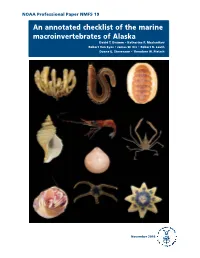
An Annotated Checklist of the Marine Macroinvertebrates of Alaska David T
NOAA Professional Paper NMFS 19 An annotated checklist of the marine macroinvertebrates of Alaska David T. Drumm • Katherine P. Maslenikov Robert Van Syoc • James W. Orr • Robert R. Lauth Duane E. Stevenson • Theodore W. Pietsch November 2016 U.S. Department of Commerce NOAA Professional Penny Pritzker Secretary of Commerce National Oceanic Papers NMFS and Atmospheric Administration Kathryn D. Sullivan Scientific Editor* Administrator Richard Langton National Marine National Marine Fisheries Service Fisheries Service Northeast Fisheries Science Center Maine Field Station Eileen Sobeck 17 Godfrey Drive, Suite 1 Assistant Administrator Orono, Maine 04473 for Fisheries Associate Editor Kathryn Dennis National Marine Fisheries Service Office of Science and Technology Economics and Social Analysis Division 1845 Wasp Blvd., Bldg. 178 Honolulu, Hawaii 96818 Managing Editor Shelley Arenas National Marine Fisheries Service Scientific Publications Office 7600 Sand Point Way NE Seattle, Washington 98115 Editorial Committee Ann C. Matarese National Marine Fisheries Service James W. Orr National Marine Fisheries Service The NOAA Professional Paper NMFS (ISSN 1931-4590) series is pub- lished by the Scientific Publications Of- *Bruce Mundy (PIFSC) was Scientific Editor during the fice, National Marine Fisheries Service, scientific editing and preparation of this report. NOAA, 7600 Sand Point Way NE, Seattle, WA 98115. The Secretary of Commerce has The NOAA Professional Paper NMFS series carries peer-reviewed, lengthy original determined that the publication of research reports, taxonomic keys, species synopses, flora and fauna studies, and data- this series is necessary in the transac- intensive reports on investigations in fishery science, engineering, and economics. tion of the public business required by law of this Department. -

Memoirs of the National Museum of Victoria 31
^MEMOIRS of the NATIONAL I MUSEUM of VICTORIA 18 May 1970 %^ Registered at the G.P.O., Me MEMOIRS of the NATIONAL MUSEUM OF VICTORIA MELBOURNE AUSTRALIA No. 31 Director J. McNally Deputy Director and Editor Edmund D. Gill PUBLISHED BY ORDER OF THE TRUSTEES 18 MAY 1970 NATIONAL MUSEUM OF VICTORIA Trustees Sir Robert Blackwood, MCE BEE FIE Aust (Chairman) Henry G. A. Osborne, BAgrSc (Deputy Chairman) James C. F. Wharton, BSc (Treasurer) Professor E. S. Hills, PhD (Lond) Hon DSc (Dunelm) DSc FIC FAA FRS Professor S. Sunderland, CMG MD BS DSc FRACP FRACS FAA The Hon. Sir Alistair Adam, MA LLM Sir Henry Somerset, CBE MSc FRACI MAIMM W. L. Drew, Secretary to Trustees Staff Director: John McNally, ED MSc Deputy Director: Edmund D. Gill, BA BD FGS FRGS Administration: A. G. Parsons (in charge) D. E. Quinn E. J. Peat G. H. Russell Patricia Rogers Nancie Wortley Gwenda Bloom Scientific Staff Geology and Palaeontology: Curator of Fossils: T. A. Darragh, MSc DipEd Curator of Minerals: A. W. Beasley, MSc PhD DIC Assistant Curator of Fossils: K. N. Bell, BSc DipEd Assistant: R. J. Evans Vertebrate Zoology: BSc (Hons) Curator of Vertebrates : Joan M. Dixon, Curator of Birds: A. R. McEvey, BA Assistant: A. J. Coventry Invertebrate Zoology: Curator of Insects: A. Neboiss, MSc FRES Curator of Invertebrates: B. J. Smith, BSc PhD Assistants: Elizabeth M. Matheson Ryllis J. Plant Anthropology: Curator of Anthropology: A. L. West, BA Dip Soc Stud Assistant: J. A. S. Holman Library: Librarian: Joyce M. Shaw, BA Assistant: Margret A. Stam, DipFDP Display and Preparation Staff: G. -

A New Miocene Deep-Sea Chiton and Early Evidence for Teredinidae-Sustained Wood-Fall Communities
Palaeontologia Electronica palaeo-electronica.org A new Miocene deep-sea chiton and early evidence for Teredinidae-sustained wood-fall communities Luca Bertolaso, Vittorio Garilli, Daniela Parrinello, Maurizio Sosso, and Bruno Dell’Angelo ABSTRACT Deep-sea wood-falls are important biodiversity hot spots for insights on chemo- synthesis-based communities. The study of deep-sea wood-fall-related palaeocommu- nities from the Neogene of north Italy shed light on interesting associations from the Miocene of Torrente Cinghio (Tortonian) and of Moncasale di Casina (Langhian). The most common components of this association are typical chemosynthetic/wood-fall molluscs, such as the gastropods Homalopoma sp. and Pseudonina bellardii, the bivalves Idas sp. and shipworms, and the chiton Leptochiton lignatilis n. sp., which belongs to a genus typical of recent sunken woods in tropical waters. The new species described is compared with other fossil and recent congeners, especially with those sharing the same kind of tegmental sculpture, fully covered with randomly or quincun- cially arranged granules. An overview of the sunken wood-related chitons is provided. Surprisingly no taxa of the boring bivalves of the family Xylophagidae, whose species have been known to be fundamental for sustaining this kind of deep sea chemosyn- thetic ecosystem, were found in the studied site; however, other boring Teredinidae bivalves have been abundantly recovered. This suggests that, conversely to what has previously been observed on sunken wood communities, Teredinidae may be viewed as a counterpart for the maintenance of deep-sea wood-fall ecosystems. Luca Bertolaso. Via Manzotti 35, 42015 Correggio (RE), Italy. bdimit@tin.it Vittorio Garilli (corresponding author).