FY15 302 B THUD Letter
Total Page:16
File Type:pdf, Size:1020Kb
Load more
Recommended publications
-
Have a Happy Halloween!
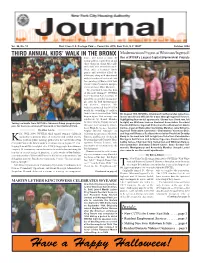
Vol. 34, No. 10 First Class U.S. Postage Paid — Permit No. 4119, New York, N.Y. 10007 October 2004 THIRD ANNUAL KIDS’ WALK IN THE BRONX Modernization Project at Whitman/Ingersoll music, and dance to greet the One of NYCHA’s Largest Capital Improvement Projects young walkers, warm them up and cheer them on along their mile and a half trek around the track. Then, after a healthful lunch, games and activities filled the afternoon, along with educational and informational materials and face painting by Harborview Arts Center Artist-Consultant and pro- fessional clown Mimi Martinez. “Do you want to have this kind of fun next summer?” NYCHA Vice Chairman Earl Andrews, Jr. asked the assembled young peo- ple. After the loud and unsurpris- ing positive response, Mr. Andrews promised that NYCHA would do everything it could to find the funds to make Kids’ Walk On August 13th, NYCHA’s Chairman Tino Hernandez joined res- happen again. That message was idents and elected officials for a tour through Ingersoll Houses, reinforced by Board Member highlighting four model apartments. Shown here (front row, left Young residents from NYCHA’s Summer Camp program pre- JoAnna Aniello, Deputy General to right) are Whitman Houses Resident Association President pare for their one-and-a-half mile walk in Van Cortlandt Park. Manager for Community Opera- Rosalind Williams, Ingersoll Relocation Vice-Chairwoman Gloria tions Hugh B. Spence, Assistant Collins, Ingersoll Relocation Committee Member Janie Williams, By Allan Leicht Deputy General Manager for Ingersoll Relocation Committee Chairwoman Veronica Obie, ids’ Walk 2004, NYCHA’s third annual summer children’s Community Operations Michelle and Ingersoll Houses Resident Association President Dorothy walkathon to promote physical recreation and combat obesity Pinnock, and Director of Citywide Berry. -

S P R I N G 20 18
S P R I N G 2018 URBAN REVIEW LETTER FROM THE EDITORS A magazine of the Hunter College Planning is inherently political; this is something that Hunter students know well. The Introduction Department of to Planning course has many students reading entire books on problem solving and policy analysis, Urban Affairs & Planning as we aspire to not simply write plans from afar but to affect change, using our skills as planners to SPRING ‘18 advocate within the imperfect and at times broken realm of politics. STAFF However, politics is not simply a tool to accomplish goals of planning. Planning itself is a powerful Editors in Chief political tool, one that can be used to accomplish and demonstrate political goals. A zoning change, a Aly Hassell parking limit, or a design for a park are not technical planning decisions but are pronouncements of Atara Lindenbaum priorities, of political goals, and of particular visions of space and community. Our responsibility as future planners is to probe this technical side of planning, determining its larger context. Layout and Design Editor Aly Hassell This issue of Urban Review had the privilege to feature two accomplished and active planners: Com- missioner Mitchell Silver of the NYC Parks Department and Dr. Lester King, Sustainability Planner Writers James Hull in Houston, TX. Both Silver and King emphasize the need for proper community engagement and Beatriz Gil dialogue. Vicky Garvey Ranjana Venkatesh It is time to ask, however, if this focus on process, on stakeholder engagement and communication Atara Lindenbaum suffices. Equitable planning processes may be inherently positive improvements, but our cities, our Andy Lawson Michael Kralovich people, need equitable results as well. -
Land Use, Zoning, and Public Policy A. INTRODUCTION B
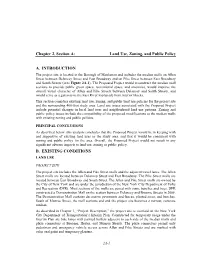
Chapter 2, Section A: Land Use, Zoning, and Public Policy A. INTRODUCTION The project site is located in the Borough of Manhattan and includes the median malls on Allen Street between Delancey Street and East Broadway and on Pike Street between East Broadway and South Streets (sees Figure 2A-1). The Proposed Project would reconstruct the median mall sections to provide public green space, recreational space, and amenities, would improve the overall visual character of Allen and Pike Streets between Delancey and South Streets, and would serve as a gateway to the East River Esplanade from interior blocks. This section considers existing land use, zoning, and public land use policies for the project site and the surrounding 400-foot study area. Land use issues associated with the Proposed Project include potential changes in local land uses and neighborhood land use patterns. Zoning and public policy issues include the compatibility of the proposed modifications to the median malls with existing zoning and public policies. PRINCIPAL CONCLUSIONS As described below, this analysis concludes that the Proposed Project would be in keeping with and supportive of existing land uses in the study area, and that it would be consistent with zoning and public policy for the area. Overall, the Proposed Project would not result in any significant adverse impacts to land use, zoning or public policy. B. EXISTING CONDITIONS LAND USE PROJECT SITE The project site includes the Allen and Pike Street malls and the adjacent travel lanes. The Allen Street malls are located between Delancey Street and East Broadway. The Pike Street malls are located between East Broadway and South Street. -
The Homeless and the Right to Remain in Public Space
RUDIN_PUBLISHERPROOF_3.28.18 .DOCX (DO NOT DELETE) 4/14/18 9:16 PM “YOU CAN’T BE HERE”: THE HOMELESS AND THE RIGHT TO REMAIN IN PUBLIC SPACE DAVID RUDIN∞ ABSTRACT In cities throughout the country, homeless individuals are continuously relocated from place to place and faced with the quandary that by engaging in basic life activities they are breaking the law. Many of these individuals and their legal advocates have argued that laws prohibiting the homeless from sleeping or sitting down in public make it effectively impossible for them to exist, violating the Eighth Amendment ban on cruel and unusual punishments and the right to travel derived from the Fourteenth Amendment. However, the vast majority of courts have rejected these arguments because they do not readily fit into existing doctrines. This article argues that the Supreme Court’s decision in Obergefell v. Hodges provides a mold for homeless individuals and their advocates to recast challenges to anti-homeless ordinances and regularly-issued move-along orders into a more compelling form. In Obergefell, the Supreme Court recognized the right to same- sex marriage by looking at the confluence of several different lines of case law and allowing concerns for equality to guide its substantive due process analysis. This article follows the mode of substantive due process analysis that Obergefell endorsed and focuses on the connections between the right to movement, the Eighth Amendment, Fourth Amendment privacy concerns, the attention to inequality motivating applications of the right to travel, and the Court’s vagueness cases as they relate to vagrancy and public spaces. -
Community Involvement in Redevelopment After the Expiration of Urban Renewal Plans
Renewing Renewal: Community Involvement in Redevelopment After the Expiration of Urban Renewal Plans A Thesis Presented to the Faculty of Architecture, Planning and Preservation COLUMBIA UNIVERSITY In Partial Fulfillment of the Requirements for the Degree Master of Science in Urban Planning by Caroline Thompson May 2020 Abstract Communities impacted by urban renewal in the mid-twentieth century were largely unable to stop the changes brought to their neighborhoods. The plans that operationalized urban renewal remained in place for over 40 years, with significant legislative, legal, and financial effort required to make any alterations. In New York City, many of the urban renewal areas and their governing plans have since expired, ushering in market-driven development and neighborhood changes. This thesis uses a mixed-methods approach to analyze the subsequent built environment changes and to explore community involvement through case studies of redevelopment in the former Seward Park Extension Urban Renewal Area (SPEURA) and Two Bridges Urban Renewal Area (TBURA). While many lots remain unchanged since the urban renewal era, those that have changed reflect local development preferences or the results of major rezonings. The case studies reveal the wide variety of methods of community involvement in site redevelopment, with implications for future participation in redevelopment in the city. Key words: urban renewal, participation, Two Bridges, Essex Crossing, Large-Scale Developments ii Table of Contents List of Figures ....................................................................................................................... -
Creating Community Controlled, Deeply Affordable Housing a RESOURCE TOOLKIT for COMMUNITY ACTIVISTS & ALLIED COMMUNITY-BASED HOUSING DEVELOPERS
Creating Community Controlled, Deeply Affordable Housing A RESOURCE TOOLKIT FOR COMMUNITY ACTIVISTS & ALLIED COMMUNITY-BASED HOUSING DEVELOPERS PARTNERS FOR DIGNITY & RIGHTS Spring 2021 Date Spring 2021 Authors Peter Sabonis Partners for Dignity & Rights Zachary Murray Up South/Down South Community Development Editors Philippa Rizopoulos Ben Palmquist Acknowledgements We would like to thank the community housing developers that provided the data and time that made this report possible. Steve King, Executive Director at Oakland CLT Keith Cooley, Director of Asset Management at SF CLT Rick Lewis, Executive Director at the Bay Area CLT Berkeley Athena Bernkopf, Project Coordinator at East Harlem/ El Barrio CLT Michael Monte, Chief Executive Officer at Champlain Housing Trust Nora Lictash, Executive Director of the Women’s Community Revitalization Project Julius Kimbrough, Executive Director of the Crescent City Community Land Trust Thanks also to the Right to the City Alliance, the New York City Community Land Initiative and the New Economy Project with whom we partnered to host the “Affordable for Whom?” conference in August 2019 that led to this report, and to Jenny Akchin, a former staff member at Picture the Homeless, who envisioned the value of information sharing among CLTs that were reaching levels of deep affordability. This report was made possible by a grant from Oak Foundation. Thank you to Deirdre Reznik, DPI Creative for design and production of this report. Creating Community Controlled, Deeply Affordable Housing Contents 2 -
PDF of CLT Bibliography
International Community Land Trust Bibliography Selected and Compiled by John Emmeus Davis [Most recent update: August 1, 2021] Abrams, Amanda. 2019. Helping at-risk homeowners stay put with a land trust. Shelterforce (April 25). Available online at: https://shelterforce.org/2019/04/25/a-land-trust-model-for-seniors/ ———. 2020. Lessons from the last housing crisis: how to get control of properties. Shelterforce (September 17). Available online at: https://shelterforce.org/2020/09/17/lessons-from-the-last- housing-crisis/ Abromowitz, David M. 1991. An essay on community land trusts: Towards permanently affordable housing. Mississippi Law Journal 61: 663–682. ———. 1992. Long-term affordability, community land trusts and ground leases. ABA Journal of Affordable Housing & Community Development Law 1(2): 5–6, 17. ———. 2000. An essay on community land trusts: Toward permanently affordable housing. In Property and values, ed. Charles Geisler and Gail Daneker, 213–231. Washington, DC: Island Press. ———. 2008. Addressing foreclosures: A great American dream neighborhood stabilization plan. Washington, DC: Center for American Progress. Abromowitz, David, and Roz Greenstein. 2008. A foreclosure-free option. Boston Globe, January 23. Abromowitz, David, and Kirby White. 2006. Deed restrictions and community land trust ground leases: Protecting long term affordable homeownership. Housing News Network, Journal of the Florida Housing Coalition 22 (May): 7–10, 24. Abromowitz, David, and Kirby White. 2010. Deed restrictions and community land trust ground leases: Two Methods of establishing affordable homeownership restrictions. In The community land trust reader, ed. John Emmeus Davis, 327-334. Cambridge, MA: Lincoln Institute of Land Policy. Aernouts, Nele and Michael Ryckewaert. 2017. Beyond housing: on the role of commoning in the establishment of a community land trust project. -

External Stakeholder Input Report: Region 2 Community – New York City, New York
Supplemental Document to the Federal Strategic Plan to Prevent and End Homelessness: June 2010 External Stakeholder Input Report: Region 2 Community – New York City, New York U.S. Interagency Council on Homelessness Federal Strategic Plan to Prevent and End Homelessness External Stakeholder Input Report: Region 2 Community Stakeholder Input March 5, 2010 New York, New York Attending: Daniel Altilio, United Way of Hudson County Kristin Green, Hudson County Division of Housing Manny Alvarado, HUD and Community Development Nereida Andino, Bank of America Tory Gunsolley, Newark Housing Authority Barbara Andrews, HHS Erin Healy, Corporation for Supportive Housing Steven Auerbach, NYRD, ORO, HRSA, HHS Arvernetta Henry, Picture the Homeless Kristin Barlup, Robin Hood Foundation Valentina Holston, Love and Wisdom, Inc George Bates, 820 River Street Inc. Vincent Hom, HUD Sarah Benjamin, Eastern Suffolk BOCES Julie Irwin, Dept. of Veterans Affairs Michael Berg, Family of Woodstock Kathy Jaworski, Ocean County Dept. of Human Doug Berman, Care For the Homeless Services Michelle Billups, HHS/HRSA Selene Kaye, American Civil Liberties Union Lisa Black, New York City Dept of Homeless Services Robert Kelty, Coalition for the Homeless Nicole Branca, Supportive Housing Network of NY Adam Kirkman, CARES, Inc. Mary Brosnahan, Coalition for the Homeless Eduardo Laguerre, NAICA Richard Brown, Monarch Housing Associates Robert Landolfi, Ocean County Dept of Human William Burnett, Picture the Homeless Services Susanne Byrne, York Street Project Herb Levine, -

A Report by the New York City Chapter of the Right to the City Alliance About the Authors: Rttc-Nyc Member Organizations
PEOPLE WITHOUT HOMES & HOMES WITHOUT PEOPLE: A COUNT OF VACANT CONDOS IN SELECT NYC NEIGHBORHOODS A REPORT BY THE NEW YORK CITY CHAPTER OF THE RIGHT TO THE CITY ALLIANCE ABOUT THE AUTHORS: RTTC-NYC MEMBER ORGANIZATIONS CAAAV ORGANIZING ASIAN COMMUNITIES works to build grassroots GOLES is a neighborhood housing and community power across diverse poor and preservation organization that serves the working-class Asian immigrant and refugee Lower East Side (LES) of Manhattan and is NEW YORK CITY AIDS HOUSING communities in NYC. CAAAV led canvassing dedicated to tenants’ rights, homelessness NETWORK (NYCAHN)/VOCAL is a efforts in the Lower East Side. prevention, economic development and membership organization comprised of community revitalization. GOLES supported and led by low-income people living canvassing efforts in the Lower East Side. with HIV/AIDS. NYCAHN led canvassing efforts in the South Bronx. COMMUNITY VOICES HEARD (CVH) organizes low-income people of color in New York City, Yonkers and the Mid-Hudson Valley, focusing on welfare reform, job creation, and public housing. CVH led JEWS FOR RACIAL AND ECONOMIC PICTURE THE HOMELESS (PTH) canvassing efforts in Harlem. JUSTICE (JFREJ) is a membership-based is an organization founded on the principle organization that engages Jews to pursue that people who are homeless must become and win racial and economic justice in an organized, effective voice for systemic partnership with Jewish and allied people change. PTH led canvassing efforts in the of color, low-income, and immigrant com- South Bronx. munities in New York City. JFREJ supported canvassing efforts in the Lower East Side. FABULOUS INDEPENDENT EDUCATED RADICALS FOR COMMUNITY EMPOWERMENT (FIERCE) is a membership-based organiza- TEACHERS UNITE is the only membership tion building the leadership of lesbian, gay, organization of public school educators bisexual, transgender, and queer (LGBTQ) building power to demand that our union youth of color in NYC. -
S E M I N a R I N P L a N N I N G T H E O
S E M I N A R I N P L A N N I N G T H E O R Y Fall semester 2016 Tuesday, 5:00-8:00 pm CRP 391D | WMB 3.116 Instructor: Bjørn Sletto Office: SUT 3.124B Phone: 512-853-0770 Office hours: Wed 2:00-5:00, Thu 2-:00-5:00 -Reading schedule subject to change- Introduction to the course: This course provides an introduction to the principal intellectual traditions and debates in what is loosely termed ‘planning theory.’ We will review the paradigmatic schools of thought that have informed planning scholarship and practice, and attempt to draw connections between currents in social science theory and planning theory. We will consider key questions in planning, such as, Should planning theory primarily be ‘practical’ or should it be ‘critical’? Should planning theorists focus their attention on improving the planning ‘process?’ Or should they instead develop normative visions for the ‘good city?’ But beyond this review of planning theory, we will consider how planning theory informs, and is shaped by, broader intellectual concerns and phenomena associated with the contemporary urban. After all, planning can’t be separated from social context. Theories and practices both inform and are shaped by shifting political economies of the past and present, by a variety of cultural and intellectual traditions, and by multiple imaginaries of the City. In the course we will examine how old and new imaginaries and conceptualizations of the urban articulate with planning theory, and how planning theory in turn informs and is shaped by planning and development practice. -
Zoning Text Amendment (ZR Sections 74-743 and 74-744) 3
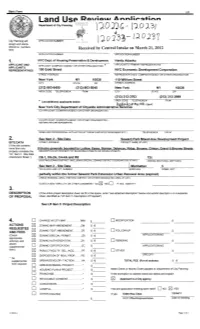
UDAAP PROJECT SUMMARY Site BLOCK LOT ADDRESS Site 1 409 56 236 Broome Street Site 2 352 1 80 Essex Street Site 2 352 28 85 Norfolk Street Site 3 346 40 (p/o) 135-147 Delancey Street Site 4 346 40 (p/o) 153-163 Delancey Street Site 5 346 40 (p/o) 394-406 Grand Street Site 6 347 71 178 Broome Street Site 8 354 1 140 Essex Street Site 9 353 44 116 Delancey Street Site 10 354 12 121 Stanton Street 1. Land Use: Publicly-accessible open space, roads, and community facilities. Residential uses - Sites 1 – 10: up to 1,069,867 zoning floor area (zfa) - 900 units; LSGD (Sites 1 – 6) - 800 units. 50% market rate units. 50% affordable units: 10% middle income (approximately 131-165% AMI), 10% moderate income (approximately 60-130% AMI), 20% low income, 10% senior housing. Sufficient residential square footage will be set aside and reserved for residential use in order to develop 900 units. Commercial development: up to 755,468 zfa. If a fee ownership or leasehold interest in a portion of Site 2 (Block 352, Lots 1 and 28) is reacquired by the City for the purpose of the Essex Street Market, the use of said interest pursuant to a second disposition of that portion of Site 2 will be restricted solely to market uses and ancillary uses such as eating establishments. The disposition of Site 9 (Block 353, Lot 44) will be subject to the express covenant and condition that, until a new facility for the Essex Street Market has been developed and is available for use as a market, Site 9 will continue to be restricted to market uses. -
Resolution by Community Board 3
THE CITY OF NEW YORK MANHATTAN COMMUNITY BOARD 3 59 East 4th Street - New York, NY 10003 Phone (212) 533- 5300 www.cb3manhattan.org - info@cb3manhattan.org Alysha Lewis-Coleman, Board Chair Susan Stetzer, District Manager September 2018 Vote Sheet Executive Committee no vote necessary Land Use, Zoning, Public & Private Housing Committee 1. Approval of previous month's minutes approved by committee 2. Borough President / Councilmember: Presentation on Text Amendment requiring Special Permit to modify Two Bridges LSRD VOTE: TITLE: Support for Council Member Chin and Manhattan Borough President Brewer's Text Amendment requiring a special permit to modify the Two Bridges Large Scale Residential Development (LSRD) WHEREAS, Council Member Margaret Chin and Manhattan Borough President Gale Brewer have filed an amendment to the New York City Zoning Resolution concerning Article VII, Chapter 8 (Special Regulations Applying to Large-Scale Residential Developments); and WHEREAS, the proposed zoning text amendment includes a provision requiring a special permit for modifications to the existing Two Bridges LSRD in Manhattan Community District 3; and WHEREAS, the requirement of a special permit for modifications to the Two Bridges LSRD would ensure that proposed changes to the underlying site planning and zoning controls that govern the LSRD would go through Uniform Land Use Review Procedures (ULURP), and be subject to review by the public, Community Board 3, the Manhattan Borough President, as well as review and approval by the New York City Council;