Rapid Ontogenetic Shift in Juvenile Pacific Bluefin Tuna Diet
Total Page:16
File Type:pdf, Size:1020Kb
Load more
Recommended publications
-

IATTC-94-01 the Tuna Fishery, Stocks, and Ecosystem in the Eastern
INTER-AMERICAN TROPICAL TUNA COMMISSION 94TH MEETING Bilbao, Spain 22-26 July 2019 DOCUMENT IATTC-94-01 REPORT ON THE TUNA FISHERY, STOCKS, AND ECOSYSTEM IN THE EASTERN PACIFIC OCEAN IN 2018 A. The fishery for tunas and billfishes in the eastern Pacific Ocean ....................................................... 3 B. Yellowfin tuna ................................................................................................................................... 50 C. Skipjack tuna ..................................................................................................................................... 58 D. Bigeye tuna ........................................................................................................................................ 64 E. Pacific bluefin tuna ............................................................................................................................ 72 F. Albacore tuna .................................................................................................................................... 76 G. Swordfish ........................................................................................................................................... 82 H. Blue marlin ........................................................................................................................................ 85 I. Striped marlin .................................................................................................................................... 86 J. Sailfish -
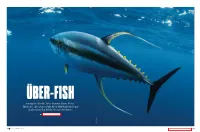
Among the World's Most Popular Game Fishes, Tunas Are Also
ÜBER-FISH Among the World’s Most Popular Game Fishes, Tunas Are Also Some of the Most Highly Evolved and Sophisticated of All the Ocean’s Predators BY DOUG OLANDER DANIEL GOEZ DANIEL 74 DECEMBER 2017 SPORTFISHINGMAG.COM 75 The Family Tree minimizes drag with a very low reduce the turbulence in the Tunas are part of the family drag coefficient,” optimizing effi- water ahead of the tail. Scombridae, which also includes cient swimming both at cruise Unlike most fishes with broad, mackerels, large and small. But and burst. While most fishes bend flexible tails that bend to scoop there are tunas, and then there their bodies side to side when water to move a fish forward, are, well, “true tunas.” moving forward, tunas’ bodies tunas derive tremendous That is, two groups don’t bend. They’re essentially thrust with thin, hard, lunate WHILE MOST FISHES BEND ( sometimes known as “tribes”) rigid, solid torpedoes. ( crescent-moon-shaped) tails dominate the tuna clan. One is And these torpedoes are that beat constantly, capable of THEIR BODIES SIDE TO SIDE Thunnini, which is the group perfectly streamlined, their 10 to 12 or more beats per second. considered true tunas, charac- larger fins fitting perfectly into That relentless thrust accounts WHEN MOVING FORWARD, terized by two separate dorsal grooves so no part of these fins for the unstoppable runs that fins and a relatively thick body. a number of highly specialized protrudes above the body surface. tuna make repeatedly when TUNAS’ BODIES DON’T BEND. The 15 species of Thunnini are features facilitate these They lack the convex eyes of hooked. -
Descriptions of Euthynnus and Auxis Larvae from the Pacific and Atlantic Oceans and Adjacent Seas
library THE GARLSBERG FOUNDATION’S OCEANOGRAPHIGAL EXPEDITION ROUND THE WORLD 1928—30 AND PREVIOUS “DANA”-EXPEDITIONS UNDER THE LEADERSHIP OF THE LATE PROFESSOR JOHANNES SCHMIDT DANA-BEPOBT No. 50. DESCRIPTIONS OF EUTHYNNUS AND AUXIS LARVAE FROM THE PACIFIC AND ATLANTIC OCEANS AND ADJACENT SEAS BY WALTER M. MATSUMOTO U.S. FISH AND WILDLIFE SERVICE WITH 31 FIGURES IN THE TEXT PUBLISHED BY THE CARLSBERG FOUNDATION THIS PAPER MAY BE EEFEEBED TO AS: •DANA-REPOKT No. 50, 1959« COPENHAGEN ANDR. FRED. H0ST A S 0 N PRINTED BY BIANCO LUNO A/S CONTENTS Page Introduction ...................................................................... 3 Descriptions of larvae and postlarvae................. 21 Methods.............................................................................. 4 Auxis type I ......................................................... 21 Genus E uthynnus.............................................................. 5 Auxis type I I ....................................................... 2:i Notes on adults and juveniles ............................. 5 Discussion of species dilTerences........................... 25 Descriptions of larvae and postlarvae................. 7 Geographical distribution of Euthynnus and Auxis Euthynnus tineatus.............................................. 7 larvae............................................................................ 25 Euthynnus alletteratus.......................................... 11 Spawning areas as indicated by larval catches___ 27 Euthynnus ijaito .................................................. -
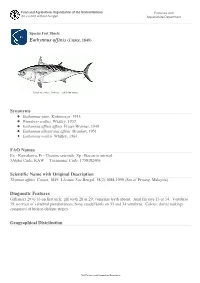
Species Fact Sheets Euthynnus Affinis (Cantor, 1849)
Food and Agriculture Organization of the United Nations Fisheries and for a world without hunger Aquaculture Department Species Fact Sheets Euthynnus affinis (Cantor, 1849) Black and white drawing: (click for more) Synonyms Euthunnus yaito Kishinouye, 1915 Wanderer wallisi Whitley, 1937 Euthunnus affinis affinis Fraser-Brunner, 1949 Euthunnus alletteratus affinis Beaufort, 1951 Euthunnus wallisi Whitley, 1964 FAO Names En - Kawakawa, Fr - Thonine orientale, Sp - Bacoreta oriental. 3Alpha Code: KAW Taxonomic Code: 1750102406 Scientific Name with Original Description Thynnus affinis Cantor, 1849, J.Asiatic Soc.Bengal, 18(2):1088-1090 (Sea of Penang, Malaysia). Diagnostic Features Gillrakers 29 to 33 on first arch; gill teeth 28 or 29; vomerine teeth absent. Anal fin rays 13 or 14. Vertebrae 39; no trace of vertebral protuberances; bony caudal keels on 33 and 34 vertebrae. Colour: dorsal makings composed of broken oblique stripes. Geographical Distribution FAO Fisheries and Aquaculture Department Launch the Aquatic Species Distribution map viewer Throughout the warm waters of the Indo-West Pacific, including oceanic islands and archipelagos.A few stray specimens have been collected in the eastern tropical Pacific. Habitat and Biology An epipelagic, neritic speciesinhabiting waters temperatures ranging from 18 to 29° C. Like other scombrids, E. affinis tend to form multispecies schools by size, 'i.e. with small Thunnus albacares, Katsuwonus pelamis, Auxis sp., and Megalaspis cordyla (a carangid), comprising from 100 to over 5 000 individuals. Although sexually mature fish may be encountered throughout the year, there are seasonal spawning peaks varying according to regions: i.e. March to May in Philippine waters; during the period of the NW monsoon (October-November to April-May) around the Seychelles; from the middle of the NW monsoon period to the beginning of the SE monsoon (January to July) off East Africa; and probably from August to October off Indonesia. -

SYNOPSIS on the BIOLOGY of YELLOWFIN TUNA Thunnus (Neothunnus) Albacares (Bonnaterre)1788(PACIFIC OCEAN)
Species Synopsis No. 16 FAO Fisheries Biology Synopsis No, 59 FIb/S59 (Distribution restricted) SAST - Tuna SYNOPSIS ON THE BIOLOGY OF YELLOWFIN TUNA Thunnus (Neothunnus) albacares (Bonnaterre)1788(PACIFIC OCEAN) Exposé synoptique sur la biologie du thon à nageoires jaunes Thunnus (Neothimnus) albacares (Bonnaterre)1788(Océan Pacifique) Sinopsis sobre la. biología dei atítn de aleta amarilla Thunnus (Neothunnus) aibacares (Bonnaterre) 1788 (Ocano Pacífico) Prepared by MILNER B, SCHAEFER, GORDON C,, BROADHEAD and CRAIG J, ORANGE Inter -American Tropical Tuna Commission La Jolla, California, U, S,, A, ISHERIES DIVISION, BIOLOGY BRANCH tOOD AND AGRICULTURE ORGANIZATION OF THE UNITED NATIONS R,ome, 1963 538 FIb/S59 Tuna 1:1 i IDENTITY Body plump, wholly covered with scales, which differ in size and form in different parts i. iTaxonomy of the body.Corselet well deveioped but its boundary is not distinct.Tle lateral line has a 1. 1. 1Definition peculiar curve above the pectorals.Teeth rather feeble.Single series of small conical /Fo11owing Berg (1940) modified according to teeth in both jaws.They are sharp and curve Fraser-Brunner (1950)J inward.Villiform teeth on the vomers palatines and pterygoids.Many dentigerous calcareous Phylum VERTEBRATA plates are found on the palate.The denticles on Subphylum Craniata these plates are quite similar to those found on Superclass Gnathostomata the vomer, palatines and pterygoids. Thus the Series Pisces roof of the mouth-cavity is quite rough, contrary Class Teleostomi to the nearly smooth roof in the Katsuwonidae. Subclass Actinopterygii Three lobes of the liver subequal.Intestine Order Perciformes rather long, with three folds.Pyloric tubes Suborder Scombroidei developed only on the posterior convex side of Family Scombridae the duodenum. -
Fish Forensics: Two Strategies for Fish Identification
430 Nahant Rd., Nahant, MA, USA 01908 | 781-581-7370 ext. 343 | oglinfo@neu.edu | www.northeastern.edu/ogl Fish Forensics: two strategies for fish identification Purpose: The purpose of this activity is to learn about two different strategies for identifying fish. One is using a dichotomous key based on physical characteristics and the second is DNA barcoding. We typically present this activity as a 10- to 15-minute exercise, but it can be easily modified to discuss the process of DNA barcoding more in depth, or to even perform these laboratory protocols. Please feel free to reach out to Ocean Genome Legacy if you have any questions or would like guidance about completing any protocols in a laboratory. Part 1: Why is it important to be identify fish? 1. Have each student, or pair of students, chose a fish. We often have students pretend they are ‘fishing’ when they select their fish. a. Fish images are in the “Fish” folder. 2. Discuss why it is important to know the identity of this fish. a. fisheries management b. food safety c. conservation d. others? Part 2: Learning to use a dichotomous key 1. One way to identify an organism is to use morphological features. Using the flow chart, answer each of the questions based on the image with which the student is working. a. Flow chart is DichotomousKeyFlow_10.11.17.pptx in the “Dichotomous Key” folder. b. The key is alternately displayed as a traditional dichotomous key with a series of questions. It can be found in the same folder. -
8.2 the Significance of Ocean Deoxygenation for Open Ocean Tunas and Billfishes Shirley Leung,K
8.2 The significance of ocean deoxygenation for open ocean tunas and billfishes Shirley Leung,K. A. S. Mislan, Barbara Muhling and Richard Brill 8.2 The significance of ocean deoxygenation for open ocean tunas and billfishes Shirley Leung1,*, K. A. S. Mislan1,2, Barbara Muhling3,4 and Richard Brill5 1 School of Oceanography, University of Washington, USA. Email : shirlleu@uw.edu 2 eScience Institute, University of Washington, USA 3 University of California Santa Cruz, Santa Cruz, CA, USA 4 National Oceanic and Atmospheric Administration, National Marine Fisheries Service, Southwest Fisheries Science Center, La Jolla, CA, USA 5 Virginia Institute of Marine Science, Gloucester Point, VA, USA Summary • Tunas and billfishes should be especially sensitive to low ambient oxygen conditions given their high metabolic rates as well as the large differences between their resting and maximum metabolic rates. Although there are many behavioural similarities among the different species, there are also clear and demonstrable differences in growth rates, maximum adult size, physiological abilities, low-oxygen tolerances, and preferred environmental conditions. • Climate change is projected to alter oxygen concentrations throughout the open ocean, with most regions undergoing decreases due to a slowdown in ocean ventilation and a decline in surface oxygen solubility. Between 200 and 700 m depth (a vertical range including depths to which tunas and billfishes commonly descend to forage), the greatest and most certain decreases in oxygen concentrations are projected to occur in the North Pacific and much of the Southern Ocean, while the smallest and least certain changes are projected to occur within the tropical Pacific Ocean. -
SAC-10-03 EN the Tuna Fishery in the EPO in 2018
INTER-AMERICAN TROPICAL TUNA COMMISSION SCIENTIFIC ADVISORY COMMITTEE 11TH MEETING San Diego, California (USA) 11-15 May 20201 DOCUMENT SAC-11-03 THE TUNA FISHERY IN THE EASTERN PACIFIC OCEAN IN 2019 INTRODUCTION .............................................................................................................................................. 3 1. Catches and landings of tunas, billfishes, and associated species ...................................................... 3 2. Catches by species .............................................................................................................................. 4 3. Catches and fishing effort ................................................................................................................... 6 4. Distributions of the catches of tropical tunas ..................................................................................... 7 5. Size compositions of the catches of tunas .......................................................................................... 8 6. The fleets ............................................................................................................................................. 9 This report provides a summary of the catches and effort in 2019 of the fishery for tunas in the eastern Pacific Ocean (EPO), for whose management the Inter-American Tropical Tuna Commission (IATTC) is responsible. It is based on data available to the IATTC staff in March 2020; therefore, some of the data for 2019 are incomplete, and all data -

SAC-10-03 EN the Tuna Fishery in the EPO in 2018
SCIENTIFIC COMMITTEE SIXTEENTH REGULAR SESSION ELECTRONIC MEETING 11-20 August 2020 The Tuna Fishery in the Eastern Pacific Ocean in 2019 WCPFC-SC16-2020/GN-IP-02 IATTC1 1 Inter-American Tropical Tuna Commission INTER-AMERICAN TROPICAL TUNA COMMISSION SCIENTIFIC ADVISORY COMMITTEE 11TH MEETING La Jolla, California (USA) 11-15 May 20201 DOCUMENT SAC-11-03 THE TUNA FISHERY IN THE EASTERN PACIFIC OCEAN IN 2019 INTRODUCTION .............................................................................................................................................. 3 1. Catches and landings of tunas, billfishes, and associated species ...................................................... 3 2. Catches by species .............................................................................................................................. 4 3. Catches and fishing effort ................................................................................................................... 6 4. Distributions of the catches of tropical tunas ..................................................................................... 7 5. Size compositions of the catches of tunas .......................................................................................... 8 6. The fleets ............................................................................................................................................. 9 This report provides a summary of the catches and effort in 2019 of the fishery for tunas in the eastern Pacific Ocean (EPO), for whose -

FAO Fisheries & Aquaculture
Food and Agriculture Organization of the United Nations Fisheries and for a world without hunger Aquaculture Department Biological characteristics of tuna Tuna and tuna-like species are very important economically and a significant Related topics source of food, with the so-called principal market tuna species - skipjack, yellowfin, bigeye, albacore, Atlantic bluefin, Pacific bluefin (those two species Tuna resources previously considered belonging to the same species referred as northern bluefin) Tuna fisheries and and southern bluefin tuna - being the most significant in terms of catch weight and utilization trade. These pages are a collection of Fact Sheets providing detailed information on tuna and tuna-like species. Related information FAO FishFinder Aquatic Species - fact Table of Contents sheets Taxonomy and classification Related activities Morphological characteristics FAO activities on tuna Geographical distribution Habitat and biology Trophic relations and growth Reproduction Bibliography Taxonomy and classification [ Family: Scombridae ] : Scombrids [ Family: Istiophoridae Family: Xiphiidae ] : Billfishes Upper systematics of tunas and tuna-like species Scombrids and billfishes belong to the suborder of the Scombroidei which position is shown below: Phylum : Chordata └─ Subphylum Vertebrata └─ Superclass Gnathostomata └─ Class Osteichthyes └─ Subclass Actinopterygii └─ Infraclass Teleostei └─ Superorder Acanthopterygii └─ Order Perciformes ├─ Suborder Scombroidei | └─ Family Scombridae └─ Suborder Xiphioidei FAO Fisheries -

Trophic Relationships Between Predators Caught
TROPHICTROPHIC RELATIONSHIPSRELATIONSHIPS BETWEENBETWEEN PREDATORSPREDATORS CAUGHTCAUGHT BYBY TUNATUNA PURSEPURSE--SEINERSSEINERS ININ THETHE EASTERNEASTERN PACIFICPACIFIC OCEANOCEAN DR. FELIPE GALVAN- MAGAÑA CENTRO INTERDISCIPLINARIO DE CIENCIAS MARINAS. LA PAZ, BAJA CALIFORNIA SUR, MEXICO DR. ROBERT J. OLSON INTERAMERICAN TROPICAL TUNA COMMISSION LA JOLLA CALIFORNIA 30 25 Area A 20 15 Area C 10 5 Area B 0 Area D -5 LATITUDE (DEG.) -10 Area F Dolphin Sets -15 School Sets Area E Floating Object Sets -20 -140 -130 -120 -110 -100 -90 -80 LONGITUDE (DEG.) Table I. Stomachs sampled from predators in the bycatch of tuna purse-seiners in the Eastern Pacific Ocean during 1992 – 1994. Samples Predator Number Stenella attenuata Spotted dolphin 311 Stenella longirostris Spinner dolphin 209 Delphinus delphis Common dolphin 51 Stenella coeruleoalba Striped dolphin 5 Thunnus albacares Yellowfin tuna 4831 Katsuwonus pelamis Skipjack 1205 Thunnus obesus Bigeye Tuna 80 Euthynnus lineatus Black skipjack 100 Auxis spp. Bullets 55 Carcharhinus limbatus Black tip shark 262 Carcharhinus falciformis Silky shark 64 Carcharhinus Whitetip shark 30 longimanus Carcharhinus leucas Bull shark 2 Carcharhinus spp. Carcharhinid sharks 82 Sphyrna spp. Hammerhead sharks 48 Isurus oxyrinchus Mako shark 4 Prionace glauca Blue shark 2 Alopias spp. Thresher shark 12 Nasolamia velox White nose shark 2 Makaira indica Black marlin 25 Makaira mazara Blue marlin 15 Makaira spp. Marlins unidentified 18 Tetrapturus audax Striped marlin 8 Istiophorus platypterus Sailfish 49 Coryphaena hippurus Mahi-mahi 545 Acanthocybium solandri Wahoo 235 Elagatis bippinulata Rainbow-runner 48 Total 8298 50% Predator and prey in dolphins sets 40% 30% 20% Weight percentage 10% 0% Epi Cephalopods Meso Cephalopods Crustacea Misc.Fishes Mesopelagic Fishes Myctophidae Phosichthyidae Gempylidae Carangidae Coryphaenidae Exocoetidae Nomeidae Tetraodontiformes Wahoo Black Skipjack Big Eye Skipjack Sharks 36 (31) 14,157g Yellowfin Billfishes 9 (2) 1,615g Other species 4 (3) 418g Auxis spp. -

The Italian Annotated Bibliography on Albacore (Thunnus Alalunga, Bonnaterre, 1788)
SCRS/2019/156 Collect. Vol. Sci. Pap. ICCAT, 76(8): 7-39 (2020) THE ITALIAN ANNOTATED BIBLIOGRAPHY ON ALBACORE (THUNNUS ALALUNGA, BONNATERRE, 1788) F. Garibaldi1, P. Addis2, A. Di Natale3, C. Piccinetti4, F. Tinti5 SUMMARY The Italian scientists have a long tradition of studies and research on albacore (Thunnus alalunga). This species is one of the most important for the Italian fishery since many centuries, even if it was often neglected. This is the first attempt to list together the many papers published so far by Italian scientists, concerning the biology of this species, the fisheries and many other scientific and cultural issues. The aim of this paper is to provide a sort of annotated bibliography, with specific key words, even if it is surely incomplete, because of the many papers published over the years. So far, we found 164 papers on albacore. This updated bibliography was set together to serve the scientists and to help them in finding some rare references that might be useful for their work. RÉSUMÉ Les scientifiques italiens ont une longue tradition d'études et de recherches sur le germon (Thunnus alalunga). Cette espèce est l'une des plus importantes pour la pêche italienne depuis de nombreux siècles, même si elle a été souvent négligée. Il s'agit de la première tentative de répertorier les nombreux articles publiés à ce jour par des scientifiques italiens concernant la biologie de cette espèce, les pêcheries et de nombreuses autres questions scientifiques et culturelles. Le but de ce document est de fournir une sorte de bibliographie annotée, avec des mots clés spécifiques, même si elle est sûrement incomplète, en raison des nombreux articles publiés au cours des années.