Growing Seeds from Your Kitchen Herb & Spice Rack
Total Page:16
File Type:pdf, Size:1020Kb
Load more
Recommended publications
-
Did You Grow Your Greens?
Did you Grow your Greens? A Share-Net Resource Book Reading-to-learn curriculum materials to support Language, Natural Sciences, Social Sciences, Life Orientation and Arts & Culture learning areas Acknowledgments The Handprint resource books have been compiled by Rob O’Donoghue and Helen Fox of the Rhodes University Environmental Education and Sustainability Unit. Lawrence Sisitka was responsible for coordination and review, and Kim Ward for editorial review and production for curriculum and Eco-School use. Development funding was provided by CAPE. Cover illustrations are by Tammy Griffin. Knowledge and activity support materials have been adapted from various sources including the Internet, and web addresses have been provided for readers to access any copyright materials directly. Available from Share-Net P O Box 394, Howick, 3290, South Africa Tel (033) 3303931 sharenet@wessa.co.za January 2009 ISBN 978-1-919991-05-4 Any part of this resource book may be reproduced copyright free, provided that if the materials are produced in booklet or published form, there is acknowledgment of Share-Net. 1 RESOURCE BOOKS The Handprint Resource Books have been designed for creative educators who are looking for practical ideas to work with in the learning areas of the National Curriculum. The focus is on sustainability practices that can be taken up within the perspective that each learning area brings to environment and sustainability concerns. The resource books are intended to provide teachers with authentic start-up materials for change-orientated learning. The aim is to work towards re-imagining more sustainable livelihood practices in a warming world. Each start-up story was developed as a reading- to-learn account of environmental learning and change. -
A Botanical Nano Ozonated Erotic Oil Composition with Maximum Bioavailability for Men
MOJ Bioequivalence & Bioavailability Review Article Open Access A botanical nano ozonated erotic oil composition with maximum bioavailability for men Abstract Volume 5 Issue 1 - 2018 The present patent–pending invention relates to a topical pharmaceutical nano Awad Mansour,1 Ammar Mansour2 ozonated composition(with maximum bioavailability) for male sexual response, 1University of Akron, USA including male sexual dysfunction, such as male sexual arousal, vitality, erection 2Essraa Hospital, Jordan disorders, premature ejaculation, and sexual pain disorders, and enhancing male sexual pleasure and satisfaction of the male sexual experience as well as penis enlargement. Correspondence: Awad Mansour, University of Akron, OH, The composition for treating this problem preferably formed of a natural oil mix, USA, Tel 9622–7278278, Email profmansour@gmail.com fenugreek oil, watermelon oil, ginger oil and ozonated olive oil. In particular the composition is applied on penis and testicles to enhance pleasure and delay ejaculation Received: November 25, 2017 | Published: February 07, 2018 for men during intercourse. Observed results showed excellent results for all ages of men with no adverse or side effects. Abbreviations: ED, erection dysfunction; PE, premature vasodilation, smooth muscle relaxation, etc. Australian researchers at the University of Queensland1 working with colleagues at Applied ejaculation; ASN, applied science and nutrition Science and Nutrition (ASN), a Brisbane–based company that Description of the invention specializes in scientific -

Tips for Cooking with Coriander / Cilantro Russian Green Bean Salad
Recipes Tips for Cooking with Coriander / Cilantro • Gently heat seeds in a dry pan until fragrant before crushing or grinding to enhance the flavor. • Crush seeds using a mortar and pestle or grind seeds in a spice mill or coffee grinder. • Seeds are used whole in pickling recipes. • Cilantro is best used fresh as it loses flavor when dried. • Clean cilantro bunches by swishing the leaves in water and patting dry. • For the best color, flavor and texture, add cilantro leaves towards the end of the cooking time. • The stems have flavor too, so tender stems may be chopped and added along with the leaves. • Store cilantro stem in a glass of water in the refrigerator, with a loose plastic bag over the top. Russian Green Bean Salad with Garlic, Walnuts, Basil, Cilantro and Coriander Seed ½ cup broken walnuts ¼ cup firmly packed basil leaves 2 large cloves garlic, peeled and each cut into ¼ cup firmly packed cilantro leaves and several pieces tender stems 4 Tbsp extra-virgin olive oil 1 pound fresh green beans, stems removed 2 Tbsp white wine vinegar and steamed until crisp – tender and cooled 1 Tbsp lemon juice in ice water 1 Tbsp water ½ cup thinly sliced green onions 1 tsp ground coriander seed ½ cup thinly sliced radishes ⅛ to ¼ tsp hot pepper sauce such as Tabasco Salt and freshly ground pepper to taste 2 Tbsp firmly packed parsley leaves and tender stems To prepare dressing, place walnuts and garlic in food processor fitted with knife blade; chop, using pulse control, until evenly fine. Add olive oil, vinegar, lemon juice, water, coriander seed and hot pepper sauce; process until smooth. -

Antioxidant and Antibacterial Properties of Endogenous Phenolic Compounds from Commercial Mustard Products
Antioxidant and antibacterial properties of endogenous phenolic compounds from commercial mustard products By Ronak Fahmi A thesis submitted to the Faculty of Graduate Studies of The University of Manitoba In partial fulfillment of the requirements of the degree of MASTER OF SCIENCE Department of Human Nutritional Sciences University of Manitoba Winnipeg, Canada Copyright © 2016 by Ronak Fahmi Abstract This study investigated the antioxidant and antimicrobial properties of endogenous phenolic compounds in Oriental (Brassica junceae) and yellow (Sinapis alba) mustard seeds. Phenolics in selected Canadian mustard products (seeds/ powder/ flour) were extracted using Accelerated Solvent Extraction (ASE) and their corresponding sinapate profiles were established through HPLC-DAD analysis. The antioxidant capacity of each extract was assessed by DPPH assay and correlated with the total phenolic content (TPC) measured using the Folin–Ciocalteau method. Sinapine was the major phenolic compound in all the samples analysed, with negligible amounts of sinapic acid. The sinapine content, expressed as sinapic acid equivalents (SAE), ranged from 5.36 × 10³ ± 0.66 to 14.44 ± 0.43 × 10³ µg SAE/g dry weight of the samples, with the highest in the yellow mustard seed extract and lowest in Oriental mustard powder. The level decreased in the following order: yellow mustard seed > Oriental mustard seed > yellow mustard bran > Oriental mustard bran > yellow mustard powder > Oriental mustard powder. Extracts from yellow mustard seeds had the highest TPC (17.61× 10³ ± 1.01 µg SAE/g), while Oriental mustard powder showed the lowest TPC with 4.14 × 10³ ± 0.92 µg SAE/g. The DPPH radical scavenging activity of mustard methanolic extracts ranged between 36% and 69%, with the following order for both varieties: ground mustard seed > mustard bran > mustard powder. -

Effect of Various Levels of Humic Acid and Organic Fertilizer on the Growth
7 Current Science International, 3(1): 7-14, 2014 ISSN: 2077-4435 Effect of Various Levels of Organic Fertilizer and Humic Acid on the Growth and Roots Quality of Turnip Plants (Brassica rapa). Aisha, H. Ali, M.R. Shafeek, Mahmoud, R. Asmaa and M. El- Desuki Vegetable Research Department National Research Center Cairo, Egypt. ABSTRACT Two field experiments were carried out during the two seasons of 2011 and 2012 at the experimental station of National Research Centre, Beheira Governorate (North of Egypt) to investigate the effect of organic compost manure fertilizer at rates of (0, 10 and 20 m3/fed.) as well as humic acid at rate of (2, 4 and 6 L/fed.) for influence plant growth, roots physical and chemical quality of turnip plants c.v. Balady. The important obtained results were as following: 1- Adding organic compost manure (produced from recycling the agriculture residues) at high rates (20 m3/fed.) had a significant effect on growth characters, i.e. plant length, number of leaves/plant, fresh and dry weight/plant as well as root fresh and dry weight and its components (root length and diameter). Also, gave the highest percentage of protein, N, P, K and Fe ppm as well as total carbohydrate percentage. 2- By increasing rate of humic acid increased growth characters, root yield characters and increment the percentage of protein, N, P, K, carbohydrate and Fe contents of turnip root tissues. 3- The highest values of the growth characters, roots characters and the percentage of protein, N, P, K, carbohydrate and Fe content ppm in turnip root tissues were associated with that plants received higher compost level (20 m3/fed.) with higher level of humic acid (6 L/fed.). -
CHEF's TASTING MENU* Can't Decide What to Or- Der? Let the Chef
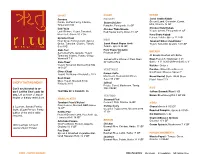
CHAAT CURRY KEBAB Samosa POULTRY Lamb Seekh Kebab* Ground Lamb, Coriander, Cumin, Potato, Stuffed Pastry, Cilantro, Butter Chicken* Mint, Cilantro 13 GF Tamarind 9 VG Pumpkin, Fenugreek, 15 GF Chicken Malai Kebab Dahi Vada Chicken Tikka Masala Yogurt, Cream, Fenugreek 12 GF Lentil Fritters, Yogurt, Tamarind, Red Pepper Curry, Onion 15 GF Black Salt, Cumin 10 V GF Hara Bhara Kebab Sprouts Chaat Paneer, Potato, Spices 12 V GF MEAT Flour Crisp, Pomegranate, Sprout, Tandoori Whole Cauliflower * Onion, Tamarind, Cilantro, Tomato, Lamb Shank Rogan Josh* Yogurt, Tamarind, Cilantro 14 V GF Sev 9VG Tomato, Spices 24 GF Dahi Puri* Pork Shank Vindaloo BREADS Semolina Puffs, Sprouts, Yogurt, Potatoes 24 GF All Breads Brushed with Butter Tamarind, Cilantro, Potato, Crispy Vermicelli 7 V Served with a Choice of Plain Naan Naan Plain 3.5 I Multigrain 4 V | Kale Chaat* Or Saffron Rice Garlic - 4 V I Chili Cheese Garlic 5 V Yogurt, Tamarind, Mumbai Trail Mix Kulcha - Onion 5 10 V GF VEGETABLE Paratha - Wheat Flour,Broccoli, Citrus Chaat Cauliflower, Cheese, Spices 7 Yogurt, Dry Mango Vinaigrette, 10 V Paneer Kofta Mushroom, Cashew Nut Onion Bread Basket Garlic I Multi Grain Beet Chaat Sauce16 V GF Plain I Naan 11 V Okra, Yogurt, Mustard Seed, CHEF’S TASTING MENU* Pistachio 10 V Jalfrezi Potato, Carrot, Mushroom, Turnip, Can’t decide what to or- Chili VG GF RICE der? Let the Chef cook for TASTING OF 3 CHAATS 15 Saffron Basmati Rice 5 VG you. Let us know of any al- SEAFOOD Brown Rice Moong Dal 5 GF VG lergies or dietary restrictions. -

Fragrant Herbs for Your Garden
6137 Pleasants Valley Road Vacaville, CA 95688 Phone (707) 451-9406 HYPERLINK "http://www.morningsunherbfarm.com" www.morningsunherbfarm.com HYPERLINK "mailto:roseloveall@morningsunherbfarm.com" roseloveall@morningsunherbfarm.com Fragrant Herbs For Your Garden Ocimum basilicum – Sweet, or Genovese basil; classic summer growing annual Ocimum ‘Pesto Perpetuo’ – variegated non-blooming basil! Ocimum ‘African Blue’ - sterile Rosmarinus officinalis ‘Blue Spires’ – upright grower, with large leaves, beautiful for standards Salvia officinalis ‘Berggarten’ – sun; classic culinary, with large gray leaves, very decorative Thymus vulgaris ‘English Wedgewood’ – sturdy culinary, easy to grow in ground or containers Artemesia dracunculus var sativa – French tarragon; herbaceous perennial. Absolutely needs great drainage! Origanum vulgare – Italian oregano, popular oregano flavor, evergreen; Greek oregano - strong flavor Mentha spicata ‘Kentucky Colonel’ – one of many, including ginger mint and orange mint Cymbopogon citratus – Lemon grass, great for cooking, and for dogs Aloysia triphylla – Lemon verbena ; Aloysia virgata – Sweet Almond Verbena – almond scented! Polygonum odoratum – Vietnamese coriander, a great perennial substitute for cilantro Agastache foeniculum ‘Blue Fortune’ – Anise hyssop, great for teas, honebee plant Agastache ‘Coronado’; A. Grape Nectar’ – both are 18 inches, delicious for tea, edible flr Agastache ‘Summer Breeze’ – large growing, full sun, bicolored pink and coral flowers Prostanthera rotundifolium – Australian Mint Bush. -
Show Activity
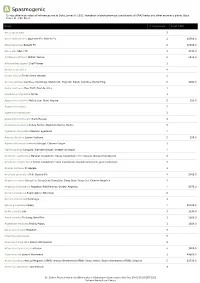
A Spasmogenic *Unless otherwise noted all references are to Duke, James A. 1992. Handbook of phytochemical constituents of GRAS herbs and other economic plants. Boca Raton, FL. CRC Press. Plant # Chemicals Total PPM Abies spectabilis 3 Abies sachalinensis Japanese Fir; Shin-Yo-Yu 2 14760.0 Abies balsamea Balsam Fir 2 12000.0 Abies alba Silver-Fir 3 3736.0 Achillea millefolium Milfoil; Yarrow 5 8530.0 Achyranthes aspera Chaff Flower 1 Acinos suaveolens 4 Acinos alpinus Te de Sierra Nevada 4 Acorus calamus Calamus; Sweetflag; Sweetroot; Flagroot; Sweet Calamus; Myrtle Flag 5 1980.0 Aegle marmelos Bael fruit; Bael de India 1 Aeolanthus myriantha Ninde 1 Agastache urticifolia Nettle-Leaf Giant Hyssop 2 156.0 Agastache rugosa 2 Agastache nepetoides 3 Agastache foeniculum Giant Hyssop 3 Agathosma betulina Honey Buchu; Mountain Buchu; Buchu 3 Ageratum conyzoides Mexican ageratum 4 Aloysia citrodora Lemon Verbena 5 924.0 Alpinia officinarum Lesser Galangal; Chinese Ginger 3 Alpinia galanga Languas; Siamese Ginger; Greater Galangal 4 Amomum xanthioides Malabar Cardamom; Tavoy Cardamom; Chin Kousha; Bastard Cardamom 2 Amomum compactum Chester Cardamom; Siam Cardamom; Round Cardamom; Java Cardamom 3 Ananas comosus Pineapple 1 Anethum graveolens Dill; Garden Dill 4 2002.0 Angelica sinensis Dang Gui; Dong Quai; Dang Qui; Dang Quai; Dong Gui; Chinese Angelica 1 Angelica archangelica Angelica; Wild Parsnip; Garden Angelica 4 8073.0 Annona squamosa Sugar-Apple; Sweetsop 2 Annona cherimola Cherimoya 1 Apium graveolens Celery 4 30100.0 Aralia cordata Udo 3 1030.0 Areca catechu Pin-Lang; Betel Nut 1 2000.0 Argemone mexicana Prickly Poppy 1 1680.0 Artemisia vulgaris Mugwort 3 Artemisia salsoloides 5 Artemisia herba-alba Desert Wormwood 3 Artemisia dracunculus Tarragon 4 3000.0 Artemisia cina Levant Wormseed 1 48000.0 Artemisia annua Annual Mugwort (GRIN); Annual Wormwood (GRIN); Sweet Annie; Sweet Wormwood (GRIN); Qinghao 5 20720.0 Artemisia absinthium Wormwood 3 Dr. -
Effects of Fenugreek Seed on the Severity and Systemic Symptoms of Dysmenorrhea
Original Article Effects of Fenugreek Seed on the Severity and Systemic Symptoms of Dysmenorrhea Sima Younesy 1, Sedigheh Amiraliakbari 1*, Somayeh Esmaeili 2,3, Hamid Alavimajd 4, Soheila Nouraei 1 1- Department of Midwifery, School of Nursing and Midwifery, Shahid Beheshti University of Medical Sciences, Tehran, Iran 2- Department of Traditional Pharmacy, School of Traditional Medicine, Shahid Beheshti University of Medical Sciences, Tehran, Iran 3- Traditional Medicine and Materia Medica Research Center, Shahid Beheshti University of Medical Sciences, Tehran, Iran 4- Department of Biostatistics, Faculty of Paramedicine, Shahid Beheshti University of Medical Sciences, Tehran, Iran Abstract Background: Primary dysmenorrhea is a prevalent disorder and its unfavorable ef- fects deteriorates the quality of life in many people across the world. Based on some evidence on the characteristics of fenugreek as a medical plant with anti-inflammato- ry and analgesic properties, this double-blind, randomized, placebo controlled trial was conducted. The main purpose of the study was to evaluate the effects of fenu- greek seeds on the severity of primary dysmenorrhea among students. Methods: Unmarried Students were randomly assigned to two groups who received fenugreek (n=51) or placebo (n=50). For the first 3 days of menstruation, 2−3 cap- sules containing fenugreek seed powder (900 mg) were given to the subjects three times daily for two consecutive menstrual cycles. Pain severity was evaluated using a visual analog scale and systemic symptoms were assessed using a multidimension- al verbal scale. * Corresponding Author: Sedigheh Amiraliakbari, Results: Pain severity at baseline did not differ significantly between the two Department of Midwifery, groups. Pain severity was significantly reduced in both groups after the intervention; School of Nursing and however, the fenugreek group experienced significantly larger pain reduction Midwifery, Shahid (p<0.001). -

Conserving Europe's Threatened Plants
Conserving Europe’s threatened plants Progress towards Target 8 of the Global Strategy for Plant Conservation Conserving Europe’s threatened plants Progress towards Target 8 of the Global Strategy for Plant Conservation By Suzanne Sharrock and Meirion Jones May 2009 Recommended citation: Sharrock, S. and Jones, M., 2009. Conserving Europe’s threatened plants: Progress towards Target 8 of the Global Strategy for Plant Conservation Botanic Gardens Conservation International, Richmond, UK ISBN 978-1-905164-30-1 Published by Botanic Gardens Conservation International Descanso House, 199 Kew Road, Richmond, Surrey, TW9 3BW, UK Design: John Morgan, studio@seascapedesign.fsnet.co.uk Acknowledgements The work of establishing a consolidated list of threatened Photo credits European plants was first initiated by Hugh Synge who developed the original database on which this report is based. All images are credited to BGCI with the exceptions of: We are most grateful to Hugh for providing this database to page 5, Nikos Krigas; page 8. Christophe Libert; page 10, BGCI and advising on further development of the list. The Pawel Kos; page 12 (upper), Nikos Krigas; page 14: James exacting task of inputting data from national Red Lists was Hitchmough; page 16 (lower), Jože Bavcon; page 17 (upper), carried out by Chris Cockel and without his dedicated work, the Nkos Krigas; page 20 (upper), Anca Sarbu; page 21, Nikos list would not have been completed. Thank you for your efforts Krigas; page 22 (upper) Simon Williams; page 22 (lower), RBG Chris. We are grateful to all the members of the European Kew; page 23 (upper), Jo Packet; page 23 (lower), Sandrine Botanic Gardens Consortium and other colleagues from Europe Godefroid; page 24 (upper) Jože Bavcon; page 24 (lower), Frank who provided essential advice, guidance and supplementary Scumacher; page 25 (upper) Michael Burkart; page 25, (lower) information on the species included in the database. -

Pastured Pork Heritage Breeds: Berkshire, Hampshire, Yorkshire, Duroc, & Old Gloucestershire Spots Vacuum Sealed Packaging All of These Cuts Are in Limited Supply
Pastured Pork Heritage Breeds: Berkshire, Hampshire, Yorkshire, Duroc, & Old Gloucestershire Spots Vacuum Sealed Packaging All of these cuts are in Limited Supply Our pigs are raised in our woods and pastures. They eat acorns, walnuts, hickory nuts, wild berries, and a natural combination diet including pasture grazing and rooting. We include organically sourced kale, alfalfa, corn, oats, wheat grass, and barley in their diet for additional nutrition. We give our animals No Antibiotics, No GMO, and no artificial growth hormones /or chemicals. We have been Sustainably Farming Since 1969. Pork Chops (bone-in) $9.99/# Pork Sirloin Chop (bone-in) $9.69/# Pork Center Cut Chops (bone-out) $10.69/# Pork Tenderloin $19.99/# Pork Steaks $7.79/# Pork Loin Roast $10.99/#--Sold out Pork Sirloin Roast $10.69/#--Sold out Pork Butt (Boston Butt—above the shoulder blade) $9.19/# Pork Picnic Roast—longer cooking times than butt $8.99/#--Sold out Ground Pork $7.69/# Ground Bulk Sausage $7.99/#--Sold out Pork Link Sausages (Sausage with Casing) $8.69/# (Sausage Options with Ingredients and Availability Below) Smoked Bacon (Nitrate Free) $10.19/# Smoked Cottage Bacon (Nitrate Free) $10.39/#--sold out Smoked Canadian Bacon (Nitrate Free) $10.59/#--Sold out Smoked Bacon Jowl (Nitrate Free) $10.29/# Smoked Bacon Ends (Nitrate Free) $8.99/# Smoked Ham Roast (Natural Smoke--Nitrate Free) $8.49/# Smoked Ham Steaks—Sliced (Natural Smoke--Nitrate Free) $8.99/#-- Sold out Fresh Hocks $4.49/#--Sold out Fresh Bacon (Pork Belly or Pork Panceta) $9.59/# Smoked Ham Hocks -

FAQ Fenugreek Seed for Increasing Milk Supply
FAQ-FENUGREEK INFORMATION Fenugreek Seed for Increasing Milk Supply By Kelly Bonyata, IBCLC EFFECT ON MILK PRODUCTION Fenugreek (Trigonella foenum-graecum L.) appears to be the herb that is most often used to increase milk supply. It has been reported to be an excellent galactagogue for some mothers, and has been used as such for centuries. The few studies that have been done have had mixed results [Swafford 2000, Reeder -pharmaceutical methods of increasing milk supply should be tried first, as there can be significant side effects from both herbal remedie2011, Turkyılmazs and prescription 2011] . Keep medications in mind thatused in to almost increase all milkcases, supply. non See the Academy of Breastfeeding Medicine’s protocol #9 on the use of galactogogues. Mothers generally notice an increase in production 24-72 hours after starting the herb, but it can take two weeks for others to see a change. Some mothers do not see a change in milk production when taking fenugreek. Dosages of less than 3500 mg per DAY have been reported to produce no effect in many women. One way reported to determine if you’re taking the correct dosage is to slowly increase the amount of fenugreek until your sweat and urine begin to smell like maple syrup. If you’re having problems with any side effects, discontinue use and consider alternative methods of increasing milk supply. Fenugreek has been used either short-term to boost milk supply or long-term to augment supply and/or pumping yields. There are no studies indicating problems with long-term usage.