Parliament of Kenya the Senate
Total Page:16
File Type:pdf, Size:1020Kb
Load more
Recommended publications
-

Parliament of Kenya the Senate
February 4, 2014 SENATE DEBATES 1 PARLIAMENT OF KENYA THE SENATE THE HANSARD Tuesday, 4th February, 2014 Special Sitting (Convened via Kenya Gazette Notice No.627 of 31st January, 2014) The Senate met at County Hall, Parliament Buildings, at 2.30 p.m. [The Speaker (Hon. Ethuro) in the Chair] PRAYERS QUORUM CALL AT COMMENCEMENT OF SITTING The Speaker (Hon. Ethuro): Order, hon. Senators. We need to determine if we have a quorum. The Clerk of the Senate (Mr. Nyegenye): Mr. Speaker, Sir, we have 32 hon. Senators in the House. We have a quorum. The Speaker (Hon. Ethuro): In that case, let us proceed. ADMINISTRATION OF OATH (The Senator-Elect for Bungoma County entered the Chamber escorted by Sen. Musila and Sen. (Dr.) Khalwale) Sen. (Dr.) Khalwale: Mr. Speaker, Sir, it is my pleasure and privilege, on behalf of the people of Bungoma County, to introduce Moses Masika Wetangula as the Senator- Elect for Bungoma County. (Applause) The Speaker (Hon. Ethuro): Welcome, Senator. He may now proceed to take the oath. The Oath of Allegiance was administered to the following Senator:- Disclaimer: The electronic version of the Senate Hansard Report is for information purposes only. A certified version of this Report can be obtained from the Hansard Editor, Senate. February 4, 2014 SENATE DEBATES 2 Sen. Wetangula Moses Masika. (Applause) The Speaker (Hon. Ethuro): Order, Sen. Wetangula. You have to go back to the bar and come and do that after. (Sen. Wetangula approached the bar) (Applause) The Speaker (Hon. Ethuro): Next order. COMMUNICATION FROM THE CHAIR JUSTIFICATION FOR SPECIAL SITTING AND PROCEDURE OF DEBATE OF MOTION TO ESTABLISH A SPECIAL COMMITTEE The Speaker (Hon. -

Report of the Truth, Justice and Reconciliation Commission
REPORT OF THE TRUTH, JUSTICE AND RECONCILIATION COMMISSION The Government should immediately carry out counselling services, especially to those who lost their entire families to avoid mental breakdown. It is not too late to counsel the victims because they have not undergone any counselling at all. The community also seeks an apology from the Government, the reason being that the Government was supposed to protect its citizens yet it allowed its security forces to violently attack them and, therefore, perpetrated gross violation of their rights. Anybody who has been My recommendation to this Government is that it should involved in the killing address the question of equality in this country. We do of Kenyans, no matter not want to feel as if we do not belong to this country. We what position he holds, demand to be treated the same just like any other Kenyan in should not be given any any part of this country. We demand for equal treatment. responsibility. Volume IV KENYA REPORT OF THE TRUTH, JUSTICE AND RECONCILIATION COMMISSION Volume IV © Truth, Justice and Reconciliation Commission, 2013 This publication is available as a pdf on the website of the Truth, Justice and Reconciliation Commission (and upon its dissolution, on the website of its successor in law). It may be copied and distributed, in its entirety, as long as it is attributed to the Truth, Justice and Reconciliation Commission and used for noncommercial educational or public policy purposes. Photographs may not be used separately from the publication. Published by Truth Justice and Reconciliation Commission (TJRC), Kenya ISBN: 978-9966-1730-3-4 Design & Layout by Noel Creative Media Limited, Nairobi, Kenya His Excellency President of the Republic of Kenya Nairobi 3 May 2013 LETTER OF TRANSMITTAL By Gazette Notice No. -

Education in 11Th and 12Th Parliaments: Assessing Kenya’S Parliamentary 10-Year Legacy on the Actualization of the Right to Education
EDUCATION IN 11TH AND 12TH PARLIAMENTS: ASSESSING KENYA’S PARLIAMENTARY 10-YEAR LEGACY ON THE ACTUALIZATION OF THE RIGHT TO EDUCATION RESEARCH DONE BY MZALENDO TRUST FOR THE RELI EAST AFRICA PARTNERS WITH THE SUPPORT FROM THE REGIONAL LEARNING INITIATIVE (RELI AFRICA) Table of Contents LIST OF ABBREVIATIONS ........................................................................................................................ 4 CHAPTER ONE ............................................................................................................................................. 6 BACKGROUND INFORMATION ........................................................................................................................... 6 EXECUTIVE SUMMARY ....................................................................................................................................... 6 SCOPE OF STUDY ............................................................................................................................................... 6 METHODOLOGY .................................................................................................................................................. 6 PURPOSE OF STUDY ........................................................................................................................................... 7 CHAPTER TWO ............................................................................................................................................ 7 SENATE LEGACY ON EDUCATION ......................................................................................................... -

Post-Election Violence in Kenya
Spontaneous or Premeditated? DISCUSSION PAPER 57 SPONTANEOUS OR PREMEDITATED? Post-Election Violence in Kenya GODWIN R. MURUNGA NORDISKA AFRIKAINSTITUTET, UppSALA 2011 Indexing terms: Elections Violence Political violence Political crisis Ethnicity Democratization Kenya The opinions expressed in this volume are those of the author and do not necessarily reflect the views of Nordiska Afrikainstitutet. Language checking: Peter Colenbrander ISSN 1104-8417 ISBN 978-91-7106-694-7 © The author and Nordiska Afrikainstitutet 2011 Production: Byrå4 Print on demand, Lightning Source UK Ltd. Spontaneous or Premeditated? Contents Contents ..............................................................................................................................................................3 Foreword .............................................................................................................................................................5 Introduction .......................................................................................................................................................7 Post-Election Violence: Overview of the Literature .............................................................................8 A Note on the Kenyan Democratisation Processes ............................................................................13 Clash of Interpretations ................................................................................................................................17 The Ballot Box and -

Kenya Election History 1963-2013
KENYA ELECTION HISTORY 1963-2013 1963 Kenya Election History 1963 1963: THE PRE-INDEPENDENCE ELECTIONS These were the last elections in pre-independent Kenya and the key players were two political parties, KANU and KADU. KADU drew its support from smaller, less urbanized communities hence advocated majimboism (regionalism) as a means of protecting them. KANU had been forced to accept KADU’s proposal to incorporate a majimbo system of government after being pressured by the British government. Though KANU agreed to majimbo, it vowed to undo it after gaining political power. The majimbo constitution that was introduced in 1962 provided for a two-chamber national legislature consisting of an upper (Senate) and lower (House of Representative). The Campaign KADU allied with the African People’s Party (APP) in the campaign. KANU and APP agreed not to field candidates in seats where the other stood a better chance. The Voting Elections were marked by high voter turnout and were held in three phases. They were widely boycotted in the North Eastern Province. Violence was reported in various parts of the country; four were killed in Isiolo, teargas used in Nyanza and Nakuru, clashes between supporters in Machakos, Mombasa, Nairobi and Kitale. In the House of Representative KANU won 66 seats out of 112 and gained working majority from 4 independents and 3 from NPUA, KADU took 47 seats and APP won 8. In the Senate KANU won 19 out 38 seats while KADU won 16 seats, APP won 2 and NPUA only 1. REFERENCE: NATIONAL ELECTIONS DATA BOOK By Institute for Education in Democracy (published in 1997). -

The Post-Election Violence and Mediation 1. the Announcement Of
Bureau du Procureur Office of the Prosecutor The Post‐Election Violence and Mediation 1. The announcement of the results of the 27 December 2007 general election in Kenya triggered widespread violence, resulting in the deaths of over a thousand people, thousands of people being injured, and several hundreds of thousands of people being displaced from their homes. 2. On 28 February 2008, international mediation efforts led by Kofi Annan, Chair of the African Union Panel of Eminent African Personalities, resulted in the signing of a power‐ sharing agreement between Mwai Kibaki as President and Raila Odinga as Prime‐Minister. The agreement, also established three commissions: (1) the Commission of Inquiry on Post‐Election Violence (CIPEV); (2) the Truth, Justice and Reconciliation Commission; and (3) the Independent Review Commission on the General Elections held in Kenya on 27 December 2007. 3. On 15 October 2008 CIPEV‐ also known as the Waki Commission, published its Final Report. The Report recommended the establishment of a special tribunal to seek accountability against persons bearing the greatest responsibility for crimes relating toe th 2007 General Elections in Kenya, short of which, the Report recommended forwarding the information it collected to the ICC. Efforts to Establish a Local Tribunal 4. On 16 December 2008, President Kibaki and Prime Minister Odinga agreed to implement the recommendations of the Waki Commission and specifically to prepare and submit a Bill to the National Assembly to establish the Special Tribunal. Yet, on 12 February 2009, the Kenyan Parliament failed to adopt the “Constitution of Kenya (Amendment) Bill 2009” which was necessary to ensure that the Special Tribunal would be in accordance with the Constitution. -

Parliament of Kenya the Senate
October 15, 2013 SENATE DEBATES 1 PARLIAMENT OF KENYA THE SENATE THE HANSARD Tuesday, 15th October, 2013 The Senate met at the Kenyatta International Conference Centre at 2.30 p.m. [The Speaker (Hon. Ethuro) in the Chair] PRAYERS QUORUM CALL AT COMMENCEMENT OF SITTING The Speaker (Hon. Ethuro): Do we have a quorum? (The Speaker consulted the Clerk-at-the Table) I am informed we have a quorum. Let us commence business. ADMINISTRATION OF OATH Sen. Mbuvi: Mr. Speaker, Sir, may I introduce to the House the newly nominated Senator, Njoroge Ben, from The National Alliance Party (TNA), under the Jubilee Coalition, which is the ruling Coalition in the Republic of Kenya. Sen. Njoroge is ready to take the Oath of Office. The Speaker (Hon. Ethuro): Let us proceed. The Oath of Allegiance was administered to:- Njoroge Ben (Applause) Sen. Ong’era: Mr. Speaker, Sir, may I present to you the newly nominated Member of the Senate, Omondi Godliver Nanjira. Godliver is from the Orange Democratic Movement (ODM), as you know, the most popular party in Kenya. (Laughter) Hon. Senators: Ndiyo! Wambie. The Speaker (Hon. Ethuro): Proceed. Disclaimer: The electronic version of the Senate Hansard Report is for information purposes only. A certified version of this Report can be obtained from the Hansard Editor, Senate. October 15, 2013 SENATE DEBATES 2 The Oath of Allegiance was administered to:- Omondi Godliver Nanjira (Applause) The Speaker (Hon. Ethuro): Hon. Senators, as Sen. Nanjira is settling down, I would like us to give them a round of applause in our usual way. -

Parliament of Kenya the Senate
September 19, 2013 SENATE DEBATES 1 PARLIAMENT OF KENYA THE SENATE THE HANSARD Thursday, 19th September, 2013 The Senate met at the Kenyatta International Conference Centre at 2.30 p.m. [The Temporary Speaker (Sen. Murkomen) in the Chair] PRAYERS QUORUM CALL AT COMMENCEMENT OF SITTING The Temporary Speaker (Sen. Murkomen): Hon. Senators, we have a quorum. Let us proceed with today’s business. PAPERS LAID REPORTS OF THE FINANCE COMMITTEE ON COUNTY ESTIMATES/CASH DISBURSEMENT SCHEDULE Sen. Billow: Mr. Temporary Speaker, Sir, I beg to lay the following Papers on the Table of the House, today, Thursday, 19th September, 2013:- Report of the Finance Committee on the Investigations on Irregular Alteration to the Budget Estimates for Turkana County for the Fiscal Year 2013/2014. Report of the Finance Committee on the Cash Disbursement Schedule for County Governments for the Fiscal Year 2013/2014. NOTICES OF MOTIONS Sen. Billow: Mr. Temporary Speaker, Sir, I beg to give notice of the following Motions:- ADOPTION OF REPORT ON COUNTY GOVERNMENT CASH DISBURSEMENT SCHEDULE FOR FINANCIAL YEAR 2013/2014 THAT, pursuant to the provisions of sections 17(7) of the Public Finance Management Act, the Senate adopts the Report of the Standing Disclaimer: The electronic version of the Senate Hansard Report is for information purposes only. A certified version of this Report can be obtained from the Hansard Editor, Senate. September 19, 2013 SENATE DEBATES 2 Committee on Finance, Commerce and Economic Affairs on the County Government Cash Disbursement Schedule for the year 2013/2014 ADOPTION OF REPORT ON IRREGULAR ALTERATION OF ESTIMATES FOR TURKANA COUNTY THAT, the Senate adopts the Report of the Standing Committee on Finance, Commerce and Economic Affairs on the Investigations carried out by the Controller of Budget on the Irregular Alteration of the Budget Estimates for Turkana County for the Fiscal Year 2013/2014. -

Who Owns the Land? Blood and Soil Issues in the Kenyan Rift Valley
WHO OWNS THE LAND? BLOOD AND SOIL ISSUES IN THE KENYAN RIFT VALLEY PART 1: The passion with which millions of citizens valued their presidential vote in the stolen 2007 presidential elections can be reflected in scenes of the bloody post-election clashes today that engulfed Rift Valley, Nyanza, Coast, Nairobi, Western and to a less extent in other parts of the country. Nakuru was the latest epicenter of inter ethnic murders. The violent reactions to rigged elections may reflect the pain of deep and historically rooted injustices some of which predate Kenya’s independence in 1963. They are in fact motivated and exacerbated by landlessness, joblessness, and poverty believed to be heavily contributed towards by the prevailing political status quo that has dominated Kenya since independence. This is a system that has continuously perpetrated, in successive fashion, socio- economic injustices that have been seamlessly transferred from one power regime to the next. The Land issue With a fast growing population in Kenya, limited resources including land and jobs, have severely been put in extreme pressure. Responsive political operatives cognizant of this reality have appreciated the importance of incorporating progressive policies that seek to aggressively address poverty, landlessness, unequal distribution of resources and unemployment, as a matter of priority (in their party manifestoes) if any social stability is to be maintained in Kenya. Without doubt, the opposition party ODM sold an attractive campaign package that sought to address historic land injustices, unemployment, inequitable resource sharing and poverty through a radical constitutional transformation, under the framework of the people-tailored Bomas Constitution Draft. -

Chapter 7 Executive Powers, Functions, and Structure In
CHAPTER 7 EXECUTIVE POWERS, FUNCTIONS, AND STRUCTURE IN KENYA AND AFRICA CONCEPTS, THEORY, HISTORY, AND PRACTICE This Chapter may be cited as: Ben Sihanya (forthcoming 2020) “Executive Powers and functions in Kenya and Africa: Concepts, theory and history,” in Ben Sihanya (2020) Constitutional Democracy, Regulatory and Administrative Law in Kenya and Africa Vol. 1: Presidency, Premier, Legislature, Judiciary, Commissions, Devolution, Bureaucracy and Administrative Justice in Kenya, Sihanya Mentoring & Innovative Lawyering, Nairobi & Siaya 7.1 Conceptualising Public, Government and Executive Power in Kenya and Africa1 My overarching argument is that the production, regulation and reproduction of executive power in kenya and Africa has to content with three interrelated theoritical and philosophical question. First, the need to promote popular sovereignity, constitutional democracy and service delivery. Second, avoiding executive fiat and despotism. Third, avoiding anarchy. We review three inter-related constitutional questions on public, government and executive power in Kenya and Africa. First, what are the three sets of public or governmetal powers in Kenya and Africa? Second, what are some of the components of these legislative, executive or administrative, and juridical or adjudicatory powers? Third, how are these powers, related procedures, shared, contested and reproduced horizontally and vertically? What lessons do we learn from Afro-Kenyanist constitutional, legal and political theory of power and the related rights or liberties and processes? How did the Building Bridges Initiative (BBI) conceptualize and address public, government and executive power? 7.1.1 The three powers and arms of Government in Kenya and Africa The three sets of powers are legislative, executive and judicial. These are exercised by the Legislature, Executive and Judiciary, respectively. -
The Senate Votes
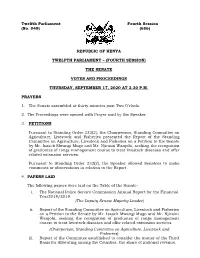
Twelfth Parliament Fourth Session (No. 049) (686) REPUBLIC OF KENYA TWELFTH PARLIAMENT – (FOURTH SESSION) THE SENATE VOTES AND PROCEEDINGS THURSDAY, SEPTEMBER 17, 2020 AT 2.30 P.M. PRAYERS 1. The Senate assembled at thirty minutes past Two O’clock. 2. The Proceedings were opened with Prayer said by the Speaker. 3. PETITIONS Pursuant to Standing Order 232(2), the Chairperson, Standing Committee on Agriculture, Livestock and Fisheries presented the Report of the Standing Committee on Agriculture, Livestock and Fisheries on a Petition to the Senate by Mr. Isaack Mwangi Mugo and Mr. Njiraini Wanjohi, seeking the recognition of graduates of range management course to treat livestock diseases and offer related extension services. Pursuant to Standing Order 232(2), the Speaker allowed Senators to make comments or observations in relation to the Report. 4. PAPERS LAID The following papers were laid on the Table of the Senate- i. The National Police Service Commission Annual Report for the Financial Year2018/2019. (The Deputy Senate Majority Leader) ii. Report of the Standing Committee on Agriculture, Livestock and Fisheries on a Petition to the Senate by Mr. Isaack Mwangi Mugo and Mr. Njiraini Wanjohi, seeking the recognition of graduates of range management course to treat livestock diseases and offer related extension services. (Chairperson, Standing Committee on Agriculture, Livestock and Fisheries) iii. Report of the Committee established to consider the matter of the Third Basis for Allocating among the Counties, the share of national revenue. (No. 049) THURSDAY, SEPTEMBER 17, 2020 (686) (Sen. Moses Wetang’ula, MP) iv. Statement of the Senate Majority Leader on the business of the Senate for the week commencing Tuesday, 22nd September, 2020. -

Newspaper Visibility of Members of Parliament in Kenya*
Journalism and Mass Communication, ISSN 2160-6579 D July 2012, Vol. 2, No. 7, 717-734 DAVID PUBLISHING Newspaper Visibility of Members of Parliament in Kenya* Kioko Ireri Indiana University, Bloomington, USA This research investigates variables that predicted news coverage of 212 members of parliament (MPs) in Kenya by four national newspapers in 2009. The 10 variables examined are: ordinary MP, cabinet minister, powerful ministry, parliamentary committee chairmanship, seniority, big tribe identity, major party affiliation, presidential ambition, commenting on contentious issues, and criticizing government. Findings indicate that commenting on contentious issues, criticizing government, cabinet minister, ordinary MP, powerful ministry, and seniority significantly predicted visibility of the parliamentarians in newspaper news. However, a multiple regression analysis shows that the strongest predictors are commenting on contentious issues, cabinet minister, criticizing government, and big tribe identity. While commenting on controversial issues was the strongest predictor, major party identification and committee leadership were found not to predict MPs’ visibility. Keywords: Kenya, members of parliament (MPs), newspapers, newspaper visibility, politicians, visibility, visibility predictor Introduction Today, the mass media have become important platforms for the interaction of elected representatives and constituents. Through the mass media, citizens learn what their leaders are doing for them and the nation. Similarly, politicians use the media to make their agendas known to people. It is, thus, rare to come across elected leaders ignorant about the importance of registering their views, thoughts, or activities in the news media. In Kenya, members of parliament have not hesitated to exploit the power of the mass media to its fullest in their re-election bids and in other agendas beneficial to them.