US Catholic Institutions and Immigrant Integration: Will the Church Rise To
Total Page:16
File Type:pdf, Size:1020Kb
Load more
Recommended publications
-

Biographical Memoirs of Saint John Bosco
The Biographical Memoirs of Saint John Bosco by REV. EUGENIO CERIA, S.D.B. AN AMERICAN EDITION TRANSLATED FROM THE ORIGINAL ITALIAN REV. DIEGO BORGATELLO, S.D.B. Editor-in-chief Volume XII 1876 SALESIANA PUBLISHERS NEW ROCHELLE, NEW YORK 1980 • IMPRIMI POTEST: Very Rev. Dominic DeBlase, S.D.B. Provincial New Rochelle, N.Y., March 25, 1980 Feast of the Annunciation of the Lord Copyright © 1980 by the Salesian Society, Inc. Library of Congress Catalog Card No. 65-3104rev All Rights Reserved Manufactured in the United States of America FIRST EDITION WITH PROFOUND GRATITUDE TO THE LATE, LAMENTED, AND HIGHLY ESTEEMED VERY REVEREND FELIX J. PENNA, S.D.B. (1904-1962) TO WHOSE WISDOM, FORESIGHT, AND NOBLE SALESIAN HEART THE ENGLISH TRANSLATION OF THE BIOGRAPHICAL MEMOIRS OF SAINT JOHN BOSCO IS A LASTING MONUMENT This Volume Is Fondly Dedicated to THE VERY REVEREND EGIDIO VIGANo Rector Major of the Salesian Society Who By Word, Deed and Spirited Leadership Has Redirected the Salesian Family to Don Bosco's Ideals of Christian Education Expressed in His System of Reason, Religion, and Kindness Editor's Preface SAINT JOHN BOSCO, the central figure of this vastly extensive biography, was a towering person in the affairs of both Church and State during the critical 19th century in Italy. He was the founder of two very active religious congregations during a time when other orders were being suppressed; he was a trusted and key liaison between the Papacy and the emerging Italian nation of the Risorgimento; above all, in troubled times, he was the saintly Christian educator who successfully wedded modern pedagogy to Christ's law and Christ's love for the poor young, and thereby deserved the proud title of Apostle of youth. -

U.S. Cape Verdeans & Black Identity Politics in the Era of Revolutions
Journal of Cape Verdean Studies Volume 1 | Issue 1 Article 8 4-2015 “Free Men Name Themselves”: U.S. Cape Verdeans & Black Identity Politics in the Era of Revolutions, 1955-75 Aminah Pilgrim Follow this and additional works at: http://vc.bridgew.edu/jcvs Part of the Critical and Cultural Studies Commons, and the International and Area Studies Commons Recommended Citation Pilgrim, Aminah. (2015). “Free Men Name Themselves”: U.S. Cape Verdeans & Black Identity Politics in the Era of Revolutions, 1955-75. Journal of Cape Verdean Studies, 1(1), 101-120. Available at: http://vc.bridgew.edu/jcvs/vol1/iss1/8 Copyright © 2015 Aminah Pilgrim This item is available as part of Virtual Commons, the open-access institutional repository of Bridgewater State University, Bridgewater, Massachusetts. © 2015 Aminah Pilgrim Journal of Cape Verdean Studies 101 April 2015 . Number 1, pp. 101-120 ©Aminah Pilgrim, 2015 \\FREE MEN NAME THEMSELVES": U.S. CAPE VERDEANS & BLACK IDENTITY POLITICS INTHE ERA OF REVOLUTIONS, 1955-75 Aminah Pilgrim University of Massachusetts Boston, USA Abstract: Contrary to widely held assumptions about Cape Verdean immigrants in the US - based on oral folklore and early historiography - the population was never "confused" about their collective identity. Individuals and groups of Cape Verdeans wrestled with US ra cial ideology just as they struggled to make new lives for themselves and their families abroad. The men and women confronted African-American or "black" identity politics from the moment of their arrivals upon these shores, and chose very deliberate strate gies for building community, re-inventing their lives and creating pathways for survival and resistance. -

Cape Verdean Theatre: Enacting Political Theory and Reclaiming Roots for Crioulo Performance Eunice S
Journal of Cape Verdean Studies Manuscript 1023 Cape Verdean Theatre: Enacting Political Theory and Reclaiming Roots for Crioulo Performance Eunice S. Ferreira Follow this and additional works at: https://vc.bridgew.edu/jcvs Part of the Critical and Cultural Studies Commons, and the International and Area Studies Commons This item is available as part of Virtual Commons, the open-access institutional repository of Bridgewater State University, Bridgewater, Massachusetts. © 2019 Eunice S. Ferreira Cape Verdean Theatre: Enacting Political Theory and Reclaiming Roots for Crioulo Performance by Eunice S. Ferreira Abstract Shining a spotlight on the Cape Verde Islands illuminates the rich diversity of theatre of the African diaspora and places its unique crioulo identity and creole identities in general, center stage. This article focuses on the post-independence theatre movement in Cape Verde where the re-Africanization theories of Amílcar Cabral (assassinated PAIGC leader in Cape Verde’s liberation struggle) shaped national identity and guided the pioneering work of theatre troupe Korda Kaoberdi (Wake up, Cape Verde). Under the dynamic leadership of Francisco Gomes Fragoso, a medical doctor who adopted the artistic name of Kwame Kondé, the troupe Korda Kaoberdi sought to create “a genuinely Cape Verdean and authentically African theatre.” Armed with the tenets of Cabral’s political theory, Fragoso reclaimed performance traditions that had been suppressed during Portuguese colonialism in order to train actors as combatants in cultural warfare. In doing so, Fragoso positioned the fledgling theatre artists of Korda Kaoberdi alongside the freedom fighters, asserting as Cabral did that culture is a weapon and sign of liberation. The author offers first-ever reconstructions of their historical productions based on archival research, Fragoso’s own writings, festival participant-observations, and personal interviews. -
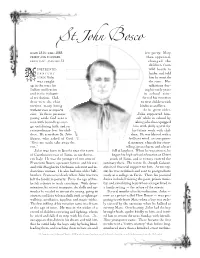
St. John Bosco While Activi- Grown to Four Would Often Take Large Groups of Boys on Day Trips Ty So That There Hundred Boys, Was No Idle Time Gained a Permanent Home
BORN 1815; DIED 1888 love purity. Mary PRIEST AND FOUNDER then appeared, FEAST DAY: JANUARY 31 changed the �t. John �osco children from INETEENTH - wild beasts to CENTURY lambs, and told NTURIN, Italy him he must do was caught the same. Hu- up in the wars for miliations dur- Italian unification ing his early years and in the industri- in school rein- al revolution. Chil- forced his intention dren were the chief to treat children with victims, many living kindness and love. without care or supervi- As he grew older, sion. To these precious John supported him- young souls God sent a self while in school by man with boundless ener- taking jobs that equipped gy, unfaltering faith, and an him with skills useful for extraordinary love for chil- his future work with chil- dren. He sent them St. John dren. He was blessed with a Bosco, who asked of God: KERRIS PAUL brilliant mind, an exception- “Give me souls; take away the al memory, a knack for story- rest.” telling, great charm, and a heart John was born in Becchi near the town full of laughter. When he was sixteen, he of Castelnuovo east of Turin, in northwest- began his high-school education at Chieri ern Italy. He was the younger of two sons of south of Turin, and at twenty entered the Francesco Bosco, a peasant farmer, and his sec- seminary there. The rector, St. Joseph Cafasso, ond wife Margherita Occhiena, a devout and in- obtained financial support for him. At twenty- dustrious woman. He also had one older half- six, he was ordained and sent to postgraduate brother. -

Saint MARY DOMENICA MAZZARELLO Virgin Co-Foundress of the Institute of the Daughters of Mary Help of Christians
13 May Saint MARY DOMENICA MAZZARELLO Virgin Co-foundress of the Institute of the Daughters of Mary Help of Christians Feast For the Institute of the Daughters of Mary Help of Christians: Solemnity. When this solemnity coincides with a Sunday of Paschal Time, the celebration is transferred to the first free day following (cf Roman Missal, General norms for the liturgical year and the Calendar, nn. 5, 60). When celebrated with the rank of solemnity because titular of a church or public oratory duly dedicated or blessed, there are three readings and the Credo is said. In this case such solemnity is not transferable to a Sunday in Paschal Time (cf ibid., General norms for the liturgical year and the Calendar, nn. 5, 58, 59). Mary Domenica was born in 1837 at Mornese, Italy. Her family upbringing guided her in the way of solid piety, tireless hard work, and a profound judgement and practical sense which she later manifested as a Superior. At the age of fifteen she joined the association of the Daughters of Mary Immaculate, and began apostolic work among the girls of the neighbourhood. A serious attack of typhus contracted at the age of twenty- three made a deep spiritual impression on her: the experience of her physical frailty deepened her abandonment to God and prompted her to open a dress-making workshop to teach local girls to work, pray and love God. Thanks to her intense sacramental life and the enlightened guidance of Don Pestarino, she made great progress in the spiritual life. In 1872 Don Bosco chose her to take on the foundation of the Institute of the Daughters of Mary Help of Christians. -

Saint John Bosco and Saint Dominic Savio Free Download
SAINT JOHN BOSCO AND SAINT DOMINIC SAVIO FREE DOWNLOAD Catherine Beebe | 157 pages | 01 Dec 1999 | Ignatius Press | 9780898704167 | English | San Francisco, United States Dominic Savio Dominic Salvo. Despite his affection for Dominic, and his wish to allow Dominic to remain at the Oratory, John Bosco decided to follow the recommendation of the doctors, especially since Dominic had developed a severe cough and he wrote to Dominic's Saint John Bosco and Saint Dominic Savio, fixing the date of his departure on 1 March He was a prayerful person and had an ever-maturing spirituality. It makes me want to research his true story more. Dominika Savia". From the Vision Books series of saints for young people, this is the enthralling story of the great modern apostle of youth, St. His Salesians do so daily and offer their students the opportunity for daily Eucharist. He led Bosco through many streets to a block of flats, rang the doorbell, and at once, went away. Lisa Barder rated it it was amazing Sep 09, Eagerly Dominic explained clearly the meaning of the passage to the delight of both Don Bosco and his father. Dominic stepped between them. A Young Apostle Don Bosco developed youth to youth ministry a hundred years before the term came to be used in education. His Liturgical Feast Day is March 9. Enlarge cover. Trials and Difficulties. They left the Oratory, hurried down one street, into another, and up a third, without saying a word, and then into another street. I don't seem to remember His face clouded over with a look of distress, and tears came to his Saint John Bosco and Saint Dominic Savio. -

Saint John Bosco Founder of the Salesian Society
Saint John Bosco Founder of the Salesian Society Feast Day January 31 January 2013 Monthly Saint Reflection St. Margaret Mary and St. Patrick’s Church St. Giovanni Melchior Bosco (also known as St. John Bosco; Don Bosco) Feast Day, January 31 • Born August 16, 1815 • Died January 31, 1888 outcasts. While Don Bosco was offering mass on December 8, 1841 (the feast of the Immaculate Conception), the sacristan chased a ragged child from the Church. Don Bosco heard the child’s cries and called out to him. A friendship sprang up between the priest and the child, Bartolomeo Garelli. Don Bosco eagerly began to teach his first pupil of the streets; and other children soon followed to the Oratory (place of prayer/private chapel). Don Bosco started out by learning how to juggle and do tricks to catch the attention of the children. Once he had Giovanni Melchior Bosco was the founder of the their attention he would teach them and take them Salesian Society. He was born on August 16, 1815 to to Mass. It wasn't always easy -- few people wanted poor parents in a little cabin at Becchi, a hillside a crowd of loud, bedraggled boys hanging around. hamlet near Castelnuovo, Piedmont, Italy. However, the children were all drawn by a kindness they had never known. By February of 1842, the His father died when he was little more than two Oratory numbered twenty boys, and by March the years old, leaving his mother, Margaret Bosco to number increased to thirty. Four years later in support John and his two brothers. -

Cape Verdean Kriolu As an Epistemology of Contact O Crioulo Cabo-Verdiano Como Epistemologia De Contato
Cadernos de Estudos Africanos 24 | 2012 Africanos e Afrodescendentes em Portugal: Redefinindo Práticas, Projetos e Identidades Cape Verdean Kriolu as an Epistemology of Contact O crioulo cabo-verdiano como epistemologia de contato Derek Pardue Electronic version URL: http://journals.openedition.org/cea/696 DOI: 10.4000/cea.696 ISSN: 2182-7400 Publisher Centro de Estudos Internacionais Printed version Number of pages: 73-94 ISSN: 1645-3794 Electronic reference Derek Pardue, « Cape Verdean Kriolu as an Epistemology of Contact », Cadernos de Estudos Africanos [Online], 24 | 2012, Online since 13 December 2012, connection on 01 May 2019. URL : http:// journals.openedition.org/cea/696 ; DOI : 10.4000/cea.696 O trabalho Cadernos de Estudos Africanos está licenciado com uma Licença Creative Commons - Atribuição-NãoComercial-CompartilhaIgual 4.0 Internacional. Cadernos de Estudos Africanos (2012) 24, 73-94 © 2012 Centro de Estudos Africanos do ISCTE - Instituto Universitário de Lisboa Ca Va Ki a a Eiy Ca Derek Pardue Universidade de Washington St. Louis, E.U.A. dpardue@wustl.edu 74 CAPE VERDEAN KRIOLU AS AN EPISTEMOLOGY OF CONTACT Cape Verdean Kriolu as an epistemology of contact Kriolu as language and sentiment represents a “contact perspective”, an outlook on life and medium of identiication historically structured by the encounter. Cape Verde was born out of an early creole formation and movement is an essential part of Cape Verdean practices of language and identity. Most recently, the Portuguese state and third-party real estate developers have provided another scenario in the long series of (dis) emplacement dramas for Cape Verdeans as Lisbon administrations have pushed to demol- ish “improvised” housing and regroup people into “social” neighborhoods. -

Pascual Chavez
Giornate di Spiritualità della Famiglia Salesiana 16 - 19 gennaio 2014 Pastoral Charity Core and synthesis of Salesian spiritualiy Fr Pascual Chávez Villanueva Rector Mejor Previously we have seen how the ”type” of spiritual person Don Bosco was: profoundly human and totally open to God; in harmony between these two dimension he lived out a plan of life that he had taken up with determination: at the service of the young. As Don Rua says: “He took no step, he said no word, he took up no task that was not directed to the saving of the young.”[14] If one examines his plan for the young one sees that it had a “heart,”, an element that gave it meaning, originality: “Truly the only concern of his heart was for souls”.[15] There is therefore a further practical explanation for the unity of his life: through his dedication to young people Don Bosco wanted to give them an experience of God. On his part this was not just generosity or philantropy but pastoral charity. This is called the “core and synthesis” of the Salesian spirit.[16] “Core and synthesis” is a telling and demanding affirmation. It is easier to list the various features, even the basic ones of our spirituality, without committing ourselves to any sort of hierarchical relationship, which would choose one as being the principal one. In this case it is necesary to enter into the spirit of Don Bosco or of the Salesian in order to discover the explanation for his way of doing things. To understand what is involved in pastoral charity we take three steps: we look first at charity, then at the specification “pastoral”, and finally at the ‘Salesian’ characteristics of pastoral charity. -

THE JANUARY MESSAGE of the RECTOR MAJOR from the Salesian Bulletin DON ANGEL FERNANDEZ ARTIME
Volume II, Issue 1 January 2020 THE JANUARY MESSAGE OF THE RECTOR MAJOR from the Salesian Bulletin DON ANGEL FERNANDEZ ARTIME, SDB “Four Boys and a Dream” Cari amici e I have in my hands a histori- that today the Salesian amiche: Dear cal document - a piece of pa- Family and Congregation friends of Don per that is a mere 4 inches extend to 136 nations of the Bosco’s char- by 2 inches - written by a world, taking care of the ism and read- young boy from the Valdocco boys, girls, teenagers, and ers of [Snippets Oratory, Michael Rua. On young adults - all of them and] the Salesian Bulletin - this tiny piece of paper he our main concern. the Salesian instrument of wrote the following: communication so dear to On the evening of Don Bosco himself, its January 26, 1854, we Founder. Shortly before I gathered in Don Bosco's We are a Family room: Don Bosco him- belonging all to Mary began writing these lines, I self, Rocchietti, Artiglia, had celebrated Holy Mass, Cagliero, and Rua; and In this issue: together with the General it was proposed that we Council of the Salesian Con- engage, with the help of In, With, and For 2-3 God and of St. Francis gregation (Salesians of Don de Sales, in an experi- the Church Bosco), in the “camerette" in ment in the practical SF Groups and 4-6 Sacred Heart Basilica. The exercise of charity to- ward neighbor, to even- Social Justice “camerette” are the room tually make a promise, To Educate Like 7 and the chapel, which is and then if it will be Don Bosco adorned with a typical altar deemed possible and of the time, where Don opportune, to make a Our Family News 8 vow of it to the Lord. -

Cabo Verde 2.0. Marca Y Desarrollo Turístico En El Archipiélago
PASOS. Revista de Turismo y Patrimonio Cultural ISSN: 1695-7121 info@pasosonline.org Universidad de La Laguna España Cabo Verde 2.0. Marca y desarrollo turístico en el archipiélago Marcelino, Pedro F.; Oca Gonzaléz, Luzia Cabo Verde 2.0. Marca y desarrollo turístico en el archipiélago PASOS. Revista de Turismo y Patrimonio Cultural, vol. 17, no. Esp.3, 2019 Universidad de La Laguna, España Available in: https://www.redalyc.org/articulo.oa?id=88165935004 DOI: https://doi.org/10.25145/j.pasos.2019.17.037 This work is licensed under Creative Commons Attribution-NonCommercial-NoDerivs 4.0 International. PDF generated from XML JATS4R by Redalyc Project academic non-profit, developed under the open access initiative Pedro F. Marcelino, et al. Cabo Verde 2.0. Marca y desarrollo turístico en el archipiélago Artículos Cabo Verde 2.0. Marca y desarrollo turístico en el archipiélago Cabo Verde 2.0: desarrollo de marca y turismo en todo el archipiélago Pedro F. Marcelino DOI: https://doi.org/10.25145/j.pasos.2019.17.037 Longyearbyen Consulting, Canadá Redalyc: https://www.redalyc.org/articulo.oa? mail@pedromarcelino.com id=88165935004 Luzia Oca Gonzaléz University of Trás#os#Montes, Portugal luziag@utad.pt Received: 21 January 2019 Accepted: 18 February 2019 Abstract: is article homes in on the genesis and the development process of tourism in the Cabo Verdes Islands, West Africa, from its definition as a national priority in the post#independence period, to its qualification as a strategic sector in the 1990s, to the prioritizing of the sector as a core economic pillar for the 21s Century. -

Feasibility of a Leasing Sector in Cape Verde Φ
V.1 Eng Codaven FEASIBILITY OF A LEASING SECTOR IN CAPE VERDE March-April 2007 Codaven March-April 2007 1 V.1 Eng Codaven TABLE OF CONTENTS 1. EXECUTIVE SUMMARY ................................................................................................ 4 2. INTRODUCTION ............................................................................................................. 7 2.1. Scope of the work (sow) and limitation. ................................................................. 7 2.2. Background ............................................................................................................... 7 3. CAPE VERDEAN ECONOMY ...................................................................................... 11 3.1. Introduction ............................................................................................................ 11 3.2. Economic Indicators for Cape Verde ................................................................... 12 3.3. Conclusions of the chapter “Cape Verdean Economy”. ..................................... 14 4. FINANCIAL SECTOR. .................................................................................................. 15 4.1. Introduction. ........................................................................................................... 15 4.2 The legal framework. ............................................................................................. 15 4.3. The Central Bank. .................................................................................................