Fall 2019 TBC 1500 Traditional Chinese Philosophy
Total Page:16
File Type:pdf, Size:1020Kb
Load more
Recommended publications
-

Chinese Philosophy
CHINESE PHILOSOPHY Vatican Relations: Problems of Conflicting Authority, 1976–1986 EARLY HISTORY (Cambridge 1992). J. LEUNG, Wenhua Jidutu: Xianxiang yu lunz- heng (Cultural Christian: Phenomenon and Argument) (Hong Shang Dynasty (c.1600–c.1045 B.C.). Chinese Kong 1997). K. C. LIU, ed. American Missionaries in China: Papers philosophical thought took definite shape during the reign from Harvard Seminars (Cambridge 1966). Lutheran World Feder- of the Shang dynasty in Bronze Age China. During this ation/Pro Mundi Vita. Christianity and the New China (South Pasa- period, the primeval forms of ancestor veneration in Neo- dena 1976). L. T. LYALL, New Spring in China? (London 1979). J. G. LUTZ, ed. Christian Missions in China: Evangelist of What? lithic Chinese cultures had evolved to relatively sophisti- (Boston 1965). D. E. MACINNIS, Religion in China Today: Policy cated rituals that the Shang ruling house offered to their and Practice (Maryknoll, NY 1989). D. MACINNIS and X. A. ZHENG, ancestors and to Shangdi, the supreme deity who was a Religion under Socialism in China (Armonk, NY 1991). R. MAD- deified ancestor and progenitor of the Shang ruling fami- SEN, China Catholics: Tragedy and Hope in an Emerging Civil So- ciety (Berkeley 1998). R. MALEK and M. PLATE Chinas Katholiken ly. A class of shamans emerged, tasked with divination suchen neue (Freiburg 1987). Missiones Catholicae cura S. Con- and astrology using oracle bones for the benefit of the rul- gregationis de Propaganda Fide descriptae statistica (Rome 1901, ing class. Archaeological excavations have uncovered 1907, 1922, 1927). J. METZLER, ed. Sacrae Congregationis de Pro- elaborate bronze sacrificial vessels and other parapherna- paganda Fide Memoria Rerum, 1622–1972 (Rome 1976). -

The Old Master
INTRODUCTION Four main characteristics distinguish this book from other translations of Laozi. First, the base of my translation is the oldest existing edition of Laozi. It was excavated in 1973 from a tomb located in Mawangdui, the city of Changsha, Hunan Province of China, and is usually referred to as Text A of the Mawangdui Laozi because it is the older of the two texts of Laozi unearthed from it.1 Two facts prove that the text was written before 202 bce, when the first emperor of the Han dynasty began to rule over the entire China: it does not follow the naming taboo of the Han dynasty;2 its handwriting style is close to the seal script that was prevalent in the Qin dynasty (221–206 bce). Second, I have incorporated the recent archaeological discovery of Laozi-related documents, disentombed in 1993 in Jishan District’s tomb complex in the village of Guodian, near the city of Jingmen, Hubei Province of China. These documents include three bundles of bamboo slips written in the Chu script and contain passages related to the extant Laozi.3 Third, I have made extensive use of old commentaries on Laozi to provide the most comprehensive interpretations possible of each passage. Finally, I have examined myriad Chinese classic texts that are closely associated with the formation of Laozi, such as Zhuangzi, Lüshi Chunqiu (Spring and Autumn Annals of Mr. Lü), Han Feizi, and Huainanzi, to understand the intellectual and historical context of Laozi’s ideas. In addition to these characteristics, this book introduces several new interpretations of Laozi. -

B Philosophy (General) B
B PHILOSOPHY (GENERAL) B Philosophy (General) For general philosophical treatises and introductions to philosophy see BD10+ Periodicals. Serials 1.A1-.A3 Polyglot 1.A4-Z English and American 2 French and Belgian 3 German 4 Italian 5 Spanish and Portuguese 6 Russian and other Slavic 8.A-Z Other. By language, A-Z Societies 11 English and American 12 French and Belgian 13 German 14 Italian 15 Spanish and Portuguese 18.A-Z Other. By language, A-Z 20 Congresses Collected works (nonserial) 20.6 Several languages 20.8 Latin 21 English and American 22 French and Belgian 23 German 24 Italian 25 Spanish and Portuguese 26 Russian and other Slavic 28.A-Z Other. By language, A-Z 29 Addresses, essays, lectures Class here works by several authors or individual authors (31) Yearbooks see B1+ 35 Directories Dictionaries 40 International (Polyglot) 41 English and American 42 French and Belgian 43 German 44 Italian 45 Spanish and Portuguese 48.A-Z Other. By language, A-Z Terminology. Nomenclature 49 General works 50 Special topics, A-Z 51 Encyclopedias 1 B PHILOSOPHY (GENERAL) B Historiography 51.4 General works Biography of historians 51.6.A2 Collective 51.6.A3-Z Individual, A-Z 51.8 Pictorial works Study and teaching. Research Cf. BF77+ Psychology Cf. BJ66+ Ethics Cf. BJ66 Ethics 52 General works 52.3.A-Z By region or country, A-Z 52.5 Problems, exercises, examinations 52.65.A-Z By school, A-Z Communication of information 52.66 General works 52.67 Information services 52.68 Computer network resources Including the Internet 52.7 Authorship Philosophy. -

Book Review the Past, Present and Future of Confucian Political Philosophy —Evaluation of Professor Ouyang Zhenren's from Nature of Mind to Politics
Book Review The Past, Present and Future of Confucian Political Philosophy —Evaluation of Professor Ouyang Zhenren's From Nature of Mind to Politics Yang Yongtao1 Professor Ouyang Zhenren's new book From Nature of Mind to Politics was published by China Social Sciences Press (Beijing) in 2017, which is a major breakthrough in the academic research on Confucian mind philosophy. At the same time, the publication of this monograph represents the latest trend and frontier achievements in the study of Confucian political philosophy. What does Confucian political philosophy say? What should be its core concern? How can people promote the future development of Confucian political philosophy? These three questions run through Professor Ouyang's From Nature of Mind to Politics. In recent years, there have been a lot of discussions on "Mind Confucianism" and "Political Confucianism" in academic circles, but the differences between them have been emphasized, which actually separates the inherent state of Confucianism. Only by grasping the internal connection from "nature of mind" to "politics" and observing the connection and prominence of "Xiu Shen( 修身)", can we better understand the essence of Confucian political philosophy, which is also Professor Ouyang's concern in writing. The book is divided into six parts: "From Nature of Mind to Politics", "Insight into Confucian political philosophy", "Nature and Evolution of The Book of Filial Piety", "Confucianism advanced in comparison", "From Confucius and Mencius to Lu Jiuyuan" and "From Confucius and Mencius to Wang Yangming". This work combines historical data with theory very well and finds ideas that many people did't see, so it can be said to be a rare and excellent study of Confucian political philosophy. -
A Study of Shen Dao
慎到 A STUDY OF SHEN DAO John Emerson Copyright 2012 John Emerson emersonj@gmail.com SHEN DAO: MYSTIC AND BUREAUCRAT I Shen Dao was a member of the Jixia Academy in Qi during the Hundred Schools era, sometime between 350 BC and 275 BC. Xunzi criticized him, Xunzi’s student Han Feizi acknowledged him as one of three masters of Legalism (along with Shang Yang and Shen Buhai), and the author of the Tianxia chapter of Zhuangzi discussed him at some length. Details about his life are scanty and uncertain, but at least we can be sure that he existed and was not purely legendary. The Hundred Schools era was perhaps the most fertile period in the history of Chinese philosophy, but because of censorship and the destruction of war, few of its texts survive, usually in heavily-edited late versions, and many figures are known only as names attached to anecdotes. In the case of Shen Dao, the available material consists of a late text called the Shenzi, the three discussions mentioned above, and scattered quotations and anecdotes of widely differing value. Thompson has carefully edited the materials that remain and I have used his text. Shen Dao is classified sometimes as a Daoist, sometimes as a Legalist, and sometimes as a follower of Huanglao, but these late retrospective classifications are not very helpful. There were no organized Daoist, Legalist, or Huanglao schools comparable to the Mohist and Confucian schools, and in effect, these classifications merely serve to lump tendencies. Insofar as these three labels mean anything, they are probably all applicable to Shen Dao.1 Given the decimation of the sources, it’s hard to discuss the history of Chinese philosophy during that era without the help of speculative assumptions. -
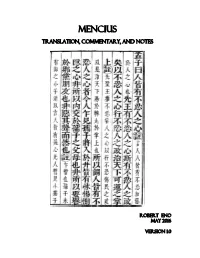
Selections from Mencius, Books I and II: Mencius's Travels Persuading
MENCIUS Translation, Commentary, and Notes Robert Eno May 2016 Version 1.0 © 2016 Robert Eno This online translation is made freely available for use in not for profit educational settings and for personal use. For other purposes, apart from fair use, copyright is not waived. Open access to this translation, without charge, is provided at: http://hdl.handle.net/2022/23423 Also available as open access translations of the Four Books The Analects of Confucius: An Online Teaching Translation http://hdl.handle.net/2022/23420 Mencius: An Online Teaching Translation http://hdl.handle.net/2022/23421 The Great Learning and The Doctrine of the Mean: An Online Teaching Translation http://hdl.handle.net/2022/23422 The Great Learning and The Doctrine of the Mean: Translation, Notes, and Commentary http://hdl.handle.net/2022/23424 Cover illustration Mengzi zhushu jiejing 孟子註疏解經, passage 2A.6, Ming period woodblock edition CONTENTS Prefatory Note …………………………………………………………………………. ii Introduction …………………………………………………………………………….. 1 TEXT Book 1A ………………………………………………………………………………… 17 Book 1B ………………………………………………………………………………… 29 Book 2A ………………………………………………………………………………… 41 Book 2B ………………………………………………………………………………… 53 Book 3A ………………………………………………………………………………… 63 Book 3B ………………………………………………………………………………… 73 Book 4A ………………………………………………………………………………… 82 Book 4B ………………………………………………………………………………… 92 Book 5A ………………………………………………………………………………... 102 Book 5B ………………………………………………………………………………... 112 Book 6A ……………………………………………………………………………….. 121 Book 6B ……………………………………………………………………………….. 131 Book -

Contemporary Chinese Philosophy.Pdf
CONTEMPORARY CHINESE PHILOSOPHY Edited by CHUNG-YING CHENG AND NICHOLAS BUNNIN CONTEMPORARY CHINESE PHILOSOPHY Dedicated to my mother Mrs Cheng Hsu Wen-shu and the memory of my father Professor Cheng Ti-hsien Chung-ying Cheng Dedicated to my granddaughter Amber Bunnin Nicholas Bunnin CONTEMPORARY CHINESE PHILOSOPHY Edited by CHUNG-YING CHENG AND NICHOLAS BUNNIN Copyright © Blackwell Publishers Ltd 2002 First published 2002 2 4 6 8 10 9 7 5 3 1 Blackwell Publishers Inc. 350 Main Street Malden, Massachusetts 02148 USA Blackwell Publishers Ltd 108 Cowley Road Oxford OX4 1JF UK All rights reserved. Except for the quotation of short passages for the purposes of criticism and review, no part of this publication may be reproduced, stored in a retrieval system, or transmitted, in any form or by any means, electronic, mechanical, photocopying, recording, or otherwise, without the prior permission of the publisher. Except in the United States of America, this book is sold subject to the condition that it shall not, by way of trade or otherwise, be lent, resold, hired out, or otherwise circulated without the publisher’s prior consent in any form of binding or cover other than that in which it is published and without a similar condition including this condition being imposed on the subsequent purchaser. Library of Congress Cataloging-in-Publication Data Contemporary chinese philosophy / edited by Chung-ying Cheng and Nicholas Bunnin p. cm. Includes bibliographical references and index. ISBN 0-631-21724-X (alk. paper) — ISBN 0-631-21725-8 (pbk. : alk. paper) 1. Philosophy, Chinese—20th century. I. Cheng, Zhongying, 1935– II. -

Appropriating the West in Late Qing and Early Republican China / Theodore Huters
Tseng 2005.1.17 07:55 7215 Huters / BRINGING THE WORLD HOME / sheet 1 of 384 Bringing the World Home Tseng 2005.1.17 07:55 7215 Huters / BRINGING THE WORLD HOME / sheet 2 of 384 3 of 384 BringingÕ the World HomeÕ Appropriating the West in Late Qing 7215 Huters / BRINGING THE WORLD HOME / sheet and Early Republican China Theodore Huters University of Hawai‘i Press Honolulu Tseng 2005.1.17 07:55 © 2005 University of Hawai‘i Press All rights reserved Printed in the United States of Amer i ca Library of Congress Cataloging- in- Publication Data Huters, Theodore. Bringing the world home : appropriating the West in late Qing and early Republican China / Theodore Huters. p. cm. Includes bibliographical references and index. ISBN 0-8248-2838-0 (hardcover : alk. paper) 1. Chinese literature—20th century—History and criticism. 2. Chinese literature—20th century—Western influences. I. Title. PL2302.H88 2005 895.1’09005—dc22 2004023334 University of Hawai‘i Press books are printed on acid- free paper and meet the guidelines for permanence and durability of the Council on Library Resources. An electronic version of this book is freely available, thanks to the support of libraries working with Knowledge Unlatched. KU is a collaborative initiative designed to make high-quality books open access for the public good. The open-access ISBN for this book is 978-0-8248-7401-8. More information about the initiative and links to the open-access version can be found at www.knowledgeunlatched.org. The open-access version of this book is licensed under Creative Commons Attribution-NonCommercial-NoDerivatives 4.0 International (CC BY- NC-ND 4.0), which means that the work may be freely downloaded and shared for non-commercial purposes, provided credit is given to the author. -

Egoism in Chinese Ethics
E Egoism in Chinese Ethics Kim-Chong CHONG The term “egoism,” wei wo, in Chinese ethics is usu- universalization and the maximization of self-interest. ally associated with Yang Zhu, but it encompasses is- Ethical egoism is therefore largely a heuristic device sues much wider than the narrow and overriding con- of the twentieth century, although the two criteria just ception of self-interest attributed to him by Mencius mentioned had precursors in Hobbes and Kant. (Mengzi): “Even if he could benefit the Empire by A. C. Graham (1989) recounts a dialogue in the pulling one hair he would not do it (Mencius 7A26).” Mozi between Wumazi and Mozi, which can illustrate These include questions about the possibility of uni- the issue of universalization, although we shall have versal love, the extension of benevolence, human na- to qualify this later. Wumazi claims to be incapable ture, the ultimate motivation for behavior, self-cultiva- of concern for everyone; he says that although he is tion, the value of spontaneity, and the conflict between concerned for the people of his own neighborhood, he particularistic concern—i.e., concern for one’s is by degrees more concerned for his family than for kin—and nonparticularistic concern. These related is- his neighbors, for his parents than for other members sues surround classical figures like Mozi, Yang Zhu, of his family, and ultimately for himself than for his Gaozi, Mencius, and, beyond them, the neo-Confu- parents. The issue for Mozi is whether this is a morality cians. that can be prescribed: “Are you going to hide your Before describing these issues, we should first mention egoism in western ethics, where it has often morality, or tell others about it?” To Wumazi’s re- been discussed in terms of ethical egoism and psycho- sponse that he will tell others, Mozi argues that Wu- logical egoism. -
Library of Congress Classification
B PHILOSOPHY (GENERAL) B Philosophy (General) For general philosophical treatises and introductions to philosophy see BD10+ Periodicals. Serials 1.A1-.A3 Polyglot 1.A4-Z English and American 2 French and Belgian 3 German 4 Italian 5 Spanish and Portuguese 6 Russian and other Slavic 8.A-Z Other. By language, A-Z Societies 11 English and American 12 French and Belgian 13 German 14 Italian 15 Spanish and Portuguese 18.A-Z Other. By language, A-Z 20 Congresses Collected works (nonserial) 20.6 Several languages 20.8 Latin 21 English and American 22 French and Belgian 23 German 24 Italian 25 Spanish and Portuguese 26 Russian and other Slavic 28.A-Z Other. By language, A-Z 29 Addresses, essays, lectures Class here works by several authors or individual authors (31) Yearbooks see B1+ 35 Directories Dictionaries 40 International (Polyglot) 41 English and American 42 French and Belgian 43 German 44 Italian 45 Spanish and Portuguese 48.A-Z Other. By language, A-Z Terminology. Nomenclature 49 General works 50 Special topics, A-Z 51 Encyclopedias Historiography 51.4 General works Biography of historians 51.6.A2 Collective 51.6.A3-Z Individual, A-Z 51.8 Pictorial works Study and teaching. Research Cf. BF77+ Psychology Cf. BJ66+ Ethics Cf. BJ66 Ethics 52 General works 1 B PHILOSOPHY (GENERAL) B Study and teaching. Research -- Continued 52.3.A-Z By region or country, A-Z 52.5 Problems, exercises, examinations 52.65.A-Z By school, A-Z Communication of information 52.66 General works 52.67 Information services 52.68 Computer network resources Including the Internet 52.7 Authorship Philosophy. -

Asian Philosophy Vol. 11, No. 1
APA Newsletters NEWSLETTER ON ASIAN AND ASIAN-AMERICAN PHILOSOPHERS AND PHILOSOPHY Volume 11, Number 1 Fall 2011 FROM THE EDITOR, DAVID H. KIM ARTICLES A. MINH NGUYEN “Teaching Chinese Philosophy: A Survey of the Field” FALGUNI A. SHETH “Report on ‘(Mis)Recognition: Race, Emotion, Embodiment’ Panel” © 2011 by The American Philosophical Association ISSN 2155-9708 APA NEWSLETTER ON Asian and Asian-American Philosophers and Philosophies David H. Kim, Editor Fall 2011 Volume 11, Number 1 on this philosophical tradition in progress (with Professor Bang FROM THE EDITOR at Kyungpook National University, South Korea) and translating Chong, Yak-Yong (丁若鏞)’s “Four Commentaries on Yi-Jing” (周易四箋) (also with Professor Bang). JeeLoo Liu is Associate Professor of Philosophy at David H. Kim CSU Fullerton and President of the Association of Chinese University of San Francisco Philosophers in America (ACPA). Her research interests are Chinese Philosophy and Philosophy of Mind. She is the author of The value of Chinese Philosophy—not to mention Asian An Introduction to Chinese Philosophy: From Ancient Philosophy Philosophy generally—warrants much greater recognition in the to Chinese Buddhism (Blackwell, 2006) and co-editor, with profession than it currently receives. The teaching of Chinese John Perry, of Consciousness and the Self (Cambridge philosophy, then, is a significant matter, and this edition of the University Press, December 2011). Currently, she is working Newsletter begins with an important service to the profession, on a monograph on Neo-Confucianism, tentatively entitled a survey article by Professor Minh Nguyen on current teaching Metaphysics, Morality, and Mind: An Analytic Reconstruction of Chinese Philosophy in various parts of the world and in of Neo-Confucianism. -
Chapter 2 Human Nature and Learning in Ancient China
Chapter 2 Human Nature and Learning in Ancient China Hung-Chung Yen Abstract Many Chinese schools of philosophy have addressed the issue of human nature. Several important traditional perspectives on human nature include the the- ory of acquired habits from the Confucianists and Mohists, the theory of the original goodness from Mencius, the theory of evil human nature from Xunzi and the Legalists, and the simple and true theory of Taoism. These schools of philosophy addressed human nature in relation to the elements of traditional values in Chinese culture, the view of feelings and emotions in learning, the functions of the teacher, and the roles of the government. In addition to analyzing human nature, the implica- tions of these traditional values on current educational practice in Taiwan are presented. Amidst these complicated and sometimes contradictory traditions, the changeable human nature is affi rmed, the autonomy of teachers and learners is rec- ognized, and deliberation on the learning process is recommended. Human nature has played a central role in traditional Chinese philosophy in the past and will con- tinue to be relevant in the future. Keywords Chinese educational philosophy • Confucianism • Taoism • Goodness and evil of human nature • Theory of acquired habits 2.1 Introduction Education is a cultural phenomenon. People’s existing thinking patterns and social values are always fi rmly intertwined with their basic attitudes, values, and thinking patterns. When analyzing educational issues from a cultural perspective, therefore, it is necessary to recognize the complexity of cultural content in order to grasp subtle applications in current practice. One of the cultural components in traditional Chinese culture is people’s basic attitudes toward human nature.