"SAXOPHONE JOURNAL MAGAZINE" John Klemmer by Thomas Erdmann
Total Page:16
File Type:pdf, Size:1020Kb
Load more
Recommended publications
-

Morgenstern, Dan. [Record Review: Dave Frishberg: Oklahoma Toad
Records ore reviewed by Chris Albertson, Mike Bourne, Don DeMicheol , Alon Heineman, Wayne Jones, Lorry Kort, John Litweiler, John McDonough, Don Morgenstern, Don Nelsen, Harvey Pekar, Doug Ramsey, Harvey Siders, Carol Sloane, and Jim Szontor. Reviews ore signed by the writers. recurRatings ore: * * * * * excellent, * * * * very good, * * * good, * * fair, * poor. Most recordings reviewed ore ovailoble for purchase through the down beat/RECORD CLUB. ( For membership information see details elsewhere in this issue or write to AEVIEIIWS down beat/RECORD CLUB, 222 W. Adams, Chicago, IL 60606) play rock. A high camp crowdpleaser. a unique story in Jess than three minutes, DON ELLIS Antea, another fine Levy original, pre while the equally unexpected slow tempo DON ELLIS AT FILLMORE-Columbia cedes the album's highlight, Old Man's applied to Exactly yields equally warm, G30243: Tina/ Analysis; Excursion II; Tb • Magic Bus At• M;, Dougbr111t; Th, B/uu; Sahatort Tear, a melancholy ballad portraying "an affecting results. On the third ballad, What S,m; Rork Odyss-,; H,y Jud •: Anua: Old Mar1·s old man's life--his joys and sorrows Is There To Say?, Bud gives himself Tear; Great Vivid,; Pussy Wigg/, Stomp. Personnel: Ellis, trumpet, drums; Glenn Stn· ... " Though Klemmer's composition and more room to stretc h, and the result is art, Stu Blumberg, John Rosenberg, Jack Coan, arrangement are excellent, Ellis steals his a small masterpiece, reflective and more trumpets; Ernie Carlson. Glenn Ferris . trombones; Don Switzer, bass trombone; Doug Bixby , contra• thunder with stunning virtuosity. Great introspecti ve than is his custom, and rem bus, tuba; Fred Selden, Lonnie Shetter, Sam Divide, in 13/4, is a pulsating vehicle iniscent in mood of later Lester Young Falzone, John Klemmer, Jon Clarke, reeds; Jay Graydon, gu irar; Tom Garvio, piano; Dennis highlighted by Shelter's alto, more dazzling a rare groove to capture. -

"JOHN KLEMMER BIOGRAPHY" (& Addendum) John Klemmer Is An
"JOHN KLEMMER BIOGRAPHY" (& Addendum) John Klemmer is an enigma to many. He seems to be a "different artist" to "different people" depending on which musical direction & time period of Klemmer's music they are attached to, are aware of & prefer. John Klemmer began playing guitar at age 5. After interests in graphics and visual art studying at The Art Institute of Chicago & with ambitions of being Dancer, Puppeteer, Painter, Sculptor, Writer, & Poet. He began Alto Sax at age 11, switching to Tenor Sax when entering High School. He spent years of extensive private lessons in Piano, Conducting, Harmony & Theory, Composition, Arranging, Clarinet, Flute, & Classical & Jazz Saxophone that continued through all his years in Chicago. He also attended Interlochen's National Music Camp immersed in the study of Classical Music & "Legitimate Classical" Saxophone etc. He turned down an offer of a four scholarship there to return to "study" in the jazz clubs etc. of Chicago. Immediately upon graduating from High School, noted jazz producer, Esmond Edwards, signed Klemmer to Cadet/Chess Records for five plus albums, his first 2 recordings being "straight ahead jazz", and then, abruptly & surprisingly if not confusing to many, of which would eventually become a trademark of his career, changed musical directions, recording the innovative hit album of the first, slightly preceding the release of Miles Davis "Bitches Brew", of the "jazz/rock fusion" genre, "Blowin Gold", co-produced by ex Rolling Stones Records producer, Marshall Chess, for the new Cadet Concept label on Chess Records. Here John introduced his use with electronics, primarily the "delay effect", which would become his life long "trademark sound", as well as, uses of the "wah wah" pedal & "ring modulator" etc. -

Recorded Jazz in the 20Th Century
Recorded Jazz in the 20th Century: A (Haphazard and Woefully Incomplete) Consumer Guide by Tom Hull Copyright © 2016 Tom Hull - 2 Table of Contents Introduction................................................................................................................................................1 Individuals..................................................................................................................................................2 Groups....................................................................................................................................................121 Introduction - 1 Introduction write something here Work and Release Notes write some more here Acknowledgments Some of this is already written above: Robert Christgau, Chuck Eddy, Rob Harvilla, Michael Tatum. Add a blanket thanks to all of the many publicists and musicians who sent me CDs. End with Laura Tillem, of course. Individuals - 2 Individuals Ahmed Abdul-Malik Ahmed Abdul-Malik: Jazz Sahara (1958, OJC) Originally Sam Gill, an American but with roots in Sudan, he played bass with Monk but mostly plays oud on this date. Middle-eastern rhythm and tone, topped with the irrepressible Johnny Griffin on tenor sax. An interesting piece of hybrid music. [+] John Abercrombie John Abercrombie: Animato (1989, ECM -90) Mild mannered guitar record, with Vince Mendoza writing most of the pieces and playing synthesizer, while Jon Christensen adds some percussion. [+] John Abercrombie/Jarek Smietana: Speak Easy (1999, PAO) Smietana -

The Fourth Way, the Counterculture, and Capitol Records
CHAPTER 9 The Sun and Moon Have Come Together: The Fourth Way, the Counterculture, and Capitol Records Kevin Fellezs ormed in 1968, musical group The Fourth Way was among the first bands to merge rock, jazz, and non-Western musical approaches in a way that mir- rored the mixed-race membership of the band—white New Zealander pianist FMike Nock, black American violinist Michael White, white American bassist Ron McClure, and black American drummer Eddie Marshall—a notable feature at the time. The band’s eponymous debut and their second release, a live recording titled The Sun and Moon Have Come Together , were recorded in the fall of 1969. Their final recording, Werwolf , was a live recording of their appearance in the 1970 Montreux Jazz Festival in Switzerland. However, with the exception of a small number of dates clustered around the band’s appearance in Montreux, The Fourth Way rarely per- formed outside of the San Francisco Bay Area, limiting their exposure. My focus in this chapter is to think through the ways in which The Fourth Way, a relatively unknown band working in the same geographic area and within the same countercultural milieu as more famous bands associated with the hippie sub- culture such as the Grateful Dead, enacted these countercultural ideals even more forcefully than their more visible peers. I am interested especially with the ways in which the band dealt with inclusive notions of belonging and an interest in hetero- dox spiritual practices that were articulated through their genre mixtures that would bear fruit in the following decades in musical styles that would come to be known as fusion (jazz-rock/funk), world music, and new age. -
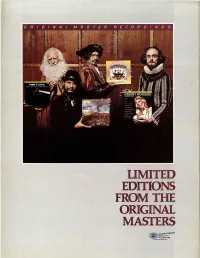
Limited Editions from the Original Masters N Original Master Recording Will Challenge and Improve the Performance of Stereo System!
LIMITED EDITIONS FROM THE ORIGINAL MASTERS N ORIGINAL MASTER RECORDING WILL CHALLENGE AND IMPROVE THE PERFORMANCE OF STEREO SYSTEM! ou could spend a small fortune on your stereo system. You could add all of the newest state-of-the-art technological wonders...enhancers, defmers, equalizers, imaging sys tems, etc...in an often futile effort to recapture the sound as it was originally recorded by your favorite artists. But equipment alone will not deliver that superior sound quality, because your sound system is ultimately only as good as the source material...your records and tapes. It is an unfortunate fact that the sound quality of mass produced Lp's and cassettes...originally recorded in the studio or in concert with great care and at great expense... becomes progressively eroded through multiple generations of transfers onto commercial quality vinyl and cassette tape to meet the demands of mass production. Until recently, no audio component, regardless of price or tech nical specifications could truly deliver the sonic integrity of the recording artist's original master tape...those carefully defined shadings and nuances that were so painstakingly produced during the original recording process. That changed completely, however, with the introduction of Mobile Fidelity Sound Lab's series of Limited Edition Original Master Recordings™...the ultimate audio component. That's right... audio component. The degree of performance of the finest receiver, amplifier, turntable, cassette deck or speaker is commensurate with the quality of the source material. And while it is true that stereo components have made quantum technological leaps in the of manufacturing must be very carefully controlled. -

In These Days of Dying Media, Is the CBC Next?
ISSUE 22 2009/03/05 VOLUME 63 Is nostalgia alone reason In these days enough to save the CBC? My horse English is a virus of dying media, comments page 9 understands me that breeds zombies is the CBC next? Is our national broadcaster's news page 4 A & c page 15 website facilitating hatred? news page 5 02 ThE Uniter March 5, 2009 www.Uniter.ca Feeling sick? Kiteboarding: you “in our culture, we’ve been lead to believe Maybe it's your think racing across that we should all be continuously home's fault snow is a good idea? embarked on a self-help program. Sometimes I wonder if that’s smart.” news page 4 sports & fitness page 21 Arts & culture page 14 news UNITER STAFF ManaGinG EDitor Stacy Cardigan Smith » editor@uniter.ca BUSiness ManaGEr No bailouts for the charities James D. Patterson » business@uniter.ca mark PrODUcTiOn ManaGEr reimer Melody Morrissette » designer@uniter.ca Copy anD style EDitor Ashley Holmes » style@uniter.ca Photo EDitor Mark Reimer » photo@uniter.ca nEwS assiGnMEnT EDitor Toban Dyck » news@uniter.ca nEwS PrODUcTiOn EDitor Ksenia Prints » newsprod@uniter.ca arts anD culturE EDitor Aaron Epp » arts@uniter.ca Comments EDitor Devin Morrow » comments@uniter.ca SPOrts & FiTness EDitor Jo Villaverde » sports@uniter.ca Listings cO-OrDinator Curran Faris » listings@uniter.ca BEaT rEPOrTEr Dan Huyghebaert » dan@uniter.ca BEaT rEPOrTEr Joe Kornelsen » joseph@uniter.ca BEaT rEPOrTEr Sandy Klowak » sandy@uniter.ca BEaT rEPOrTEr Andrew McMonagle » andrew@uniter.ca Bruce Michalski of winnipeg harvest hopes that people will give back to the community in ways other than donating money during the recession. -

Yamaha – Pianosoft Solo 29
YAMAHA – PIANOSOFT SOLO 29 SOLO COLLECTIONS ARTIST SERIES JOHN ARPIN – SARA DAVIS “A TIME FOR LOVE” BUECHNER – MY PHILIP AABERG – 1. A Time for Love 2. My Foolish FAVORITE ENCORES “MONTANA HALF LIGHT” Heart 3. As Time Goes By 4.The 1. Jesu, Joy Of Man’s Desiring 1. Going to the Sun 2. Montana Half Light 3. Slow Dance More I See You 5. Georgia On 2. “Bach Goes to Town” 4.Theme for Naomi 5. Marias River Breakdown 6.The Big My Mind 6. Embraceable You 3. Chanson 4. Golliwog’s Cake Open 7. Madame Sosthene from Belizaire the Cajun 8. 7. Sophisticated Lady 8. I Got It Walk 5. Contradance Diva 9. Before Barbed Wire 10. Upright 11. The Gift Bad and That Ain’t Good 9. 6. La Fille Aux Cheveux De Lin 12. Out of the Frame 13. Swoop Make Believe 10.An Affair to Remember (Our Love Affair) 7. A Giddy Girl 8. La Danse Des Demoiselles 00501169 .................................................................................$34.95 11. Somewhere Along the Way 12. All the Things You Are 9. Serenade Op. 29 10. Melodie Op. 8 No. 3 11. Let’s Call 13.Watch What Happens 14. Unchained Melody the Whole Thing Off A STEVE ALLEN 00501194 .................................................................................$34.95 00501230 .................................................................................$34.95 INTERLUDE 1. The Song Is You 2. These DAVID BENOIT – “SEATTLE MORNING” SARA DAVIS Foolish Things (Remind Me of 1. Waiting for Spring 2. Kei’s Song 3. Strange Meadowlard BUECHNER PLAYS You) 3. Lover Man (Oh Where 4. Linus and Lucy 5. Waltz for Debbie 6. Blue Rondo a la BRAHMS Can You Be) 4. -

Goldsmith 1929-2004
Volume 9, Number 7 Original Music Soundtracks for Movies and Television Goodbye, David pg. 4 JERRY GOLDSMITH 1929-2004 07> 7225274 93704 $4.95 U.S. • $5.95 Canada v9n07COV.id 1 9/7/04, 3:36:04 PM v9n07COV.id 2 9/7/04, 3:36:07 PM contents AUGUST 2004 DEPARTMENTS COVER STORY 2 Editorial Jerry Goldsmith 1929-2004 Let the Healing Begin. It would be difficult to reflect on both Jerry Goldsmith’s film music legacy and his recent passing without devoting an entire 4 News issue of FSM to him; so that’s what we’ve done. From fan Goodbye, David. letters and remembrances to an in-depth look at his life and 5 Record Label musical legacy, we’ve covered a lot of ground. Just as impor- Round-up tant, we hope you, Jerry’s fans, find it a fitting tribute to a man What’s on the way. whose monumental work meant so much to so many. 5 Now Playing Movies and CDs in The Artist, release. 12 The Gold Standard 6 Concerts Quantifying Jerry Goldsmith’s contribution to film scoring Film music performed isn’t easy...but we’ll try anyway. around the globe. By Jeff Bond 7 Upcoming Film Assignments 19 Goldsmith Without Tears Who’s writing what The imagined, decades-long conversation with Goldsmith for whom. may be over, but his music lives on. By John S. Walsh 9 Mail Bag Lonely Are the Brave. 24 Islands in the Stream 10 Pukas Jerry’s industry contemporaries chime in on If Only It Were True. -

"A" - You're Adorable (The Alphabet Song) 1948 Buddy Kaye Fred Wise Sidney Lippman 1 Piano Solo | Twelfth 12Th Street Rag 1914 Euday L
Box Title Year Lyricist if known Composer if known Creator3 Notes # "A" - You're Adorable (The Alphabet Song) 1948 Buddy Kaye Fred Wise Sidney Lippman 1 piano solo | Twelfth 12th Street Rag 1914 Euday L. Bowman Street Rag 1 3rd Man Theme, The (The Harry Lime piano solo | The Theme) 1949 Anton Karas Third Man 1 A, E, I, O, U: The Dance Step Language Song 1937 Louis Vecchio 1 Aba Daba Honeymoon, The 1914 Arthur Fields Walter Donovan 1 Abide With Me 1901 John Wiegand 1 Abilene 1963 John D. Loudermilk Lester Brown 1 About a Quarter to Nine 1935 Al Dubin Harry Warren 1 About Face 1948 Sam Lerner Gerald Marks 1 Abraham 1931 Bob MacGimsey 1 Abraham 1942 Irving Berlin 1 Abraham, Martin and John 1968 Dick Holler 1 Absence Makes the Heart Grow Fonder (For Somebody Else) 1929 Lewis Harry Warren Young 1 Absent 1927 John W. Metcalf 1 Acabaste! (Bolero-Son) 1944 Al Stewart Anselmo Sacasas Castro Valencia Jose Pafumy 1 Ac-cent-tchu-ate the Positive 1944 Johnny Mercer Harold Arlen 1 Ac-cent-tchu-ate the Positive 1944 Johnny Mercer Harold Arlen 1 Accidents Will Happen 1950 Johnny Burke James Van Huesen 1 According to the Moonlight 1935 Jack Yellen Joseph Meyer Herb Magidson 1 Ace In the Hole, The 1909 James Dempsey George Mitchell 1 Acquaint Now Thyself With Him 1960 Michael Head 1 Acres of Diamonds 1959 Arthur Smith 1 Across the Alley From the Alamo 1947 Joe Greene 1 Across the Blue Aegean Sea 1935 Anna Moody Gena Branscombe 1 Across the Bridge of Dreams 1927 Gus Kahn Joe Burke 1 Across the Wide Missouri (A-Roll A-Roll A-Ree) 1951 Ervin Drake Jimmy Shirl 1 Adele 1913 Paul Herve Jean Briquet Edward Paulton Adolph Philipp 1 Adeste Fideles (Portuguese Hymn) 1901 Jas. -

" JOHN KLEMMER" "I Am a "Romanticist" & Very "Emotional" By
about:blank " JOHN KLEMMER" "I am a "romanticist" & very "emotional" by nature. I discovered early on in my life that I was that way & that "that" type of Music is what I "hear" & "do best." JOHN KLEMMER, the passionately gifted saxophonist who gave us the exquisite "Brazilia", talks openly to SEMOUR NURSE at The Bottom End in this very special interview. Seymour Nurse: How did you first get into jazz, and who were the musicians that inspired you the most? John Klemmer: I was, as a youngster, into "Early Rock N Roll & R&B" ["white 1 of 29 4/22/10 6:12 PM about:blank blues"] like Little Richard, & Elvis etc. I went to a record store & saw an album cover of John Coltrane's "My Favorite Things" & it was a saxophone I had never seen before. I then realized I was in the "jazz section" [what is "jazz" I asked myself?] & chose, by album cover & instincts, those jazz albums I wanted to "try". I took them home & as I listened two [2] things struck me [at 11 years old]; #1. I liked "most" of the Music & I could tell it was more sophisticated, complex, harder to play & took more knowledge etc. than what I had been listening to & playing up until then. #2. I said to myself; "I can't play like that & I have to learn how to, simply because, "I can't play like that!" [Yet!] ALL-ANY "jazz artist" or ANY-ALL musical artists inspired me both on record or "locally". I learned & enjoyed something from everyone. -
'Standardized Chapel Library Project' Lists
Standardized Library Resources: Baha’i Print Media: 1) The Hidden Words by Baha’u’llah (ISBN-10: 193184707X; ISBN-13: 978-1931847070) Baha’i Publishing (November 2002) A slim book of short verses, originally written in Arabic and Persian, which reflect the “inner essence” of the religious teachings of all the Prophets of God. 2) Gleanings from the Writings of Baha’u’llah by Baha’u’llah (ISBN-10: 1931847223; ISBN-13: 978-1931847223) Baha’i Publishing (December 2005) Selected passages representing important themes in Baha’u’llah’s writings, such as spiritual evolution, justice, peace, harmony between races and peoples of the world, and the transformation of the individual and society. 3) Some Answered Questions by Abdul-Baham, Laura Clifford Barney and Leslie A. Loveless (ISBN-10: 0877431906; ISBN-13 978-0877431909) Baha’i Publishing, (June 1984) A popular collection of informal “table talks” which address a wide range of spiritual, philosophical, and social questions. 4) The Kitab-i-Iqan Book of Certitude by Baha’u’llah (ISBN-10: 1931847088; ISBN-13: 978:1931847087) Baha’i Publishing (May 2003) Baha’u’llah explains the underlying unity of the world’s religions and the revelations humankind have received from the Prophets of God. 5) God Speaks Again by Kenneth E. Bowers (ISBN-10: 1931847126; ISBN-13: 978- 1931847124) Baha’i Publishing (March 2004) Chronicles the struggles of Baha’u’llah, his voluminous teachings and Baha’u’llah’s legacy which include his teachings for the Baha’i faith. 6) God Passes By by Shoghi Effendi (ISBN-10: 0877430209; ISBN-13: 978-0877430209) Baha’i Publishing (June 1974) A history of the first 100 years of the Baha’i faith, 1844-1944 written by its appointed guardian. -

Jazz Legend John Klemmer John Beaudin - Hi John Welcome
about:blank Jazz Legend John Klemmer John Beaudin - Hi John welcome. Boney James said that your 'Touch' album was one of the sexiest pieces out there. Have you guys met? Also have you met any of the other young sax players out there? John Klemmer - I know Boney mostly through his Producer Paul Brown, who is a very nice guy. I have met most of the current 'Smooth Jazz Players' a number of years ago when they came to my Concerts. As far as Boney's comment about my 'Touch' album I am very flattered and quit frankly probably is right! (laughing) What a lot of artists don't understand is that when I made 'Touch' my intention was to only compose and play what I felt in my heart and the style of music I loved and felt I did the best. There was no overt attempt at making a 'sexy' recording or a 'hit record.' Although as I was making the record I had a strong feeling it was going to go through the roof! This whole area is where I think a lot of guys get confused, lost and perhaps grossly mistaken especially in the 'Smooth 1 of 16 4/22/10 6:20 PM about:blank Jazz' arena. Not only about how they judge my motivation about how and why 'Touch' was made but also how they go about in making their own recordings. Whatever you do, play has to be genuine and honest or else it won't really 'communicate' with an audience and the music needs to 'hit them in their guts' in a significantly huge and long lasting way.