Central Coast Astronomy Virtual Star Party Th June 13 7Pm Pacific
Total Page:16
File Type:pdf, Size:1020Kb
Load more
Recommended publications
-

THUBAN the Star Thuban in the Constellation Draco (The Dragon) Was the North Pole Star Some 5,000 Years Ago, When the Egyptians Were Building the Pyramids
STAR OF THE WEEK: THUBAN The star Thuban in the constellation Draco (the Dragon) was the North Pole Star some 5,000 years ago, when the Egyptians were building the pyramids. Thuban is not a particularly bright star. At magnitude 3.7 and known as alpha draconis it is not even the brightest star in its constellation. What is Thuban’s connection with the pyramids of Egypt? Among the many mysteries surrounding Egypt’s pyramids are the so-called “air shafts” in the Great Pyramid of Giza. These narrow passageways were once thought to serve for ventilation as the The Great Pyramid of Giza, an enduring monument of ancient pyramids were being built. In the 1960s, though, Egypt. Egyptologists believe that it was built as a tomb for fourth dynasty Egyptian Pharaoh Khufu around 2560 BC the air shafts were recognized as being aligned with stars or areas of sky as the sky appeared for the pyramids’ builders 5,000 years ago. To this day, the purpose of all these passageways inside the Great Pyramid isn’t clear, although some might have been connected to rituals associated with the king’s ascension to the heavens. Whatever their purpose, the Great Pyramid of Giza reveals that its builders knew the starry skies intimately. They surely knew Thuban was their Pole Star, the point around which the heavens appeared to turn. Various sources claim that Thuban almost exactly pinpointed the position of the north celestial pole in the This diagram shows the so-called air shafts in the Great year 2787 B.C. -

Winter Constellations
Winter Constellations *Orion *Canis Major *Monoceros *Canis Minor *Gemini *Auriga *Taurus *Eradinus *Lepus *Monoceros *Cancer *Lynx *Ursa Major *Ursa Minor *Draco *Camelopardalis *Cassiopeia *Cepheus *Andromeda *Perseus *Lacerta *Pegasus *Triangulum *Aries *Pisces *Cetus *Leo (rising) *Hydra (rising) *Canes Venatici (rising) Orion--Myth: Orion, the great hunter. In one myth, Orion boasted he would kill all the wild animals on the earth. But, the earth goddess Gaia, who was the protector of all animals, produced a gigantic scorpion, whose body was so heavily encased that Orion was unable to pierce through the armour, and was himself stung to death. His companion Artemis was greatly saddened and arranged for Orion to be immortalised among the stars. Scorpius, the scorpion, was placed on the opposite side of the sky so that Orion would never be hurt by it again. To this day, Orion is never seen in the sky at the same time as Scorpius. DSO’s ● ***M42 “Orion Nebula” (Neb) with Trapezium A stellar nursery where new stars are being born, perhaps a thousand stars. These are immense clouds of interstellar gas and dust collapse inward to form stars, mainly of ionized hydrogen which gives off the red glow so dominant, and also ionized greenish oxygen gas. The youngest stars may be less than 300,000 years old, even as young as 10,000 years old (compared to the Sun, 4.6 billion years old). 1300 ly. 1 ● *M43--(Neb) “De Marin’s Nebula” The star-forming “comma-shaped” region connected to the Orion Nebula. ● *M78--(Neb) Hard to see. A star-forming region connected to the Orion Nebula. -
Dhruva the Ancient Indian Pole Star: Fixity, Rotation and Movement
Indian Journal of History of Science, 46.1 (2011) 23-39 DHRUVA THE ANCIENT INDIAN POLE STAR: FIXITY, ROTATION AND MOVEMENT R N IYENGAR* (Received 1 February 2010; revised 24 January 2011) Ancient historical layers of Hindu astronomy are explored in this paper with the help of the Purân.as and the Vedic texts. It is found that Dhruva as described in the Brahmân.d.a and the Vis.n.u purân.a was a star located at the tail of a celestial animal figure known as the Úiúumâra or the Dolphin. This constellation, which can be easily recognized as the modern Draco, is described vividly and accurately in the ancient texts. The body parts of the animal figure are made of fourteen stars, the last four of which including Dhruva on the tail are said to never set. The Taittirîya Âran.yaka text of the Kr.s.n.a-yajurveda school which is more ancient than the above Purân.as describes this constellation by the same name and lists fourteen stars the last among them being named Abhaya, equated with Dhruva, at the tail end of the figure. The accented Vedic text Ekâgni-kân.d.a of the same school recommends observation of Dhruva the fixed Pole Star during marriages. The above Vedic texts are more ancient than the Gr.hya-sûtra literature which was the basis for indologists to deny the existence of a fixed North Star during the Vedic period. However the various Purân.ic and Vedic textual evidence studied here for the first time, leads to the conclusion that in India for the Yajurvedic people Thuban (α-Draconis) was Dhruva the Pole Star c 2800 BC. -
Wynyard Planetarium & Observatory a Autumn Observing Notes
Wynyard Planetarium & Observatory A Autumn Observing Notes Wynyard Planetarium & Observatory PUBLIC OBSERVING – Autumn Tour of the Sky with the Naked Eye CASSIOPEIA Look for the ‘W’ 4 shape 3 Polaris URSA MINOR Notice how the constellations swing around Polaris during the night Pherkad Kochab Is Kochab orange compared 2 to Polaris? Pointers Is Dubhe Dubhe yellowish compared to Merak? 1 Merak THE PLOUGH Figure 1: Sketch of the northern sky in autumn. © Rob Peeling, CaDAS, 2007 version 1.2 Wynyard Planetarium & Observatory PUBLIC OBSERVING – Autumn North 1. On leaving the planetarium, turn around and look northwards over the roof of the building. Close to the horizon is a group of stars like the outline of a saucepan with the handle stretching to your left. This is the Plough (also called the Big Dipper) and is part of the constellation Ursa Major, the Great Bear. The two right-hand stars are called the Pointers. Can you tell that the higher of the two, Dubhe is slightly yellowish compared to the lower, Merak? Check with binoculars. Not all stars are white. The colour shows that Dubhe is cooler than Merak in the same way that red-hot is cooler than white- hot. 2. Use the Pointers to guide you upwards to the next bright star. This is Polaris, the Pole (or North) Star. Note that it is not the brightest star in the sky, a common misconception. Below and to the left are two prominent but fainter stars. These are Kochab and Pherkad, the Guardians of the Pole. Look carefully and you will notice that Kochab is slightly orange when compared to Polaris. -

Draco the Dragon
Biblical Astronomer, number 100 51 DRACO THE DRAGON Gerardus D. Bouw, Ph.D. The embarrassment of dragons “Everyone knows it. Scientists have proven it dozens of times. Dragons are mythological; they never existed, leastwise, not while man roamed the earth. True, the ancient Chinese, Indians, Europeans, Amerin- dians, Africans, Australians, and others believed dragons existed in their time. They described dragons, told tales of killing them, and of the pesti- lences coming from dragons. But today we are much wiser and know that such ancient lore is nothing but myth. We are humanists, the measure of all things! We don’t need God. God is just a crutch for the feeble- minded, the weak. Today we know infinitely more than those grunting cave men. They and their dragon-infested Bible: bah!” “Hey!” a voice responds. “We’re not humanists. We believe in God, and we, too, know that dragons are mythological. Ignorant, supersti- tious men introduced the dragons into the Bible. We now have the correct interpretation for those problematic words. They’re not dragons but jack- als. We’re Bible critics, the measure of all things! We find out what God really meant to say but could not say plainly because of the cave-man mentality he had to address in His Word!” Now, that the author of this article totally disagrees with both the above statements let that be understood from the start. If that means being labeled feeble-minded, so be it. We think better of the ancients. Having studied their technology, we find them to be very clever and inventive, and we suspect that they could think circles around the aforementioned humanist and critical geniuses of today. -
October 2020
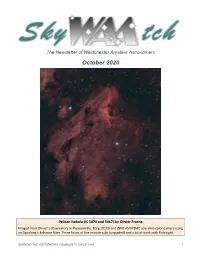
The Newsletter of Westchester Amateur Astronomers October 2020 Pelican Nebula (IC 5070 and 5067) by Olivier Prache Imaged from Olivier’s observatory in Pleasantville. Borg 101ED and ZWO ASI071MC one-shot-color camera using an Optolong L-Enhance filter. Three hours of five-minute subs (unguided) and a bit of work with PixInsight. SERVING THE ASTRONOMY COMMUNITY SINCE 1986 1 Westchester Amateur Astronomers SkyWAAtch October 2020 WAA October Meeting WAA November Meeting Friday, October 2 at 7:30 pm Friday, November at 6 7:30 pm On-line via Zoom On-line via Zoom Intelligent Nighttime Lighting: The Many BLACK HOLES: Not so black? Benefits of Dark Skies Willie Yee Charles Fulco Recent years have seen major breakthroughs in the Science educator Charles Fulco will discuss the meth- study of black holes, including the first image of a ods and many benefits of reducing light pollution, black hole from the Event Horizon Telescope and the including energy and tax dollar savings, health bene- detection of black hole collisions with the Laser fits and of course seeing the Milky Way again. Invita- Interferometer Gravitational-wave Observatory. tions and log-in instructions will be sent to WAA Dr. Yee, a NASA Solar System Ambassador and Past members via email. President of the Mid-Hudson Astronomical Association, will review the basic science of black Starway to Heaven holes and the myths surrounding them, and present Ward Pound Ridge Reservation, the recent findings of these projects. Cross River, NY Call: 1-877-456-5778 (toll free) for announcements, Scheduled for Oct 10th (rain/cloud date Oct 17). -
GTO Keypad Manual, V5.001
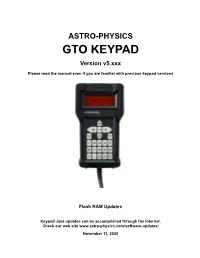
ASTRO-PHYSICS GTO KEYPAD Version v5.xxx Please read the manual even if you are familiar with previous keypad versions Flash RAM Updates Keypad Java updates can be accomplished through the Internet. Check our web site www.astro-physics.com/software-updates/ November 11, 2020 ASTRO-PHYSICS KEYPAD MANUAL FOR MACH2GTO Version 5.xxx November 11, 2020 ABOUT THIS MANUAL 4 REQUIREMENTS 5 What Mount Control Box Do I Need? 5 Can I Upgrade My Present Keypad? 5 GTO KEYPAD 6 Layout and Buttons of the Keypad 6 Vacuum Fluorescent Display 6 N-S-E-W Directional Buttons 6 STOP Button 6 <PREV and NEXT> Buttons 7 Number Buttons 7 GOTO Button 7 ± Button 7 MENU / ESC Button 7 RECAL and NEXT> Buttons Pressed Simultaneously 7 ENT Button 7 Retractable Hanger 7 Keypad Protector 8 Keypad Care and Warranty 8 Warranty 8 Keypad Battery for 512K Memory Boards 8 Cleaning Red Keypad Display 8 Temperature Ratings 8 Environmental Recommendation 8 GETTING STARTED – DO THIS AT HOME, IF POSSIBLE 9 Set Up your Mount and Cable Connections 9 Gather Basic Information 9 Enter Your Location, Time and Date 9 Set Up Your Mount in the Field 10 Polar Alignment 10 Mach2GTO Daytime Alignment Routine 10 KEYPAD START UP SEQUENCE FOR NEW SETUPS OR SETUP IN NEW LOCATION 11 Assemble Your Mount 11 Startup Sequence 11 Location 11 Select Existing Location 11 Set Up New Location 11 Date and Time 12 Additional Information 12 KEYPAD START UP SEQUENCE FOR MOUNTS USED AT THE SAME LOCATION WITHOUT A COMPUTER 13 KEYPAD START UP SEQUENCE FOR COMPUTER CONTROLLED MOUNTS 14 1 OBJECTS MENU – HAVE SOME FUN! -

The Evening Sky Map
I N E D R I A C A S T N E O D I T A C L E O R N I G D S T S H A E P H M O O R C I . Z N O p l f e i n h d o P t O o N ) l h a r g Z i u s , o I l C t P h R I r e o R N ( O o r C r H e t L p h p E E i s t D H a ( r g T F i . O B NORTH D R e N M h t E A X O e s A H U M C T . I P N S L E E P Z “ E A N H O NORTHERN HEMISPHERE M T R T Y N H E ” K E η ) W S . T T E W U B R N W D E T T W T H h A The Evening Sky Map e MAY 2021 E . C ) Cluster O N FREE* EACH MONTH FOR YOU TO EXPLORE, LEARN & ENJOY THE NIGHT SKY r S L a o K e Double r Y E t B h R M t e PERSEUS A a A r CASSIOPEIA n e S SKY MAP SHOWS HOW Get Sky Calendar on Twitter P δ r T C G C A CEPHEUS r E o R e J s O h Sky Calendar – May 2021 http://twitter.com/skymaps M39 s B THE NIGHT SKY LOOKS T U ( O i N s r L D o a j A NE I I a μ p T EARLY MAY PM T 10 r 61 M S o S 3 Last Quarter Moon at 19:51 UT. -
Figure-Of-Eight Velocity Curves: UGC 10205? J.C
AND Your thesaurus codes are: ASTROPHYSICS 03(11.09.1 UGC 10205; 11.11.1; 11.19.2; 11.19.6) 9.5.1997 Figure-of-eight velocity curves: UGC 10205? J.C. Vega1,E.M.Corsini2, A. Pizzella2, and F. Bertola2 1 Telescopio Nazionale Galileo, Osservatorio Astronomico di Padova, vicolo dell’Osservatorio 5, I-35122 Padova, Italy 2 Dipartimento di Astronomia, Universit`a di Padova, vicolo dell’Osservatorio 5, I-35122 Padova, Italy Received..................; accepted................... Abstract. We measured the velocity curve Boulesteix 1996). and the velocity dispersion profile of the ion- In the inner regions of the Sc NGC 5907 Miller ized gas along the major axis of the edge-on & Rubin (1995) observed double-valued ion- galaxy UGC 10205. The observed kinematics ized gas emissions. They attributed the higher extends up to about 4000 from the nucleus. In velocity system to disk gas near the nucleus, the inner ±1300 of this early-type spiral three and the lower velocity system to an outer kinematically distinct gaseous components are gas ring. Although these two gas components present. We disentangle a fast-rotating and are supposed to be spatially distinct, they are a slow-rotating component. They give to the viewed superimposed along the line-of-sight on UGC 10205 velocity curve a “figure-of-eight” account of NGC 5907 high inclination. appearance. A third velocity component is The spirals NGC 5746 (Kuijken & Merrifield also detected on the southeast side of the 1995; Bureau & Freeman 1996), NGC 5965 galaxy. Possibly it is produced by gas in non- (Kuijken & Merrifield 1995), IC 5096 (Bureau circular motions. -

DGSAT: Dwarf Galaxy Survey with Amateur Telescopes
Astronomy & Astrophysics manuscript no. arxiv30539 c ESO 2017 March 21, 2017 DGSAT: Dwarf Galaxy Survey with Amateur Telescopes II. A catalogue of isolated nearby edge-on disk galaxies and the discovery of new low surface brightness systems C. Henkel1;2, B. Javanmardi3, D. Mart´ınez-Delgado4, P. Kroupa5;6, and K. Teuwen7 1 Max-Planck-Institut f¨urRadioastronomie, Auf dem H¨ugel69, 53121 Bonn, Germany 2 Astronomy Department, Faculty of Science, King Abdulaziz University, P.O. Box 80203, Jeddah 21589, Saudi Arabia 3 Argelander Institut f¨urAstronomie, Universit¨atBonn, Auf dem H¨ugel71, 53121 Bonn, Germany 4 Astronomisches Rechen-Institut, Zentrum f¨urAstronomie, Universit¨atHeidelberg, M¨onchhofstr. 12{14, 69120 Heidelberg, Germany 5 Helmholtz Institut f¨ur Strahlen- und Kernphysik (HISKP), Universit¨at Bonn, Nussallee 14{16, D-53121 Bonn, Germany 6 Charles University, Faculty of Mathematics and Physics, Astronomical Institute, V Holeˇsoviˇck´ach 2, CZ-18000 Praha 8, Czech Republic 7 Remote Observatories Southern Alps, Verclause, France Received date ; accepted date ABSTRACT The connection between the bulge mass or bulge luminosity in disk galaxies and the number, spatial and phase space distribution of associated dwarf galaxies is a dis- criminator between cosmological simulations related to galaxy formation in cold dark matter and generalised gravity models. Here, a nearby sample of isolated Milky Way- class edge-on galaxies is introduced, to facilitate observational campaigns to detect the associated families of dwarf galaxies at low surface brightness. Three galaxy pairs with at least one of the targets being edge-on are also introduced. Approximately 60% of the arXiv:1703.05356v2 [astro-ph.GA] 19 Mar 2017 catalogued isolated galaxies contain bulges of different size, while the remaining objects appear to be bulgeless. -

SAA 100 Club
S.A.A. 100 Observing Club Raleigh Astronomy Club Version 1.2 07-AUG-2005 Introduction Welcome to the S.A.A. 100 Observing Club! This list started on the USENET newsgroup sci.astro.amateur when someone asked about everyone’s favorite, non-Messier objects for medium sized telescopes (8-12”). The members of the group nominated objects and voted for their favorites. The top 100 objects, by number of votes, were collected and ranked into a list that was published. This list is a good next step for someone who has observed all the objects on the Messier list. Since it includes objects in both the Northern and Southern Hemispheres (DEC +72 to -72), the award has two different levels to accommodate those observers who aren't able to travel. The first level, the Silver SAA 100 award requires 88 objects (all visible from North Carolina). The Gold SAA 100 Award requires all 100 objects to be observed. One further note, many of these objects are on other observing lists, especially Patrick Moore's Caldwell list. For convenience, there is a table mapping various SAA100 objects with their Caldwell counterparts. This will facilitate observers who are working or have worked on these lists of objects. We hope you enjoy looking at all the great objects recommended by other avid astronomers! Rules In order to earn the Silver certificate for the program, the applicant must meet the following qualifications: 1. Be a member in good standing of the Raleigh Astronomy Club. 2. Observe 80 Silver observations. 3. Record the time and date of each observation. -

July/August 2009
JULY/AUGUST 2009 The constellation Crux and the Coal Sack in all their glory during Lee Paul’s Southern Skies Fiesta Trip in Costa Rica. Page 3. Photo courtesy of Lee Paul. _____________________________________________________________________________________ INSIDE THIS ISSUE News: What’s going on in our club? Page 3. NASA Space Place: Some NASA science! Page 6. Looked Up Lately? Let RBAC prepare your observing list! Page 7. RIVER BEND ASTRONOMY CLUB CURRENT ASTRONOMY JULY/AUGUST 2009 * PAGE 1 Monthly Meetings Saturday, July 18, 2009 * 7:00 PM Saturday, August 22, 2009 * 7:00 PM Saturday, September 19, 2009 * 7:00 PM Kronk Observatory 132 Jessica Drive, St. Jacob, IL 62281 Looked Up Lately? River Bend Astronomy club serves astronomy enthusiasts Join River Bend Astronomy Club of the American Bottom region, the Mississippi River Want to learn more about astronomy? The members of RiverBend bluffs and beyond, fostering observation, education, and a Astronomy Club invite you to join. You won’t need expensive tools spirit of camaraderie. or special skills – just a passion for observing the natural world. Meetings offer learning, peeks through great telescopes, Officers and administrators and fun under the stars. PRESIDENT Gary Kronk You will receive the club newsletter, Current Astronomy, VICE-PRESIDENT Jamie Goggin packed with news and photos. TREASURER Mike Veith Get connected with our member-only online discussion LEAGUE CORRESPONDENT Bill Breeden group. SECRETARY Bill Breeden Borrow from the club’s multimedia library. OUTREACH COORDINATORS Jeff & Terry Menz Borrow from the club’s selection of solar telescopes. LIBRARIAN Kathy Kronk And that’s not all! Through club membership you also FOUNDING MEMBERS Ed Cunnius join the Astronomical League, with its special programs Kurt Sleeter and colorful quarterly newsletter The Reflector to enrich your hobby.