Download Download
Total Page:16
File Type:pdf, Size:1020Kb
Load more
Recommended publications
-
TPM/IPM Weekly Report for Arborists, Landscape Managers & Nursery Managers
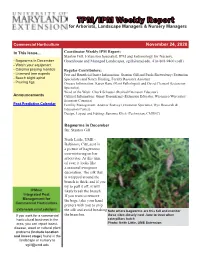
TPM/IPM Weekly Report for Arborists, Landscape Managers & Nursery Managers Commercial Horticulture November 24, 2020 In This Issue... Coordinator Weekly IPM Report: Stanton Gill, Extension Specialist, IPM and Entomology for Nursery, - Bagworms in December Greenhouse and Managed Landscapes, sgill@umd.edu. 410-868-9400 (cell) - Watch your equipment - Carolina praying mantids Regular Contributors: - Licensed tree experts Pest and Beneficial Insect Information: Stanton Gill and Paula Shrewsbury (Extension - Beech blight aphid Specialists) and Nancy Harding, Faculty Research Assistant - Pruning figs Disease Information: Karen Rane (Plant Pathologist) and David Clement (Extension Specialist) Weed of the Week: Chuck Schuster (Retired Extension Educator) Announcements Cultural Information: Ginny Rosenkranz (Extension Educator, Wicomico/Worcester/ Somerset Counties) Pest Predictive Calendar Fertility Management: Andrew Ristvey (Extension Specialist, Wye Research & Education Center) Design, Layout and Editing: Suzanne Klick (Technician, CMREC) Bagworms in December By: Stanton Gill Neith Little, UME - Baltimore City, sent in a picture of bagworms overwintering on her arborvitae. At this time of year, it looks like a seasonal evergreen decoration. The silk that is wrapped around the branch is thick, and if you try to pull it off, it will IPMnet likely break the branch. Integrated Pest If you want to remove Management for the bags, take your hand Commercial Horticulture pruners with you to snip extension.umd.edu/ipm the silk and avoid breaking Note where bagworms are this fall and monitor If you work for a commercial the branches. these sites closely next June to treat when horticultural business in the caterpillars hatch area, you can report insect, Photo: Neith Little, UME Extension disease, weed or cultural plant problems (include location and insect stage) found in the landscape or nursery to sgill@umd.edu Watch Your Equipment By: Stanton Gill One of the landscape companies called last week to let us know they left a $60,000 skid loader at a job site overnight. -
Aphids (Hemiptera, Aphididae)
A peer-reviewed open-access journal BioRisk 4(1): 435–474 (2010) Aphids (Hemiptera, Aphididae). Chapter 9.2 435 doi: 10.3897/biorisk.4.57 RESEARCH ARTICLE BioRisk www.pensoftonline.net/biorisk Aphids (Hemiptera, Aphididae) Chapter 9.2 Armelle Cœur d’acier1, Nicolas Pérez Hidalgo2, Olivera Petrović-Obradović3 1 INRA, UMR CBGP (INRA / IRD / Cirad / Montpellier SupAgro), Campus International de Baillarguet, CS 30016, F-34988 Montferrier-sur-Lez, France 2 Universidad de León, Facultad de Ciencias Biológicas y Ambientales, Universidad de León, 24071 – León, Spain 3 University of Belgrade, Faculty of Agriculture, Nemanjina 6, SER-11000, Belgrade, Serbia Corresponding authors: Armelle Cœur d’acier (coeur@supagro.inra.fr), Nicolas Pérez Hidalgo (nperh@unile- on.es), Olivera Petrović-Obradović (petrovic@agrif.bg.ac.rs) Academic editor: David Roy | Received 1 March 2010 | Accepted 24 May 2010 | Published 6 July 2010 Citation: Cœur d’acier A (2010) Aphids (Hemiptera, Aphididae). Chapter 9.2. In: Roques A et al. (Eds) Alien terrestrial arthropods of Europe. BioRisk 4(1): 435–474. doi: 10.3897/biorisk.4.57 Abstract Our study aimed at providing a comprehensive list of Aphididae alien to Europe. A total of 98 species originating from other continents have established so far in Europe, to which we add 4 cosmopolitan spe- cies of uncertain origin (cryptogenic). Th e 102 alien species of Aphididae established in Europe belong to 12 diff erent subfamilies, fi ve of them contributing by more than 5 species to the alien fauna. Most alien aphids originate from temperate regions of the world. Th ere was no signifi cant variation in the geographic origin of the alien aphids over time. -

ARTHROPODA Subphylum Hexapoda Protura, Springtails, Diplura, and Insects
NINE Phylum ARTHROPODA SUBPHYLUM HEXAPODA Protura, springtails, Diplura, and insects ROD P. MACFARLANE, PETER A. MADDISON, IAN G. ANDREW, JOCELYN A. BERRY, PETER M. JOHNS, ROBERT J. B. HOARE, MARIE-CLAUDE LARIVIÈRE, PENELOPE GREENSLADE, ROSA C. HENDERSON, COURTenaY N. SMITHERS, RicarDO L. PALMA, JOHN B. WARD, ROBERT L. C. PILGRIM, DaVID R. TOWNS, IAN McLELLAN, DAVID A. J. TEULON, TERRY R. HITCHINGS, VICTOR F. EASTOP, NICHOLAS A. MARTIN, MURRAY J. FLETCHER, MARLON A. W. STUFKENS, PAMELA J. DALE, Daniel BURCKHARDT, THOMAS R. BUCKLEY, STEVEN A. TREWICK defining feature of the Hexapoda, as the name suggests, is six legs. Also, the body comprises a head, thorax, and abdomen. The number A of abdominal segments varies, however; there are only six in the Collembola (springtails), 9–12 in the Protura, and 10 in the Diplura, whereas in all other hexapods there are strictly 11. Insects are now regarded as comprising only those hexapods with 11 abdominal segments. Whereas crustaceans are the dominant group of arthropods in the sea, hexapods prevail on land, in numbers and biomass. Altogether, the Hexapoda constitutes the most diverse group of animals – the estimated number of described species worldwide is just over 900,000, with the beetles (order Coleoptera) comprising more than a third of these. Today, the Hexapoda is considered to contain four classes – the Insecta, and the Protura, Collembola, and Diplura. The latter three classes were formerly allied with the insect orders Archaeognatha (jumping bristletails) and Thysanura (silverfish) as the insect subclass Apterygota (‘wingless’). The Apterygota is now regarded as an artificial assemblage (Bitsch & Bitsch 2000). -

Ecological Monitoring at Rare, 2020
Ecological Monitoring 2020 rare Charitable Research Reserve Prepared by: Jordan Wrobel Jenna Quinn 1 Acknowledgements Many thanks to Colleges and Institutes Canada (CICan) Career-Launcher Internships, funded by Natural Resource’s Canada’s Green Jobs- Science and Technology Internship Program, and Employment Ontario for providing essential funding for ecological monitoring at rare; without their support, this monitoring program and report would not have been possible. I would also like to thank rare staff for assistance with monitoring and support of intellectual and professional growth. Thank you to Caroline Reisiger and Sarah Cui for their much- appreciated assistance with fieldwork and to Dr. Justin Gaudon for your support with the statistical analyses. To rare’s committed volunteers: Jacqueline Haynes, Miriam Bauman, Emma Wegener, Hilary Irving, Bethany Wakefield, and Logan Mercier; thank you so much for your support with monitoring, these programs would not be as successful without you. I would like to thank all advocates of rare Charitable Research Reserve for helping to support rare’s vision and activities. The rare Charitable Research Reserve acknowledges and is grateful to all of the original stewards of the land in which rare resides, within the Haldimand Tract, spanning six miles on either side of the Grand River from source to mouth. Understanding that this land has been rich in diverse Indigenous presence since time immemorial, there are several Indigenous Nations that we would like to mention. We would like to honor and respect the sovereignty of both First Nations in our area: the Haudenosaunee Peoples of Six Nations of the Grand River and the Anishinaabe Peoples of Mississaugas of the New Credit First Nation. -
Gall-Inducing Aphids (Hemiptera: Aphidoidea: Eriosomatinae) Associated with Salicaceae and Ulmaceae in Razavi Khorasan Province, with New Records for Fauna of Iran
Acta Phytopathologica et Entomologica Hungarica 54 (1), pp. 113–126 (2019) DOI: 10.1556/038.54.2019.010 Gall-inducing Aphids (Hemiptera: Aphidoidea: Eriosomatinae) Associated with Salicaceae and Ulmaceae in Razavi Khorasan Province, with New Records for Fauna of Iran A. NAJMI1, H. S. NAMAGHI1*, S. BARJADZE2 and L. FEKRAT1 1Department of Plant Protection, Faculty of Agriculture, Ferdowsi University of Mashhad, Mashhad, Iran 2Institute of Zoology, Ilia State University, Tbilisi, Georgia (Received: 11 November 2018; accepted: 16 November 2018) A survey of gall-inducing aphids on elm and poplar trees was carried out during 2017 in Razavi Kho- rasan province, NE Iran. As a result, 15 species of gall-inducing aphids from 5 genera, all belonging to the subfamily Eriosomatinae, were recorded on 6 host plant species. The collected species included the genera Eriosoma, Kaltenbachiella, Pemphigus, Tetraneura and Thecabius. Pemphigus passeki Börner (Hemiptera: Aphididae) and Pemphigus populinigrae (Schrank) (Hemiptera: Aphididae) on Populus nigra var. italica (Sal- icaceae) were new records for the Iranian aphid fauna. Both new recorded species belong to the tribe Pem- phigini, subfamily Eriosomatinae. Among the identified species, 8 aphid species were new records for Razavi Khorasan province. Keywords: Aphid, elm, poplar, fauna, gall-inducing aphid. Many insect groups, around 13,000 species, are known as plant gall makers (Nyman and Julkunen-Tiitto, 2000; Suzuki et al., 2009). Among them, Aphidoidea is a very large superfamily in the hemipteran suborder Sternorrhyncha with about 5000 known species (Blackman and Eastop, 2000; Ge et al., 2016). It is estimated that there are practically 10–20 % gallicolous aphid species nationwide (Chakrabarti, 2007; Chen and Qiao, 2012; Álvarez et al., 2013). -
Gall-Inducing Aphids (Hemiptera: Aphidoidea: Eriosomatinae) Associated with Salicaceae and Ulmaceae in Razavi Khorasan Province, with New Records for Fauna of Iran
View metadata, citation and similar papers at core.ac.uk brought to you by CORE provided by Repository of the Academy's Library Acta Phytopathologica et Entomologica Hungarica 54 (1), pp. 113–126 (2019) DOI: 10.1556/038.54.2019.010 Gall-inducing Aphids (Hemiptera: Aphidoidea: Eriosomatinae) Associated with Salicaceae and Ulmaceae in Razavi Khorasan Province, with New Records for Fauna of Iran A. NAJMI1, H. S. NAMAGHI1*, S. BARJADZE2 and L. FEKRAT1 1Department of Plant Protection, Faculty of Agriculture, Ferdowsi University of Mashhad, Mashhad, Iran 2Institute of Zoology, Ilia State University, Tbilisi, Georgia (Received: 11 November 2018; accepted: 16 November 2018) A survey of gall-inducing aphids on elm and poplar trees was carried out during 2017 in Razavi Kho- rasan province, NE Iran. As a result, 15 species of gall-inducing aphids from 5 genera, all belonging to the subfamily Eriosomatinae, were recorded on 6 host plant species. The collected species included the genera Eriosoma, Kaltenbachiella, Pemphigus, Tetraneura and Thecabius. Pemphigus passeki Börner (Hemiptera: Aphididae) and Pemphigus populinigrae (Schrank) (Hemiptera: Aphididae) on Populus nigra var. italica (Sal- icaceae) were new records for the Iranian aphid fauna. Both new recorded species belong to the tribe Pem- phigini, subfamily Eriosomatinae. Among the identified species, 8 aphid species were new records for Razavi Khorasan province. Keywords: Aphid, elm, poplar, fauna, gall-inducing aphid. Many insect groups, around 13,000 species, are known as plant gall makers (Nyman and Julkunen-Tiitto, 2000; Suzuki et al., 2009). Among them, Aphidoidea is a very large superfamily in the hemipteran suborder Sternorrhyncha with about 5000 known species (Blackman and Eastop, 2000; Ge et al., 2016). -

Forest Insect and Disease Conditions in Vermont 2015
FOREST INSECT AND DISEASE CONDITIONS IN VERMONT 2015 AGENCY OF NATURAL RESOURCES DEPARTMENT OF FORESTS, PARKS & RECREATION MONTPELIER - VERMONT 05620-3801 STATE OF VERMONT PETER SHUMLIN, GOVERNOR AGENCY OF NATURAL RESOURCES DEBORAH L. MARKOWITZ, SECRETARY DEPARTMENT OF FORESTS, PARKS & RECREATION Michael C. Snyder, Commissioner Steven J. Sinclair, Director of Forests http://www.vtfpr.org/ We gratefully acknowledge the financial and technical support provided by the USDA Forest Service, Northeastern Area State and Private Forestry that enables us to conduct the surveys and publish the results in this report. This document serves as the final report for fulfillment of the Cooperative Lands – Survey and Technical Assistance and Forest Health Monitoring programs. In accordance with federal law and U.S. Department of Agriculture policy, this institution is prohibited from discrimination on the basis of race, color, national origin, sex, age, or disability. This document is available upon request in large print, Braille or audio cassette. FOREST INSECT AND DISEASE CONDITIONS IN VERMONT CALENDAR YEAR 2015 PREPARED BY: Barbara Schultz, Trish Hanson, Sandra Wilmot, Joshua Halman, Kathy Decker, Tess Greaves AGENCY OF NATURAL RESOURCES DEPARTMENT OF FORESTS, PARKS & RECREATION STATE OF VERMONT – DEPARTMENT OF FORESTS, PARKS & RECREATION FOREST RESOURCE PROTECTION PERSONNEL Barbara Schultz Kathy Decker Elizabeth Spinney Forest Health Program Manager Plant Pathologist/Invasive Plant Program Invasive Plant Coordinator Dept. of Forests, Parks & Recreation Manager/District Manager 111 West Street 100 Mineral Street, Suite 304 Dept. of Forests, Parks & Recreation Essex Junction, VT 05452-4695 Springfield, VT 05156-3168 1229 Portland St., Suite 201 Work Phone: 802-477-2134 Cell Phone: 802-777-2082 St. -

Ecological and Logistical Considerations Toward Introducing Heringia Calcarata to New Zealand
Ecological and logistical considerations toward introducing Heringia calcarata to New Zealand Sean D. M. Gresham Thesis submitted to the faculty of the Virginia Polytechnic Institute and State University in partial fulfillment of the degree of Master of Science in Life Science In Entomology J. Christopher Bergh (Committee Chair) Loke T. Kok Scott M. Salom 28 January 2013 Blacksburg, VA Keywords: Eriosoma lanigerum, Heringia calcarata, Aphelinus mali, Intraguild predation, biological control, ovary development, captive rearing Ecological and logistical considerations toward introducing Heringia calcarata to New Zealand Sean D. M. Gresham Abstract This thesis outlines research conducted as part of a collaborative project between Virginia Tech and Plant and Food Research New Zealand (PFRNZ) to introduce Heringia calcarata (Loew) (Diptera: Syrphidae) to New Zealand (NZ) for biological control of woolly apple aphid (WAA), Eriosoma lanigerum (Hausmann) (Hemiptera: Aphididae). Ultimately, the introduction of H. calcarata to New Zealand will be contingent upon satisfying regulatory requirements and concerns, including documentation that it will not have an adverse effect on the existing biological control of WAA by Aphelinus mali (Haldeman) (Hymenoptera: Aphelinidae). As well, it will be critical to develop methods for sustained rearing of H. calcarata in captivity. Basic and applied studies were conducted toward providing essential information for advancing this project. Apple shoot sections with a WAA colony that did or did not contain mummified aphids parasitized by A. mali were deployed in pairs at the base of apple trees. There was no significant difference in the mean number of H. calcarata eggs deposited between shoots with parasitized (1.5 ± 0.34 SE) and non-parasitized colonies (1.75 ± 0.42 SE), although female H. -

Insights from Ant Farmers and Their Trophobiont Mutualists
Received: 28 August 2017 | Revised: 21 November 2017 | Accepted: 28 November 2017 DOI: 10.1111/mec.14506 SPECIAL ISSUE: THE HOST-ASSOCIATED MICROBIOME: PATTERN, PROCESS, AND FUNCTION Can social partnerships influence the microbiome? Insights from ant farmers and their trophobiont mutualists Aniek B. F. Ivens1,2 | Alice Gadau2 | E. Toby Kiers1 | Daniel J. C. Kronauer2 1Animal Ecology Section, Department of Ecological Science, Faculty of Science, Vrije Abstract Universiteit, Amsterdam, The Netherlands Mutualistic interactions with microbes have played a crucial role in the evolution 2Laboratory of Social Evolution and and ecology of animal hosts. However, it is unclear what factors are most important Behavior, The Rockefeller University, New York, NY, USA in influencing particular host–microbe associations. While closely related animal spe- cies may have more similar microbiota than distantly related species due to phyloge- Correspondence Aniek B. F. Ivens, Animal Ecology Section, netic contingencies, social partnerships with other organisms, such as those in Department of Ecological Science, Faculty of which one animal farms another, may also influence an organism’s symbiotic micro- Science, Vrije Universiteit, Amsterdam, The Netherlands. biome. We studied a mutualistic network of Brachymyrmex and Lasius ants farming Email: a.b.f.ivens@vu.nl several honeydew-producing Prociphilus aphids and Rhizoecus mealybugs to test Present address whether the mutualistic microbiomes of these interacting insects are primarily corre- Alice Gadau, Arizona -

Aphids (Hemiptera: Aphidoidea) Associated with Native Trees in Malta (Central Mediterranean)
BULLETIN OF THE ENTOMOLOGICAL SOCIETY OF MALTA (2009) Vol. 2 : 81-93 Aphids (Hemiptera: Aphidoidea) associated with native trees in Malta (Central Mediterranean) David MIFSUD1, Nicolás PÉREZ HIDALGO2 & Sebastiano BARBAGALLO3 ABSTRACT. In the present study 25 aphid species which are known to be associated with trees in the Maltese Islands are recorded. Of these, 18 species represent new records; these include Aphis craccivora, Brachyunguis tamaricis, Cavariella aegopodii, Chaitophorus capreae, C. populialbae, Cinara cupressi, C. maghrebica, C. palaestinensis, Essigella californica, Eulachnus rileyi, E. tuberculostemmatus, Hoplocallis picta, Lachnus roboris, Myzocallis schreiberi, Tetraneura nigriabdominalis, Thelaxes suberi, Tinocallis takachihoensis and Tuberolachnus salignus. A number of the above mentioned species alternate hosts between the primary host, being the tree species, and secondary hosts being mainly roots of grasses. The record of Tetraneura ulmi could be incorrect and could possibly be referred to T. nigriabdominalis. Most of the aphid species recorded in the present study have restricted distribution in the Maltese Islands due to the rarity of their host trees. This is particularly so for those aphids associated with Populus, Quercus, Salix and Ulmus whose conservation should be addressed. INTRODUCTION Aphids belong to the suborder Sternorrhyncha within the order Hemiptera, along with scale insects, jumping plant-lice, or psylloids, and whiteflies. The Aphidoidea is predominantly a northern temperate group, richest in species in North America, Europe, and Central and Eastern Asia. A general feature of the life cycle of aphids is their parthenogenetic generations exploiting active growing plant parts and a sexual generation resulting in an overwintering diapause egg. The known world fauna of aphids consists of approximately 4400 described species placed in nearly 500 currently accepted genera. -
Cascading Effects of a Highly Specialized Beech-Aphid--Fungus
Cascading eVects of a highly specialized beech-aphid–fungus interaction on forest regeneration Susan C. Cook-Patton1, Lauren Maynard1, Nathan P. Lemoine2, Jessica Shue1 and John D. Parker1 1 Smithsonian Environmental Research Center, Edgewater, MD, United States 2 Florida International University, United States ABSTRACT Specialist herbivores are thought to often enhance or maintain plant diversity within ecosystems, because they prevent their host species from becoming competitively dominant. In contrast, specialist herbivores are not generally expected to have neg- ative impacts on non-hosts. However, we describe a cascade of indirect interactions whereby a specialist sooty mold (Scorias spongiosa) colonizes the honeydew from a specialist beech aphid (Grylloprociphilus imbricator), ultimately decreasing the survival of seedlings beneath American beech trees (Fagus grandifolia). A common garden experiment indicated that this mortality resulted from moldy honeydew impairing leaf function rather than from chemical or microbial changes to the soil. In addition, aphids consistently and repeatedly colonized the same large beech trees, suggesting that seedling-depauperate islands may form beneath these trees. Thus this highly specialized three-way beech-aphid–fungus interaction has the potential to negatively impact local forest regeneration via a cascade of indirect eVects. Subjects Biodiversity, Ecology, Entomology, Plant Science Keywords Seedling survival, Grylloprociphilus imbricator, Scorias spongiosa, Forest regeneration, Submitted 1 -

Aphid Species (Hemiptera, Aphididae) New in Fauna of Upper Silesia Region
Acta entomologica silesiana Vol. 25: 147–150 ISSN 1230-7777, ISSN 2353-1703 (online) Bytom, December 29, 2017 Aphid species (Hemiptera: Aphididae) new in fauna of Upper Silesia region http://doi.org/10.5281/zenodo.834223 AdriAn MAsłowski1,2, PAtrycjA Ledwoń1,2, ALeksAndrA wygLendA1,2, joAnnA ZygAłA1,2, doMinikA ŻebrAckA1,2, AgniesZkA ŚMiech1,2, MAriusZ kAnturski1, łukAsZ depa1 * 1 * Department of Zoology, University of Silesia, Bankowa 9, 40-007 Katowice, e-mail: lukasz.depa@us.edu.pl 2 Students’ Scientific Association “Faunatycy”, Department of Zoology, University of Silesia, Bankowa 9, 40-007 Katowice ABSTRACT. Aphid species (Hemiptera, Aphididae) new in fauna of Upper Silesia region. Paper presents data on the occurrence of five aphids species for the first time recorded from the territory of the zoogeographical region of Upper Silesia. This gives a total number of 386 aphid taxa known from this region. KEY WORDS: faunistics, zoogeography, aphid, Poland, alien species. INTRODUCTION Aphids, contrary to most of other insects, are the group reaching its highest species diversity in the zone of moderate climates. Poland is among the best studied European countries in terms of aphid fauna, with 764 recorded aphid taxa (wojciechowski et al. 2015). However, particular regions of Poland are still unevenly studied (osiAdAcZ & hAłAj 2009). The region of Upper Silesia, despite being the area of intense aphidological studies (e.g. depa & wojciechowski 2009, DEPA & TRELA 2011, treLA & hercZek 2014) still is far from being satisfactorily investigated. Here we present the results of studies of members of Student’s Scientific Association “Faunatycy” concerning aphid fauna of this region, resulting in discovery of five aphid species for the first time recorded in Upper Silesia.