LIBERIA) INC (20,000Ha)
Total Page:16
File Type:pdf, Size:1020Kb
Load more
Recommended publications
-
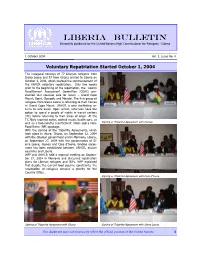
Liberia BULLETIN Bimonthly Published by the United Nations High Commissioner for Refugees - Liberia
LibeRIA BULLETIN Bimonthly published by the United Nations High Commissioner for Refugees - Liberia 1 October 2004 Vol. 1, Issue No. 4 Voluntary Repatriation Started October 1, 2004 The inaugural convoys of 77 Liberian refugees from Sierra Leone and 97 from Ghana arrived to Liberia on October 1, 2004, which marked the commencement of the UNHCR voluntary repatriation. Only two weeks prior to the beginning of the repatriation, the County Resettlement Assessment Committee (CRAC) pro- claimed four counties safe for return – Grand Cape Mount, Bomi, Gbarpolu and Margibi. The first group of refugees from Sierra Leone is returning to their homes in Grand Cape Mount. UNHCR is only facilitating re- turns to safe areas. Upon arrival, returnees have the option to spend a couple of nights in transit centers (TC) before returning to their areas of origin. At the TC, they received water, cooked meals, health care, as well as a two-months resettlement ration and a Non- Signing of Tripartite Agreement with Guinea Food Items (NFI) package. With the signing of the Tripartite Agreements, which took place in Accra, Ghana, on September 22, 2004 with the Ghanian government and in Monrovia, Liberia, on September 27, 2004 with the governments of Si- erra Leone, Guinea and Cote d’Ivorie, binding agree- ment has been established between UNHCR, asylum countries and Liberia. WFP and UNHCR held a regional meeting on Septem- ber 27, 2004 in Monrovia and discussed repatriation plans for Liberian refugees and IDPs. WFP explained that despite the current food pipeline constraints, the repatriation of refugees remains a priority for the Country Office. -

Ornithological Expedition to Southern Bénin, April 2011
Ornithological expedition to southern Bénin, April 2011 Françoise Dowsett-Lemaire & Robert J. Dowsett Dowsett-Lemaire Misc. Report 80 (2011) Dowsett-Lemaire F. & Dowsett R.J. 2011. Ornithological expedition to southern Bénin, April 2011. Dowsett-Lemaire Miscellaneous Report 80: 16pp. Birds of southern Bénin -1- Dowsett-Lemaire Misc. Rep. 80 (2011) Ornithological expedition to southern Bénin, April 2011 by Françoise Dowsett-Lemaire & Robert J. Dowsett Résumé Ceci est notre deuxième visite au sud du Bénin, faisant suite à une première expédition pendant la saison sèche de 2009. Le mois d’avril 2011 a été partagé entre les forêts principales du sud (Lama, Niaouli), les forêts plus sèches ou forêts claires des Monts Kouffé et Tobé à l’ouest, les plaines marécageuses du Zou et du Sô, et la zone côtière (Pahou et Grand-Popo). Un séjour du 12 au 16 avril à la limite sud des Monts Kouffé et dans la zone protégée de Tobé (Bantè) a permis d’étendre l’aire de distribution de plusieurs espèces forestières ou de sa - vane, notamment du rare Aigle couronné Stephanoaetus coronatus (un ex. essayant de capturer un Daman des rochers sur le rocher de Tobé), du Râle perlé Sarothrura pulchra (un chanteur à Tobé, limite nord actuelle), de l’Oedicnème tachard Burhinus capensis (Tobé, limite sud actuelle), Malcoha à bec jaune Ceuthmochares aereus (Tobé & Kouffé, limite nord), Coucal à ventre blanc Centropus leucogaster (Tobé & Kouffé, limite nord), Grand-duc de Verreaux Bubo lacteus (Kouffé), Trogon narina Apaloderma narina (Kouffé), Calao rieur By - canistes -

Ghana Mega Rockfowl & Upper Guinea Specials 3 to 25 January 2016 (23 Days) Trip Report
Knox Ghana Mega Rockfowl & Upper Guinea Specials 3 to 25 January 2016 (23 days) Trip Report Akun Eagle-Owl by David Hoddinott Trip Report compiled by Tour Leader Markus Lilje RBT Knox Ghana Mega Trip Report January 2015 2 Trip Summary Our private Ghana Mega trip proved yet again to be a resounding success! We notched up a fantastic species total in 23 days, where we covered the length and breadth of the country and a great variety of habitats in this superb West African country! Our tour started off with a visit to Shai Hills. This small but fabulous reserve has a nice variety of habitats including mixed woodland, grassland, wetlands and granite outcrops and therefore supports an interesting array of bird species. During our morning exploring the reserve we recorded African Cuckoo-Hawk, Western Marsh Harrier, Red-necked Buzzard, stunning Violet Turaco, numerous immaculate Blue-bellied Roller, Vieillot’s and Double-toothed Barbets, Senegal and African Wattled Lapwings, White-shouldered Black Tit, Red- shouldered Cuckooshrike, Black-bellied Bustard, Senegal Parrot, Senegal Batis and restless Senegal Eremomela. A number of migrants were seen including Willow Warbler, Whinchat and Spotted Flycatcher. Even mammals showed well for us as we had a number of Kob, Bushbuck, Olive Baboon, Callithrix Monkey and unusually good views of Lesser Spot- Blue-bellied Roller by Markus Lilje nosed Monkey! Well pleased with our morning’s birding, we left Shai Hills and made our way to Ho. En route we stopped for lunch near the Volta Dam where we enjoyed most memorable close-up encounters with Mangrove Sunbird and Bronze- tailed Starling. -

Government of the Republic of Sierra Leone Bumbuna Hydroelectric
Government of the Republic of Sierra Leone Ministry of Energy and Power Public Disclosure Authorized Bumbuna Hydroelectric Project Environmental Impact Assessment Draft Final Report - Appendices Public Disclosure Authorized Public Disclosure Authorized January 2005 Public Disclosure Authorized in association with BMT Cordah Ltd Appendices Document Orientation The present EIA report is split into three separate but closely related documents as follows: Volume1 – Executive Summary Volume 2 – Main Report Volume 3 – Appendices This document is Volume 3 – Appendices. Nippon Koei UK, BMT Cordah and Environmental Foundation for Africa i Appendices Glossary of Acronyms AD Anno Domini AfDB African Development Bank AIDS Auto-Immune Deficiency Syndrome ANC Antenatal Care BCC Behavioural Change Communication BHP Bumbuna Hydroelectric Project BWMA Bumbuna Watershed Management Authority BOD Biochemical Oxygen Demand BP Bank Procedure (World Bank) CBD Convention on Biodiversity CHC Community Health Centre CHO Community Health Officer CHP Community Health Post CLC Community Liaison Committee COD Chemical Oxygen Demand dbh diameter at breast height DFID Department for International Development (UK) DHMT District Health Management Team DOC Dissolved Organic Carbon DRP Dam Review Panel DUC Dams Under Construction EA Environmental Assessment ECA Export Credit Agency EFA Environmental Foundation for Africa EHS Environment, Health and Safety EHSO Environment, Health and Safety Officer EIA Environmental Impact Assessment EMP Environmental Management Plan EPA -

Bird Checklists of the World Country Or Region: Ghana
Avibase Page 1of 24 Col Location Date Start time Duration Distance Avibase - Bird Checklists of the World 1 Country or region: Ghana 2 Number of species: 773 3 Number of endemics: 0 4 Number of breeding endemics: 0 5 Number of globally threatened species: 26 6 Number of extinct species: 0 7 Number of introduced species: 1 8 Date last reviewed: 2019-11-10 9 10 Recommended citation: Lepage, D. 2021. Checklist of the birds of Ghana. Avibase, the world bird database. Retrieved from .https://avibase.bsc-eoc.org/checklist.jsp?lang=EN®ion=gh [26/09/2021]. Make your observations count! Submit your data to ebird. -

Ghana Nov 2013
Wise Birding Holidays All tours donate to conservation projects worldwide! Trip Report GHANA: Picathartes to Plover Tour Monday 18th Nov. - Tuesday 3rd Dec. 2013 Tour Participants: John Archer, Bob Watts, Graeme Spinks, Peter Alfrey, Nigel & Kath Oram Leaders: Chris Townend & Robert Oteng-Appau HIGHLIGHTS OF TRIP Yellow-headed Picathartes: Whilst sitting quietly in the magical forest, we were wowed by at least 5 different birds as they returned to their roost site. Egyptian Plover: A minimum of 5 adults were seen very well on the White Volta River, along with a very young chick. Confirmed as the first breeding record for Ghana! Rufous-sided Broadbill: A smart male performed admirably as it carried out its acrobatic display flight with amazing mechanical whirring sound. Black Dwarf Hornbill: An amazing 4 different birds seen throughout the tour! Black Bee-Eater: A very understated name for such a fantastically stunning bird! This Yellow-headed Picathartes taken by tour participant Peter Alfrey was one of five birds seen and voted bird of the trip!! WISE BIRDING HOLIDAYS LTD – GHANA: Picathartes to Plover Tour, November 2013 Monday 18th November: Arrive Accra The whole group arrived on time into Accra’s Kotoka Airport. Here, we boarded our spacious air-conditioned coach which was to be our transport for the next 15 days. After about 30 minutes we arrived at our beach hotel and were all soon checked in to our rooms. Everyone was tired, but full of anticipation for our first full days’ birding in Ghana. It was straight to bed for some whereas others were in need of a cool beer before sleep! Tuesday 19th November: Sakumono Lagoon / Winneba Plains It was a relaxed start today with a brief look at the sea before breakfast where the highlights were a few Royal Terns and a Caspian Tern along with our first Copper Sunbird and Laughing Dove in the hotel gardens. -

The Avifauna of Two Woodlands in Southeast Tanzania
Scopus 25: 2336, December 2005 The avifauna of two woodlands in southeast Tanzania Anders P. Tøttrup, Flemming P. Jensen and Kim D. Christensen In Tanzania Brachystegia or miombo woodland occupies about two-thirds of the country including the central plateau to the north and the south eastern plateau (Lind & Morrison 1974). Along the coast more luxuriant woodlands are found in what White (1983) terms the Zanzibar-Inhambane regional mosaic floristic region. This highly complex vegetation comprises unique types of forest, thicket, woodland, bushland and grassland, interspersed with areas presently under cultivation and fallow (Hawthorne 1993). The coastal woodlands are usually deciduous or semi-deciduous but contain some evergreen species and often merge with coastal thickets, scrub forest and coastal forest (Hawthorne 1993, Vollesen 1994). The avifauna of miombo woodlands has been described for Zambia (e.g. Benson & Irwin 1966) and Zimbabwe (e.g. Vernon 1968, 1984, 1985), while little has been published on the birds of the coastal woodlands. An exception is Stjernstedt (1970) who reported on the birds in lush and dense Brachystegia microphylla vegetation in a sea of miombo in southeast Tanzania. Here we report our observations of birds in two woodlands in coastal southeast Tanzania, one of which harboured miombo trees. We present information on the number of species encountered during the fieldwork, and compare the avifauna of the two sites. We discuss possible causes for the differences observed and provide new information on habitat preferences for some of the species we recorded at these sites. Study sites Field work was carried out in two coastal woodlands in the Lindi Region, southeast Tanzania in September and October 2001. -

GHANA MEGA Rockfowl & Upper Guinea Specials Th St 29 November to 21 December 2011 (23 Days)
GHANA MEGA Rockfowl & Upper Guinea Specials th st 29 November to 21 December 2011 (23 days) White-necked Rockfowl by Adam Riley Trip Report compiled by Tour Leader David Hoddinott RBT Ghana Mega Trip Report December 2011 2 Trip Summary Our record breaking trip total of 505 species in 23 days reflects the immense birding potential of this fabulous African nation. Whilst the focus of the tour was certainly the rich assemblage of Upper Guinea specialties, we did not neglect the interesting diversity of mammals. Participants were treated to an astonishing 9 Upper Guinea endemics and an array of near-endemics and rare, elusive, localized and stunning species. These included the secretive and rarely seen White-breasted Guineafowl, Ahanta Francolin, Hartlaub’s Duck, Black Stork, mantling Black Heron, Dwarf Bittern, Bat Hawk, Beaudouin’s Snake Eagle, Congo Serpent Eagle, the scarce Long-tailed Hawk, splendid Fox Kestrel, African Finfoot, Nkulengu Rail, African Crake, Forbes’s Plover, a vagrant American Golden Plover, the mesmerising Egyptian Plover, vagrant Buff-breasted Sandpiper, Four-banded Sandgrouse, Black-collared Lovebird, Great Blue Turaco, Black-throated Coucal, accipiter like Thick- billed and splendid Yellow-throated Cuckoos, Olive and Dusky Long-tailed Cuckoos (amongst 16 cuckoo species!), Fraser’s and Akun Eagle-Owls, Rufous Fishing Owl, Red-chested Owlet, Black- shouldered, Plain and Standard-winged Nightjars, Black Spinetail, Bates’s Swift, Narina Trogon, Blue-bellied Roller, Chocolate-backed and White-bellied Kingfishers, Blue-moustached, -
There Are Two Systems of Surveillance Operating in Burundi at Present
LIVELIHOOD ZONING ACTIVITY IN LIBERIA - UPDATE A SPECIAL REPORT BY THE FAMINE EARLY WARNING SYSTEM NETWORK (FEWS NET) May 2017 1 LIVELIHOOD ZONING ACTIVITY IN LIBERIA - UPDATE A SPECIAL REPORT BY THE FAMINE EARLY WARNING SYSTEM NETWORK (FEWS NET) April 2017 This publication was prepared by Stephen Browne and Amadou Diop for the Famine Early Warning Systems Network (FEWS NET), in collaboration with the Liberian Ministry of Agriculture, USAID Liberia, WFP, and FAO. The authors’ views expressed in this publication do not necessarily reflect the views of the United States Agency for International Development or the United States Government. Page 2 of 60 Contents Acknowledgements ...................................................................................................................... 4 Acronyms and Abbreviations ......................................................................................................... 5 Background and Introduction......................................................................................................... 6 Methodology ............................................................................................................................... 8 National Livelihood Zone Map .......................................................................................................12 National Seasonal Calendar ..........................................................................................................13 Timeline of Shocks and Hazards ....................................................................................................14 -

Protected Area Management Plan Development - SAPO NATIONAL PARK
Technical Assistance Report Protected Area Management Plan Development - SAPO NATIONAL PARK - Sapo National Park -Vision Statement By the year 2010, a fully restored biodiversity, and well-maintained, properly managed Sapo National Park, with increased public understanding and acceptance, and improved quality of life in communities surrounding the Park. A Cooperative Accomplishment of USDA Forest Service, Forestry Development Authority and Conservation International Steve Anderson and Dennis Gordon- USDA Forest Service May 29, 2005 to June 17, 2005 - 1 - USDA Forest Service, Forestry Development Authority and Conservation International Protected Area Development Management Plan Development Technical Assistance Report Steve Anderson and Dennis Gordon 17 June 2005 Goal Provide support to the FDA, CI and FFI to review and update the Sapo NP management plan, establish a management plan template, develop a program of activities for implementing the plan, and train FDA staff in developing future management plans. Summary Week 1 – Arrived in Monrovia on 29 May and met with Forestry Development Authority (FDA) staff and our two counterpart hosts, Theo Freeman and Morris Kamara, heads of the Wildlife Conservation and Protected Area Management and Protected Area Management respectively. We decided to concentrate on the immediate implementation needs for Sapo NP rather than a revision of existing management plan. The four of us, along with Tyler Christie of Conservation International (CI), worked in the CI office on the following topics: FDA Immediate -

Zimbabwe Zambia Malawi Species Checklist Africa Vegetation Map
ZIMBABWE ZAMBIA MALAWI SPECIES CHECKLIST AFRICA VEGETATION MAP BIOMES DeserT (Namib; Sahara; Danakil) Semi-deserT (Karoo; Sahel; Chalbi) Arid SAvannah (Kalahari; Masai Steppe; Ogaden) Grassland (Highveld; Abyssinian) SEYCHELLES Mediterranean SCruB / Fynbos East AFrican Coastal FOrest & SCruB DrY Woodland (including Mopane) Moist woodland (including Miombo) Tropical Rainforest (Congo Basin; upper Guinea) AFrO-Montane FOrest & Grassland (Drakensberg; Nyika; Albertine rift; Abyssinian Highlands) Granitic Indian Ocean IslandS (Seychelles) INTRODUCTION The idea of this booklet is to enable you, as a Wilderness guest, to keep a detailed record of the mammals, birds, reptiles and amphibians that you observe during your travels. It also serves as a compact record of your African journey for future reference that hopefully sparks interest in other wildlife spheres when you return home or when travelling elsewhere on our fragile planet. Although always exciting to see, especially for the first-time Africa visitor, once you move beyond the cliché of the ‘Big Five’ you will soon realise that our wilderness areas offer much more than certain flagship animal species. Africa’s large mammals are certainly a big attraction that one never tires of, but it’s often the smaller mammals, diverse birdlife and incredible reptiles that draw one back again and again for another unparalleled visit. Seeing a breeding herd of elephant for instance will always be special but there is a certain thrill in seeing a Lichtenstein’s hartebeest, cheetah or a Lilian’s lovebird – to name but a few. As a globally discerning traveller, look beyond the obvious, and challenge yourself to learn as much about all wildlife aspects and the ecosystems through which you will travel on your safari. -

Zambia and Malawi Trip Report – August/September 2014
Zambia and Malawi Trip Report – August/September 2014 Miombo Tit www.birdingecotours.com info@birdingecotours.com 2 | T R I P R E P O R T Zambia and Malawi August/September 2014 This trip was run as a customized tour for three clients, all with lists of well over 7000 species seen worldwide, and in fact Dollyann was hoping to reach 8000 species by the end of this trip. Travel to some really remote destinations, particularly in Malawi, was necessary to find some of the group’s target birds. Places like Misuku Hills and Uzumara Forest in Malawi are hardly ever visited by birders, primarily from a logistics point of view, and also because of lack of suitable accommodation. Both these destinations are, however, excellent birding spots, and Uzumara in particular could be included in most itineraries, using accommodation in the town of Rumphi as a base. On the Zambian side we included the Mwinilunga area, a must for any serious birder; this area hosts many Angolan/Congo specials, found nowhere else in Zambia. Day 1, 14th August. Livingstone Airport to Lodge Ron, Dollyann, and Kay arrived on the same flight from Johannesburg at around 13h00. After a short meet and greet and a quick visit to the bank for some local currency, we loaded up and started our journey to our lodge. Not much was seen en route other than a few marauding Pied Crows and a single African Grey Hornbill. We arrived at the lodge in good time and decided to take 20 minutes to refresh, before starting our bird quest.