Download Full Publication in English
Total Page:16
File Type:pdf, Size:1020Kb
Load more
Recommended publications
-
4,300 New Idps >20
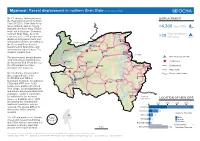
Myanmar: Recent displacement in northern Shan State (as of 16 Feb 2016) On 7 February, fighting between DISPLACEMENT the Restoration Council for Shan State (RCSS) / Shan State Army South (SSA-S) and the Ta’ang >4,300 New IDPs National Liberation Army (TNLA) broke out in Kyaukme Township, northern Shan State. As of 16 Monekoe New temporary February, over 3,300 people were >20 IDP sites displaced to Kyaukme town and Konkyan surrounding villages, according to Kachin State Namhkan the Relief and Resettlement Laukkaing Mong Wee Department in Shan State and Tarmoenye humanitarian organizations. The Northern Mabein Lawt Naw Kutkai situation remains fluid. Shan State Hopang Hseni Kunlong CHINA The government, private donors, Manton Pan Lon New tempoary IDP sites local civil society organizations, Mongmit Conflict area the Myanmar Red Cross Society, Namtu the UN and partners have Namhsan Lashio Mongmao Pangwaun Displacement provided relief materials. Tawt San Major roads Mongngawt On 9 February, armed conflict Monglon Rivers / water bodies also erupted between the Hsipaw Namphan RCSS/SSA and TNLA in Kyaukme Tangyan Namhkam Township. According to Mongyai CSOs and WFP, over 1,000 Nawnghkio people were displaced to Mong Wee village. Local organisations Pangsang and private donors provided initial assistance, which is reported to be sufficient for the moment. Matman Eastern However, buildings where IDPs Shan State LOCATION OF NEW IDPS are staying are crowded and 0 500 1000 1500 2000 additional assistance may be required. The area is difficult to Kyaukme 2,400 access due to the security Kho Mone 520 situation. Kyaukme Township Mine Tin 220 The UN and partners are liaising Male closely with relevant authorities Monglon 110 Female No data and CSOs and are assessing the Pain Nal Kon 90 situation to identify gaps and provide further aid if needed. -

Peace & Conflict Update – October 2017
PEACE & CONFLICT UPDATE – OCTOBER 2017 Updates archive: http://www.burmalink.org/peace-conflict-updates/ Updates archive: https://www.burmalink.org/peace-process-overview/ ACRONYM DICTIONARY AA Arakan Army ALP Arakan Liberation Party BA Burma Army (Tatmadaw) CSO Civil Society Organisation DASSK Daw Aung San Suu Kyi EAO Ethnic Armed Organisation FPNCC Federal Political Negotiation Consultative Committee IDP Internally Displaced Person KBC Karen Baptist Convention KIA Kachin Independence Arm, armed wing of the KIO KIO Kachin Independence Organization KNU Karen National Union MoU Memorandum of Understanding MNEC Mon National Education Committee MNHRC Myanmar National Human Rights Commission NCA Nationwide Ceasefire Agreement (in name only, not inclusive and not nationwide) NLD National League for Democracy NRPC National Reconciliation and Peace Center PC Peace Commission PPST Peace Process Steering Committee (NCA negotiating body) SSPP/SSA-N Shan State Progress Party/Shan State Army (North) TNLA Ta'ang National Liberation Army UN United Nations UNFC United Nationalities Federal Council UPC Union Peace Conference UPDJC Union Peace Dialogue Joint Committee UWSA United Wa State Army 21CPC 21st Century Panglong Conference OCTOBER HIGHLIGHTS • Over 600,000 Rohingya have been displaced since the August 25 attacks and subsequent 'clearance operations' in Arakan (Rakhine). Talks of repatriation of Rohingya refugees between Burma and Bangladesh have stalled, and many Rohingya refugees reject the prospect of returning in the light of unresolved causes to the violence, and fears of ongoing abuse. • Displaced populations on the Thailand-Burma border face increasing challenges and humanitarian funding cuts. As of October 1, TBC has stopped distributing food aid to Shan IDP camps and the Ei Tu Hta Karen IDP camp. -
Inside Trained to Torture
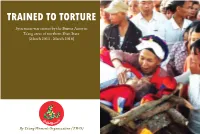
TRAINED TO TORTURE Systematic war crimes by the Burma Army in Ta’ang areas of northern Shan State (March 2011 - March 2016) z f; kifu mi GHeftDyfkefwt By Ta'ang Women's Organization (TWO) ACKNOWLEDGEMENTS We would like to express special thanks to all the victims and the communities who contributed their voices and evidence for the report by sharing their testimonies and also giving their time and energy to inform this report. Special thanks extended to the Burma Relief Center (BRC) for their financial support and supporting the volunteer to edit the translation of this report. We would like to thank all the individuals and organizations who assisted us with valuable input in the process of producing the “Trained to Torture” report, including friends who drawing maps for the report and layout and also the Palaung people as a whole for generously helping us access grassroots area which provided us with invaluable information for this report. TABLE OF CONTENTS Summary 1 Methodology 4 Background 5 Burma Army expansion and spread of conflict in Ta’ang areas 7 Continued reliance on local militia to “divide and rule” 9 Ta’ang exclusion from the peace process 11 Analysis of human rights violations by the Burma Army in Ta’ang areas (March 2011 - March 2016) 12 • Torture 14 - Torture and killing of Ta’ang prisoners of war 16 - Torture by government-allied militia 17 • Extrajudicial killing of civilians 18 • Sexual violence 19 • Shelling, shooting at civilian targets 20 • Forced portering, use of civilians as human shields 22 • Looting and deliberate -

Weekly Security Review (27 August – 2 September 2020)
Commercial-In-Confidence Weekly Security Review (27 August – 2 September 2020) Weekly Security Review Safety and Security Highlights for Clients Operating in Myanmar 27 August – 2 September 2020 Page 1 of 27 Commercial-In-Confidence Weekly Security Review (27 August – 2 September 2020) EXECUTIVE SUMMARY ............................................................................................................................. 3 Internal Conflict ....................................................................................................................................... 4 Nationwide .......................................................................................................................................... 4 Rakhine State ....................................................................................................................................... 4 Shan State ............................................................................................................................................ 5 Myanmar and the World ......................................................................................................................... 8 Election Watch ........................................................................................................................................ 8 Social and Political Stability ................................................................................................................... 11 Transportation ...................................................................................................................................... -
Appendix 6 Satellite Map of Proposed Project Site
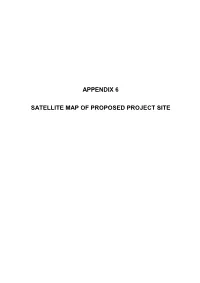
APPENDIX 6 SATELLITE MAP OF PROPOSED PROJECT SITE Hakha Township, Rim pi Village Tract, Chin State Zo Zang Village A6-1 Falam Township, Webula Village Tract, Chin State Kim Mon Chaung Village A6-2 Webula Village Pa Mun Chaung Village Tedim Township, Dolluang Village Tract, Chin State Zo Zang Village Dolluang Village A6-3 Taunggyi Township, Kyauk Ni Village Tract, Shan State A6-4 Kalaw Township, Myin Ma Hti Village Tract and Baw Nin Village Tract, Shan State A6-5 Ywangan Township, Sat Chan Village Tract, Shan State A6-6 Pinlaung Township, Paw Yar Village Tract, Shan State A6-7 Symbol Water Supply Facility Well Development by the Procurement of Drilling Rig Nansang Township, Mat Mon Mun Village Tract, Shan State A6-8 Nansang Township, Hai Nar Gyi Village Tract, Shan State A6-9 Hopong Township, Nam Hkok Village Tract, Shan State A6-10 Hopong Township, Pawng Lin Village Tract, Shan State A6-11 Myaungmya Township, Moke Soe Kwin Village Tract, Ayeyarwady Region A6-12 Myaungmya Township, Shan Yae Kyaw Village Tract, Ayeyarwady Region A6-13 Labutta Township, Thin Gan Gyi Village Tract, Ayeyarwady Region Symbol Facility Proposed Road Other Road Protection Dike Rainwater Pond (New) : 5 Facilities Rainwater Pond (Existing) : 20 Facilities A6-14 Labutta Township, Laput Pyay Lae Pyauk Village Tract, Ayeyarwady Region A6-15 Symbol Facility Proposed Road Other Road Irrigation Channel Rainwater Pond (New) : 2 Facilities Rainwater Pond (Existing) Hinthada Township, Tha Si Village Tract, Ayeyarwady Region A6-16 Symbol Facility Proposed Road Other Road -

Inle Lake Long Term Restoration & Conservation Plan
Foreword Inle Lake is one of the priority conservation areas in Myanmar due to its unique ecology, historical, religious, cultural, traditional background and natural beauty. It is one of the most popular tourist destinations in Myanmar and tourism is expected to rise significantly with the opening up of the country. Realization that widespread soil erosion on the mountain ranges flanking Inle Lake could eventually cause problems that would threaten the future existence of the Lake prevailed since late 19th century. Measures were introduced, but were ineffective as they were not developed progressively enough. Several droughts occurred since 1989, but the severe drought that occurred in 2010 was the wakeup call, which brought about serious concerns and recognition that urgent planning and mitigation measures in a comprehensive and integrated manner was imperative, if the Lake was to be saved. Ministry of Environmental Conservation and Forestry (MOECAF) organized a National Workshop in 2011 at Nay Pyi Taw; basic elements required to draw up a Long Term Action Plan were identified and a resolution to formulate a Long Term Restoration and Conservation Plan for Inle Lake was adopted. MOECAF requested UN-Habitat to assist in formulation of the Long Term Restoration and Conservation Plan for Inle Lake and the Royal Norwegian Government kindly provided necessary financial assistance. The Team of experts engaged by UN-Habitat identified the main causes, both natural and human induced, that have impacted adversely on the Lake and its environment. Fall out of climatic variations, irresponsible clearing of soil cover, various forms of change in land use patterns in the Watershed areas caused widespread soil erosion, resulting in heavy loads of sediment entering the main feeder streams and ultimately into the Lake, causing it to become very much smaller in size and shallower in depth. -
The Union Report the Union Report : Census Report Volume 2 Census Report Volume 2
THE REPUBLIC OF THE UNION OF MYANMAR The 2014 Myanmar Population and Housing Census The Union Report The Union Report : Census Report Volume 2 Volume Report : Census The Union Report Census Report Volume 2 Department of Population Ministry of Immigration and Population May 2015 The 2014 Myanmar Population and Housing Census The Union Report Census Report Volume 2 For more information contact: Department of Population Ministry of Immigration and Population Office No. 48 Nay Pyi Taw Tel: +95 67 431 062 www.dop.gov.mm May, 2015 Figure 1: Map of Myanmar by State, Region and District Census Report Volume 2 (Union) i Foreword The 2014 Myanmar Population and Housing Census (2014 MPHC) was conducted from 29th March to 10th April 2014 on a de facto basis. The successful planning and implementation of the census activities, followed by the timely release of the provisional results in August 2014 and now the main results in May 2015, is a clear testimony of the Government’s resolve to publish all information collected from respondents in accordance with the Population and Housing Census Law No. 19 of 2013. It is my hope that the main census results will be interpreted correctly and will effectively inform the planning and decision-making processes in our quest for national development. The census structures put in place, including the Central Census Commission, Census Committees and Offices at all administrative levels and the International Technical Advisory Board (ITAB), a group of 15 experts from different countries and institutions involved in censuses and statistics internationally, provided the requisite administrative and technical inputs for the implementation of the census. -

December 2008
cover_asia_report_2008_2:cover_asia_report_2007_2.qxd 28/11/2008 17:18 Page 1 Central Committee for Drug Lao National Commission for Drug Office of the Narcotics Abuse Control Control and Supervision Control Board Vienna International Centre, P.O. Box 500, A-1400 Vienna, Austria Tel: (+43 1) 26060-0, Fax: (+43 1) 26060-5866, www.unodc.org Opium Poppy Cultivation in South East Asia Lao PDR, Myanmar, Thailand OPIUM POPPY CULTIVATION IN SOUTH EAST ASIA IN SOUTH EAST CULTIVATION OPIUM POPPY December 2008 Printed in Slovakia UNODC's Illicit Crop Monitoring Programme (ICMP) promotes the development and maintenance of a global network of illicit crop monitoring systems in the context of the illicit crop elimination objective set by the United Nations General Assembly Special Session on Drugs. ICMP provides overall coordination as well as direct technical support and supervision to UNODC supported illicit crop surveys at the country level. The implementation of UNODC's Illicit Crop Monitoring Programme in South East Asia was made possible thanks to financial contributions from the Government of Japan and from the United States. UNODC Illicit Crop Monitoring Programme – Survey Reports and other ICMP publications can be downloaded from: http://www.unodc.org/unodc/en/crop-monitoring/index.html The boundaries, names and designations used in all maps in this document do not imply official endorsement or acceptance by the United Nations. This document has not been formally edited. CONTENTS PART 1 REGIONAL OVERVIEW ..............................................................................................3 -

Militarized Conflicts in Northern Shan State
A Return to War: Militarized Conflicts in Northern Shan State ASIA PAPER May 2018 EUROPEAN UNION A Return to War: Militarized Conflicts in Northern Shan State © Institute for Security and Development Policy V. Finnbodavägen 2, Stockholm-Nacka, Sweden www.isdp.eu “A Return to War: Militarized Conflicts in Northern Shan State” is an Asia Paper published by the published by the Institute for Security and Development Policy. The Asia Paper Series is the Occasional Paper series of the Institute’s Asia Program, and addresses topical and timely subjects. The Institute is based in Stockholm, Sweden, and cooperates closely with research centers worldwide. The Institute serves a large and diverse community of analysts, scholars, policy-watchers, business leaders, and journalists. It is at the forefront of research on issues of conflict, security, and development. Through its applied research, publications, research cooperation, public lectures, and seminars, it functions as a focal point for academic, policy, and public discussion. This publication has been produced with funding by the European Union. The content of this publication does not reflect the official opinion of the European Union. Responsibility for the information and views expressed in the paper lies entirely with the authors. No third-party textual or artistic material is included in the publication without the copyright holder’s prior consent to further dissemination by other third parties. Reproduction is authorised provided the source is acknowledged. © European Union and ISDP, 2018 Printed in Lithuania ISBN: 978-91-88551-11-5 Cover photo: Patrick Brown patrickbrownphoto.com Distributed in Europe by: Institute for Security and Development Policy Västra Finnbodavägen 2, 131 30 Stockholm-Nacka, Sweden Tel. -
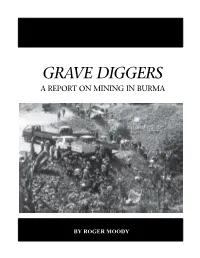
Grave Diggers a Report on Mining in Burma
GRAVE DIGGERS A REPORT ON MINING IN BURMA BY ROGER MOODY CONTENTS Abbreviations........................................................................................... 2 Map of Southeast Asia............................................................................. 3 Acknowledgments ................................................................................... 4 Author’s foreword ................................................................................... 5 Chapter One: Burma’s Mining at the Crossroads ................................... 7 Chapter Two: Summary Evaluation of Mining Companies in Burma .... 23 Chapter Three: Index of Mining Corporations ....................................... 29 Chapter Four: The Man with the Golden Arm ....................................... 43 Appendix I: The Problems with Copper.................................................. 53 Appendix II: Stripping Rubyland ............................................................. 59 Appendix III: HIV/AIDS, Heroin and Mining in Burma ........................... 61 Appendix IV: Interview with a former mining engineer ........................ 63 Appendix V: Observations from discussions with Burmese miners ....... 67 Endnotes .................................................................................................. 68 Cover: Workers at Hpakant Gem Mine, Kachin State (Photo: Burma Centrum Nederland) A Report on Mining in Burma — 1 Abbreviations ASE – Alberta Stock Exchange DGSE - Department of Geological Survey and Mineral Exploration (Burma) -

The Myanmar-Thailand Corridor 6 the Myanmar-Malaysia Corridor 16 the Myanmar-Korea Corridor 22 Migration Corridors Without Labor Attachés 25
Online Appendixes Public Disclosure Authorized Labor Mobility As a Jobs Strategy for Myanmar STRENGTHENING ACTIVE LABOR MARKET POLICIES TO ENHANCE THE BENEFITS OF MOBILITY Public Disclosure Authorized Mauro Testaverde Harry Moroz Public Disclosure Authorized Puja Dutta Public Disclosure Authorized Contents Appendix 1 Labor Exchange Offices in Myanmar 1 Appendix 2 Forms used to collect information at Labor Exchange Offices 3 Appendix 3 Registering jobseekers and vacancies at Labor Exchange Offices 5 Appendix 4 The migration process in Myanmar 6 The Myanmar-Thailand corridor 6 The Myanmar-Malaysia corridor 16 The Myanmar-Korea corridor 22 Migration corridors without labor attachés 25 Appendix 5 Obtaining an Overseas Worker Identification Card (OWIC) 29 Appendix 6 Obtaining a passport 30 Cover Photo: Somrerk Witthayanant/ Shutterstock Appendix 1 Labor Exchange Offices in Myanmar State/Region Name State/Region Name Yangon No (1) LEO Tanintharyi Dawei Township Office Yangon No (2/3) LEO Tanintharyi Myeik Township Office Yangon No (3) LEO Tanintharyi Kawthoung Township Office Yangon No (4) LEO Magway Magwe Township Office Yangon No (5) LEO Magway Minbu District Office Yangon No (6/11/12) LEO Magway Pakokku District Office Yangon No (7) LEO Magway Chauk Township Office Yangon No (8/9) LEO Magway Yenangyaung Township Office Yangon No (10) LEO Magway Aunglan Township Office Yangon Mingalardon Township Office Sagaing Sagaing District Office Yangon Shwe Pyi Thar Township Sagaing Monywa District Office Yangon Hlaing Thar Yar Township Sagaing Shwe -

Table Three: Natural Resource Investment Patterns in Ethnic States & Border Regions
Working Document Table Three: Natural resource investment patterns in ethnic States & border regions State or Existing investments Potential Investments Key issues relating Region to investment in the natural resource sector Chin State Mining Mining Minerals currently being explored in Chin State Political parties and CSOs in Mwe Taung Nickel Mine, Tiddim are: chromite, manganese, and limestone. Chin State have raised > Nickel (ferronickle alloy) mine at MweTaung, concerns regarding the Mwe Tiddim Township in an ‘advanced exploration’ Tuang mine including: the stage.i The original feasibility study was Forestry lack of transparency in initiated in June 2012 under agreement project development, a between the Department of Geological Survey Timber revenue-sharing & Mineral Exploration and NORINCO.ii Wood is an important local fuel and building arrangement that does not > The mine is now being developed as a joint- material. There is the potential to expand provide adequate benefit to venture; with the state-owned Myanmar commercial timber exploitation. Timber Chin State, and lack of any Mining Enterprise #1 holding a 20% stake and harvesting through community forestry hold EIA/SIA processes.viii the foreign investors holding an 80% stake.iii potential.vi Some areas of Chin State are > The foreign stake is held by NORINCO (North suitable for teak and other hardwood For an overview of Mining Investment Co. Ltd.) (China) and Zijin plantations. opportunities for natural International Mining Group (Hong Kong). resource development see > Zijin IMG is a fully owned subsidiary of Zijin the Chin State Development Working Document Mining Group, a massive Chinese state-owned Pine Resin extraction Plan document created by mining company.iv There has been some interest from Japanese MMIID in cooperation with > The initial investment is $50 million.