Politics, Art and the Black Bauhinia Flag
Total Page:16
File Type:pdf, Size:1020Kb
Load more
Recommended publications
-

Media Capture with Chinese Characteristics
JOU0010.1177/1464884917724632JournalismBelair-Gagnon et al. 724632research-article2017 Article Journalism 1 –17 Media capture with Chinese © The Author(s) 2017 Reprints and permissions: characteristics: Changing sagepub.co.uk/journalsPermissions.nav https://doi.org/10.1177/1464884917724632DOI: 10.1177/1464884917724632 patterns in Hong Kong’s journals.sagepub.com/home/jou news media system Nicholas Frisch Yale University, USA Valerie Belair-Gagnon University of Minnesota, USA Colin Agur University of Minnesota, USA Abstract In the Special Administrative Region of Hong Kong, a former British territory in southern China returned to the People’s Republic as a semi-autonomous enclave in 1997, media capture has distinct characteristics. On one hand, Hong Kong offers a case of media capture in an uncensored media sector and open market economy similar to those of Western industrialized democracies. Yet Hong Kong’s comparatively small size, close proximity, and broad economic exposure to the authoritarian markets and politics of neighboring Mainland China, which practices strict censorship, place unique pressures on Hong Kong’s nominally free press. Building on the literature on media and politics in Hong Kong post-handover and drawing on interviews with journalists in Hong Kong, this article examines the dynamics of media capture in Hong Kong. It highlights how corporate-owned legacy media outlets are increasingly deferential to the Beijing government’s news agenda, while social media is fostering alternative spaces for more skeptical and aggressive voices. This article develops a scholarly vocabulary to describe media capture from the perspective of local journalists and from the academic literature on media and power in Hong Kong and China since 1997. -

Photo Gallery
Cover Illustration The new Central Government Offices on the harbourfront are designed as an ‘open door’ to depict the administration as open and receptive to new ideas. The offices, which opened in August, are part of a major project at Tamar that houses the Legislative Council Complex and the Chief Executive’s Office and features an abundance of greenery and open space. End-paper Maps Front Hong Kong Special Administrative Region Back Hong Kong and Pearl River Delta Satellite Image Map Events in 2011 This year’s major events included a visit to Hong Kong in August by the Vice-Premier of the State Council, Mr Li Keqiang, pictured, delivering the keynote address at the Forum on the National 12th Five-Year Plan and Economic, Trade and Financial Co-operation and Development between the Mainland and Hong Kong at the Hong Kong Convention and Exhibition Centre. Other major events included visits by foreign dignitaries as well as overseas visits by senior Hong Kong officials – and Guinness World Records. Events in 2011 Top left: The then Chief Secretary for Administration, Mr Henry Tang, calls on Singapore Prime Minister, Mr Lee Hsien Loong, during his trip to the island state in February. Above left: The Chief Secretary for Administration, Mr Stephen Lam, meets the German Federal Minister of Foreign Affairs, Mr Guido Westerwelle, in Berlin in October. Above right: The Chief Executive, Mr Donald Tsang (first row, first right), poses with other world leaders at the Asia-Pacific Economic Co-operation Economic Leaders’ Meeting in Honolulu in November. Right: The Chief Executive welcomes the US Secretary of State, Mrs Hillary Rodham Clinton, at Government House in Hong Kong on July 25. -
Uncivilized: on the Issue of Racism in the 2019 Hong Kong Protest Movement
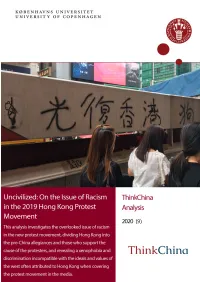
This ThinkChina analysis is written by Mai Corlin, Postdoctoral Fellow, Department of Fine Arts, Chinese University of Hong Kong. Editor(s): Casper Wichmann and Silke Hult Lykkedatter. Disclaimer: The views and opinions expressed in this ThinkChina publication are those of the author(s) and not necessarily those of ThinkChina. Copyright of this publication is held by ThinkChina. You may not copy, reproduce, republish or circulate in any way the content from this publication without acknowledgement of ThinkChina as the source, except for your own personal and non-commercial use. Any other use requires the prior written permission of ThinkChina or the author(s). ©ThinkChina and the author(s) 2020 Front page picture: Photograph by Mai Corlin. Caption: Graffiti drawn during a demonstration in the Hong Kong district of Mongkok. Winnie the Pooh (left) is a reference to Xi Jinping. The Chinese characters read the first part of the well-known slogan attributed Hong Kong activist and localist, Edward Leung: “Liberate Hong Kong, Revolution of Our Time (光復香港, 時代革命 ).” ThinkChina, University of Copenhagen Karen Blixens Vej 4 2300 Copenhagen S Mail: cw@thinkchina.dk Web: www.thinkchina.dk ThinkChina Analysis 2020 Uncivilized: On the Issue of Racism in the 2019 Hong Kong Protest Movement Mai Corlin: Postdoctoral Fellow, Department of Fine Arts, Chinese University of Hong Kong Since the introduction of an extradition bill in April 2019, which in some cases would have allowed extradition to mainland China, a new wave of civil unrest arose, and in June 2019, the streets of Hong Kong were once again flooded by public demonstrations – a new protest movement, not completely unlike the ‘Umbrella Movement’ for democracy in 2014. -
Bibliography
BIBLIOGRAPHY An Jingfu (1994) The Pain of a Half Taoist: Taoist Principles, Chinese Landscape Painting, and King of the Children . In Linda C. Ehrlich and David Desser (eds.). Cinematic Landscapes: Observations on the Visual Arts and Cinema of China and Japan . Austin: University of Texas Press, 117–25. Anderson, Marston (1990) The Limits of Realism: Chinese Fiction in the Revolutionary Period . Berkeley: University of California Press. Anon (1937) “Yueyu pian zhengming yundong” [“Jyutpin zingming wandung” or Cantonese fi lm rectifi cation movement]. Lingxing [ Ling Sing ] 7, no. 15 (June 27, 1937): no page. Appelo, Tim (2014) ‘Wong Kar Wai Says His 108-Minute “The Grandmaster” Is Not “A Watered-Down Version”’, The Hollywood Reporter (6 January), http:// www.hollywoodreporter.com/news/wong-kar-wai-says-his-668633 . Aristotle (1996) Poetics , trans. Malcolm Heath (London: Penguin Books). Arroyo, José (2000) Introduction by José Arroyo (ed.) Action/Spectacle: A Sight and Sound Reader (London: BFI Publishing), vii-xv. Astruc, Alexandre (2009) ‘The Birth of a New Avant-Garde: La Caméra-Stylo ’ in Peter Graham with Ginette Vincendeau (eds.) The French New Wave: Critical Landmarks (London: BFI and Palgrave Macmillan), 31–7. Bao, Weihong (2015) Fiery Cinema: The Emergence of an Affective Medium in China, 1915–1945 (Minneapolis: University of Minnesota Press). Barthes, Roland (1968a) Elements of Semiology (trans. Annette Lavers and Colin Smith). New York: Hill and Wang. Barthes, Roland (1968b) Writing Degree Zero (trans. Annette Lavers and Colin Smith). New York: Hill and Wang. Barthes, Roland (1972) Mythologies (trans. Annette Lavers), New York: Hill and Wang. © The Editor(s) (if applicable) and The Author(s) 2016 203 G. -

In Hong Kong the Political Economy of the Asia Pacific
The Political Economy of the Asia Pacific Fujio Mizuoka Contrived Laissez- Faireism The Politico-Economic Structure of British Colonialism in Hong Kong The Political Economy of the Asia Pacific Series editor Vinod K. Aggarwal More information about this series at http://www.springer.com/series/7840 Fujio Mizuoka Contrived Laissez-Faireism The Politico-Economic Structure of British Colonialism in Hong Kong Fujio Mizuoka Professor Emeritus Hitotsubashi University Kunitachi, Tokyo, Japan ISSN 1866-6507 ISSN 1866-6515 (electronic) The Political Economy of the Asia Pacific ISBN 978-3-319-69792-5 ISBN 978-3-319-69793-2 (eBook) https://doi.org/10.1007/978-3-319-69793-2 Library of Congress Control Number: 2017956132 © Springer International Publishing AG, part of Springer Nature 2018 This work is subject to copyright. All rights are reserved by the Publisher, whether the whole or part of the material is concerned, specifically the rights of translation, reprinting, reuse of illustrations, recitation, broadcasting, reproduction on microfilms or in any other physical way, and transmission or information storage and retrieval, electronic adaptation, computer software, or by similar or dissimilar methodology now known or hereafter developed. The use of general descriptive names, registered names, trademarks, service marks, etc. in this publication does not imply, even in the absence of a specific statement, that such names are exempt from the relevant protective laws and regulations and therefore free for general use. The publisher, the authors and the editors are safe to assume that the advice and information in this book are believed to be true and accurate at the date of publication. -

Street Protests and Air Pollution in Hong Kong
Street protests and air pollution in Hong Kong Brimblecombe, Peter Published in: Environmental Monitoring and Assessment Published: 01/05/2020 Document Version: Final Published version, also known as Publisher’s PDF, Publisher’s Final version or Version of Record License: CC BY Publication record in CityU Scholars: Go to record Published version (DOI): 10.1007/s10661-020-8243-0 Publication details: Brimblecombe, P. (2020). Street protests and air pollution in Hong Kong. Environmental Monitoring and Assessment, 192(5), [295]. https://doi.org/10.1007/s10661-020-8243-0 Citing this paper Please note that where the full-text provided on CityU Scholars is the Post-print version (also known as Accepted Author Manuscript, Peer-reviewed or Author Final version), it may differ from the Final Published version. When citing, ensure that you check and use the publisher's definitive version for pagination and other details. General rights Copyright for the publications made accessible via the CityU Scholars portal is retained by the author(s) and/or other copyright owners and it is a condition of accessing these publications that users recognise and abide by the legal requirements associated with these rights. Users may not further distribute the material or use it for any profit-making activity or commercial gain. Publisher permission Permission for previously published items are in accordance with publisher's copyright policies sourced from the SHERPA RoMEO database. Links to full text versions (either Published or Post-print) are only available if corresponding publishers allow open access. Take down policy Contact lbscholars@cityu.edu.hk if you believe that this document breaches copyright and provide us with details. -
Can We Use Big Data to Secure a Better Future?
Inter national Journal of Business & Cyber Security (IJBCS) Vol. 1 Issue 1 July 2016 The Majority Report - Can we use big data to secure a better future? VIVIEN P.S. CHAN K.P. CHOW The University of Hong Kong Abstract With the widely adopted use of social media, it now becomes a common platform for c alling supporters for civil unrest events. Despite the noble aims of these civil unrest events, sometimes these events might turn violent and disturb the daily lives of the general public. This paper aims to propose a conceptual framework regarding the s tudy of using online social media data to predict offline civil unrest events. We Keywords propose to use time - series metrics as the prediction attributes instead of analyzing Social Media message contentsbecause the message contents on social media are usually noisy, Platform, informal and not so easy to interpret. In the case of a data set containing both civil Predictive unrest event dates and normal dates, we found that it contains many more samples Modeling, from the normal dates class than from the civil unrest event dates class. Thus, Civil Unrest creating an im balanced class problem. We showed using accuracy as the performance metrics could be misleading as civil unrest events were the minority class. Thus, we suggest to use additional tactics to handle the imbalanced class prediction problem. We propose to u se a combination of oversampling the minority class and using feature selection techniques to tackle the imbalanced class problem. The current resultsdemonstrate that use of time - series metrics to predict civil unrest events is a possible solution to the problems of handling the noise and unstructured format of social media data contents in the process of analysis and predictions. -
Student Political Activism in a Global Context: an Analytic Imperative for Enhanced Understanding of Higher Education Coordination in Hong Kong
72 Comparative & International Higher Education 6 (2014) Student Political Activism in a Global Context: An Analytic Imperative for Enhanced Understanding of Higher Education Coordination in Hong Kong Hei-hang Hayes Tanga,* aThe University of Hong Kong, Hong Kong Introduction cation sectors from a comparative but not normative perspective. During the capitalizing processes of In the face of accumulated contradictions of global knowledge and educational credentials in the Chinese capitalism, the current decade sees the international rise setting, collaborations and tensions among the state, of student political activism—among other democratic economy, and academia arise but in various patterns. responses for a similar pursuit of social justice. Against Moreover, for a relevant and committed application of the backdrop of an increasingly interconnected world, Clark’s conceptualization, the student power factor was global exchanges of rationales, discourses, experiences, not taken into analytical consideration, although the and strategies by student activists across various world’s agency of student political activism is very essential to locations stimulate and reinforce the spirit of “youth shaping the evolving relationship between higher edu- idealism” (Altbach 1989), which in a way challenges cation and the role of the state. In addition, the interna- state authority and market forces. Students have long tionalization of student political activism, in quest for played an indispensable role in affecting how academic social justice and democracy, challenges the global life of the time is being lived out. Examining student trend of capitalism. The static nature of the conceptual- political activism has increasingly become an analytic ization is further problematized by the realities brought imperative for understanding better the new university- through globalization, including the “ideoscape” of state-market dynamics. -
US Foreign Policy Toward Hong Kong Protests
US Foreign Policy toward Hong Kong Protests A Neoclassical Realist Assessment of US foreign policy Fuk Cheong Ho S4867211 Thesis Submitted in Partial Fulfillment of the Requirements for the Degree of Master in Political Science (MSc) Specialization: International Relations prof. dr. J.A. Verbeek (Bertjan) Nijmegen School of Management Radboud University, Nijmegen, The Netherlands 28 June 2020 Abstract It is puzzling why would the US intervene in 2019 Hong Kong Protest under President Trump and his “America First” policy. Neoclassical Realism suggests that while system stimuli set the grand strategy for US foreign policy, unit-level factors determine the character and venue of the US foreign policy. In an attempt to test such claim by Neoclassical Realism, this thesis adopts the Semi-Orthodox approach, which argues that domestic factors act as a channel through which the system’s imperative is translated regularly into states’ foreign policy. By using the process tracing method to test the case - Hong Kong Human Rights and Democracy Act of 2019, this thesis found that in a permissive environment without imminent threat, domestic factors weighed more heavily on US foreign policy. System stimuli set the grand strategy for US foreign policy, unit-level factors such as perceptions of foreign policy elites (FPE), legislative branch influence, the dominance of liberal ideals in US foreign policy discourse, and political structure determine the characters of US foreign policy toward Hong Kong protests. In general, the explanation by Neoclassical -

And the Cold War, 1945-1970”
WOODROW WILSON INTERNATIONAL CENTER FOR SCHOLARS THE SOVIET UNION, HONG KONG, Lee H. Hamilton, Christian Ostermann, Director AND THE OLD AR Director C W , 1945-1970 BOARD OF TRUSTEES: Michael Share ADVISORY COMMITTEE: Joseph B. Gildenhorn, Chairman Working Paper No. 41 William Taubman Steven Alan Bennett, (Amherst College) Vice Chairman Chairman PUBLIC MEMBERS Michael Beschloss (Historian, Author) The Secretary of State Colin Powell; The Librarian of James H. Billington Congress (Librarian of Congress) James H. Billington; The Archivist of the United States Warren I. Cohen John W. Carlin; (University of Maryland- The Chairman of the Baltimore) National Endowment for the Humanities Bruce Cole; John Lewis Gaddis The Secretary of the (Yale University) Smithsonian Institution Lawrence M. Small; The Secretary of James Hershberg Education (The George Washington Roderick R. Paige; University) The Secretary of Health & Human Services Tommy G. Thompson; Washington, D.C. Samuel F. Wells, Jr. (Woodrow Wilson Center) PRIVATE MEMBERS January 2003 Joseph A Cari, Jr. Sharon Wolchik Carol Cartwright, (The George Washington Daniel L. Lamaute, University) Thomas R. Reedy, COLD WAR INTERNATIONAL HISTORY PROJECT THE COLD WAR INTERNATIONAL HISTORY PROJECT WORKING PAPER SERIES CHRISTIAN F. OSTERMANN, Series Editor This paper is one of a series of Working Papers published by the Cold War International History Project of the Woodrow Wilson International Center for Scholars in Washington, D.C. Established in 1991 by a grant from the John D. and Catherine T. MacArthur Foundation, the Cold War International History Project (CWIHP) disseminates new information and perspectives on the history of the Cold War as it emerges from previously inaccessible sources on “the other side” of the post-World War II superpower rivalry. -

Congressional-Executive Commission on China
CONGRESSIONAL-EXECUTIVE COMMISSION ON CHINA ANNUAL REPORT 2017 ONE HUNDRED FIFTEENTH CONGRESS FIRST SESSION OCTOBER 5, 2017 Printed for the use of the Congressional-Executive Commission on China ( Available via the World Wide Web: http://www.cecc.gov VerDate Nov 24 2008 16:24 Oct 04, 2017 Jkt 000000 PO 00000 Frm 00001 Fmt 6011 Sfmt 5011 U:\DOCS\26811 DIEDRE 2017 ANNUAL REPORT VerDate Nov 24 2008 16:24 Oct 04, 2017 Jkt 000000 PO 00000 Frm 00002 Fmt 6019 Sfmt 6019 U:\DOCS\26811 DIEDRE CONGRESSIONAL-EXECUTIVE COMMISSION ON CHINA ANNUAL REPORT 2017 ONE HUNDRED FIFTEENTH CONGRESS FIRST SESSION OCTOBER 5, 2017 Printed for the use of the Congressional-Executive Commission on China ( Available via the World Wide Web: http://www.cecc.gov U.S. GOVERNMENT PUBLISHING OFFICE 26–811 PDF WASHINGTON : 2017 For sale by the Superintendent of Documents, U.S. Government Publishing Office Internet: bookstore.gpo.gov Phone: toll free (866) 512–1800; DC area (202) 512–1800 Fax: (202) 512–2104 Mail: Stop IDCC, Washington, DC 20402–0001 VerDate Nov 24 2008 16:24 Oct 04, 2017 Jkt 000000 PO 00000 Frm 00003 Fmt 5011 Sfmt 5011 U:\DOCS\26811 DIEDRE CONGRESSIONAL-EXECUTIVE COMMISSION ON CHINA LEGISLATIVE BRANCH COMMISSIONERS Senate House MARCO RUBIO, Florida, Chairman CHRISTOPHER H. SMITH, New Jersey, JAMES LANKFORD, Oklahoma Cochairman TOM COTTON, Arkansas ROBERT PITTENGER, North Carolina STEVE DAINES, Montana TRENT FRANKS, Arizona TODD YOUNG, Indiana RANDY HULTGREN, Illinois DIANNE FEINSTEIN, California MARCY KAPTUR, Ohio JEFF MERKLEY, Oregon TIMOTHY J. WALZ, Minnesota GARY PETERS, Michigan TED LIEU, California ANGUS KING, Maine EXECUTIVE BRANCH COMMISSIONERS Department of State, To Be Appointed Department of Labor, To Be Appointed Department of Commerce, To Be Appointed At-Large, To Be Appointed At-Large, To Be Appointed ELYSE B. -
Thematic Unit Template
Chinese World Grade Level: Grade Two Unit Theme: Countries/Cities/Geography Ohio Standards Connection: Foreign Language Standard: Communication: Communicate in languages other than English. Benchmark A: Ask and answer questions and share preferences on familiar topics. Indicator 1: Ask and answer questions about likes and dislikes (e.g., What is your favorite color?/¿Cuál es tu color favorite? What fruit don’t you like?/Welche Frucht hast du nicht gern?). Benchmark H: Identify the main idea and describe characters and setting in oral, signed or written narratives. Indicator 9: Answer simple questions concerning essential elements of a story (e.g., who? what? when? where? how?). Benchmark K: Present information orally, signed or in writing. Indicator 15: Label familiar objects or people (e.g., school supplies, family members, geometric shapes) and share with others. Benchmark L: Apply age-appropriate writing process strategies to write short, guided paragraphs on various topics. Indicator 16: Apply age-appropriate writing process strategies (prewriting, drafting, revising, editing, publishing) to simple sentences. Standard: Cultures: Gain knowledge and understanding of other cultures. Benchmark A: Observe, identify and describe simple patterns of behavior of the target culture. Indicator 1: Identify appropriate patterns of behavior (e.g., gestures used with friends and family). Benchmark B: Identify and imitate gestures and oral expressions to participate in age- appropriate cultural activities. Indicator 3: Sing/sign songs, play games and celebrate events from the target culture. Benchmark C: Observe, identify, describe and reproduce objects, images and symbols of the target culture. 1 Indicator 4: Make a tangible cultural product (e.g., a craft, toy, food, flag).