Saudi Arabia 2019 Crime & Safety Report: Jeddah
Total Page:16
File Type:pdf, Size:1020Kb
Load more
Recommended publications
-
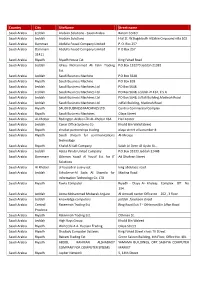
Country City Sitename Street Name Saudi Arabia Jeddah Arabian Solutions - Saudi Arabia Barom Center Saudi Arabia Jeddah Arabian Solutions Hial St
Country City SiteName Street name Saudi Arabia Jeddah Arabian Solutions - Saudi Arabia Barom Center Saudi Arabia Jeddah Arabian Solutions Hial St. W.Bogddadih AlZabin Cmpound villa 102 Saudi Arabia Damman Abdulla Fouad Company Limited P. O. Box 257 Saudi Arabia Dammam Abdulla Fouad Company Limited P O Box 257 31411 Saudi Arabia Riyadh Riyadh House Est. King Fahad Road Saudi Arabia Jeddah Idress Mohammed Ali Fatni Trading P.O.Box 132270 Jeddah 21382 Est. Saudi Arabia Jeddah Saudi Business Machine P.O.Box 5648 Saudi Arabia Riyadh Saudi Business Machine P.O Box 818 Saudi Arabia Jeddah Saudi Business Machines Ltd PO Box 5648 Saudi Arabia Jeddah Saudi Business Machines Ltd. PO Box 5648, Jeddah 21432, K S A Saudi Arabia Jeddah Saudi Business Machines Ltd. PO Box 5648, Juffali Building,Madinah Road Saudi Arabia Jeddah Saudi Business Machines Ltd. Juffali Building, Madinah Road Saudi Arabia Riyadh SAUDI BUSINESS MACHINES LTD. Centria Commercial Complex Saudi Arabia Riyadh Saudi Business Machines Olaya Street Saudi Arabia Al-Khobar Redington Arabia LTD AL-Khobar KSA Hail Center Saudi Arabia Jeddah Canar Office Systems Co Khalid Bin Walid Street Saudi Arabia Riyadh shrakat partnerships trading olaya street villa number 8 Saudi Arabia Riyadh Saudi Unicom for communications Al-Mrouje technology Saudi Arabia Riyadh Khalid Al Safi Company Salah Al-Deen Al-Ayubi St., Saudi Arabia Jeddah Azizia Panda United Company P.O.Box 33333 Jeddah 21448 Saudi Arabia Dammam Othman Yousif Al Yousif Est. for IT Ad Dhahran Street Solutions Saudi Arabia Al Khober al hasoob al asiavy est. king abdulaziz road Saudi Arabia Jeddah EchoServe-Al Sada Al Shamila for Madina Road Information Technology Co. -

Us Military Assistance to Saudi Arabia, 1942-1964
DANCE OF SWORDS: U.S. MILITARY ASSISTANCE TO SAUDI ARABIA, 1942-1964 DISSERTATION Presented in Partial Fulfillment of the Requirements for the Degree Doctor of Philosophy in the Graduate School of The Ohio State University By Bruce R. Nardulli, M.A. * * * * * The Ohio State University 2002 Dissertation Committee: Approved by Professor Allan R. Millett, Adviser Professor Peter L. Hahn _______________________ Adviser Professor David Stebenne History Graduate Program UMI Number: 3081949 ________________________________________________________ UMI Microform 3081949 Copyright 2003 by ProQuest Information and Learning Company. All rights reserved. This microform edition is protected against unauthorized copying under Title 17, United States Code. ____________________________________________________________ ProQuest Information and Learning Company 300 North Zeeb Road PO Box 1346 Ann Arbor, MI 48106-1346 ABSTRACT The United States and Saudi Arabia have a long and complex history of security relations. These relations evolved under conditions in which both countries understood and valued the need for cooperation, but also were aware of its limits and the dangers of too close a partnership. U.S. security dealings with Saudi Arabia are an extreme, perhaps unique, case of how security ties unfolded under conditions in which sensitivities to those ties were always a central —oftentimes dominating—consideration. This was especially true in the most delicate area of military assistance. Distinct patterns of behavior by the two countries emerged as a result, patterns that continue to this day. This dissertation examines the first twenty years of the U.S.-Saudi military assistance relationship. It seeks to identify the principal factors responsible for how and why the military assistance process evolved as it did, focusing on the objectives and constraints of both U.S. -
READ Middle East Brief 101 (PDF)
Judith and Sidney Swartz Director and Professor of Politics Repression and Protest in Saudi Arabia Shai Feldman Associate Director Kristina Cherniahivsky Pascal Menoret Charles (Corky) Goodman Professor of Middle East History and Associate Director for Research few months after 9/11, a Saudi prince working in Naghmeh Sohrabi A government declared during an interview: “We, who Senior Fellow studied in the West, are of course in favor of democracy. As a Abdel Monem Said Aly, PhD matter of fact, we are the only true democrats in this country. Goldman Senior Fellow Khalil Shikaki, PhD But if we give people the right to vote, who do you think they’ll elect? The Islamists. It is not that we don’t want to Myra and Robert Kraft Professor 1 of Arab Politics introduce democracy in Arabia—but would it be reasonable?” Eva Bellin Underlying this position is the assumption that Islamists Henry J. Leir Professor of the Economics of the Middle East are enemies of democracy, even if they use democratic Nader Habibi means to come to power. Perhaps unwittingly, however, the Sylvia K. Hassenfeld Professor prince was also acknowledging the Islamists’ legitimacy, of Islamic and Middle Eastern Studies Kanan Makiya as well as the unpopularity of the royal family. The fear of Islamists disrupting Saudi politics has prompted very high Renée and Lester Crown Professor of Modern Middle East Studies levels of repression since the 1979 Iranian revolution and the Pascal Menoret occupation of the Mecca Grand Mosque by an armed Salafi Neubauer Junior Research Fellow group.2 In the past decades, dozens of thousands have been Richard A. -
Jeddah Tower for Web.Indd
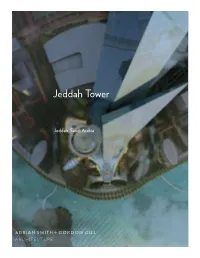
Jeddah Tower Jeddah, Saudi Arabia Jeddah Tower Jeddah, Saudi Arabia At over 1,000 meters (3,280 feet) and a total construction area of 530,000 square meters (5.7 million square feet), Jeddah Tower— formerly known as Kingdom Tower—will be the centerpiece and first construction phase of the $20 billion Kingdom City development in Jeddah, Saudi Arabia, near the Red Sea. SERVICES Expected to cost $1.2 billion to construct, Jeddah Tower will be a mixed-use building featuring a luxury hotel, office Architecture space, serviced apartments, luxury condominiums and the world’s highest observatory. Jeddah Tower’s height will be Interior Design at least 173 meters (568 feet) taller than Burj Khalifa, which was designed by Adrian Smith while at Skidmore, Owings Master Planning & Merrill. CLIENT AS+GG’s design for Jeddah Tower is both highly technological and distinctly organic. With its slender, subtly Jeddah Economic Company asymmetrical massing, the tower evokes a bundle of leaves shooting up from the ground—a burst of new life that FUNCTION heralds more growth all around it. This symbolizes the tower as a catalyst for increased development around it. Mixed use The sleek, streamlined form of the tower can be interpreted as a reference to the folded fronds of young desert plant FACTS growth. The way the fronds sprout upward from the ground as a single form, then start separating from each other at 1,000+ m height the top, is an analogy of new growth fused with technology. 530,000 sm area While the design is contextual to Saudi Arabia, it also represents an evolution and a refinement of an architectural continuum of skyscraper design. -

Country Travel Risk Summaries
COUNTRY RISK SUMMARIES Powered by FocusPoint International, Inc. Report for Week Ending September 19, 2021 Latest Updates: Afghanistan, Burkina Faso, Cameroon, India, Israel, Mali, Mexico, Myanmar, Nigeria, Pakistan, Philippines, Russia, Saudi Arabia, Somalia, South Sudan, Sudan, Syria, Turkey, Ukraine and Yemen. ▪ Afghanistan: On September 14, thousands held a protest in Kandahar during afternoon hours local time to denounce a Taliban decision to evict residents in Firqa area. No further details were immediately available. ▪ Burkina Faso: On September 13, at least four people were killed and several others ijured after suspected Islamist militants ambushed a gendarme patrol escorting mining workers between Sakoani and Matiacoali in Est Region. Several gendarmes were missing following the attack. ▪ Cameroon: On September 14, at least seven soldiers were killed in clashes with separatist fighters in kikaikelaki, Northwest region. Another two soldiers were killed in an ambush in Chounghi on September 11. ▪ India: On September 16, at least six people were killed, including one each in Kendrapara and Subarnapur districts, and around 20,522 others evacuated, while 7,500 houses were damaged across Odisha state over the last three days, due to floods triggered by heavy rainfall. Disaster teams were sent to Balasore, Bhadrak and Kendrapara districts. Further floods were expected along the Mahanadi River and its tributaries. ▪ Israel: On September 13, at least two people were injured after being stabbed near Jerusalem Central Bus Station during afternoon hours local time. No further details were immediately available, but the assailant was shot dead by security forces. ▪ Mali: On September 13, at least five government soldiers and three Islamist militants were killed in clashes near Manidje in Kolongo commune, Macina cercle, Segou region, during morning hours local time. -

Saudi Arabia 2020 Crime & Safety Report: Riyadh
Saudi Arabia 2020 Crime & Safety Report: Riyadh This is an annual report produced in conjunction with the Regional Security Office at the U.S. Embassy in Riyadh. OSAC encourages travelers to use this report to gain baseline knowledge of security conditions in Saudi Arabia. For more in-depth information, review OSAC’s Saudi Arabia country page for original OSAC reporting, consular messages, and contact information, some of which may be available only to private- sector representatives with an OSAC password. Travel Advisory The current U.S. Department of State Travel Advisory at the date of this report’s publication assesses Saudi Arabia at Level 2, indicating travelers should exercise increased caution due to terrorism and the threat of missile and drone attacks on civilian targets. Do not travel to within 50 miles of the border with Yemen due to terrorism and armed conflict. Review OSAC’s report, Understanding the Consular Travel Advisory System. Overall Crime and Safety Situation Crime Threats The U.S. Department of State has assessed Riyadh as being a LOW-threat location for crime directed at or affecting official U.S. government interests. Crime in Saudi Arabia has increased over recent years but remains at levels far below most major metropolitan areas in the United States. Criminal activity does not typically target foreigners and is mostly drug-related. Review OSAC’s reports, All That You Should Leave Behind, The Overseas Traveler’s Guide to ATM Skimmers & Fraud, Taking Credit, Hotels: The Inns and Outs, and Considerations for Hotel Security. Cybersecurity Issues The Saudi government continues to expand its cybersecurity activities. -

Alkhurma Hemorrhagic Fever in Humans, Najran, Saudi Arabia Abdullah G
RESEARCH Alkhurma Hemorrhagic Fever in Humans, Najran, Saudi Arabia Abdullah G. Alzahrani, Hassan M. Al Shaiban, Mohammad A. Al Mazroa, Osama Al-Hayani, Adam MacNeil, Pierre E. Rollin, and Ziad A. Memish Alkhurma virus is a fl avivirus, discovered in 1994 in a district, south of Jeddah (3). Among the 20 patients with person who died of hemorrhagic fever after slaughtering a confi rmed cases, 11 had hemorrhagic manifestations and sheep from the city of Alkhurma, Saudi Arabia. Since then, 5 died. several cases of Alkhurma hemorrhagic fever (ALKHF), Full genome sequencing has indicated that ALKV is with fatality rates up to 25%, have been documented. From a distinct variant of Kyasanur Forest disease virus, a vi- January 1, 2006, through April 1, 2009, active disease sur- rus endemic to the state of Karnataka, India (4). Recently, veillance and serologic testing of household contacts identi- fi ed ALKHF in 28 persons in Najran, Saudi Arabia. For epi- ALKV was found by reverse transcription–PCR in Orni- demiologic comparison, serologic testing of household and thodoros savignyi ticks collected from camels and camel neighborhood controls identifi ed 65 serologically negative resting places in 3 locations in western Saudi Arabia (5). persons. Among ALKHF patients, 11 were hospitalized and ALKHF is thought to be a zoonotic disease, and reservoir 17 had subclinical infection. Univariate analysis indicated hosts may include camels and sheep. Suggested routes of that the following were associated with Alkhurma virus in- transmission are contamination of a skin wound with blood fection: contact with domestic animals, feeding and slaugh- of an infected vertebrate, bite of an infected tick, or drink- tering animals, handling raw meat products, drinking unpas- ing of unpasteurized, contaminated milk (6). -

The Following Lawyers in the Dhahran / Al-Khobar / Dammam Area Have Expressed Interest in Providing Legal Services and Advice to U.S
The following lawyers in the Dhahran / Al-Khobar / Dammam area have expressed interest in providing legal services and advice to U.S. citizens. Law offices are generally open during Saudi working hours of approximately 9:00 a.m. to 1:00 p.m. and 5:00 p.m. to 8:00 p.m. 1. Abdulaziz Alassaf & Partners in association with Shearman & Sterling LLP Firm size: 20 attorneys Mailing Address: P.O. Box 30572, Al-Khobar 31952 Physical Address: : SUMO Tower, 6th Floor, Unit 6140,Prince Turki Street (Corniche), Al- Khobar Phone(s): +966 (01) 3 830 6554 Fax: +966 (01) 3 830 4949 Email: basil.alfouzan@sa.shearman.com Website: http://www.shearman.com/en/offices/saudi-arabia Languages: Arabic, English, French, Russian Law School: Various Saudi and foreign law schools Geographic Area: All provinces Areas of Practice: Employment / Labor Disputes Contract Mergers and acquisitions Private equity Joint ventures Corporate restructuring Capital markets and regulatory advice Company law and corporate governance Structuring foreign investments Formation of Saudi, GCC and foreign owned companies Agency, distribution and franchises Procurement contracts Litigation Arbitration and mediation Risk management Enforcement and debt recovery Regulatory enforcement Alternative dispute resolution Fees: Fixed Rates, Hourly Rates, Contingency depending upon the nature of the case Ex-Pat Clients: Previous representation of Americans and other Westerners Additional: Headquarters in Riyadh, branch offices in Jeddah and Al-Khobar. No criminal matters. 2.Abdulateef Abdalla Ahmed -

Economic Development Prospects for the Eastern Province
Economic Development Prospects for the Eastern Province Economic Development Prospects for the Eastern Province www.chamber.org.sa Eastern Province in Brief 02 Section One: 04 Eastern Province’s Key Economic Development Section Two: 06 Industrial Activity in Eastern Province Contents Section Three: 15 Infrastructure Development in Eastern Province Section Four: 18 Tourism Activity in Eastern Province Section Five: 22 Population in Eastern Province Section Six: 24 Work Force in Eastern Province Section Seven: 26 Housing Units in Eastern Province Section Eight: 28 Hospital & Beds in Eastern Province Section Nine: 32 Agriculture & Livestock Resources in Eastern Province Section Ten: 38 Water Production in Eastern Province Conclusion and References 42-45 Eastern Province in Brief ASH SHARQIYAH Eastern Province The Eastern Province of Saudi Arabia is the place where Kingdom’s first oil was extracted in 1938 and subsequently this region has become the center of world-class oil, gas and petrochemical industries with the presence of global giants in these sectors. Today, the Eastern Province is dubbed “The Industrial Capital of the Entire Gulf” for its enormous industrial activities. And it is evident when this region has become the biggest recipient of industrial capital investments of the Kingdom. 22 Economic Development Prospects for the Eastern Province With the support from the recently launched “Saudi Vision 2030”, the Eastern Province has taken a key role in the Kingdom’s drive to diversify its income away from oil. Most of the manufacturing industries such as petrochemicals, chemicals, steel, cement, aluminum and plastics are located in the region. These industries are mainly based in the Dammam-I, II and III industrial estates, Al Ahsa-I and II industrial estates, Hafr Al-Batin industrial estate and Jubail-I and II industrial cities. -

OSAC Country Security Report Saudi Arabia
OSAC Country Security Report Saudi Arabia Last Updated: August 10, 2021 Travel Advisory The current U.S. Department of State Travel Advisory at the date of this report’s publication indicates travelers should not travel due to COVID-19. The advisory further highlights that travelers should reconsider travel due to the threat of missile and drone attacks on civilian facilities. Exercise increased caution due to terrorism. Do not travel to within 50 miles of the Yemeni border, including Abha, Jizan, Najran, Khamis Mushait, and the Abha airport due to missile and drone attacks; and terrorism. In addition, do not travel to Qatif in the Eastern Province and its suburbs, including Awamiyah due to terrorism. Review OSAC’s report, Understanding the Consular Travel Advisory System. The Institute for Economics & Peace Global Peace Index 2021 ranks Saudi Arabia 125 out of 163 worldwide, rating the country as being at a Low state of peace. Crime Environment The U.S. Department of State has assessed Riyadh as being a LOW-threat location for crime directed at or affecting official U.S. government interests. The U.S. Department of State has not included a Crime “C” Indicator on the Travel Advisory for Saudi Arabia. Emergency contact information differs in regions and cities. In the Riyadh and Makkah regions, call 911 police and fire department/civil defense. Elsewhere in Saudi Arabia, call 999 for police and 998 for the fire department/civil defense. Review the State Department’s Crime Victims Assistance brochure. Crime: General Threat Crime in Saudi Arabia has increased over recent years, but remains at levels far below most major metropolitan areas in the United States. -

April 2013 Trends May 2013 Watchlist
A monthly bulletin by Crisis Group on current and potential conflicts around the world 117 1 May 2013 Board of Trustees Chair April 2013 Trends Thomas Pickering President and CEO Deteriorated Situations Improved Situations Louise Arbour Afghanistan (p.5) Lebanon (p.9) Kosovo (p.7) Vice-Chairs Bangladesh (p.5) Pakistan (p.6) Serbia (p.7) Ayo Obe Central African Venezuela (p.9) Ghassan Salamé Republic (p.2) Executive Committee Iraq (p.10) Morton Abramowitz Cheryl Carolus Maria Livanos Cattaui Unchanged Situations Yoichi Funabashi Algeria (p.11), Armenia (p.7), Azerbaijan (p.8), Bahrain (p.10), Bosnia (p.7), Burundi (p.2), Frank Giustra Cameroon (p.2), Central African Republic (p.2), Chad (p.2), China (internal) (p.5), China/Japan (p.5), Mark Malloch-Brown Moisés Naím Comoros (p.3), Côte d’Ivoire (p.4), Cyprus (p.8), Democratic Republic of the Congo (p.2), George Soros Ecuador (p.9), Egypt (p.11), Eritrea (p.2), Ethiopia (p.2), Georgia (p.8), Guatemala (p.9), Guinea (p.4), Pär Stenbäck Indonesia (p. 6), Iran (p.10), Israel/Occupied Palestinian Territories (p.9), Jordan (p.11), Kashmir (p.5), Kazakhstan (p.4), Kenya (p.2), Kuwait (p.11), Kyrgyzstan (p.4), Libya (p.11), Kofi Annan Macedonia (p7), Madagascar (p.3), Malawi (p.3), Malaysia (p.6), Mali (p.4), Mauritania (p.12), Nahum Barnea Samuel Berger Mexico (p.9), Morocco (p.12), Mozambique (p.3), Myanmar (p.6), Nagorno-Karabakh Emma Bonino (Azerbaijan) (p.8), India (non-Kashmir) (p.6), Nepal (p.6), Nigeria (p.4), North Caucasus (Russia) (p.8), Micheline Calmy-Rey North Korea (p.5), Rwanda -

Al-Qatif Oasis, Saudi Arabia
HUMAN SETTLEMENT DEVELOPMENT - Vol. IV - The National-Local Policy Vacuum in Sustainable Land Use Planning: Al- Qatif Oasis, Saudi Arabia - Faez Al-Shihri, John F. Benson THE NATIONAL-LOCAL POLICY VACUUM IN SUSTAINABLE LAND USE PLANNING: AL-QATIF OASIS, SAUDI ARABIA Faez Al-Shihri Department of Urban & Regional Planning, College of Architecture & Planning, King Faisal University, Saudi Arabia John F. Benson School of Architecture, Planning and Landscape, University of Newcastle, UK Keywords: land-use planning, sustainable development, agricultural land, oases, Saudi Arabia, environmental impact assessment, strategic environmental assessment Contents 1. Introduction 2. Setting the Scene: Oases in Saudi Arabia 3. The Impacts of Urban Growth 3.1. Impact on Agricultural Land 3.2. Impact on Coastal Land 4. The Policy Framework 4.1. Physical Development and Urban Planning Policies 4.2. Environmental Policies 4.3. Agricultural and Water Development Policies 5. Policy Integration and Co-operation 6. Education and Participation 7. Towards Sustainable Development in the Oasis Acknowledgements Glossary Bibliography Summary Despite a high-level commitment to sustainable development in Saudi Arabia, many national policies (e.g. for land-use planning, the environment, agriculture and water) have largely failed to protect the natural resource base of one of its most important oases (Al-Qatif)UNESCO through an absence of compre– EOLSShensive and integrated policies, a lack of effective implementation of existing policies, a lack of effective co-operation between governmental SAMPLEagencies responsible for CHAPTERSphysical development, planning and environmental protection, and finally through a lack of public participation and education. We describe and highlight those factors that have contributed to the unsustainable development of the oasis and then offer guidelines for more sustainable development in the future.