Beyond the Tsunami
Total Page:16
File Type:pdf, Size:1020Kb
Load more
Recommended publications
-

Northern Sri Lanka Jane Derges University College London Phd In
Northern Sri Lanka Jane Derges University College London PhD in Social Anthropology UMI Number: U591568 All rights reserved INFORMATION TO ALL USERS The quality of this reproduction is dependent upon the quality of the copy submitted. In the unlikely event that the author did not send a complete manuscript and there are missing pages, these will be noted. Also, if material had to be removed, a note will indicate the deletion. Dissertation Publishing UMI U591568 Published by ProQuest LLC 2013. Copyright in the Dissertation held by the Author. Microform Edition © ProQuest LLC. All rights reserved. This work is protected against unauthorized copying under Title 17, United States Code. ProQuest LLC 789 East Eisenhower Parkway P.O. Box 1346 Ann Arbor, Ml 48106-1346 Fig. 1. Aathumkkaavadi DECLARATION I, Jane Derges, confirm that the work presented in this thesis is my own. Where information has been derived from other sources I confirm that this has been indicated the thesis. ABSTRACT Following twenty-five years of civil war between the Sri Lankan government troops and the Liberation Tigers of Tamil Eelam (LTTE), a ceasefire was called in February 2002. This truce is now on the point of collapse, due to a break down in talks over the post-war administration of the northern and eastern provinces. These instabilities have lead to conflicts within the insurgent ranks as well as political and religious factions in the south. This thesis centres on how the anguish of war and its unresolved aftermath is being communicated among Tamils living in the northern reaches of Sri Lanka. -
Socio-Religious Desegregation in an Immediate Postwar Town Jaffna, Sri Lanka
Carnets de géographes 2 | 2011 Espaces virtuels Socio-religious desegregation in an immediate postwar town Jaffna, Sri Lanka Delon Madavan Electronic version URL: http://journals.openedition.org/cdg/2711 DOI: 10.4000/cdg.2711 ISSN: 2107-7266 Publisher UMR 245 - CESSMA Electronic reference Delon Madavan, « Socio-religious desegregation in an immediate postwar town », Carnets de géographes [Online], 2 | 2011, Online since 02 March 2011, connection on 07 May 2019. URL : http:// journals.openedition.org/cdg/2711 ; DOI : 10.4000/cdg.2711 La revue Carnets de géographes est mise à disposition selon les termes de la Licence Creative Commons Attribution - Pas d'Utilisation Commerciale - Pas de Modification 4.0 International. Socio-religious desegregation in an immediate postwar town Jaffna, Sri Lanka Delon MADAVAN PhD candidate and Junior Lecturer in Geography Université Paris-IV Sorbonne Laboratoire Espaces, Nature et Culture (UMR 8185) delonmadavan@gmail.com Abstract The cease-fire agreement of 2002 between the Sri Lankan state and the separatist movement of Liberalisation Tigers of Tamil Eelam (LTTE), was an opportunity to analyze the role of war and then of the cessation of fighting as a potential process of transformation of the segregation at Jaffna in the context of immediate post-war period. Indeed, the armed conflict (1987-2001), with the abolition of the caste system by the LTTE and repeated displacements of people, has been a breakdown for Jaffnese society. The weight of the hierarchical castes system and the one of religious communities, which partially determine the town's prewar population distribution, the choice of spouse, social networks of individuals, values and taboos of society, have been questioned as a result of the conflict. -

Migration and Morality Amongst Sri Lankan Catholics
UNLIKELY COSMPOLITANS: MIGRATION AND MORALITY AMONGST SRI LANKAN CATHOLICS A Dissertation Presented to the Faculty of the Graduate School of Cornell University In Partial Fulfillment of the Requirements for the Degree of Doctor of Philosophy by Bernardo Enrique Brown August, 2013 © 2013 Bernardo Enrique Brown ii UNLIKELY COSMOPOLITANS: MIGRATION AND MORALITY AMONGST SRI LANKAN CATHOLICS Bernardo Enrique Brown, Ph.D. Cornell University, 2013 Sri Lankan Catholic families that successfully migrated to Italy encountered multiple challenges upon their return. Although most of these families set off pursuing very specific material objectives through transnational migration, the difficulties generated by return migration forced them to devise new and creative arguments to justify their continued stay away from home. This ethnography traces the migratory trajectories of Catholic families from the area of Negombo and suggests that – due to particular religious, historic and geographic circumstances– the community was able to develop a cosmopolitan attitude towards the foreign that allowed many of its members to imagine themselves as ―better fit‖ for migration than other Sri Lankans. But this cosmopolitanism was not boundless, it was circumscribed by specific ethical values that were constitutive of the identity of this community. For all the cosmopolitan curiosity that inspired people to leave, there was a clear limit to what values and practices could be negotiated without incurring serious moral transgressions. My dissertation traces the way in which these iii transnational families took decisions, constantly navigating between the extremes of a flexible, rootless cosmopolitanism and a rigid definition of identity demarcated by local attachments. Through fieldwork conducted between January and December of 2010 in the predominantly Catholic region of Negombo, I examine the work that transnational migrants did to become moral beings in a time of globalization, individualism and intense consumerism. -

Beautification and the Embodiment of Authenticity in Post-War Eastern Sri Lanka
University of Pennsylvania ScholarlyCommons Undergraduate Humanities Forum 2014-2015: Penn Humanities Forum Undergraduate Color Research Fellows 5-2015 Ornamenting Fingernails and Roads: Beautification and the Embodiment of Authenticity in Post-War Eastern Sri Lanka Kimberly Kolor University of Pennsylvania Follow this and additional works at: https://repository.upenn.edu/uhf_2015 Part of the Asian History Commons Kolor, Kimberly, "Ornamenting Fingernails and Roads: Beautification and the Embodiment of uthenticityA in Post-War Eastern Sri Lanka" (2015). Undergraduate Humanities Forum 2014-2015: Color. 7. https://repository.upenn.edu/uhf_2015/7 This paper was part of the 2014-2015 Penn Humanities Forum on Color. Find out more at http://www.phf.upenn.edu/annual-topics/color. This paper is posted at ScholarlyCommons. https://repository.upenn.edu/uhf_2015/7 For more information, please contact repository@pobox.upenn.edu. Ornamenting Fingernails and Roads: Beautification and the Embodiment of Authenticity in Post-War Eastern Sri Lanka Abstract In post-conflict Sri Lanka, communal tensions continue ot be negotiated, contested, and remade. Color codes virtually every aspect of daily life in salient local idioms. Scholars rarely focus on the lived visual semiotics of local, everyday exchanges from how women ornament their nails to how communities beautify their open—and sometimes contested—spaces. I draw on my ethnographic data from Eastern Sri Lanka and explore ‘color’ as negotiated through personal and public ornaments and notions of beauty with a material culture focus. I argue for a broad view of ‘public,’ which includes often marginalized and feminized public modalities. This view also explores how beauty and ornament are salient technologies of community and cultural authenticity that build on histories of ethnic imaginaries. -
Dalit Theology and Indian Christian History in Dialogue: Constructive and Practical Possibilities
religions Article Dalit Theology and Indian Christian History in Dialogue: Constructive and Practical Possibilities Andrew Ronnevik Department of Religion, Baylor University, Waco, TX 76706, USA; andrew_ronnevik1@baylor.edu Abstract: In this article, I consider how an integration of Dalit theology and Indian Christian history could help Dalit theologians in their efforts to connect more deeply with the lived realities of today’s Dalit Christians. Drawing from the foundational work of such scholars as James Massey and John C. B. Webster, I argue for and begin a deeper and more comprehensive Dalit reading and theological analysis of the history of Christianity and mission in India. My explorations—touching on India’s Thomas/Syrian, Catholic, Protestant, and Pentecostal traditions—reveal the persistence and complexity of caste oppression throughout Christian history in India, and they simultaneously draw attention to over-looked, empowering, and liberative resources that are bound to Dalit Christians lives, both past and present. More broadly, I suggest that historians and theologians in a variety of contexts—not just in India—can benefit from blurring the lines between their disciplines. Keywords: Dalit theology; history of Indian Christianity; caste; liberation 1. Introduction In the early 1980s, Christian scholars in India began to articulate a new form of Citation: Ronnevik, Andrew. 2021. theology, one tethered to the lives of a particular group of Indian people. Related to libera- Dalit Theology and Indian Christian tion theology, postcolonialism, and Subaltern Studies, Dalit theology concentrates on the History in Dialogue: Constructive voices, experiences, and aspirations of India’s so-called “untouchables”, who constitute the and Practical Possibilities. -

Caste List of MBC and DC of Tamilnadu State
Cast List of Most Backward Classes 1. Ambalakarar 2. Andipandaram 3. Bestha, Siviar 4. Bhatraju( other than Kshatriya Raju ) 5. Boyar, Oddar 6. Dasari 7. Dommara 8. Eravallar( except in Kanniyakumari District and ShencottahTaluk of Tirunelveli District where the community is a Scheduled Tribe ) 9. Isaivellalar 10. Jambuvanodai 11. Jangam 12. Jogi 13. KonguChettiar( in Coimbatore and Erode Districts only ) 14. Koracha 15. Kulala (including Kuyavar and Kumbarar ) 16. KunnuvarMannadi 17. Kurumba 18. KuruhiniChetty 19. Maruthuvar, Navithar, Mangala, Velakattalavar, Velakatalanair and Pronopakari 20. MondGolla 21 MoundadanChetty 22. Mahendra, Medara 23. Mutlakampatti 24. Narikoravar 25. Nokkar 26. Vanniakula Kshatriya ( includingVanniyar, Vanniya, VanniaGounder, Gounder or Kander, Padayachi, Palli and AgnikulaKshatriya ) 27. Paravar( except in Kanniyakumari District and ShencottahTaluk of Tirunelveli District where the Community is a Scheduled Caste) (including converts to Christianity ) 28. Meenavar( Parvatharajakulam, Pattanavar, Sembadavar) ( including converts to Christianity ) 29. Mukkuvar or Mukayar( including converts to Christianity) 30. PunnanVettuvaGounder 31. Pannayar( other than Kathikarar in Kanniyakumari District) 32. SathathaSrivaishnava( includingSathani, Chattadi and Chattada Srivaishnava) 33. SozhiaChetty 34. TelugupattyChetty 35. ThottiaNaicker( includingRajakambalam, Gollavar, Sillavar, Thockalavar and ThozhuvaNaicker ) 36. Thondaman 37. Valaiyar( includingChettinadValayars ) 38. Vannar( SalavaiThozhilalar ) ( including -

Re-Examining Cultural Accommodation and Difference in the Historiography of South Indian Catholicism
MIDS Working Paper No. 237 RE-EXAMINING CULTURAL ACCOMMODATION AND DIFFERENCE IN THE HISTORIOGRAPHY OF SOUTH INDIAN CATHOLICISM CHANDRA MALLAMPALLI RE-EXAMINING CULTURAL ACCOMMODATION AND DIFFERENCE IN THE HISTORIOGRAPHY OF SOUTH INDIAN CATHOLICISM CHANDRA MALLAMPALLI MIDS Working Paper No. 237 December 2019 MIDS Working Paper No. 237 Re-examining Cultural Accommodation and Difference in the Historiography of South Indian Catholicism by Chandra Mallampalli (mallampa@westmont.edu) Professor of History, Westmont College, Santa Barbara, and Visiting Fellow, Madras Institute of Development Studies, Chennai © Madras Institute of Development Studies, 2019 Published by Madras Institute of Development Studies 79, Second Main Road, Gandhi Nagar, Adyar, Chennai 600 020 INDIA Phone: 2441 1574/2589/2295/9771 pub@mids.ac.in www.mids.ac.in RE-EXAMINING CULTURAL ACCOMMODATION AND DIFFERENCE IN THE HISTORIOGRAPHY OF SOUTH INDIAN CATHOLICISM CHANDRA MALLAMPALLI Abstract This essay explores the manner in which Catholicism adapted to South Indian society and shed its aura of foreignness. For the early Portuguese missionaries, cultural adaptation was not a priority and quite often was not desirable. Converts adopted Western clothes, surnames, and other cultural habits. But as Catholic congregations were established in regions farther removed from Goa, priests could not overcome natural tendencies of converts to observe local traditions. The Jesuits appear to have made a virtue out of a natural tendency toward cultural accommodation. Such accommodation is a distinctive feature of Indian Catholicism, but it is not the only development that needs to be accounted for. Against this heritage of accommodation, it is just as important to recognise and, if possible, explain the emergence of a distinctive Catholic identity. -
Community List
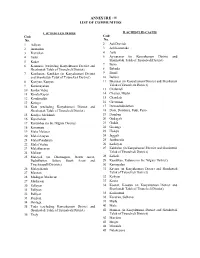
ANNEXURE - III LIST OF COMMUNITIES I. SCHEDULED TRIB ES II. SCHEDULED CASTES Code Code No. No. 1 Adiyan 2 Adi Dravida 2 Aranadan 3 Adi Karnataka 3 Eravallan 4 Ajila 4 Irular 6 Ayyanavar (in Kanyakumari District and 5 Kadar Shenkottah Taluk of Tirunelveli District) 6 Kammara (excluding Kanyakumari District and 7 Baira Shenkottah Taluk of Tirunelveli District) 8 Bakuda 7 Kanikaran, Kanikkar (in Kanyakumari District 9 Bandi and Shenkottah Taluk of Tirunelveli District) 10 Bellara 8 Kaniyan, Kanyan 11 Bharatar (in Kanyakumari District and Shenkottah 9 Kattunayakan Taluk of Tirunelveli District) 10 Kochu Velan 13 Chalavadi 11 Konda Kapus 14 Chamar, Muchi 12 Kondareddis 15 Chandala 13 Koraga 16 Cheruman 14 Kota (excluding Kanyakumari District and 17 Devendrakulathan Shenkottah Taluk of Tirunelveli District) 18 Dom, Dombara, Paidi, Pano 15 Kudiya, Melakudi 19 Domban 16 Kurichchan 20 Godagali 17 Kurumbas (in the Nilgiris District) 21 Godda 18 Kurumans 22 Gosangi 19 Maha Malasar 23 Holeya 20 Malai Arayan 24 Jaggali 21 Malai Pandaram 25 Jambuvulu 22 Malai Vedan 26 Kadaiyan 23 Malakkuravan 27 Kakkalan (in Kanyakumari District and Shenkottah 24 Malasar Taluk of Tirunelveli District) 25 Malayali (in Dharmapuri, North Arcot, 28 Kalladi Pudukkottai, Salem, South Arcot and 29 Kanakkan, Padanna (in the Nilgiris District) Tiruchirapalli Districts) 30 Karimpalan 26 Malayakandi 31 Kavara (in Kanyakumari District and Shenkottah 27 Mannan Taluk of Tirunelveli District) 28 Mudugar, Muduvan 32 Koliyan 29 Muthuvan 33 Koosa 30 Pallayan 34 Kootan, Koodan (in Kanyakumari District and 31 Palliyan Shenkottah Taluk of Tirunelveli District) 32 Palliyar 35 Kudumban 33 Paniyan 36 Kuravan, Sidhanar 34 Sholaga 39 Maila 35 Toda (excluding Kanyakumari District and 40 Mala Shenkottah Taluk of Tirunelveli District) 41 Mannan (in Kanyakumari District and Shenkottah 36 Uraly Taluk of Tirunelveli District) 42 Mavilan 43 Moger 44 Mundala 45 Nalakeyava Code III (A). -

Police Matters: the Everyday State and Caste Politics in South India, 19001975 by Radha Kumar
PolICe atter P olice M a tte rs T he v eryday tate and aste Politics in South India, 1900–1975 • R a dha Kumar Cornell unIerIt Pre IthaCa an lonon Copyright 2021 by Cornell University The text of this book is licensed under a Creative Commons Attribution-NonCommercial-NoDerivatives 4.0 International License: https:creativecommons.orglicensesby-nc-nd4.0. To use this book, or parts of this book, in any way not covered by the license, please contact Cornell University Press, Sage House, 512 East State Street, Ithaca, New ork 14850. Visit our website at cornellpress.cornell.edu. First published 2021 by Cornell University Press Library of Congress Cataloging-in-Publication Data Names: Kumar, Radha, 1981 author. Title: Police matters: the everyday state and caste politics in south India, 19001975 by Radha Kumar. Description: Ithaca New ork: Cornell University Press, 2021 Includes bibliographical references and index. Identifiers: LCCN 2021005664 (print) LCCN 2021005665 (ebook) ISBN 9781501761065 (paperback) ISBN 9781501760860 (pdf) ISBN 9781501760877 (epub) Subjects: LCSH: Police—India—Tamil Nadu—History—20th century. Law enforcement—India—Tamil Nadu—History—20th century. Caste— Political aspects—India—Tamil Nadu—History. Police-community relations—India—Tamil Nadu—History—20th century. Caste-based discrimination—India—Tamil Nadu—History—20th century. Classification: LCC HV8249.T3 K86 2021 (print) LCC HV8249.T3 (ebook) DDC 363.20954820904—dc23 LC record available at https:lccn.loc.gov2021005664 LC ebook record available at https:lccn.loc.gov2021005665 Cover image: The Car en Route, Srivilliputtur, c. 1935. The British Library Board, Carleston Collection: Album of Snapshot Views in South India, Photo 6281 (40). -

Nationalism, Caste-Blindness, and the Continuing Problems of War-Displaced Panchamars in Post-War Jaffna Society
Article CASTE: A Global Journal on Social Exclusion Vol. 1, No. 1, pp. 51–70 February 2020 brandeis.edu/j-caste ISSN 2639-4928 DOI: 10.26812/caste.v1i1.145 Nationalism, Caste-Blindness, and the Continuing Problems of War-Displaced Panchamars in Post-War Jaffna Society Kalinga Tudor Silva1 Abstract More than a decade after the end of the 26-year old LTTE—led civil war in Sri Lanka, a particular section of the Jaffna society continues to stay as Internally Displaced People (IDP). This paper tries to unravel why some low caste groups have failed to end their displacement and move out of the camps while everybody else has moved on to become a settled population regardless of the limitations they experience in the post-war era. Using both quantitative and qualitative data from the affected communities the paper argues that ethnic-biases and ‘caste-blindness’ of state policies, as well as Sinhala and Tamil politicians largely informed by rival nationalist perspectives are among the underlying causes of the prolonged IDP problem in the Jaffna Peninsula. In search of an appropriate solution to the intractable IDP problem, the author calls for an increased participation of these subaltern caste groups in political decision making and policy dialogues, release of land in high security zones for the affected IDPs wherever possible, and provision of adequate incentives for remaining people to move to alternative locations arranged by the state in consultation with IDPs themselves and members of neighbouring communities where they cannot be relocated at their original sites. Keywords Caste, caste-blindness, ethnicity, nationalism, social class, IDPs, Panchamars, Sri Lanka 1Department of Sociology, University of Peradeniya, Peradeniya, Sri Lanka E-mail: kalingatudorsilva@gmail.com © 2020 Kalinga Tudor Silva. -
CENTRAL LIST of Obcs for the STATE of TAMILNADU Entry No
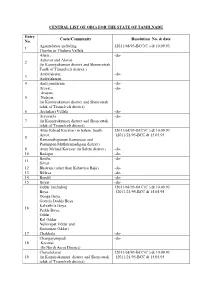
CENTRAL LIST OF OBC FOR THE STATE OF TAMILNADU E C/Cmm Rsoluti No. & da N. Agamudayar including 12011/68/93-BCC(C ) dt 10.09.93 1 Thozhu or Thuluva Vellala Alwar, -do- Azhavar and Alavar 2 (in Kanniyakumari district and Sheoncottah Taulk of Tirunelveli district ) Ambalakarar, -do- 3 Ambalakaran 4 Andi pandaram -do- Arayar, -do- Arayan, 5 Nulayar (in Kanniyakumari district and Shencottah taluk of Tirunelveli district) 6 Archakari Vellala -do- Aryavathi -do- 7 (in Kanniyakumari district and Shencottah taluk of Tirunelveli district) Attur Kilnad Koravar (in Salem, South 12011/68/93-BCC(C ) dt 10.09.93 Arcot, 12011/21/95-BCC dt 15.05.95 8 Ramanathapuram Kamarajar and Pasumpon Muthuramadigam district) 9 Attur Melnad Koravar (in Salem district) -do- 10 Badagar -do- Bestha -do- 11 Siviar 12 Bhatraju (other than Kshatriya Raju) -do- 13 Billava -do- 14 Bondil -do- 15 Boyar -do- Oddar (including 12011/68/93-BCC(C ) dt 10.09.93 Boya, 12011/21/95-BCC dt 15.05.95 Donga Boya, Gorrela Dodda Boya Kalvathila Boya, 16 Pedda Boya, Oddar, Kal Oddar Nellorepet Oddar and Sooramari Oddar) 17 Chakkala -do- Changayampadi -do- 18 Koravar (In North Arcot District) Chavalakarar 12011/68/93-BCC(C ) dt 10.09.93 19 (in Kanniyakumari district and Shencottah 12011/21/95-BCC dt 15.05.95 taluk of Tirunelveli district) Chettu or Chetty (including 12011/68/93-BCC(C ) dt 10.09.93 Kottar Chetty, 12011/21/95-BCC dt 15.05.95 Elur Chetty, Pathira Chetty 20 Valayal Chetty Pudukkadai Chetty) (in Kanniyakumari district and Shencottah taluk of Tirunelveli district) C.K. -

Understanding the Cultures of Fishing Communities
When Fish is Water: Food Security and Fish in a Coastal Community in The Dominican Republic Item Type Report Authors Stoffle, Richard, W. Publisher Food and Agriculture Organization of the United Nations Download date 08/10/2021 00:41:31 Link to Item http://hdl.handle.net/10150/292622 Understanding the cultures of fishing communities A key to fisheries management and food security Food and Agriculture Organization of the United Nations Cover photo: Small -scale fishing community, West Indies, by J.R. McGoodwin FAO Understanding the cultures of FISHERIES TECHNICAL fishing communities PAPER A key to fisheries management 401 and food security by James R. McGoodwin Professor Department of Anthropology University of Colorado Boulder, USA Food and Agriculture Organization of the United Nations Rome, 2001 The designations employed and the presentation of the material in this information product do not imply the expression of any opinion whatsoever on the part of the Food and Agriculture Organization of the United Nations concerning the legal status of any country, territory, city or area or of its authorities, or concerning the delimitation of its frontiers or boundaries. ISBN 92 -5- 104606 -9 All rights reserved. Reproduction and dissemination of material in this information product for educational or other non -commercial purposes are authorized without any prior written permission from the copyright holders provided the source is fully acknowledged. Reproduction of material in this information product for resale or other commercial purposes is prohibited without written permission of the copyright holders. Applications for such permission should be addressed to the Chief, Publishing and Multimedia Service, Information Division, FAO, Viale delle Terme di Caracalla, 00100 Rome, Italy or by e -mail to copyright @fao.org © FAO 2001 111 PREPARATION OF THIS DOCUMENT The Fishery Policy and Planning Division of the FAO Fisheries Department regularly publishes technical documentation relevant for fisheries policy planning and management.