Example to Make a Scientific Poster
Total Page:16
File Type:pdf, Size:1020Kb
Load more
Recommended publications
-

Mathématiques Et Espace
Atelier disciplinaire AD 5 Mathématiques et Espace Anne-Cécile DHERS, Education Nationale (mathématiques) Peggy THILLET, Education Nationale (mathématiques) Yann BARSAMIAN, Education Nationale (mathématiques) Olivier BONNETON, Sciences - U (mathématiques) Cahier d'activités Activité 1 : L'HORIZON TERRESTRE ET SPATIAL Activité 2 : DENOMBREMENT D'ETOILES DANS LE CIEL ET L'UNIVERS Activité 3 : D'HIPPARCOS A BENFORD Activité 4 : OBSERVATION STATISTIQUE DES CRATERES LUNAIRES Activité 5 : DIAMETRE DES CRATERES D'IMPACT Activité 6 : LOI DE TITIUS-BODE Activité 7 : MODELISER UNE CONSTELLATION EN 3D Crédits photo : NASA / CNES L'HORIZON TERRESTRE ET SPATIAL (3 ème / 2 nde ) __________________________________________________ OBJECTIF : Détermination de la ligne d'horizon à une altitude donnée. COMPETENCES : ● Utilisation du théorème de Pythagore ● Utilisation de Google Earth pour évaluer des distances à vol d'oiseau ● Recherche personnelle de données REALISATION : Il s'agit ici de mettre en application le théorème de Pythagore mais avec une vision terrestre dans un premier temps suite à un questionnement de l'élève puis dans un second temps de réutiliser la même démarche dans le cadre spatial de la visibilité d'un satellite. Fiche élève ____________________________________________________________________________ 1. Victor Hugo a écrit dans Les Châtiments : "Les horizons aux horizons succèdent […] : on avance toujours, on n’arrive jamais ". Face à la mer, vous voyez l'horizon à perte de vue. Mais "est-ce loin, l'horizon ?". D'après toi, jusqu'à quelle distance peux-tu voir si le temps est clair ? Réponse 1 : " Sans instrument, je peux voir jusqu'à .................. km " Réponse 2 : " Avec une paire de jumelles, je peux voir jusqu'à ............... km " 2. Nous allons maintenant calculer à l'aide du théorème de Pythagore la ligne d'horizon pour une hauteur H donnée. -

Musical Composition Graduate Portfolio
University of Northern Iowa UNI ScholarWorks Dissertations and Theses @ UNI Student Work 2021 Musical composition graduate portfolio Juan Marulanda University of Northern Iowa Let us know how access to this document benefits ouy Copyright ©2021 Juan Marulanda Follow this and additional works at: https://scholarworks.uni.edu/etd Recommended Citation Marulanda, Juan, "Musical composition graduate portfolio" (2021). Dissertations and Theses @ UNI. 1102. https://scholarworks.uni.edu/etd/1102 This Open Access Thesis is brought to you for free and open access by the Student Work at UNI ScholarWorks. It has been accepted for inclusion in Dissertations and Theses @ UNI by an authorized administrator of UNI ScholarWorks. For more information, please contact scholarworks@uni.edu. Copyright by JUAN MARULANDA 2021 All Rights Reserved MUSICAL COMPOSITION GRADUATE PORTFOLIO An Abstract Submitted in Partial Fulfillment of the Requirements for the Degree Master of Music Juan Marulanda University of Northern Iowa May 2021 This Study By: Juan Carlos Marulanda Entitled: Musical Composition Graduate Portfolio has been approved as meeting the thesis requirement for the Degree of Master of Music: Composition Date Dr. Daniel Swilley, Chair, Recital Committee Date Dr. Michael Conrad, Recital Committee Member Date Dr. Jonathan Schwabe, Recital Committee Member Date Dr. Jennifer Waldron, Dean, Graduate College This Recital Performance By: Juan Marulanda Entitled: Musical Composition Graduate Portfolio has been approved as meeting the thesis requirement for the Degree of Master of Music: Composition Date Dr. Daniel Swilley, Chair, Recital Committee Date Dr. Michael Conrad, Recital Committee Member Date Dr. Jonathan Schwabe, Recital Committee Member Date Dr. Jennifer Waldron, Dean, Graduate College ABSTRACT The musical works included in this portfolio were composed between Fall 2019 and Spring 2021. -
Vssc163 Draftv3 IBVS 2 Colour Correct Graph.Pmd
British Astronomical Association VARIABLE STAR SECTION CIRCULAR No 163, March 2015 Contents IBVS 6080 – 6109 - J. Simpson ............................................... inside front cover From the Director - R. Pickard ........................................................................... 3 Polar V1432 Aquilae - Editor’s Note .................................................................. 4 Eclipsing Binary News - D. Loughney .............................................................. 4 Update on the Campaign to Observe the Dwarf Nova CSS 121005:212625+201948 - J. Shears ............... 6 How Variable Stars get Their Names - D. Griffin .............................................. 9 References to Naming of Variable Stars - D. Griffin ........................................ 11 The Discovery of Three New Variable Stars using the Bradford Robotic Telescope and the Software Package Muniwin - D. Conner .................. 12 FY Librae - a First Look at the Behaviour during 2014 - P. Williams .............. 16 FY Librae goes Active and Reaffirms the Howarth and Bailey Formula - J. Toone .............. 18 Refining the Period of V505 Scuti - I. Miller ................................................... 21 Binocular Programme - M. Taylor ................................................................... 21 Eclipsing Binary Predictions – Where to Find Them - D. Loughney .............. 22 Charges for Section Publications .............................................. inside back cover Guidelines for Contributing to the Circular ............................. -
The Maunder Minimum and the Variable Sun-Earth Connection
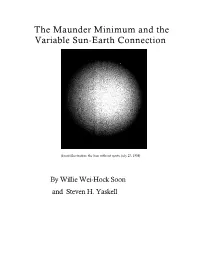
The Maunder Minimum and the Variable Sun-Earth Connection (Front illustration: the Sun without spots, July 27, 1954) By Willie Wei-Hock Soon and Steven H. Yaskell To Soon Gim-Chuan, Chua Chiew-See, Pham Than (Lien+Van’s mother) and Ulla and Anna In Memory of Miriam Fuchs (baba Gil’s mother)---W.H.S. In Memory of Andrew Hoff---S.H.Y. To interrupt His Yellow Plan The Sun does not allow Caprices of the Atmosphere – And even when the Snow Heaves Balls of Specks, like Vicious Boy Directly in His Eye – Does not so much as turn His Head Busy with Majesty – ‘Tis His to stimulate the Earth And magnetize the Sea - And bind Astronomy, in place, Yet Any passing by Would deem Ourselves – the busier As the Minutest Bee That rides – emits a Thunder – A Bomb – to justify Emily Dickinson (poem 224. c. 1862) Since people are by nature poorly equipped to register any but short-term changes, it is not surprising that we fail to notice slower changes in either climate or the sun. John A. Eddy, The New Solar Physics (1977-78) Foreword By E. N. Parker In this time of global warming we are impelled by both the anticipated dire consequences and by scientific curiosity to investigate the factors that drive the climate. Climate has fluctuated strongly and abruptly in the past, with ice ages and interglacial warming as the long term extremes. Historical research in the last decades has shown short term climatic transients to be a frequent occurrence, often imposing disastrous hardship on the afflicted human populations. -

FIXED STARS a SOLAR WRITER REPORT for Churchill Winston WRITTEN by DIANA K ROSENBERG Page 2
FIXED STARS A SOLAR WRITER REPORT for Churchill Winston WRITTEN BY DIANA K ROSENBERG Page 2 Prepared by Cafe Astrology cafeastrology.com Page 23 Churchill Winston Natal Chart Nov 30 1874 1:30 am GMT +0:00 Blenhein Castle 51°N48' 001°W22' 29°‚ 53' Tropical ƒ Placidus 02' 23° „ Ý 06° 46' Á ¿ 21° 15° Ý 06' „ 25' 23° 13' Œ À ¶29° Œ 28° … „ Ü É Ü 06° 36' 26' 25° 43' Œ 51'Ü áá Œ 29° ’ 29° “ àà … ‘ à ‹ – 55' á á 55' á †32' 16° 34' ¼ † 23° 51'Œ 23° ½ † 06' 25° “ ’ † Ê ’ ‹ 43' 35' 35' 06° ‡ Š 17° 43' Œ 09° º ˆ 01' 01' 07° ˆ ‰ ¾ 23° 22° 08° 02' ‡ ¸ Š 46' » Ï 06° 29°ˆ 53' ‰ Page 234 Astrological Summary Chart Point Positions: Churchill Winston Planet Sign Position House Comment The Moon Leo 29°Le36' 11th The Sun Sagittarius 7°Sg43' 3rd Mercury Scorpio 17°Sc35' 2nd Venus Sagittarius 22°Sg01' 3rd Mars Libra 16°Li32' 1st Jupiter Libra 23°Li34' 1st Saturn Aquarius 9°Aq35' 5th Uranus Leo 15°Le13' 11th Neptune Aries 28°Ar26' 8th Pluto Taurus 21°Ta25' 8th The North Node Aries 25°Ar51' 8th The South Node Libra 25°Li51' 2nd The Ascendant Virgo 29°Vi55' 1st The Midheaven Gemini 29°Ge53' 10th The Part of Fortune Capricorn 8°Cp01' 4th Chart Point Aspects Planet Aspect Planet Orb App/Sep The Moon Semisquare Mars 1°56' Applying The Moon Trine Neptune 1°10' Separating The Moon Trine The North Node 3°45' Separating The Moon Sextile The Midheaven 0°17' Applying The Sun Semisquare Jupiter 0°50' Applying The Sun Sextile Saturn 1°52' Applying The Sun Trine Uranus 7°30' Applying Mercury Square Uranus 2°21' Separating Mercury Opposition Pluto 3°49' Applying Venus Sextile -

Meeting Program
A A S MEETING PROGRAM 211TH MEETING OF THE AMERICAN ASTRONOMICAL SOCIETY WITH THE HIGH ENERGY ASTROPHYSICS DIVISION (HEAD) AND THE HISTORICAL ASTRONOMY DIVISION (HAD) 7-11 JANUARY 2008 AUSTIN, TX All scientific session will be held at the: Austin Convention Center COUNCIL .......................... 2 500 East Cesar Chavez St. Austin, TX 78701 EXHIBITS ........................... 4 FURTHER IN GRATITUDE INFORMATION ............... 6 AAS Paper Sorters SCHEDULE ....................... 7 Rachel Akeson, David Bartlett, Elizabeth Barton, SUNDAY ........................17 Joan Centrella, Jun Cui, Susana Deustua, Tapasi Ghosh, Jennifer Grier, Joe Hahn, Hugh Harris, MONDAY .......................21 Chryssa Kouveliotou, John Martin, Kevin Marvel, Kristen Menou, Brian Patten, Robert Quimby, Chris Springob, Joe Tenn, Dirk Terrell, Dave TUESDAY .......................25 Thompson, Liese van Zee, and Amy Winebarger WEDNESDAY ................77 We would like to thank the THURSDAY ................. 143 following sponsors: FRIDAY ......................... 203 Elsevier Northrop Grumman SATURDAY .................. 241 Lockheed Martin The TABASGO Foundation AUTHOR INDEX ........ 242 AAS COUNCIL J. Craig Wheeler Univ. of Texas President (6/2006-6/2008) John P. Huchra Harvard-Smithsonian, President-Elect CfA (6/2007-6/2008) Paul Vanden Bout NRAO Vice-President (6/2005-6/2008) Robert W. O’Connell Univ. of Virginia Vice-President (6/2006-6/2009) Lee W. Hartman Univ. of Michigan Vice-President (6/2007-6/2010) John Graham CIW Secretary (6/2004-6/2010) OFFICERS Hervey (Peter) STScI Treasurer Stockman (6/2005-6/2008) Timothy F. Slater Univ. of Arizona Education Officer (6/2006-6/2009) Mike A’Hearn Univ. of Maryland Pub. Board Chair (6/2005-6/2008) Kevin Marvel AAS Executive Officer (6/2006-Present) Gary J. Ferland Univ. of Kentucky (6/2007-6/2008) Suzanne Hawley Univ. -

Downloads/ Astero2007.Pdf) and by Aerts Et Al (2010)
This work is protected by copyright and other intellectual property rights and duplication or sale of all or part is not permitted, except that material may be duplicated by you for research, private study, criticism/review or educational purposes. Electronic or print copies are for your own personal, non- commercial use and shall not be passed to any other individual. No quotation may be published without proper acknowledgement. For any other use, or to quote extensively from the work, permission must be obtained from the copyright holder/s. i Fundamental Properties of Solar-Type Eclipsing Binary Stars, and Kinematic Biases of Exoplanet Host Stars Richard J. Hutcheon Submitted in accordance with the requirements for the degree of Doctor of Philosophy. Research Institute: School of Environmental and Physical Sciences and Applied Mathematics. University of Keele June 2015 ii iii Abstract This thesis is in three parts: 1) a kinematical study of exoplanet host stars, 2) a study of the detached eclipsing binary V1094 Tau and 3) and observations of other eclipsing binaries. Part I investigates kinematical biases between two methods of detecting exoplanets; the ground based transit and radial velocity methods. Distances of the host stars from each method lie in almost non-overlapping groups. Samples of host stars from each group are selected. They are compared by means of matching comparison samples of stars not known to have exoplanets. The detection methods are found to introduce a negligible bias into the metallicities of the host stars but the ground based transit method introduces a median age bias of about -2 Gyr. -

GEORGE HERBIG and Early Stellar Evolution
GEORGE HERBIG and Early Stellar Evolution Bo Reipurth Institute for Astronomy Special Publications No. 1 George Herbig in 1960 —————————————————————– GEORGE HERBIG and Early Stellar Evolution —————————————————————– Bo Reipurth Institute for Astronomy University of Hawaii at Manoa 640 North Aohoku Place Hilo, HI 96720 USA . Dedicated to Hannelore Herbig c 2016 by Bo Reipurth Version 1.0 – April 19, 2016 Cover Image: The HH 24 complex in the Lynds 1630 cloud in Orion was discov- ered by Herbig and Kuhi in 1963. This near-infrared HST image shows several collimated Herbig-Haro jets emanating from an embedded multiple system of T Tauri stars. Courtesy Space Telescope Science Institute. This book can be referenced as follows: Reipurth, B. 2016, http://ifa.hawaii.edu/SP1 i FOREWORD I first learned about George Herbig’s work when I was a teenager. I grew up in Denmark in the 1950s, a time when Europe was healing the wounds after the ravages of the Second World War. Already at the age of 7 I had fallen in love with astronomy, but information was very hard to come by in those days, so I scraped together what I could, mainly relying on the local library. At some point I was introduced to the magazine Sky and Telescope, and soon invested my pocket money in a subscription. Every month I would sit at our dining room table with a dictionary and work my way through the latest issue. In one issue I read about Herbig-Haro objects, and I was completely mesmerized that these objects could be signposts of the formation of stars, and I dreamt about some day being able to contribute to this field of study. -
Culmination of a Constellation
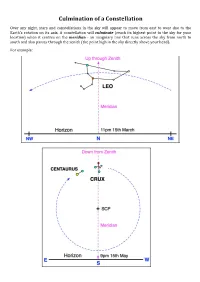
Culmination of a Constellation Over any night, stars and constellations in the sky will appear to move from east to west due to the Earth’s rotation on its axis. A constellation will culminate (reach its highest point in the sky for your location) when it centres on the meridian - an imaginary line that runs across the sky from north to south and also passes through the zenith (the point high in the sky directly above your head). For example: When to Observe Constellations The taBle shows the approximate time (AEST) constellations will culminate around the middle (15th day) of each month. Constellations will culminate 2 hours earlier for each successive month. Note: add an hour to the given time when daylight saving time is in effect. The time “12” is midnight. Sunrise/sunset times are rounded off to the nearest half an hour. Sun- Jan Feb Mar Apr May Jun Jul Aug Sep Oct Nov Dec Rise 5am 5:30 6am 6am 7am 7am 7am 6:30 6am 5am 4:30 4:30 Set 7pm 6:30 6pm 5:30 5pm 5pm 5pm 5:30 6pm 6pm 6:30 7pm And 5am 3am 1am 11pm 9pm Aqr 5am 3am 1am 11pm 9pm Aql 4am 2am 12 10pm 8pm Ara 4am 2am 12 10pm 8pm Ari 5am 3am 1am 11pm 9pm Aur 10pm 8pm 4am 2am 12 Boo 3am 1am 11pm 9pm 7pm Cnc 1am 11pm 9pm 7pm 3am CVn 3am 1am 11pm 9pm 7pm CMa 11pm 9pm 7pm 3am 1am Cap 5am 3am 1am 11pm 9pm 7pm Car 2am 12 10pm 8pm 6pm Cen 4am 2am 12 10pm 8pm 6pm Cet 4am 2am 12 10pm 8pm Cha 3am 1am 11pm 9pm 7pm Col 10pm 8pm 4am 2am 12 Com 3am 1am 11pm 9pm 7pm CrA 3am 1am 11pm 9pm 7pm CrB 4am 2am 12 10pm 8pm Crv 3am 1am 11pm 9pm 7pm Cru 3am 1am 11pm 9pm 7pm Cyg 5am 3am 1am 11pm 9pm 7pm Del -

Astronomy with the Naked Eye a New Geography of the Heavens With
A N EW G EOG R AP H Y OF TH E H EAV EN S W I T H D ESCR IPTIO N S A N D CH A R TS O l’ CONbTELLA TlONS. STARS. AN D PLA N ETS BY R R E P S E R V I SS G A T T . / 8 8 4 7 NEW Y ORK AND DONDON M C M V I I ! RRE P. s s av x ss g GA TT , 1 . 0 mm 33. 1 907 CONTENTS FIIE PLEASURE OF KNOWI NG TH E CONSTELLATI ONS — ’ the sta rs as lan dma rks Eflect of going north or south on the a p — — pearan ce of the hea vens Personal in fluen ce of the s ta rs View — ing the cons tella tion. a mid hi storic scenes Cass iopeia seen fro m ’ — Clytemnestra s tomb The celestia l pagea nt fro mMount Etna — — The sta rs ann ounce the seas ons Atmos pheric influence on — t he a ppea rance of the s ta rs Indi v idua lity of the stars 4 ta r — — — magn itudes Sta r colors The c ha rmof s ta r gro u pings The — h a rmony of the spheres How scientific astronomy has drifted Page 1 NSTELLATIONS ON TH E MERI DI AN I N JAN U ARY — 0! the meridian The dou ble revol u tion of the hea ven s — ~ ~ cha rioteer Ca pella a n d its his tory Ca melopa r — — — the Bu ll Aldeba ran The Hyades The Pleia ' of and su er a u the e ad es— n p stition bo t Pl i O on . -

November 2020 BRAS Newsletter
A Mars efter Lowell's Glober ca. 1905-1909”, from Percival Lowell’s maps; National Maritime Museum, Greenwich, London (see Page 6) Monthly Meeting November 9th at 7:00 PM, via Jitsi (Monthly meetings are on 2nd Mondays at Highland Road Park Observatory, temporarily during quarantine at meet.jit.si/BRASMeets). GUEST SPEAKER: Chuck Allen from the Astronomical League will speak about The Cosmic Distance Ladder, which explores the historical advancement of distance determinations in astronomy. What's In This Issue? President’s Message Member Meeting Minutes Business Meeting Minutes Outreach Report Asteroid and Comet News Light Pollution Committee Report Globe at Night Member’s Corner – John Nagle ALPO 2020 Conference Astro-Photos by BRAS Members - MARS Messages from the HRPO REMOTE DISCUSSION Solar Viewing Edge of Night Natural Sky Conference Recent Entries in the BRAS Forum Observing Notes: Pisces – The Fishes Like this newsletter? See PAST ISSUES online back to 2009 Visit us on Facebook – Baton Rouge Astronomical Society BRAS YouTube Channel Baton Rouge Astronomical Society Newsletter, Night Visions Page 2 of 24 November 2020 President’s Message Welcome to the home stretch for 2020. The nights are starting earlier and earlier as the weather becomes more and more comfortable and all of our old favorites of the fall and winter skies really start finding their places right where they belong. October was a busy month for us, with several big functions at the Observatory, including two oppositions and two more all night celebrations. By comparison, November is looking fairly calm, the big focus there is going to be our third annual Natural Sky Conference on the 13th, which I’m encouraging people who care about the state of light pollution in our city and the surrounding area to get involved in. -

Clusters Nebulae & Galaxies
CLUSTERS, NEBULAE & GALAXIES A NOVICE OBSERVER’S HANDBOOK By: Prof. P. N. Shankar PREFACE In the normal course of events, an amateur who builds or acquires a telescope will use it initially to observe the Moon and the planets. After the thrill of seeing the craters of the Moon, the Galilean moons of Jupiter and its bands, and the rings of Saturn he(*) is usually at a loss as to what to do next; Mars and Venus are usually disappointing as are the stars (they don’t look any bigger!). If the telescope had good resolution one could observe binaries, but alas, this is often not the case. Moreover, at this stage, the amateur is unlikely to be willing to do serious work on variable stars or on planetary observations. What can he do with his telescope that will rekindle his interest and prepare him for serious work? I believe that there is little better for him to do than hunt for the Messier objects; this book is meant as a guide in this exciting adventure. While this book is primarily a guide to the Messier objects, a few other easy clusters and nebulae have also been included. I have tried, while writing this handbook, to keep in mind the difficulties faced by a beginner. Even if one has good star maps, such as those in Norton’s Star Atlas, a beginner often has difficulty in locating some of the Messier objects because he does not know what he is expected to see! A cluster like M29 is a little difficult because it is a sparse cluster in a rich field; M97 is nominally brighter than M76, another planetary, but is more difficult to see; M33 is an approximately 6th magnitude galaxy but is far more difficult than many 9th magnitude galaxies.