National Forum for Biological Recording Conference 2017
Total Page:16
File Type:pdf, Size:1020Kb
Load more
Recommended publications
-

Conservation Team Report 2016-2017
Conservation Team Report 2016 - 2017 1 www.welshwildlife.org Wildlife Trust of South and West Wales Conservation Team report 2016-2017 Contents 1. Introduction .................................................................................................................... 4 1.1 Members of the conservation team ......................................................................... 4 1.2 Our assets .............................................................................................................. 8 1.3 Our funders ............................................................................................................. 9 2. Nature Reserves ............................................................................................................ 9 2.1 Introduction to our work on our nature reserves ...................................................... 9 2.2 Habitat management ............................................................................................. 13 2.3 Research .............................................................................................................. 22 2.4 Recording and monitoring ..................................................................................... 23 2.5 Volunteers ............................................................................................................ 28 2.6 Access management ............................................................................................ 35 2.7 Interpretation ........................................................................................................ -

Pseudoscorpions (Arachnida: Pseudoscorpiones) from Leaf Litter of the Slovak Karst National Park
Arachnologische Mitteilungen / Arachnology Letters 61: 77-83 Karlsruhe, April 2021 Pseudoscorpions (Arachnida: Pseudoscorpiones) from leaf litter of the Slovak Karst National Park Alexandra Jászayová & Tomáš Jászay doi: 10.30963/aramit6113 Abstract. A total of 667 specimens of pseudoscorpions, belonging to 15 species and four families were collected during 2014. Samples were taken from leaf litter at five localities in the Western Carpathians in the Slovak Karst National Park, Slovakia. The most abundant fa- milies were Neobisiidae (381 specimens) and Chthoniidae (275 specimens). Furthermore ten chernetid specimens and a single cheliferid deutonymph were recorded. Four of the 15 pseudoscorpion species were recorded in the Slovak Karst for the first time. Keywords: Carpathians, distribution, faunistics, Slovakia Zusammenfassung. Pseudoskorpione (Arachnida: Pseudoscorpiones) aus Laubstreu im Nationalpark Slowakischer Karst. Im Jahr 2014 wurden insgesamt 667 Pseudoskorpione aus 15 Arten und vier Familien gesammelt. Die Proben wurden in fünf verschiedenen Gebieten im Nationalpark Slowakischer Karst (Westkarpaten, Slowakei) genommen. Am häufigsten waren die Familien Neobisiidae (381 Exemplare) und Chthoniidae (275 Exemplare) vertreten. Weiterhin wurden zehn Exemplaren der Chernetidae und nur eine Deutonym- phe einer Cheliferidae erfasst. Vier der 15 Pseudoskorpionarten wurden erstmals im slowakischen Karst nachgewiesen. The Slovak Karst National Park is one of the most valuable localities (Fig. 1): Brzotín Rocks (BR), Pod Fabiánkou (F), areas in Slovakia in terms of biodiversity (Tomaskinova & Drieňovec (D), Hrušovská lesostep forest-steppe (HL) and Tomaskin 2013). The territory of the National Park consists Jasovské dubiny ( JD). of the Koniarská, Plešivská, Silická, Zádielská and Jasovská BR: Brzotín Rocks National Nature Reserve is situated at plateaus, the Horný and Dolný hills, and is divided into gorges 290–679 m a.s.l. -
Additions, Deletions and Corrections to An
Bulletin of the Irish Biogeographical Society No. 36 (2012) ADDITIONS, DELETIONS AND CORRECTIONS TO AN ANNOTATED CHECKLIST OF THE IRISH BUTTERFLIES AND MOTHS (LEPIDOPTERA) WITH A CONCISE CHECKLIST OF IRISH SPECIES AND ELACHISTA BIATOMELLA (STAINTON, 1848) NEW TO IRELAND K. G. M. Bond1 and J. P. O’Connor2 1Department of Zoology and Animal Ecology, School of BEES, University College Cork, Distillery Fields, North Mall, Cork, Ireland. e-mail: <k.bond@ucc.ie> 2Emeritus Entomologist, National Museum of Ireland, Kildare Street, Dublin 2, Ireland. Abstract Additions, deletions and corrections are made to the Irish checklist of butterflies and moths (Lepidoptera). Elachista biatomella (Stainton, 1848) is added to the Irish list. The total number of confirmed Irish species of Lepidoptera now stands at 1480. Key words: Lepidoptera, additions, deletions, corrections, Irish list, Elachista biatomella Introduction Bond, Nash and O’Connor (2006) provided a checklist of the Irish Lepidoptera. Since its publication, many new discoveries have been made and are reported here. In addition, several deletions have been made. A concise and updated checklist is provided. The following abbreviations are used in the text: BM(NH) – The Natural History Museum, London; NMINH – National Museum of Ireland, Natural History, Dublin. The total number of confirmed Irish species now stands at 1480, an addition of 68 since Bond et al. (2006). Taxonomic arrangement As a result of recent systematic research, it has been necessary to replace the arrangement familiar to British and Irish Lepidopterists by the Fauna Europaea [FE] system used by Karsholt 60 Bulletin of the Irish Biogeographical Society No. 36 (2012) and Razowski, which is widely used in continental Europe. -

The Entomologist's Record and Journal of Variation
M DC, — _ CO ^. E CO iliSNrNVINOSHilWS' S3ldVyan~LIBRARlES*"SMITHS0N!AN~lNSTITUTl0N N' oCO z to Z (/>*Z COZ ^RIES SMITHSONIAN_INSTITUTlON NOIiniIiSNI_NVINOSHllWS S3ldVaan_L: iiiSNi'^NviNOSHiiNS S3iavyan libraries Smithsonian institution N( — > Z r- 2 r" Z 2to LI ^R I ES^'SMITHSONIAN INSTITUTlON'"NOIini!iSNI~NVINOSHilVMS' S3 I b VM 8 11 w </» z z z n g ^^ liiiSNi NviNOSHims S3iyvyan libraries Smithsonian institution N' 2><^ =: to =: t/J t/i </> Z _J Z -I ARIES SMITHSONIAN INSTITUTION NOIiniliSNI NVINOSHilWS SSIdVyan L — — </> — to >'. ± CO uiiSNi NViNosHiiws S3iyvaan libraries Smithsonian institution n CO <fi Z "ZL ~,f. 2 .V ^ oCO 0r Vo^^c>/ - -^^r- - 2 ^ > ^^^^— i ^ > CO z to * z to * z ARIES SMITHSONIAN INSTITUTION NOIinillSNl NVINOSHllWS S3iaVdan L to 2 ^ '^ ^ z "^ O v.- - NiOmst^liS^> Q Z * -J Z I ID DAD I re CH^ITUCnMIAM IMOTtTIITinM / c. — t" — (/) \ Z fj. Nl NVINOSHIIINS S3 I M Vd I 8 H L B R AR I ES, SMITHSONlAN~INSTITUTION NOIlfl :S^SMITHS0NIAN_ INSTITUTION N0liniliSNI__NIVIN0SHillMs'^S3 I 8 VM 8 nf LI B R, ^Jl"!NVINOSHimS^S3iavyan"'LIBRARIES^SMITHS0NIAN~'lNSTITUTI0N^NOIin L '~^' ^ [I ^ d 2 OJ .^ . ° /<SS^ CD /<dSi^ 2 .^^^. ro /l^2l^!^ 2 /<^ > ^'^^ ^ ..... ^ - m x^^osvAVix ^' m S SMITHSONIAN INSTITUTION — NOIlfliliSNrNVINOSHimS^SS iyvyan~LIBR/ S "^ ^ ^ c/> z 2 O _ Xto Iz JI_NVIN0SH1I1/MS^S3 I a Vd a n^LI B RAR I ES'^SMITHSONIAN JNSTITUTION "^NOlin Z -I 2 _j 2 _j S SMITHSONIAN INSTITUTION NOIinillSNI NVINOSHilWS S3iyVaan LI BR/ 2: r- — 2 r- z NVINOSHiltNS ^1 S3 I MVy I 8 n~L B R AR I Es'^SMITHSONIAN'iNSTITUTIOn'^ NOlin ^^^>^ CO z w • z i ^^ > ^ s smithsonian_institution NoiiniiiSNi to NviNosHiiws'^ss I dVH a n^Li br; <n / .* -5^ \^A DO « ^\t PUBLISHED BI-MONTHLY ENTOMOLOGIST'S RECORD AND Journal of Variation Edited by P.A. -

Monochroa Suffusella (Lepidoptera: Gelechiidae, Gelechiinae), New to the Belgian Fauna
Monochroa suffusella (Lepidoptera: Gelechiidae, Gelechiinae), new to the Belgian fauna Dan Slootmaekers & Willy De Prins Abstract. On June 20th, 2015 several specimens of Monochroa suffusella (Douglas, 1850) were netted in Kalmthout (prov. Antwerp, Belgium). This is the first record of this species for Belgium. Information on the geographical distribution and biology of the species is provided as well as an examination of the genitalia. Samenvatting. Op 20 juni 2015 werden enkele exemplaren van Monochroa suffusella (Douglas, 1850) met een net gevangen te Kalmthout (prov. Antwerpen, België). Het is de eerste keer dat deze soort in België werd waargenomen. Informatie over de geografische verspreiding en de biologie wordt gegeven samen met een beschrijving van de genitalia. Résumé. Le 20 juin 2015 quelques exemplaires de Monochroa suffusella (Douglas, 1850) furent capturés au filet à Kalmthout (prov. d'Anvers, Belgique). Il s'agit de la première mention de cette espèce en Belgique. Des informations concernant la distribution géographique et la biologie de l'espèce sont fournies ainsi qu’un examen des génitalias. Key words: Monochroa suffusella – Faunistics –Lepidoptera– New record – Belgium. Slootmaekers D.: Kronenburgstraat 102, 2000 Antwerpen, Belgium. danslootmaekers@gmail.com De Prins W.: Dorpstraat 401B, B-3061 Leefdaal, Belgium. willy.deprins@gmail.com Introduction about 40 species in the Holarctic region (Sakamaki 1996: 245) and it was hitherto represented by 9 species in During a twilight visit to Grenspark De Zoom- Belgium, of which only 6 were observed after 2004 (De Kalmthoutse Heide (Kalmthout, prov. Antwerp, Belgium) Prins & Steeman 2003–2015). on June 20th, 2015 conditions were good for micro moths to be on the wing. -

Phoresie Und Phagophilie Bei Pseudoscorpionen. 441-497 Download Unter
ZOBODAT - www.zobodat.at Zoologisch-Botanische Datenbank/Zoological-Botanical Database Digitale Literatur/Digital Literature Zeitschrift/Journal: Österreichische Zoologische Zeitschrift Jahr/Year: 1948 Band/Volume: 01 Autor(en)/Author(s): Beier Max Walter Peter Artikel/Article: Phoresie und Phagophilie bei Pseudoscorpionen. 441-497 download unter www.biologiezentrum.at Phoresie und Phagophilie bei Pseudoscorpionen. Von M. Beier, Wien. Mit 22 Textabbildungen. I. Biologisch-ökologischer Teil. Gewisse Pseudoscorpione werden häufig an Fliegen und an- deren kleineren Insekten angetroffen, an deren Beinen sie sich mit einer Palpenschere festhalten. Diese Erscheinung wird erstmalig von dem Grazer Naturforscher Poda (1761) und seither von zahlreichen anderen Autoren erwähnt. Sie ist unter dem Namen Phoresie bekannt und hat verschiedene, sich widersprechende Deutungsversuche erfahren, die alle ein unbefriedigendes Ergebnis zeitigten. Weniger bekannt ist die Tatsache, daß sich Pseudoscorpione regelmäßig auch unter den Flügeldecken großer tropischer Käfer und Wanzen finden sowie ständige Gäste in den Nestern von Ter- miten, sozialen Hymenopteren, Vögeln und Kleinsäugetieren sind, wo sie in einem phagophilen Verhältnisse leben. Die Gesetzmäßigkeit dieser Erscheinung wurde sogar in letzter Zeit von V a c h ο η (1940) bestritten. Es ist nun die Aufgabe vorliegender Arbeit, auf Grund der vorhandenen Literatur und eines reichhaltigen eigenen Materiales sämtliche Tatsachen zusammenzustellen und den ganzen Fragen- komplex zu prüfen, wobei die einzelnen Vergesellschaftungsformen gesondert behandelt werden sollen. A. Verzeichnis der Arten, die an die Extremitäten anderer Arthropoden angeklammert gefunden wurden (Phoresie). (Die mit einem * bezeichneten Arten werden mit einer gewissen Regel- mäßigkeit in Phoresie festgestellt, bei den übrigen handelt es sich um ver- download unter www.biologiezentrum.at 442 Μ. Beier: einzelte Zufallsfunde, die übrigens hinsichtlich der Artzugehörigkeit zum Teil fraglich sind.) ? „Obisium" spec. -
Journal of Cave and Karst Studies
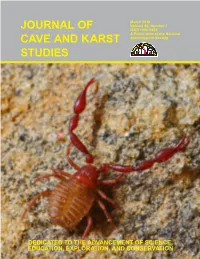
March 2018 Volume 80, Number 1 JOURNAL OF ISSN 1090-6924 A Publication of the National CAVE AND KARST Speleological Society STUDIES DEDICATED TO THE ADVANCEMENT OF SCIENCE, EDUCATION, EXPLORATION, AND CONSERVATION Published By BOARD OF EDITORS The National Speleological Society Anthropology George Crothers http://caves.org/pub/journal University of Kentucky Lexington, KY Office george.crothers@utk.edu 6001 Pulaski Pike NW Huntsville, AL 35810 USA Conservation-Life Sciences Tel:256-852-1300 Julian J. Lewis & Salisa L. Lewis Lewis & Associates, LLC. nss@caves.org Borden, IN lewisbioconsult@aol.com Editor-in-Chief Earth Sciences Benjamin Schwartz Malcolm S. Field Texas State University National Center of Environmental San Marcos, TX Assessment (8623P) bs37@txstate.edu Office of Research and Development U.S. Environmental Protection Agency Leslie A. North 1200 Pennsylvania Avenue NW Western Kentucky University Washington, DC 20460-0001 Bowling Green, KY leslie.north@wku.edu 703-347-8601 Voice 703-347-8692 Fax field.malcolm@epa.gov Mario Parise University Aldo Moro Production Editor Bari, Italy Scott A. Engel mario.parise@uniba.it Knoxville, TN 225-281-3914 Exploration Paul Burger saecaver@gmail.com National Park Service Eagle River, Alaska Journal Copy Editor paul_burger@nps.gov Linda Starr Microbiology Albuquerque, NM Kathleen H. Lavoie State University of New York Plattsburgh, NY lavoiekh@plattsburgh.edu Paleontology Greg McDonald National Park Service Fort Collins, CO greg_mcdonald@nps.gov Social Sciences Joseph C. Douglas The Journal of Cave and Karst Studies , ISSN 1090-6924, CPM Volunteer State Community College Number #40065056, is a multi-disciplinary, refereed journal pub- Gallatin, TN lished four times a year by the National Speleological Society. -

Predation Interactions Among Henhouse-Dwelling Arthropods, With
Predation interactions among henhouse-dwelling arthropods, with a focus on the poultry red mite Dermanyssus gallinae Running title: Predation interactions involving Dermanyssus gallinae in poultry farms Ghais Zriki, Rumsais Blatrix, Lise Roy To cite this version: Ghais Zriki, Rumsais Blatrix, Lise Roy. Predation interactions among henhouse-dwelling arthropods, with a focus on the poultry red mite Dermanyssus gallinae Running title: Predation interactions involving Dermanyssus gallinae in poultry farms. Pest Management Science, Wiley, 2020, 76 (11), pp.3711-3719. 10.1002/ps.5920. hal-02985136 HAL Id: hal-02985136 https://hal.archives-ouvertes.fr/hal-02985136 Submitted on 1 Nov 2020 HAL is a multi-disciplinary open access L’archive ouverte pluridisciplinaire HAL, est archive for the deposit and dissemination of sci- destinée au dépôt et à la diffusion de documents entific research documents, whether they are pub- scientifiques de niveau recherche, publiés ou non, lished or not. The documents may come from émanant des établissements d’enseignement et de teaching and research institutions in France or recherche français ou étrangers, des laboratoires abroad, or from public or private research centers. publics ou privés. 1 Predation interactions among henhouse-dwelling 2 arthropods, with a focus on the poultry red mite 3 Dermanyssus gallinae 4 Running title: 5 Predation interactions involving Dermanyssus gallinae 6 in poultry farms 7 Ghais ZRIKI1*, Rumsaïs BLATRIX1, Lise ROY1 8 1 CEFE, CNRS, Université de Montpellier, Université Paul Valery 9 Montpellier 3, EPHE, IRD, 1919 route de Mende, 34293 Montpellier Cedex 10 5, France 11 *Correspondence: Ghais ZRIKI, CEFE, CNRS 1919 route de Mende, 34293 12 Montpellier Cedex 5, France. -

Sovraccoperta Fauna Inglese Giusta, Page 1 @ Normalize
Comitato Scientifico per la Fauna d’Italia CHECKLIST AND DISTRIBUTION OF THE ITALIAN FAUNA FAUNA THE ITALIAN AND DISTRIBUTION OF CHECKLIST 10,000 terrestrial and inland water species and inland water 10,000 terrestrial CHECKLIST AND DISTRIBUTION OF THE ITALIAN FAUNA 10,000 terrestrial and inland water species ISBNISBN 88-89230-09-688-89230- 09- 6 Ministero dell’Ambiente 9 778888988889 230091230091 e della Tutela del Territorio e del Mare CH © Copyright 2006 - Comune di Verona ISSN 0392-0097 ISBN 88-89230-09-6 All rights reserved. No part of this publication may be reproduced, stored in a retrieval system, or transmitted in any form or by any means, without the prior permission in writing of the publishers and of the Authors. Direttore Responsabile Alessandra Aspes CHECKLIST AND DISTRIBUTION OF THE ITALIAN FAUNA 10,000 terrestrial and inland water species Memorie del Museo Civico di Storia Naturale di Verona - 2. Serie Sezione Scienze della Vita 17 - 2006 PROMOTING AGENCIES Italian Ministry for Environment and Territory and Sea, Nature Protection Directorate Civic Museum of Natural History of Verona Scientifi c Committee for the Fauna of Italy Calabria University, Department of Ecology EDITORIAL BOARD Aldo Cosentino Alessandro La Posta Augusto Vigna Taglianti Alessandra Aspes Leonardo Latella SCIENTIFIC BOARD Marco Bologna Pietro Brandmayr Eugenio Dupré Alessandro La Posta Leonardo Latella Alessandro Minelli Sandro Ruffo Fabio Stoch Augusto Vigna Taglianti Marzio Zapparoli EDITORS Sandro Ruffo Fabio Stoch DESIGN Riccardo Ricci LAYOUT Riccardo Ricci Zeno Guarienti EDITORIAL ASSISTANT Elisa Giacometti TRANSLATORS Maria Cristina Bruno (1-72, 239-307) Daniel Whitmore (73-238) VOLUME CITATION: Ruffo S., Stoch F. -

South-Central England Regional Action Plan
Butterfly Conservation South-Central England Regional Action Plan This action plan was produced in response to the Action for Butterflies project funded by WWF, EN, SNH and CCW by Dr Andy Barker, Mike Fuller & Bill Shreeves August 2000 Registered Office of Butterfly Conservation: Manor Yard, East Lulworth, Wareham, Dorset, BH20 5QP. Registered in England No. 2206468 Registered Charity No. 254937. Executive Summary This document sets out the 'Action Plan' for butterflies, moths and their habitats in South- Central England (Dorset, Hampshire, Isle of Wight & Wiltshire), for the period 2000- 2010. It has been produced by the three Branches of Butterfly Conservation within the region, in consultation with various other governmental and non-governmental organisations. Some of the aims and objectives will undoubtedly be achieved during this period, but some of the more fundamental challenges may well take much longer, and will probably continue for several decades. The main conservation priorities identified for the region are as follows: a) Species Protection ! To arrest the decline of all butterfly and moth species in South-Central region, with special emphasis on the 15 high priority and 6 medium priority butterfly species and the 37 high priority and 96 medium priority macro-moths. ! To seek opportunities to extend breeding areas, and connectivity of breeding areas, of high and medium priority butterflies and moths. b) Surveys, Monitoring & Research ! To undertake ecological research on those species for which existing knowledge is inadequate. Aim to publish findings of research. ! To continue the high level of butterfly transect monitoring, and to develop a programme of survey work and monitoring for the high and medium priority moths. -

Pseudoscorpionida: Chernetidae), Two Remarkable Sexually Dimorphic Pseudoscorpions from Australasia
Records of the Western Australian Museum Supplement No. 52: 199-208 (1995). Barbaraella gen. novo and Cacoxylus Beier (Pseudoscorpionida: Chernetidae), two remarkable sexually dimorphic pseudoscorpions from Australasia Mark S. Harvey Western Australian Museum, Francis Street, Perth, Western Australia 6000, Australia Abstract -A new genus, Barbaraella, with the new species, B. mainae, is described from northwestern Australia, in which males possess greatly elongate pedipalps. The possible relationships of the genus are discussed and a close affinity with Teratochemes is suggested. Cacoxylus echinatlls Beier is redescribed, and the unusual sexual dimorphism of the body is highlighted. The composition of the Lamprochernetinae is discussed and 7 genera are included: Lamprochernes Tomosvary, Allochernes Beier, Wyochemes Hoff, Pselaphochemes Beier, NlIdochernes Beier, Lasiochernes Beier and Megachernes Beier. INTRODUCTION in the Eucla Caravan Park for a series of Sexual dimorphism in pseudoscorpions is pseudoscorpions collected over many years generally restricted to the genital region, although sampling the varied habitats in Western Australia. differences may be observed in other areas of the body (Chamberlin 1931) such as the abdomen (e.g. Syarinidae, Cheliferidae, Withiidae, Atemnidae), MATERIALS AND METHODS chela (e.g. Chernetidae), coxae (e.g. Feaellidae, The specimens that form the basis of this study Pseudochiridiidae, Cheliferidae), cheliceral galea, are lodged in the American Museum of Natural and tarsal claws (some Cheliferidae). Of the chelal History, New York (AMNH), Natural History modifications, size differences skewed in favour of Museum, London (BMNH), the Smithsonian females (Zeh 1987) are the most apparent, although Institution, Washington D.e. (USNM) and the the males of some species, especially chernetids, Western Australian Museum, Perth (WAM). -
Contents/Special Index 2008
The Entomologist’s Record and Journal of Variation Edited by C. W. Plant Contents and Special Index Volume 123 2011 ISSN 0013-8916 A publication of The Amateur www.entrecord.com Entomologists’ Society THE ENTOMOLOGIST’S RECORD AND JOURNAL OF VARIATION World List abbreviation: Entomologist’s Rec. J. Var. http://www.entrecord.com Published by the Amateur Entomologists’ Society UK Registered Charity number 2674302 Annual subscription for 2011 is £25 for individuals or £50 for institutional subscribers Editor C.W. PLANT, B.Sc., F.R.E.S. 14 West Road, Bishops Stortford, Hertfordshire CM23 3QP. Telephone: 01279 507697 E-mail: cpauk1@ntlworld.com Who to contact Material for publication, books for review, obituaries, advertisements – the Editor Subscriptions, change of address, etc – contact PO Box 8774, London SW7 5ZG Late or non-arrivals, back issues – contact PO Box 8774, London SW7 5ZG Back Issues Volumes more than ten years old may be read at www.biodiversitylibrary.org/bibliography/8408 Readers are respectfully advised that the publication of material in this journal does not imply that the views and opinions expressed therein are shared by the Editor or by the Amateur Entomologists’ Society or by any party other than the named author or authors. Guidelines for Contributors The Editor welcomes contributions on British Isles Lepidoptera, on non-British Lepidoptera where likely to be of interest to British researchers and on other groups of British Insects for which specialist English language journals do not currently exist. We accept descriptions of new species. Other subject matter may be accepted entirely at the discretion of the Editor, whose decision is final.